


Eastern Switzerland is far more than a stopover between Zurich and the Alps. From the monastery towers of St. Gallen to the meadows of Appenzell, vineyards above Lake Constance and the spray of the Rhine Falls near Schaffhausen, the region offers a dense but varied hotel scene. With more than a thousand properties spread across the wider area, the challenge is less finding a room and more choosing the right base for the way you want to explore. This guide focuses on five key zones and compares city hotels, traditional inns, lakeside escapes, mountain hideaways and upscale spa resorts so you can match your stay to your itinerary.
How to Choose Your Base in Eastern Switzerland
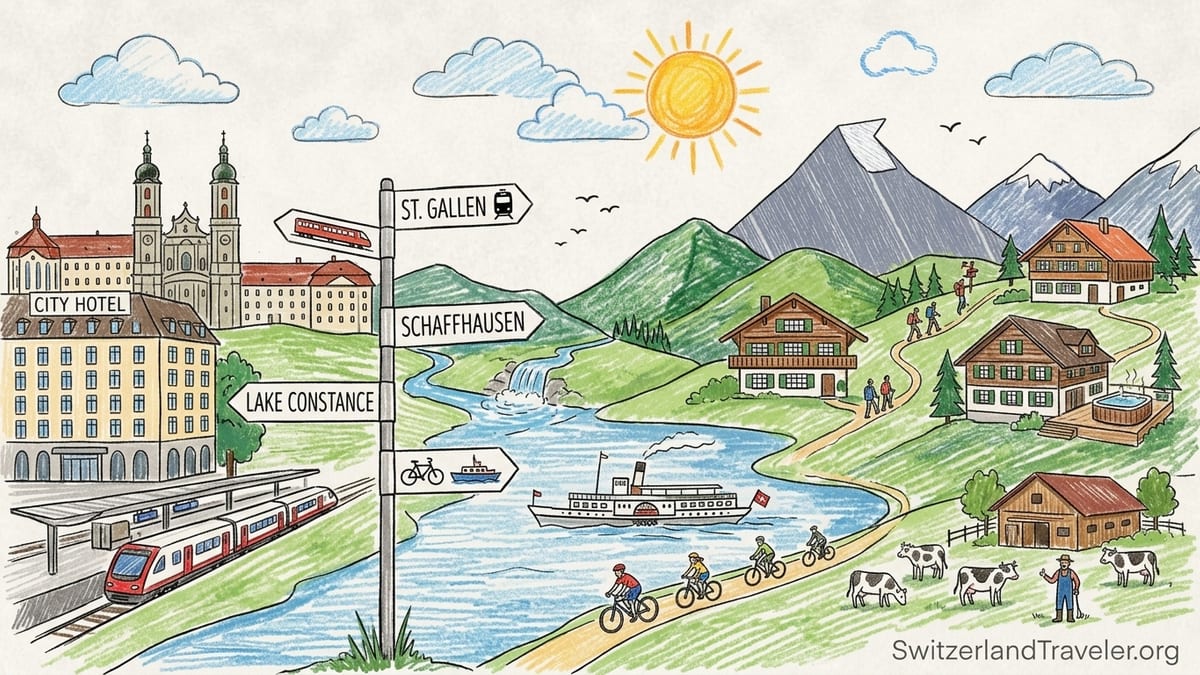
Eastern Switzerland is compact enough that you can use one base for several days of excursions, yet varied enough that your choice of town will shape the feel of your trip. St. Gallen works best for travelers who value rail connections, culture and a car-free stay. Appenzell and nearby Weissbad appeal to hikers and families who want easy trail access straight from the hotel door. The Swiss shore of Lake Constance, especially towns like Romanshorn, Arbon and Rorschach, suits visitors who want water views, cycling and cross-border boat trips. Schaffhausen and the Rhine Falls area work as a characterful overnight stop before or after flights from Zurich.
It helps to think in categories rather than rankings. City hotels in St. Gallen and Schaffhausen tend to offer the easiest rail access, reliable business-style rooms and parking either on site or in nearby garages, though family rooms can be limited. Traditional inns and rural guesthouses in Appenzell or the Thurgau countryside deliver more local character, generous breakfasts and often free parking, but might have fewer spa facilities and smaller room inventories. Lakeside hotels and mountain properties usually trade slightly longer transfers for scenery, balconies and direct access to swimming piers or hiking paths.
Prices shift with the Swiss franc and season, but in broad terms midrange city hotels start around the low to mid 200 Swiss francs per night for a double in high season, with traditional inns in rural areas sometimes a bit lower and upscale spa resorts higher. To keep costs predictable, look closely at what “half board” includes, whether breakfast is complimentary, and if spa access or parking carries an extra fee. Many properties in Appenzell and around Lake Constance bundle extras such as regional transit cards, guided walks or e-bike use into the room rate, which can offset higher nightly prices.
St. Gallen: Well Connected City Hotels
For travelers arriving by train from Zurich or Munich, St. Gallen is the natural hub. The compact Old Town sits a short walk from the main station, and several modern city hotels cluster within a few blocks. These properties appeal if you want to explore the UNESCO-listed Abbey Library and textile museum on foot, then day trip by rail to Lake Constance, Appenzell or even Schaffhausen without ever renting a car. Parking is available at many hotels, often in underground garages, but driving through the historic core involves one-way streets and signposted access zones, so having clear directions from the hotel is helpful.
Downtown, you will find contemporary properties with soundproofed rooms, strong Wi-Fi and well-regarded breakfasts that range from continental buffets with regional cheeses to full spreads including hot dishes. Many business-oriented hotels offer family rooms or connecting doubles configured for up to four people, which can be good value for parents with older children. Breakfast is typically included or offered at a fixed surcharge, and you should confirm whether this is per room or per person when comparing rates. Most city hotels feature at least a small bar or bistro-style restaurant, though you are also steps from St. Gallen’s dense cluster of cafés and beer halls.
Spa facilities within the city itself are usually modest: think compact saunas and small relaxation areas rather than full resort complexes. If you want a large spa, plan to pair a St. Gallen stay with a dedicated spa night in Weissbad or at a lakeside resort. What St. Gallen offers instead is unbeatable public transport. Frequent trains reach Romanshorn on Lake Constance in about half an hour and Appenzell in a similar time, while regional services link east to Rorschach, south toward the Alps and west to Zurich Airport. Travelers using Swiss Travel Passes will find it especially efficient to base in St. Gallen for three or four nights and radiate out on day trips.
Appenzell & Weissbad: Traditional Inns and Wellness Resorts
Appenzell and the nearby hamlet of Weissbad deliver the quintessential Eastern Switzerland image: painted wooden façades, green hills, and cowbells echoing across meadows. Accommodation here splits between traditional village inns in Appenzell itself and larger spa-focused resorts closer to the valley edges. Traditional hotels in the village center often occupy historic buildings with creaking floors and decorative exteriors, but rooms inside tend to be updated with modern bathrooms and good-quality beds. They usually include breakfast featuring local yogurt, cheese and breads, and many have on-site restaurants serving Appenzeller specialties such as käseschnitte or rösti in the evenings.
Weissbad, a few minutes by train from Appenzell, is known for its wellness hotels set amid pastures and forested slopes. At the upper end, resort-style properties here offer extensive spa facilities such as indoor and outdoor pools, sauna houses with multiple sauna types, steam baths, relaxation rooms and even natural swimming ponds. Spa access for hotel guests is typically included in the room rate, though some premium treatments and private spa suites cost extra. These resorts often market multi-day programs focused on hiking, regeneration or “detox,” with half-board packages that bundle breakfast, multi-course dinners and sometimes guided walks.
Parking in and around Appenzell and Weissbad is usually straightforward, with many hotels including outdoor or garage spaces at no additional charge. At the same time, rail access is better than it appears on a map. Local trains connect Appenzell and Weissbad to St. Gallen, and from there to the national network, on hourly or better timetables. For hikers, the key advantage of staying here is immediate trail access. Popular routes toward Ebenalp, the Seealpsee lake or panoramic ridges start either in walking distance or via short cable car rides, and many hotels provide trail maps, drying rooms for boots and packed lunches on request. Families appreciate the mix of easy valley walks, playgrounds and summer alp experiences accessible without long transfers.
Lake Constance: Lakeside Hotels and Family Bases
The Swiss shore of Lake Constance feels more low-key than the German side but offers an appealing mix of lakefront promenades, cycling routes and direct boat connections. Towns such as Romanshorn, Arbon and Rorschach line up along the rail corridor east of St. Gallen, and each has a small cluster of lakeside or lake-view hotels. Many properties here are mid-sized, family-run hotels that balance leisure and business guests, with terraces looking across to Germany and Austria. Rooms with balconies or partial lake views carry a modest premium, but for many visitors the ability to stroll to the water in a few minutes outweighs the difference.
Romanshorn stands out for its role as a transport hub, with frequent trains to St. Gallen and Schaffhausen and a car ferry across the lake to Friedrichshafen in Germany. That makes it a strong choice if you want to combine Swiss and German lakeside towns on the same trip. Hotels and guesthouses around Romanshorn station and harbor often emphasize convenience for cyclists and rail travelers, with secure bike storage, self-service laundries and early breakfast options for guests catching morning boats or trains. In nearby Rorschacherberg above Rorschach, hillside hotels make the most of the wider lake panorama, pairing terraced restaurants with views and relatively peaceful surroundings a short bus ride or drive from the shore.
Families and relaxed travelers should look out for properties near public lidos and beaches, known locally as Strandbad or Freibad. In Arbon, for instance, accommodation near the lakeside park gives direct access to playgrounds, swimming areas and long lakefront walks, while still being only a short walk or bus ride from the train station. Parking policies vary: some lakeside hotels include outdoor parking in the rate, while others charge a nightly fee or direct guests to public lots close by. Rail access along the lake is frequent, which means you can comfortably base here without a car and still day trip to St. Gallen, Appenzell and even Schaffhausen with one or two changes.
Schaffhausen & Rhine Falls: Characterful Town Hotels
Schaffhausen, on the Upper Rhine, combines a compact medieval core with easy access to one of Switzerland’s most famous natural sights, the Rhine Falls. The city’s hotels are clustered in and around the Old Town and near the railway station. Many occupy historic townhouses with painted façades and arcaded courtyards, updated inside with modern bathrooms and soundproofing. These properties particularly suit travelers who like to explore on foot, as the main shopping streets, the riverfront promenade and local museums lie within a few minutes’ walk. Some hotels are housed in former guildhalls or traditional townhouses, which adds character but can also mean slightly irregular room shapes and smaller lifts.
Schaffhausen’s train station anchors an efficient network of local and regional trains, including services to Zurich, Winterthur, St. Gallen and toward Germany. Direct or simple connections reach Neuhausen Rheinfall and other stations around the Rhine Falls, so you can visit the cascades in half a day without worrying about parking. A few hotels in the wider area have “Rhine Falls” in their name and market themselves specifically to waterfall visitors, sometimes with free parking and short walks to viewing platforms. In town, many hotels respond to weekend leisure demand with attractive breakfast spreads featuring local bread, cheeses and house-made jams, and some offer discounted boat tickets or sightseeing cards.
Parking in Schaffhausen’s Old Town is more limited than in suburban areas, but several hotels provide spaces in nearby garages or have their own small courtyards. If you are driving, check whether access routes run through low-traffic or restricted zones and note any arrival instructions sent by the hotel. For families, look for hotels that specify family or quadruple rooms, as not every historic property has the space to offer them. While full-scale spas are rare within the city, some hotels include small wellness areas or partner with nearby fitness clubs. If an extended spa experience is a priority, consider pairing a night in Schaffhausen with a resort stay in Appenzell or on Lake Constance.
Rural Inns and Mountain Properties
Beyond the main towns, Eastern Switzerland is dotted with traditional inns and small mountain hotels that appeal to travelers seeking quiet, scenery and local interaction. In the Appenzellerland, family-run guesthouses sit in small hamlets or on ridges accessible by narrow roads, with views across rolling hills toward the Säntis massif. Rooms tend to be simple but comfortable, often with wood paneling and regional textiles, and most include breakfast as standard. Many properties offer half-board, with substantial evening meals built around local meat, cheese and seasonal produce served at fixed times. These stays can feel more like being welcomed into a community than staying in an anonymous hotel chain.
Farther north in the canton of Thurgau, vineyards and orchards between Lake Constance and the Rhine hide inns that combine agriculture with hospitality. Staying here suits visitors who enjoy slow travel, cycling between villages and sampling local wines. Parking is almost always free and right beside the building, while public transport access can vary from frequent bus links to only a handful of services per day. If you rely on trains and buses, it is worth plotting your potential route in advance and confirming with the inn whether evening return journeys are realistic after dinner or sunset walks.
Mountain properties in the region include small hotels at upper cable car stations or along popular hiking routes. These are particularly appealing in summer and early autumn, when you can step straight out onto alpine paths at sunrise. Facilities are more limited than in valley resorts: spas are usually absent or simple, and rooms may be compact, sometimes with shared bathrooms. The trade-off is closeness to nature and quieter nights, plus dramatic views and the chance to watch changing weather over the peaks. Because room numbers are low, these properties can book out quickly during school holidays and sunny weekends, so advance reservations are recommended despite the overall depth of the region’s accommodation inventory.
Comparing Practicalities: Parking, Trains, Breakfast and Spas
When comparing accommodation types across Eastern Switzerland, some practical factors make a big difference. If you are relying on rail, St. Gallen and Schaffhausen city hotels give you the simplest arrival and onward travel, followed by lakeside towns like Romanshorn, Arbon and Rorschach, all well served by trains. Appenzell and Weissbad sit on secondary lines but are still easy to reach, while rural inns and mountain hotels may require a combination of train, bus and in some cases cable car. Travelers driving a rental car will find parking easiest in rural and lakeside areas, where many hotels include it in the room rate, and slightly more complex in historic city centers, where space is tighter and garage fees more common.
Breakfast formats are broadly similar across the region, with buffets that typically feature bread, croissants, local cheeses, cold cuts, yogurt, cereals and fruit, plus coffee and tea. Upscale city hotels and spa resorts often add made-to-order egg dishes and wider hot selections. In traditional inns, breakfast is usually more intimate and might be served at your table, sometimes with homemade jams or cheese from the family farm. If you are traveling with children, check whether breakfast pricing is reduced or complimentary for younger guests, as policies vary. For longer stays, the option of half-board can simplify budgeting, especially in remote areas where alternative dining options are limited.
Spa facilities are a major differentiator. The most extensive wellness areas tend to be at dedicated resorts in Weissbad and some lakeside hotels, with pools, multiple saunas, steam baths and relaxation zones included for guests. City hotels in St. Gallen and Schaffhausen might offer a small sauna or fitness room but rarely a full spa. Rural inns and mountain lodges may have no spa at all, though a few now include compact wellness corners with hot tubs or infrared cabins. Families should note that some spa areas restrict access or certain times to adults, so it can be useful to confirm policies in advance if you plan to visit with teenagers.
The Takeaway
Choosing the best hotel in Eastern Switzerland is less about chasing a single “top” property and more about aligning your base with your travel style. St. Gallen and Schaffhausen anchor the region with well-connected city hotels suited to rail-based itineraries and urban sightseeing. Appenzell and Weissbad offer traditional charm and serious spa credentials, ideal for walkers and wellness-focused stays. The Swiss shore of Lake Constance adds water views, family-friendly lidos and cross-border ferry links, while rural inns and mountain properties round out the picture for travelers who value quiet and local color over full-service amenities.
With a regional inventory that runs into the many hundreds of options, availability is rarely the problem. The real advantage goes to travelers who decide early how much they want to drive, how important spa access is, whether they prioritize lake or mountain views, and how often they plan to change bases. By thinking in categories rather than rankings and weighing practical details like parking, breakfast format and family-room options, you can narrow the field quickly. The result is a stay that feels tailored to your Eastern Switzerland journey, whether that means monastery towers at sunset in St. Gallen, alpine glow above Weissbad or the sound of Lake Constance lapping below your balcony.
FAQ
Q1. Is it better to base in St. Gallen or Appenzell without a car?
St. Gallen is usually more convenient without a car because it sits on mainline rail routes, but Appenzell also works well for hikers who plan mostly local walks and accept slightly longer train rides for day trips.
Q2. Which area has the best spa hotels in Eastern Switzerland?
The strongest concentration of full-service spa resorts is around Weissbad near Appenzell, with additional wellness-focused properties scattered along Lake Constance and in a few rural locations.
Q3. Can I visit the Rhine Falls easily from Lake Constance or St. Gallen?
Yes. Regular trains connect Lake Constance towns and St. Gallen to Schaffhausen and Neuhausen Rheinfall, making the Rhine Falls an easy half-day or day trip by public transport.
Q4. Are family rooms common in Eastern Switzerland hotels?
Many midrange and upscale hotels offer family rooms or connecting doubles, especially in city and lakeside locations, but historic inns and small mountain lodges may have fewer large-room options, so advance booking is sensible.
Q5. Do I need to rent a car to enjoy rural inns and mountain properties?
A car increases flexibility for rural stays, but some inns and mountain hotels are reachable by a combination of train, bus and cable car; check timetables and last-bus times carefully when planning.
Q6. How expensive are hotels in Eastern Switzerland compared with the rest of the country?
Prices are broadly in line with national averages, with midrange doubles in popular areas typically in the low to mid hundreds of Swiss francs per night and spa resorts higher, especially in peak summer and during holidays.
Q7. Is parking usually included in the room rate?
In rural areas and many lakeside or village hotels, parking is often included, while in city centers such as St. Gallen and Schaffhausen garage spaces may carry a nightly fee; always check the policy before booking.
Q8. When is the best time to visit for hiking around Appenzell and Weissbad?
Late spring to early autumn, roughly May through October, is best for hiking, with higher trails and most mountain railways and cable cars typically fully operational from around June to September.
Q9. Are lakeside hotels on Lake Constance suitable for winter stays?
Yes, although swimming and lido facilities are seasonal, lakeside hotels remain open through winter and offer quiet walks, foggy but atmospheric views and easy rail links to Christmas markets in nearby towns.
Q10. How far in advance should I book hotels in Eastern Switzerland?
For peak summer, autumn foliage weekends and major events, it is wise to book several months ahead, especially for spa resorts and small mountain hotels with limited room numbers.