

Solothurn arrived in my Switzerland plans almost as a punchline. Switzerland Tourism calls it the country’s most beautiful Baroque city and the local tourist office leans into a peculiar claim: that Solothurn is secretly built around the number 11. There are said to be 11 churches and chapels, 11 fountains, 11 towers, 11 museums and a cathedral where almost everything from the steps to the bells can be counted in elevens. It sounded like a marketing gimmick. So I caught a train, walked the old town from riverfront to cathedral tower, and spent a day testing how much of Solothurn’s obsession with 11 you can actually see without a guidebook in hand.
Arriving in a City That Promises Elevens
My first glimpse of Solothurn was not Baroque at all but practical: a low, modern station concourse, a digital board glowing with departures to Bern and Zürich, and a short underpass that spits you out toward the old town. What struck me immediately was the scale. Within five minutes on foot I had crossed the main road, passed a couple of contemporary office blocks and was already under the shadow of the city walls, with St. Ursus Cathedral’s pale facade hovering above the rooftops. For a city that appears as a mere dot between Basel, Bern and Zürich on most rail maps, Solothurn feels surprisingly complete yet wonderfully compact.
The convenience is almost suspicious. From Zürich main station, direct InterRegio trains usually take about 65 to 75 minutes to reach Solothurn, with second-class advance fares often starting around 15 to 25 Swiss francs each way if you book Super Saver tickets and travel outside rush hour. From Bern, the trip is roughly 30 minutes, and from Basel about 55. In all three cases you step off onto a central platform, walk straight out and are effectively in town; there is no need for trams or buses unless you are heading for the Weissenstein cable car on the edge of the city.
That ease of access matters because Solothurn really reveals itself on foot. Unlike cities that sprawl, here the historic core is compressed into a neat bend of the Aare, squeezed between the river and the first low rise of the Jura. Within a ten-minute stroll you can reach the cathedral, the Aare promenade, the astronomical clock on the Zeitglockenturm, the main café-lined streets and several of the famous fountains. It makes the idea of spending a day simply wandering and counting elevens feel realistic rather than forced.
Before I saw any of those though, something else introduced me to Solothurn’s signature quirk. At the tourist information point near the main square, a small display cheerfully listed the city’s elevens: 11 churches and chapels, 11 fountains, 11 towers, 11 museums. It felt oddly self-aware, as if Solothurn knows visitors come primed for a treasure hunt and is happy to hand them a loose map, then send them off to see how many examples they can independently confirm.
Walking Into the Myth: St. Ursus Cathedral and Its Elevens
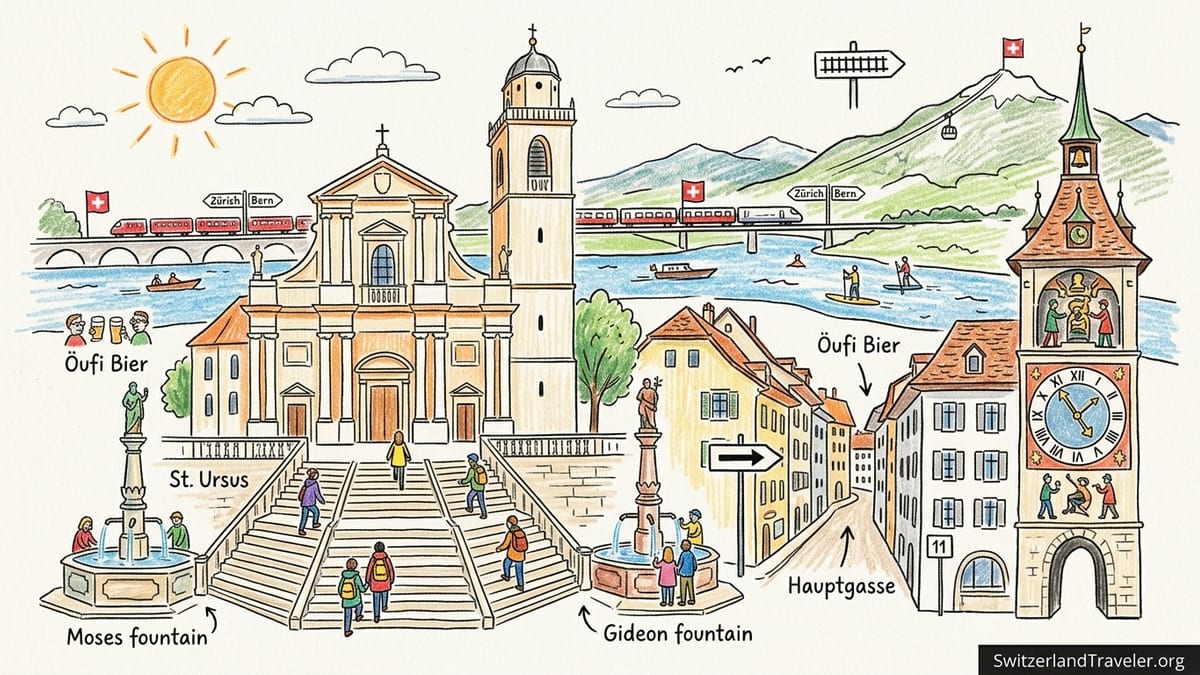
If there is a place where the story of the number 11 becomes solid stone, it is on the wide staircase of St. Ursus Cathedral. The approach alone is theatrical. You turn off Hauptgasse, the main old-town street, and the space suddenly opens up to a light-filled square anchored by the cathedral’s creamy, almost Italian facade. The stairs fan up toward the entrance in three distinct flights. Without thinking, I did what everyone does: I started counting.
The first section was interrupted by people pausing for photos, so I sat to one side, waited for a gap and then walked back down. From the base I climbed steadily, counting softly: one to eleven, then a flat landing, then one to eleven again, a second landing, and a last run that, yes, ended on eleven. The lowest flight feels slightly compressed and you can see how the side fountains nibble into the staircase, but the pattern is unmistakable. In person, those much-discussed “three times eleven steps” are not a brochure claim. They are a physical rhythm under your feet, a small, satisfying confirmation that the number here is more than local legend.
Inside, the architecture shifts from exuberant Baroque expectation to a cooler, early Neoclassical restraint. Pale stone, clean lines and a high nave give the space an airy clarity that contrasts with the more heavily decorated Jesuit churches in other Swiss cities. Here too the elevens hide in plain sight. From the main entrance, the floor is paved in large stone squares. One of them, slightly darker and often referred to on tours, is said to mark the spot from which all eleven altars can be seen. Without a guide, I simply walked the central aisle and looked sideways, and even without counting each altar precisely, the repetition of side chapels and altarpieces in symmetrical pairs makes the idea of an eleven-based design easy to believe.
The tower and bells are beyond casual counting. Local information boards refer to eleven bells, and the tower height is reported as a neat 66 meters, which mathematicians will note is six times eleven. What I could test myself was the sense of the building’s proportions. From the top of the old-town streets, the cathedral’s tower is consistently the vertical anchor in the skyline. From the river, its form is compressed by perspective but still dominates. Whether or not you remember the numeric trivia, St. Ursus gives Solothurn an outsized architectural presence that smaller Swiss towns often lack.
Chasing Elevens Beyond the Cathedral
Once you leave the cathedral square, the game becomes subtler. Solothurn’s tourist office can provide a themed map that marks out where elevens supposedly appear. I chose not to pick it up at first and instead let my own curiosity lead. The first unprompted “eleven” I noticed was not monumental at all but on a beer glass. At a café terrace near the Aare, several tables were sporting green and white bottles and branded glasses for “Öufi Bier.” A quick check with the waiter confirmed that “Öufi” is local dialect for “eleven,” and that the brewery’s entire identity plays on Solothurn’s number. That felt like an authentic find: not a signboard, not a plaque, but a living habit of what people actually drink.
Back in the lanes, I kept stumbling over further hints. On one corner house a decorative metal number plaque showed an oversized 11, with no special explanation. In a small shop window selling regional souvenirs there were postcards and fridge magnets printed with stylised elevens against silhouettes of the cathedral. These were clearly made with visitors in mind, but they underlined that the number has become visual shorthand for the city in the way bears do for Bern or lions for Lucerne.
Only later did I check the official list and consciously seek some of the other elevens. The astronomical clock on the Zeitglockenturm, the old clock tower, is marked on most maps simply as a historic attraction. Up close you see a richly painted dial and moving figures, similar in spirit to Bern’s Zytglogge but on a more intimate scale. Somewhere in old descriptions there is mention of an older city clock that counted only eleven hours. Today, standing in the square beneath the tower, what matters more than the historical minutiae is the sense that Solothurn’s timekeeping has always had its own rhythm. The idea of setting appointments “at eleven” feels charmingly on brand.
As for the famous counts of 11 churches, 11 fountains, 11 towers and 11 museums, I will be honest: walking without a checklist, I did not conclusively confirm any of those totals. I certainly passed more than a handful of ornate fountains, including the Moses and Gideon fountains flanking the cathedral staircase, and saw tower after tower punctuating the ring of former fortifications. But unless you are on a theme tour or determined to tick off every single example, the pleasure is less in proving the arithmetic and more in the way the legend pushes you to look up and around. You start noticing how many clock towers hover above rooflines, how often a small chapel appears at the end of a lane, how fountains are not just street furniture but sculpted characters in their own right.
Along the Aare: Where Solothurn Really Breathes
For all the talk of Baroque facades and numerical quirks, the part of Solothurn that feels most alive is the Aare riverfront. From the old town you can reach the water in no more than two or three minutes. Stone steps lead down from the bridges to low quays, where locals dangle their feet above the current and young people meet after work with takeaway pizza and, yes, bottles of Öufi Bier. On a clear afternoon, the sun falls along the river in a soft diagonal, illuminating one bank while leaving the other in a calm, cool shadow.
I followed the promenade from the Wengibrücke, the main bridge near the station, upstream past moored boats and riverside cafés. Several places offered outdoor seating within metres of the water. At one bar the blackboard outside advertised an Aperol Spritz for about 10 Swiss francs and a local draught beer for roughly 7. A simple plate of pasta at a casual trattoria just off the river ran to around 20 to 24 francs, while more elaborate mains at a mid-range restaurant climbed to 30 or 35. None of this is cheap by international standards, but compared with Zürich or Geneva the prices felt slightly softer, especially for river-view seats that in a larger city would be priced as a premium.
The atmosphere along the Aare shifts with the hours. Around midday the banks are sprinkled with office workers on short breaks and visitors grabbing an ice cream from small kiosks. By late afternoon, paddleboarders appear upriver, gliding past the city on the gentle current, and cyclists ring their bells as they weave between strollers. On a warm summer evening, the riverside has the relaxed buzz you might associate more with a university town than a sedate Baroque showpiece. In practice, this is where Solothurn shakes off its museum image and feels like a place where people actually live.
Across the water the view back to the old town is particularly telling. The cathedral tower rises clearly above the compact cluster of stone houses, backed by the dark line of the Jura foothills. Higher still, if the weather is clear, you can trace the silhouette of the Weissenstein ridge. Knowing that a cable car climbs from the outskirts of town up to Weissenstein, where the view stretches across the Swiss Plateau toward the Alps, gives the skyline an extra dimension. Even if you do not have time for the excursion, the visible presence of the mountain makes Solothurn feel anchored between river, town and high ground in a very Swiss way.
Old-Town Lanes, Cafés and the Question of “Baroque”
Walking the old town without an agenda, I was curious whether Solothurn would feel distinctly Baroque or simply like another pleasant Swiss Altstadt with a label attached. The answer is somewhere in between. The main streets radiating from the cathedral and main square are lined with dignified townhouses, many from the seventeenth and eighteenth centuries, bearing the coats of arms of former French ambassadors or wealthy local families. Facades show rounded window pediments, carved stone doorways and decorative niches, but the overall effect is restrained, closer to early classicism than the heavy, gilded Baroque you might find in southern Germany or Austria.
Side lanes narrow quickly. In places the streets kink unexpectedly, revealing abrupt little squares with fountains or small churches. In one such corner, near the Franciscan church, a modest café had set out only half a dozen tables. The clipboard menu listed cappuccino at around 4.80 Swiss francs, a slice of fruit tart for 6 to 7 francs and a simple lunch special, a quiche with salad, for about 18. Inside, regulars seemed to know the staff by name, and several customers were reading local newspapers rather than tapping on laptops. It felt a world away from the more polished chains you find in bigger cities.
The density of cafés and bars relative to Solothurn’s size is a pleasant surprise. Along Hauptgasse alone I counted a dozen spots where you could plausibly sit for an hour over coffee or a glass of wine and watch the flow of people between the river and the cathedral hill. In some, old timber ceilings and stone floors subtly echoed the city’s age; in others, crisp Nordic-style interiors signaled a younger clientele. The common thread was informality. There is little in the way of velvet-rope nightlife, but plenty of low-key places where conversations carry into the evening.
Does Solothurn live up to its branding as Switzerland’s most beautiful Baroque city? If you arrive expecting the theatrical urban planning of, say, a small Italian Baroque capital, you may find it understated. Yet taken as a whole, the coherence of its historic core is impressive. There are very few jarring modern intrusions inside the old-town ring, and the way the cathedral, Jesuit church, town hall, patrician houses and fountains all sit within a short walk does create a sense of curated harmony. It is less about individual Instagram moments and more about the mood that builds as you wander.
How Much Time You Really Need in Solothurn
On paper, Solothurn looks like the quintessential half-day stop. In practice, my visit expanded to a full, satisfying day without any padding, and I could easily have filled more time with a nearby excursion. Here is how the timing broke down. From Zürich, I arrived on a mid-morning train just after 10:30. Within fifteen minutes I had dropped my small bag in a station locker, walked into the old town and climbed the cathedral steps. I spent close to an hour between the interior, small details like the altars and floor patterns, and simply sitting on the upper landing watching the square below.
From there I wandered down to the river, claimed a coffee at a café terrace, and then followed the Aare for almost an hour, stopping often to photograph the changing angles of the old town and the Jura backdrop. After a simple lunch back on Hauptgasse, I looped through several lanes I had not yet explored, detoured to see the astronomical clock, and then sought out one or two of the more talked-about fountains. By late afternoon I had the sense that I had covered the essential urban sights while still leaving space for unplanned corners.
If you wanted to add Weissenstein to the day, you would need to budget more time. Getting from the station to the cable car base by local bus or on foot, riding up, and then taking a short walk along the ridge and back can easily add three to four hours, especially if you stop for a drink or meal with a view. Combined with a relaxed old-town visit, that pushes Solothurn into very plausible overnight territory for travellers who like to pair city walks with light mountain time.
For a “satisfying visit” focused on the city itself, I would suggest a minimum of five to six hours on the ground. That allows you to enter the cathedral, linger on the riverfront, sample at least one café or bakery, detour to the clock tower, and pause at some fountains without feeling rushed. If you only have a couple of hours between trains, you will still enjoy the core, but you will leave feeling like you have skimmed a place that deserves at least one long, slow lap.
Life After Office Hours: Evenings, Costs and Atmosphere
One question that often hovers over smaller Swiss cities is whether they fall asleep once offices close. In Solothurn, the answer depends on what kind of liveliness you are looking for. Around 6 p.m., when I was there on a weekday, the old town briefly felt quiet as commuters crossed the bridges toward residential districts. Then, almost imperceptibly, a second wave arrived: couples meeting for drinks, families heading out for pizza, friends settling into riverside benches with takeaway snacks. The streets never became crowded, but neither did they feel deserted.
Restaurant menus gave a useful reality check on costs. In a mid-range place near the main square, a margherita pizza was priced around 19 Swiss francs, meat-topped pizzas between 22 and 26, and a plate of risotto about 24 to 28. A glass of local wine hovered near 8 or 9 francs, while soft drinks sat around 4.50 to 5. In more ambitious restaurants housed in historic buildings, mains climbed into the mid-thirties or low forties, but many also offered a simpler “plat du jour” at lunchtime for slightly under 25 francs. When you factor in that you can still find a takeaway bakery sandwich for under 10 francs and a coffee under 5, it is possible to spend a day in Solothurn without your food budget spiralling beyond what you would expect elsewhere in Switzerland.
In terms of safety and comfort, walking back to the station after dark felt uneventful. Street lighting in the old town is soft rather than harsh, highlighting facades and fountains without bleaching them. The route from the riverfront cafés back up through Hauptgasse to the station is short and well-travelled, and there were enough people around that I never felt alone. If you stay the night in one of the small hotels or guesthouses in or near the old town, you are unlikely to be more than a ten-minute walk from the central sights.
Those expecting big-city nightlife or a dense bar scene might find Solothurn subdued. There are a handful of livelier spots, some leaning toward craft beer and live music, others more cocktail-oriented, but they are scattered rather than clustered. The predominant evening mood is one of relaxed conversation, not late-night intensity. For many travellers, that will be part of the charm: you can enjoy a riverside drink, hear church bells rather than thumping bass, and still catch a relatively early train back to a larger hub if that is where you are sleeping.
Should Solothurn Be a Day Trip or an Overnight Stay?
By the time I boarded my return train, the question nagging me was not whether Solothurn was worth visiting, but how best to fit it into a Swiss itinerary already crowded with mountain icons and bigger cities. The rail convenience argues strongly for a day trip. From Bern you can be on the platform in Solothurn less than half an hour after leaving the capital. From Basel or Zürich the journey is just long enough to justify a coffee on board but short enough that you can be in town by late morning and comfortably back for dinner.
Seen this way, Solothurn works brilliantly as a palate cleanser between more intense destinations. After days spent in museums in Basel or amid the crowds around Zürichsee, the city’s pocket-sized old town and slow riverfront feel like a gentle reset. You can immerse yourself in a coherent slice of Swiss Baroque, indulge in the quirk of counting elevens, and still have the evening free elsewhere. Travellers on tight schedules, or those using a Swiss Travel Pass who want to sample several places without changing hotel every night, will probably find this approach the most efficient.
Yet there is a solid case for staying overnight, especially if you are drawn to smaller cities that reveal themselves gradually. An evening in Solothurn lets you see the cathedral facade turn honey-coloured in the lowering light, hear the old clocks mark the hour through quieter streets, and watch the Aare lose its daytime shimmer and turn glassy. It also buys you time for an early-morning walk when delivery vans and locals on bikes outnumber visitors, which is when the city’s lived-in side comes most clearly into view.
If you want to combine the old town with a trip up Weissenstein or a lazy boat ride along the Aare, an overnight stay stops the day feeling crammed. You can, for instance, spend your arrival afternoon exploring the historic core, enjoy dinner along the river, sleep in Solothurn, and then devote the following morning to the mountain or river before moving on. The trade-off is that you will be allocating a scarce Swiss night to a place without headline-grabbing sights. Whether that feels worthwhile depends on whether you value depth and quiet character over a checklist of icons.
The Takeaway
Solothurn surprised me less with its claims than with its consistency. The number 11, so easy to dismiss as a travel-office gimmick, really does show up when you pay attention, from the cathedral stairs and the legend of 11 altars and bells to beer labels and small design touches around town. You do not need to buy into every piece of folklore to enjoy the way the story nudges you to look more closely at fountains, clocks and towers that might otherwise blur together.
Yet if I am honest, it was not the Baroque branding or the arithmetic that lingered most after I left. It was the feel of a compact city pressed between river and hills, where you can step from station platform to historic square in minutes, drift unhurriedly between cafés and quays, and glance up to see both cathedral stone and the green outline of Weissenstein in the same frame. The old town’s architecture provides the stage set, but the riverfront and the everyday life playing out along it provide the mood.
Would I recommend Solothurn as a dedicated overnight destination or primarily as a day trip between Bern, Basel or Zürich? For most travellers, especially on a first or second visit to Switzerland, Solothurn shines brightest as an unhurried day trip. Give it at least five or six hours, walk the streets without rushing, count a few elevens for yourself and linger by the Aare as the light changes before you ride the rails back to a bigger hub. If, however, you are the kind of traveller who enjoys small cities at half-speed, who values time to sit with a place until the postcard scenes fade into everyday detail, then Solothurn quietly rewards a night of its own.
FAQ
Q1. How long do I need for a satisfying visit to Solothurn?
Plan on at least five to six hours in town. That gives you enough time to visit St. Ursus Cathedral, stroll the Aare riverfront, see the astronomical clock, explore the old-town lanes and pause at a few cafés and fountains without rushing from sight to sight.
Q2. Is Solothurn better as a day trip or an overnight stay?
For most travellers it works best as a relaxed day trip from Bern, Basel or Zürich, thanks to very easy train connections. Consider an overnight stay if you want to pair the old town with a trip up Weissenstein or simply enjoy quieter evenings and early mornings in a small city without crowds.
Q3. How do I get to Solothurn by train from major Swiss cities?
Direct InterRegio trains from Zürich usually take around 65 to 75 minutes, from Basel about 55 minutes and from Bern roughly 30 minutes. All arrive at a compact central station that is an easy five to ten minute walk from the old town, so you will not need local transport just to reach the sights.
Q4. Is Solothurn really obsessed with the number 11, or is that just marketing?
There is definite branding involved, but several elevens are genuinely visible on a casual visit. You can count three flights of eleven steps up to St. Ursus Cathedral, spot the locally brewed Öufi (eleven) beer in bars, and find references to elevens in fountains, towers and souvenirs. Some of the longer lists, such as exactly eleven churches or eleven museums, are harder to confirm without a guidebook.
Q5. What are the must-see sights for a first-time visitor?
Prioritise St. Ursus Cathedral and its staircase, the old-town lanes around Hauptgasse, the Zeitglockenturm with its astronomical clock, and the Aare riverfront with its cafés and views back to the skyline. If you have more time, consider the Jesuit church, a couple of the figure-topped fountains and, in good weather, the view toward Weissenstein.
Q6. How expensive is food and drink in Solothurn?
Prices are in line with much of Switzerland but a touch gentler than in Zürich or Geneva. Expect to pay roughly 4.50 to 5 Swiss francs for a coffee, around 7 for a local beer in a bar, 18 to 24 for a simple lunch dish like quiche or pasta, and 25 to 35 for mains in mid-range restaurants near the main square or river.
Q7. Does Solothurn feel lively in the evening?
Solothurn is not a nightlife hub, but it does not feel dead after office hours either. Riversides and central squares see a gentle flow of people meeting for drinks or dinner, and there are several cosy bars and cafés open into the evening. The atmosphere is relaxed and conversational rather than loud or club-focused.
Q8. Is the city centre easy to explore on foot?
Yes, the historic core is very compact. From the station you can reach the cathedral, main squares, riverfront and clock tower within a ten-minute walk. The streets are mostly flat, though there is a short climb up to the cathedral steps. Comfortable shoes are helpful because the old-town lanes are paved with stone.
Q9. Can I combine a visit to Solothurn with a trip to Weissenstein?
Yes, if you have a full day or stay overnight. Allow three to four extra hours to get from the station to the Weissenstein cable car base, ride up, enjoy the views along the Jura ridge and return. It is an appealing combination for travellers who want both a small-city experience and an accessible mountain panorama.
Q10. Is Solothurn suitable for travellers on a tight schedule?
Thanks to its compact size and direct train connections, Solothurn is ideal if you only have one spare day between bigger destinations. Even a four-hour stopover lets you see the cathedral, wander the main streets and enjoy the Aare, though you will appreciate the city more if you can stretch your visit closer to a full day.