


I arrived in the Swiss Mittelland with Matterhorn-shaped expectations. Like many visitors, I carried mental postcards of razor-edged peaks, cogwheel railways and cliff-hugging villages. Instead, the train from Zurich rolled through a broad green corridor of fields and low hills, where the horizon was broken more by church spires and power lines than by jagged summits. It felt, at first, like a Switzerland between scenes, the stretch of countryside you cross on the way to “real” mountains. It took several days, a rented bicycle and more than one thermal soak before I began to understand that the Mittelland is not a warm-up act for the Alps, but a different kind of stage entirely.
Resetting Expectations Between Jura and Alps
The Mittelland is the broad plateau that runs from Lake Geneva in the southwest to Lake Constance in the northeast, sandwiched between the Jura to the north and the Alps to the south. It makes up roughly a third of Switzerland’s territory and is the country’s most populated band of land, threaded by rivers like the Aare, Reuss, Limmat and Rhine and edged by lakes such as Zurich, Neuchâtel and Murten. Yet for many travelers raised on tourism posters of snow pyramids and turquoise lakes, this middle country barely registers as a destination. It is the landscape glimpsed from the train window between airport and alpine resort.
Even official descriptions reinforce that hierarchy. Switzerland Tourism’s Fribourg route materials describe the Mittelland here as an “agricultural and rolling” region sitting between more spectacular mountain landscapes. Regional geography guides talk about it as a hilly, densely settled plateau, vital to the economy but lacking the dramatic verticality of the high Alps. The language is accurate. Much of the Mittelland is a quilt of farmland, forest patches, low ridges and river valleys, with altitude differences that you feel in your legs on a bike, not in your ears on a cable car.
My own first impression matched those words a little too well. Coming off a week in the Bernese Oberland, where I had taken a cable car from Lauterbrunnen into frosted peaks before breakfast, arriving in Aarau felt almost muted. The old town was pretty in a textbook way, with painted eaves and arcaded lanes, but there were no cliffs dropping straight into town, no waterfalls thundering at the edge of the square. From my hotel window I saw suburban roofs, a distant industrial chimney and, beyond that, a stripe of forest. It looked like a very prosperous, very tidy, almost ordinary landscape.
That initial underwhelm is the honest starting point for many first-time visitors who detour into the Mittelland. If you come expecting the Alps, you will not find them here. What the region offers instead is a chance to watch and join in the everyday choreography of Swiss life, in a setting shaped more by rivers and soil than by rock faces. It took a conscious reset of expectations for me to begin to see that, and the turning point came when I followed the Aare on two wheels instead of just crossing it on bridges.
Cycling the Aare: How a River Route Changed the View
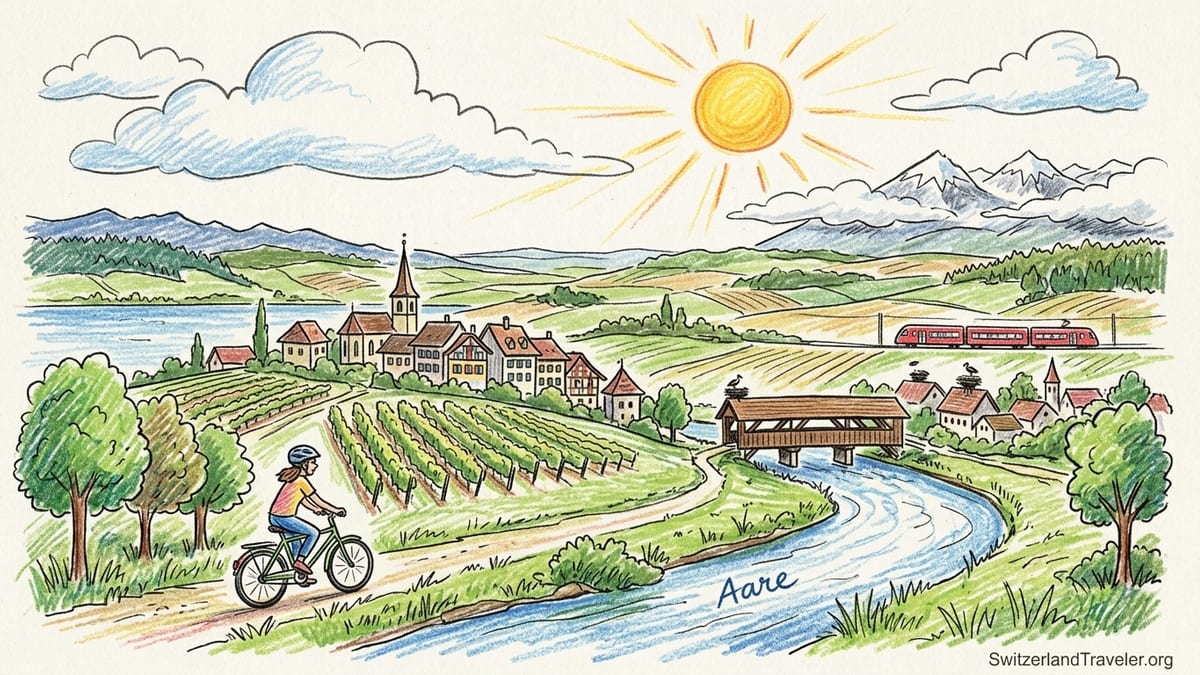
The Aare is the quiet architect of much of the Mittelland. Flowing northeast along the foot of the Jura, it collects tributaries from higher ground like a long, shallow gutter before finally reaching the Rhine. Geography texts describe it as the main drainage spine of the plateau, but for travelers it is simply a constant companion: the river below your train near Olten, the turquoise loop around Bern’s old town, the broad current under Solothurn’s baroque facades. A dedicated Aare cycle route links large stretches of this corridor, and it was on a rented city bike between Aarau and Solothurn that the Mittelland started to come into focus for me.
Leaving Aarau, the cycle path ducked almost immediately into what felt like a different country than the one around the station. Within ten minutes I was riding along a tree-lined embankment, the Aare sliding quietly to my right, backwater pools reflecting willows on my left. Occasional freight trains thundered by on the far bank, but most of the noise was birdsong and the low whir of my tires on gravel. Maps describe this section of the Mittelland as “gently undulating” and “largely agricultural.” They might also note that it smells faintly of cut grass and river sand, and that the steepest climbs are up to village bakeries.
Places that had seemed unremarkable in timetable columns became small discoveries at handlebar height. In the village of Aarwangen, I pushed my bike over to look at the riverside castle mentioned in the Mittelland Route cycling notes. In Büren an der Aare, a place guidebook summaries often skip, I lingered on the wooden covered bridge and in the compact old town, where storks have been encouraged to nest on rooftops in nearby Altreu. The presence of the river gave these settlements a shared personality: quiet but connected, local in pace but threaded into a long-distance route that runs from the Bernese Oberland down across the plateau.
By the time I rolled into Solothurn, sometimes called Switzerland’s most beautiful baroque town, the Mittelland no longer felt like a background corridor. The ride made clear how this plateau is shaped by water and human settlement rather than by rock walls. The experience is subtle compared to a cable car ascent from valley to glacier, but no less physical. You feel it in the gentle gradients, the way villages hug the levees, the sudden opening of floodplain meadows. For cyclists, especially those who prefer steady pedaling over high-altitude hairpins, this is a kind of Swiss landscape that makes sense at human speed.
Old Towns Without Crowds: Aarau, Solothurn and Fribourg
One of the quiet rewards of the Mittelland is its stock of under-sung historic towns. Unlike Interlaken or Zermatt, whose streets can feel like international concourses in summer, places like Aarau, Solothurn and Fribourg still serve first and foremost as regional centers. Their shops, markets and riverfronts exist for residents who commute, study and meet friends, not primarily for tour groups on fixed schedules. That difference shapes everything from the soundscape to the way you are noticed or, often, not noticed at all.
Aarau is a case in point. Guidebooks will tell you about its beautifully painted gabled roofs, the Obertorturm tower and the compact car-free core just uphill from the station. What struck me more, after recalibrating my expectations, was how local the old town felt at 5 p.m. on a weekday. Office workers parked bikes against centuries-old walls and ducked into grocery stores. Children in fluorescent safety vests walked home from school, stopping to buy ice cream. The architecture is postcard-perfect, but there are no banks of souvenir shops or grind of tour buses idling outside. For a visitor who wants to see how a Swiss cantonal capital actually functions, this uncurated normality is part of the appeal.
Solothurn amplifies this balance of beauty and lived-in ease. The town markets itself, not inaccurately, as the country’s baroque showpiece, with the white bulk of St. Ursus Cathedral dominating a riverfront of honey-colored townhouses. Yet walk a block back from the Aare and you find streets where shoe shops, butchers and opticians outnumber boutiques aimed at tourists. When I dropped into a café near the Hauptbahnhof on a drizzly afternoon, the clientele seemed to be mostly pensioners chatting over coffee, students revising for exams and a few cyclists waiting for the rain to pass. No one was holding a selfie stick.
Further west, Fribourg offers a different take on Mittelland urbanity. Perched above the Sarine River, with its lower town squeezed into a deep meander and its upper town spread across a plateau, it blurs the textbook image of a flat Swiss plateau. Official descriptions of the Fribourg region highlight its agricultural belt and rolling terrain between Jura and Alps, but in the city itself it is the vertical connection between neighborhoods and the layered history of a bilingual canton that stand out. From the modern university quarter, you can walk down into the medieval quarter by funicular or on foot, passing apartments where laundry hangs over narrow lanes and small workshops spill light onto cobbles. It feels like a working town that happens to sit in a very photogenic bend in a river valley.
In each of these places, my initial sense of “underwhelming” scenery faded as I realized that the absence of extreme drama also meant an absence of extreme visitor pressure. There were no queues for restaurants, no timed-entry tickets to manage. Instead, there was space to pay attention to smaller details: hand-painted shop signs, the clink of pétanque on a riverside square in Solothurn, a student orchestra rehearsing in a church in Fribourg. The Mittelland does not compete with the Alps for spectacle; it offers something closer to backstage access.
Vineyards and Everyday Wine Culture Around Lake Murten
Another moment of reevaluation came on the northern shore of Lake Murten, where vineyards climb the low slopes of Mont Vully above waters that, on calm days, reflect every cloud. On paper, the Vully wine region is almost modest to a fault. Wine boards describe it as Switzerland’s smallest major wine-growing area, with around 150 hectares of vines worked by roughly two dozen domains in a string of villages between Lake Murten and Lake Neuchâtel. It is a patch of green on the map compared to the wide expanses of vineyards in Valais or along Lake Geneva.
On the ground, that small scale translates into something very tangible for visitors: proximity. The vines start almost at the last garden walls of villages like Môtier and Praz. You can walk a clearly marked vineyard trail that threads its way between parcels, reading panels that explain how the Romans first planted vines here and how today’s growers divide their work between the cantons of Fribourg and Vaud. The protected Vully appellation is shared by both cantons, and local producers focus on grapes such as Chasselas and Pinot Noir along with regional specialties like Freiburger (Freisamer) and Traminer, the local name for Gewürztraminer-style wines.
I joined a weekend tasting at a cellar on the edge of Vully-le-Haut, where a chalkboard outside advertised an unpretentious lineup: a crisp Chasselas, a light Pinot Noir, a more aromatic Traminer. Prices, as of the 2024 season, averaged around the equivalent of 15 to 25 Swiss francs per bottle at the cellar door, depending on the label and vintage, noticeably less than many restaurant wine lists in Zurich or Geneva. There was no glossy visitor center, no bus parking lot; guests simply wandered in, glasses in hand, as the winemaker moved between tables answering questions in French and German.
Here, too, the Mittelland’s relative lack of drama worked in its favor. The slopes above Lake Murten are steep enough to create layered views of water, vines and distant Jura, but gentle enough that you can walk the entire vineyard path in an afternoon without turning it into a workout. Families pushed strollers along gravel tracks between plots, stopping at picnic tables placed for the view. At a bakery in Sugiez, a village just off the lake, I ordered a slice of Vully cream tart, a local specialty, and watched as cyclists rolled past on the lakeshore path, panniers rattling gently. The scene was about as far from high-mountain adrenaline as Swiss tourism gets, and that was the point.
For travelers used to associating Swiss wine with glitzy tasting rooms in the Lavaux terraces or sprawling cooperative cellars in Valais, Vully offers a more down-to-earth alternative. It fits the wider character of the Mittelland: agricultural, lived-in and easy to fold into an ordinary travel day. You might swim in Lake Murten in the morning, walk the vineyards after lunch, then catch a regional train back to Fribourg or Bern by early evening, without once needing a reservation months in advance.
Soaking into the Landscape: Thermal Baths and Everyday Wellness
If the Alps excel at high-altitude thrills, the Mittelland quietly specializes in recovery. The plateau between Jura and Alps is peppered with hot springs, and several have been developed into sizable spa complexes that serve regional residents first, international visitors second. One of the best-known is the thermal bath complex at Bad Zurzach, near the Rhine in canton Aargau. Marketed through Switzerland Tourism as the country’s largest thermal baths, it draws a steady stream of day-trippers arriving by local bus to the stop marked simply “Therme.”
On a cool autumn afternoon, I joined them. Walking into the complex felt like stepping into a particularly relaxed slice of Swiss daily life. Seniors floated slowly in outdoor pools kept at body temperature, chatting in dialect. Families migrated between warmer and cooler basins, lingering in those with massage jets. The posted day admission price in late 2024 was around 40 to 50 Swiss francs for adults depending on the length of stay and access to sauna areas, comparable to what you might pay for a ski day-pass at a small resort but with a very different clientele and tempo.
The view from the water was telling. Instead of mountains dropping straight into the pool, the horizon was a low line of forested hills and village roofs, with the bulb of a church steeple rising above them. It was pleasant rather than dramatic, a backdrop to conversation rather than a destination in itself. Yet that unremarkable setting made it easier to relax. No one was angling for the perfect skyline shot. People read newspapers by the pool, notched off lengths in the lap lane, or dozed in deck chairs while clouds moved slowly overhead.
Other Mittelland spa towns echo this scene. Baden, further up the Limmat, has been a thermal destination since Roman times, and its modern pools sit almost cheek by jowl with railway tracks that feed commuters into Zurich. Smaller thermal complexes in canton Bern and Solothurn tuck themselves into river bends or the edges of industrial towns. Their design language is resolutely contemporary, all glass walls and pale stone, but the context is always the same: this is wellness folded into a working landscape. For spa travelers who value routines over spectacle, the Mittelland can feel like Switzerland at its most usable.
Markets, Trains and the Convenience of Everyday Switzerland
Another way the Mittelland quietly wins over repeat visitors is through the convenience baked into its geography. Maps of Swiss infrastructure show a dense mesh of rail and road lines running along the plateau, with major cities like Zurich, Bern, Basel and Lausanne connected by frequent intercity trains. Between and around them, regional services fan out to smaller towns, meaning that places like Biel, Murten, Solothurn and Aarau are rarely more than an hour or so apart by public transport. This is not unique to the Mittelland, but it is in this corridor that the network feels most continuous.
From a traveler’s perspective, that means day-to-day logistics are easier here than almost anywhere else in the country. During my week based in Bern, I could decide over breakfast to spend the morning in Fribourg’s old town, the afternoon at a market in Murten and the evening soaking in a small local pool back in the city, simply by consulting departure boards. Trains ran at least twice an hour on most segments, and ticket machines displayed fares in multiple languages. The landscape between stops might have lacked cliff drama, but the ability to move smoothly through it more than compensated.
Local markets added another layer of everyday texture. In Solothurn on a Saturday morning, stalls filled the historic center with pyramids of apples and wheels of cheese from nearby Emmental, while butchers sold grilled sausages for a few francs apiece. In Fribourg, a weekly market along the Rue de Lausanne showcased vegetables from the surrounding plateau and dairy products from both French and German speaking farms. Prices reflected the reality of Swiss living costs, but buying picnic supplies at these markets still felt more grounded and, often, more economical than eating every meal in a restaurant designed for tourists.
Even outside market days, the Mittelland’s role as the country’s most populated region gives it a density of ordinary services that many alpine resorts lack. Supermarkets stay open later; there are more pharmacies and bakeries, more playgrounds and everyday restaurants where menus are written without foreign visitors in mind. For slow travelers and families, this can be a significant advantage. Staying in a modest hotel in Biel or Olten, for example, you have access to lakeshore paths, riverside bike routes and quick connections to surrounding towns, all without the premium pricing or seasonal shutdowns that affect some mountain villages between winter and summer seasons.
A Different Kind of Scenic: Learning to Read the Plateau
None of this is to pretend that the Mittelland offers scenery to rival the Eiger’s north face or the amphitheater of peaks around Zermatt. It does not, and expecting it to do so is a recipe for disappointment. What it offers instead is a different visual language, one that rewards learning how to read subtler cues in the landscape. The plateau is often described in geography references as “not at all a flat plain, but a varied mosaic of hills, lakes and low ridges,” and that variety becomes more apparent the longer you stay.
On stormy days, the Jura on one side and the distant Alps on the other can disappear into cloud, leaving you with a near view of fields, orchards and villages. On clear evenings, those same ranges reappear as blue or white silhouettes on the horizon, framing a foreground of red-tiled roofs and church towers. From a viewpoint above Fribourg, the Sarine has carved a surprisingly deep trench through the plateau, creating steep, wooded slopes that would not look out of place in a more overtly dramatic region. Around the Napf and Töss hills to the east, the terrain becomes more rugged, with farmsteads perched on ridges that feel almost alpine in miniature.
What shifted my perspective was accepting that these differences in scale were part of the Mittelland’s identity rather than flaws. Instead of measuring every view against the Alps, I started to notice how the plateau’s softer forms made human traces more visible: terraced fields stepping down to a river, the straight line of a Roman road beneath a modern cycle path, the spread of commuter suburbs around a baroque core. The beauty here lies in the conversation between nature and infrastructure, not in the domination of one over the other.
For photographers and landscape lovers, the Mittelland demands a different eye. Wide-angle shots of peaks give way to mid-range frames that capture patterns in vineyards, reflections in slow-moving water, the geometry of bridges and viaducts. Sunrise over Lake Neuchâtel or sunset behind the Jura can be quietly spectacular, but the experience is more about stillness and gradual shifts in light than about jaw-dropping reveals. In a travel culture that often chases extremes, this quieter aesthetic can feel refreshing.
The Takeaway
By the time I left the Mittelland, my early sense of it as “the bit between the good parts” had been quietly dismantled. No single moment provided a grand conversion. Rather, the region worked on me cumulatively: an unhurried ride along the Aare between forests and floodplains, a late-afternoon espresso in a Solothurn side street, the taste of a Vully Traminer sipped on a bench above Lake Murten, the heavy-limbed relaxation that follows a few hours in thermal water with no timetable attached.
This is not Switzerland as a stage set, where scenery exists primarily as the background for one-in-a-lifetime photos. It is Switzerland as a lived-in country, doing its chores while trains run on time, schoolchildren walk home along river embankments and commuters read newspapers in spa cafés after work. For travelers willing to set aside Alpine fantasies for a few days, the Mittelland offers an education in how geography, infrastructure and daily life intersect in a place that is both highly organized and surprisingly gentle.
The travelers most likely to appreciate the Mittelland are not first-time visitors racing between highlight reels. They are repeat visitors curious about what lies between Zurich and Zermatt, cyclists who care more about well-maintained paths and short distances between bakeries than about steep passes, slow travelers drawn to markets and neighborhood cafés, spa-goers who value routine over spectacle, and anyone more interested in everyday Swiss life than in iconic viewpoints. For them, the plateau between Jura and Alps is not a compromise, but an answer to a different question: not how high Switzerland can go, but how well it can work at ground level.
FAQ
Q1. What exactly is the Swiss Mittelland and where does it start and end?
The Swiss Mittelland, often called the Swiss Plateau, is the broad band of hilly land between the Jura mountains and the Alps, stretching roughly from Lake Geneva in the southwest to Lake Constance in the northeast. It includes major cities like Zurich, Bern, Basel and Lausanne as well as smaller towns such as Aarau, Solothurn, Fribourg and Biel.
Q2. Will I be disappointed if I visit the Mittelland expecting Alpine scenery?
If you come looking for sheer rock walls and glaciers, yes, the Mittelland will feel less dramatic. It is characterized by rolling hills, farmland, lakes and river valleys. Travelers who arrive understanding that it offers a softer, more everyday landscape tend to appreciate it far more.
Q3. Which towns are good bases for exploring the Mittelland by train?
Bern, Fribourg, Solothurn, Biel and Aarau all work well as bases. They sit on main rail lines with frequent services, have attractive old towns and make it easy to do day trips to lakes, vineyards or neighboring cities without a car.
Q4. Is cycling in the Mittelland suitable for casual riders?
Yes. Many routes, such as stretches of the Aare cycle path between Aarau, Biel and Solothurn, follow rivers and avoid steep climbs. Surfaces are a mix of paved paths and good gravel, and distances between towns are manageable for riders who prefer relaxed days over endurance challenges.
Q5. Are there notable wine regions in the Mittelland?
Yes. Around Lake Murten, the Vully wine region offers about 150 hectares of vines across villages in the cantons of Fribourg and Vaud, producing Chasselas, Pinot Noir and local specialties like Freiburger and Traminer. The area is compact enough to explore on foot or by bike, with cellar-door tastings and vineyard trails.
Q6. How expensive are thermal baths in the Mittelland?
Prices vary by facility and duration, but as a rough guide, large complexes such as the baths at Bad Zurzach have recently charged in the region of 40 to 50 Swiss francs for an adult day visit, with higher rates for packages that include saunas or wellness extras.
Q7. Is the Mittelland a good choice for families with children?
Yes. The region combines easy public transport, plenty of playgrounds and parks, riverside paths suitable for short bike rides and towns with all the usual services. Distances are short, and you can mix low-key activities like markets or lakeside walks without the logistics of high-mountain excursions.
Q8. When is the best time of year to visit the Mittelland?
Late spring to early autumn is ideal for cycling, vineyard walks and markets, with fields and forests at their greenest. Autumn adds grape harvest activity and colorful foliage. Winter can be atmospheric in the towns, but outdoor activities focus more on walks and spa visits than on snow sports at this altitude.
Q9. Do I need a car to explore the Mittelland properly?
No. The Mittelland has Switzerland’s densest rail and bus network. Trains link major and mid-size towns at least twice an hour on key routes, and local buses cover smaller villages. For many visitors, combining public transport with occasional bike rentals offers plenty of freedom.
Q10. Who will enjoy the Mittelland more than the Alps?
Repeat visitors seeking a deeper sense of everyday Swiss life, cyclists who prefer river routes to mountain passes, slow travelers who value markets and cafés, spa enthusiasts and anyone who is more interested in lived-in towns and working landscapes than in ticking off famous peaks will likely find the Mittelland especially rewarding.