


On a map, Switzerland’s Three Lakes region looks like a neat little cluster at the foot of the Jura mountains. Biel/Bienne, Neuchâtel and Murten line up along canals that literally connect the three lakes, and Switzerland Tourism even markets them together as a single Jura & Three-Lakes destination. In my notebook, that translated into an ambitious two-day plan to hop between lakes, vineyards and old towns as if they were different tram stops in one compact city. On the ground, the mix of cantons, transport networks and language zones told a very different story.
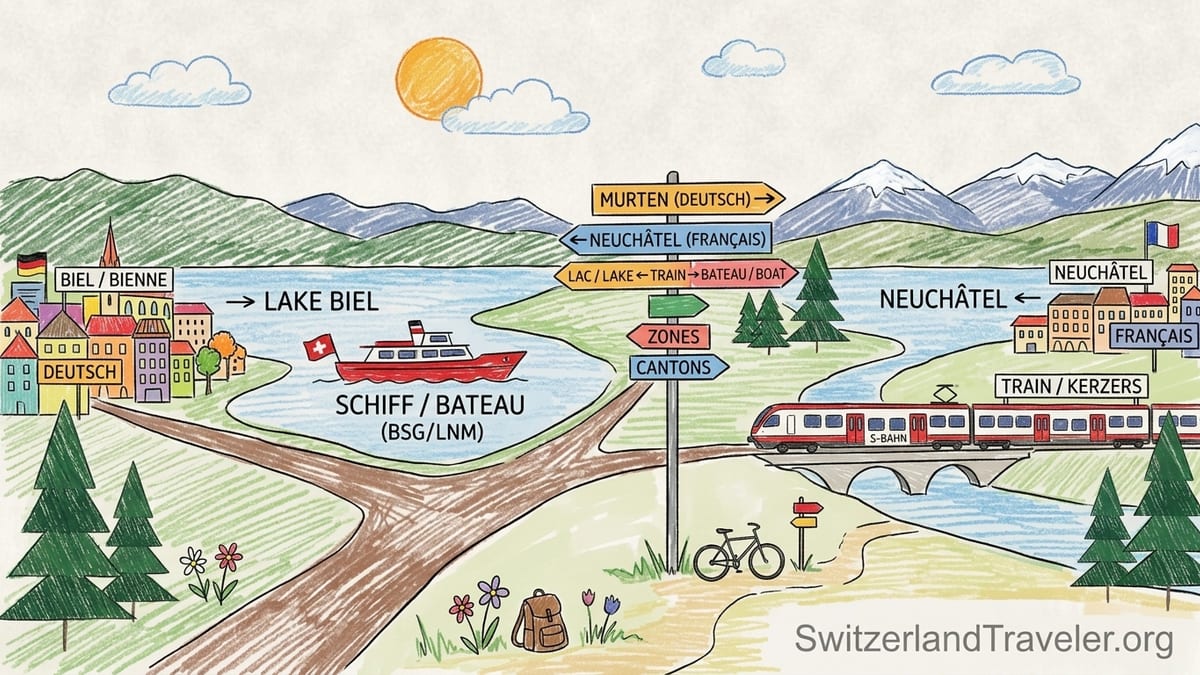
Where the “Three Lakes” Idea Came Off the Rails
Like many travelers, I first encountered the region under a single name. Switzerland Tourism groups it as “Jura & Three-Lakes,” stretching across the cantons of Neuchâtel and Jura, plus parts of Bern, Fribourg and Vaud. The lakes of Biel, Neuchâtel and Murten are described as sisters, their shores linked by canals and a classic “Three Lakes Cruise” that can carry you from Murten to Biel in one long, lazy day on the water. The marketing maps make it look like one cohesive holiday park, with neat color shading that quietly ignores cantonal borders and the country’s linguistic divide.
With that image in mind, I built what looked like a clever two-day plan. I would stay one night in Biel/Bienne, then string together a circuit that included a morning in the German-speaking watchmaking city, a midday boat ride through vineyards to French-speaking Neuchâtel, an evening stroll in lakeside Murten, and a final return to Biel by train. I penciled in extra stops in wine villages above Lake Biel and along the sandy shores of Lake Neuchâtel. On paper, nothing was much more than 30 or 40 kilometers apart. In my head, it felt like planning a day across different neighborhoods of the same town.
The trouble was that a tourism region is not the same as a transport region. The Three Lakes area straddles the Röstigraben, the informal language border between German- and French-speaking Switzerland, and crosses at least four cantons with their own fare zones, tourism passes and local habits. I knew all of that in theory. What I underestimated was how those lines would quietly shape timetables, pricing, and even the way I read signs, menus and station information as I tried to knit the lakes together at speed.
By the end of the first day, I had still enjoyed myself. I had also missed a boat, paid for an extra train I had not budgeted, and walked a long stretch of shoreline that felt more like a commute than a lakeside ramble. The region was not the problem. My assumption that “three lakes” meant “one compact destination” was.
Planning by Map, Not Timetable
My first planning misstep was treating water and rail like interchangeable lines on a diagram. I patched together the Three Lakes Cruise and regional trains as if they were metro services that I could hop on every half hour. On the Switzerland Tourism site and local regional pages, the Biel, Neuchâtel and Murten boats are presented as an iconic experience, operated in partnership by the Lake Biel Navigation Company (BSG) and the Société de navigation sur les lacs de Neuchâtel et Morat (LNM). The full-length cruise between the lakes can take most of a day if you ride it in one stretch, which should have been a warning in itself.
Instead of checking a specific operating date and season for my travel window, I relied on an old PDF timetable and a generic summary: roughly a three-hour section here, a ninety-minute section there. I built connections from Biel’s boats to Neuchâtel’s boats as if I could always expect a departure within the hour. What I only noticed when I checked again on the SBB mobile app the evening before departure was that April and October shoulder-season sailings are often limited, and some cross-lake segments do not run daily outside high summer. I had essentially built a peak-July cruise day into an early shoulder-season weekend.
The consequences showed up first between Neuchâtel and Murten. LNM publishes clear fares, including around 28 Swiss francs for a one-way Neuchâtel to Murten trip and a Three Lakes day card for about 69 francs, with acceptance of the nationwide Half Fare travelcard and the General Abonnement. Those prices are attractive if you spend most of your day on the boats. I, however, was chasing a late afternoon connection to Murten that did not actually exist on my date. The only way to keep the skeleton of the plan was to replace a scenic canal-and-lake section with an inland train ride.
Even the trains were less frequent than I had lazily assumed. The Jura foot railway between Lausanne, Neuchâtel and Biel is one of Switzerland’s major intercity lines, with frequent services. But Murten sits a little off that main axis, linked by regional S-Bahn style trains via Kerzers or Avenches. Travel planners like the SBB site show that Biel to Murten by rail can easily take about an hour with a change in Neuchâtel or Kerzers. That is still fast by many standards, but it is not a ten-minute city tram hop. By the time I had shuffled segments on the SBB app to accommodate realistic departure times, my tight lake-hopping loop had turned into a day glued to schedules.
The Hidden Frictions of Changing Cantons and Zones
The second surprise was how often I crossed invisible lines. The Three Lakes tourism region is stitched together from different administrative pieces: Neuchâtel and Jura to the west, parts of the canton of Bern around Biel and the Seeland plain, and parts of Fribourg and Vaud around Murten and the southern and western shores of Lake Neuchâtel. That patchwork is a strength from a cultural point of view. It also means that as a visitor, you slide between different tariff associations and regional cards more than you might expect from a single-colored blob on a map.
Neuchâtel, for example, promotes the Neuchâtel Tourist Card, which gives overnight guests free regional public transport within the canton and discounts for certain lake cruises and attractions. A night in a lakeside hotel in Neuchâtel can effectively cover your bus to the station, a local RegioExpress train to the Jura foothills, and a segment on the lake. Biel/Bienne, by contrast, belongs to the Libero fare network shared with Bern and parts of Solothurn. An overnight visitor there might get a city transport card covering buses and local funiculars, but not necessarily lake boats or trains onward to Neuchâtel.
I had booked my one night in Biel because it was well positioned between Bern, Basel and the lakes, and because it straddles German and French in a way that fits the region’s bilingual identity. What I had not realized was that if I had instead based myself in Neuchâtel, much of my intended second-day transport would have been covered or discounted by that canton’s guest card. By stitching together short stays and multiple cantons, I repeatedly stepped just outside the boundaries of any one transport deal and ended up buying more standalone tickets than I expected.
The boats add a further layer. Both BSG on Lake Biel and LNM on Lakes Neuchâtel and Murten accept nationwide passes like the Half Fare Card and the General Abonnement, and they sell their own day tickets for individual lakes and for the classic Three Lakes Cruise. There are also occasional promotions, such as limited day passes sold via partner municipalities for heavily reduced prices. I discovered mention of such a local deal for one of the lakes only after I had already purchased a regular day ticket from the pier. It was a reminder that in this cross-cantonal region, good offers often live on local-language pages of small municipalities or regional offices rather than in one central place.
Language Switching: Feature, Not Bug
If the administrative borders were mostly invisible, the language line was printed in bold. Biel/Bienne bills itself as Switzerland’s largest officially bilingual city, with street signs, station boards and public information consistently presented in both German and French. Train departure signs at Biel’s station rotate between “Abfahrt” and “Départ.” Restaurant menus often list “Fischknusperli” and “filets de perche” on the same laminated sheet. That bilingualism is a central part of Biel’s identity, not a concession to tourists. It set my expectations for the rest of the trip.
Once I left Biel by boat along the northern shore of Lake Biel, the balance began to tilt. Vineyard villages like Twann and Ligerz still sit in the canton of Bern and still feel linguistically mixed, but spoken German becomes more common on the boats and jetties. Crossing toward St. Peter’s Island, announcements may come first in German, then French. By the time you follow the waterway through the canal system and step off the boat in Neuchâtel, the environment is firmly French-speaking. Station signs at Neuchâtel and regional bus stops list destinations first in French. Restaurants present menus primarily in French, sometimes with a thin English translation below.
None of this caused practical problems. Staff on boats and in hotels spoke matter-of-fact English when needed, and the national rail app defaults to your chosen language. But when you are tired, slightly behind schedule and trying to decide between a pier and a nearby bus stop, small changes in language can make signs feel slower to parse. I caught myself reading “débarcadère” three times before realizing it was simply the pier I was searching for, or hesitating over the direction of “rive est” on an information board, even though it obviously referred to the east bank. Those are tiny frictions, but they add up when a day is already packed.
The more important realization was emotional rather than logistical. My plan had treated Biel, Neuchâtel and Murten as interchangeable pretty lake towns that happened to speak different languages, essentially as checkboxes under a single marketing label. In reality, the language shift is one of the region’s essential textures. Biel’s bilingual street life, Neuchâtel’s French-speaking café culture and Murten’s small German-speaking old town with its medieval walls are three distinct experiences. To skim through each of them in a rush, with my mind half on the next timetable change, was to miss part of what the Three Lakes idea is trying to showcase in the first place.
When Public Transport Worked Brilliantly
It is important to say that none of my misadventures were caused by poor transport. In fact, the most striking thing about the Three Lakes region is how elegantly boats, trains and buses are integrated when you use them with a realistic pace. The canals that connect the lakes are themselves products of thoughtful engineering, redirecting the Aare and linking the basins so that a through-cruise from Biel to Murten is even possible at all. Local tourism boards highlight combined routings where you float one way and ride rails back, and when you follow those patterns rather than try to outsmart them, the system often feels close to seamless.
One stretch that reminded me of this was the journey between Biel and Neuchâtel by rail. Even without a boat, the InterRegio service along the Jura foothills stitches the lakes together in a way that is both fast and scenic. The ride takes roughly 30 minutes, with regular departures, and many services continue onward to major hubs like Lausanne or Basel. From Neuchâtel station, a clearly marked underpass guides you toward buses and the lakeshore promenade. Within a few minutes of stepping off the train, I was standing on the quay with a view of the Alps on the horizon.
Another example came on the Murten side. While my hoped-for direct boat connection from Neuchâtel to Murten did not run on my travel date, the S-Bahn style link between Kerzers and Murten proved both efficient and pleasant. A short regional train from Neuchâtel took me across the language border again, announcements switching back to German and French in equal measure. A quick change at Kerzers dropped me into a smaller, local train that trundled through fields and farms before depositing me a short walk from Murten’s lakeside. Even with the transfer, the process was straightforward, with synchronized timetables designed to minimize waiting time.
On Lake Biel, too, once I surrendered the idea of chaining together three separate boat segments in one afternoon, the navigation network came into its own. A simple circular cruise from Biel around the lake, with a stop at St. Peter’s Island and perhaps a pause in a wine village, filled half a day with minimal stress. BSG’s published fares and the seasonal day passes made it easy to calculate whether it was worth stepping on and off multiple times. I ended up chatting with locals who were using the same boat as a floating terrace for a Sunday family outing, which felt far removed from my original race between lakes.
Where I Underestimated Distances and Shorelines
The parts that went less smoothly mostly involved my optimistic walking estimates. Shorelines on maps tempt you into thinking that one resort blurs into the next. On Lake Neuchâtel especially, the southern and eastern banks appear as a continuous string of beaches and villages. I decided to build in a “flexible lakeside walk” segment between two boat or train stops, telling myself that if I kept it around 90 minutes I could still make the next planned leg.
What actually happened was a slow, meandering tramp that took closer to two and a half hours. The path itself was not difficult, and much of it wound along pleasant reed beds and small marinas. But while the Swiss national cycle and hiking routes provide excellent signposting, the distances between named resorts like Estavayer-le-Lac, Cudrefin and smaller hamlets are not trivial if you are carrying a day pack and checking your watch. I found myself repeatedly estimating “just one more bay” and then watching the path curve away from the water, loop around an inlet or climb over a small bluff.
The cumulative impact showed up later in the day. By the time I reached my intended pier for a late-afternoon boat back to Neuchâtel, the sailing had already gone. The next boat on that route was several hours away. A posted timetable directed me to a nearby bus stop that connected to a regional train line, but the interchange was tight and not especially intuitive for a first-time visitor. I eventually reached Neuchâtel by a combination of bus and train, with the sun already dropping toward the Jura crest and my hopes of a sunset drink on the lakeshore in Murten fading with it.
This is where the geography of the Three Lakes region asserts itself. The lakes run roughly west to east along the foot of the Jura, with wetlands, nature reserves and agricultural land in between. Canalized links like the Broye and Zihl are feats of engineering, but they do not magically compress space in the way an urban tram line might. Paths along reserves such as the Grande Cariçaie often detour away from the waterfront for conservation reasons. When you respect that geography, the region offers some of the most rewarding lowland walking in Switzerland. When you try to bend it to an overstuffed schedule, it quietly resists.
Lessons in Pacing a Bilingual, Cross-Cantonal Region
By the end of my second day, somewhere between a delayed regional train and a missed lake sunset, I started to see the Three Lakes region not as a failed compact destination, but as a set of overlapping circles. One circle is linguistic: German-speaking communities to the east, French-speaking ones to the west, and meeting points like Biel in between. Another is administrative: canton-specific guest cards, local fare networks and tourism offices that concentrate on their immediate shore or valley. A third is experiential: Biel’s industrial watchmaking heritage and lively lakeside promenades, Neuchâtel’s creamy stone façades and university vibe, Murten’s preserved medieval walls and lakeside lawns.
My original itinerary tried to touch as many of those circles as possible in a short window, assuming that engineering and timetables would smooth over any frictions. In doing so, I turned what could have been a gently interwoven stay into something closer to a transport exercise. The boats and trains themselves were almost always punctual, comfortable and clean. The stress came from my attempt to compress different cultures, cantons and shorelines into a single, continuous narrative across two days.
The most practical lesson is that the Three Lakes region rewards depth over breadth. Instead of doubling up on both long boat segments and long shoreline walks in one day, choose one mode to do properly. If you buy a Three Lakes cruise ticket, commit to spending most of the day floating, with maybe one or two well-timed shore excursions. If you want to hike or cycle between lakeside villages, give that priority and design the rest of your transport around a couple of fixed train anchors rather than a string of optional boats.
The softer lesson involves mindset. Treating Biel, Neuchâtel and Murten as interchangeable lake towns because they share canals and marketing material is a missed opportunity. Once I slowed down enough to order a coffee in French on Neuchâtel’s Place Pury without glancing at my watch, or to listen to two Biel locals naturally switch between German and French as they chatted about the weekend market, the region’s bilingual, cross-cantonal character became a joy rather than a logistical challenge. The language changes are not obstacles to overcome. They are the texture that gives the Three Lakes its particular flavor.
The Improved Strategy: One Lake Base, One Cross-Lake Day
If I were to plan the same trip again, I would start by choosing a single lake as a base for at least three nights. Biel, Neuchâtel and Murten all make strong candidates, and the right choice depends less on transport optimization than on mood. Biel offers a larger-city feel with bilingual flair and easy rail connections to Bern and Basel. Neuchâtel leans French-speaking, with a handsome old town and direct access to both lake and Jura excursions. Murten is smaller and more overtly resort-like, with its arcaded main street and intimate lakeside lawns. Any of them can anchor a stay without requiring you to change hotels every night.
From that base, I would then add exactly one generous cross-lake day that stitches in a second lake, ideally centered on a single long boat journey or a clearly defined hike-and-boat combination. For example, if based in Neuchâtel, I might take a morning boat toward Murten, ride through the Broye canal and spend a leisurely afternoon on Murten’s town walls and lakeshore before returning by a simple rail route via Kerzers. If based in Biel, I might devote one day entirely to the Biel to Neuchâtel connection, traveling out by boat through the Zihl canal and back by train along the Jura foothills.
The key is to treat that cross-lake day as an occasion, not as a default commute. That means checking current-season timetables directly on the operators’ sites or the SBB app for your exact travel dates, paying attention to first and last sailings, and accepting that you may spend several hours on one mode of transport. It also means leaving real gaps in the schedule. A two-hour pause for lunch in a lakeside village, with enough margin to stroll without counting steps, will almost always feel better than squeezing in an extra, rushed stop across another cantonal line.
Above all, I would consciously frame Biel, Neuchâtel and Murten as distinct experiences rather than must-do checkboxes. One visit might be “a week based in Neuchâtel with a day-trip to Biel,” another “a few days in Murten with a long cruise toward Neuchâtel.” Over several trips, you will accumulate a mental map of the Three Lakes region that feels joined-up. On any one visit, there is no prize for treating all three lakes and their vineyards as a single continuous attraction.
The Takeaway
The western Mittelland’s Three Lakes region is easy to underestimate. Marketing maps and cruise brochures compress its geography into a tidy band of blue at the foot of the Jura, and Switzerland’s famously punctual public transport suggests you can shuttle between lakes with the ease of changing metro lines. My attempt to treat Biel, Neuchâtel and Murten as one compact stop on a grand Swiss loop proved otherwise. Cross-cantonal fare zones, language shifts, seasonal boat timetables and longer-than-expected shoreline walks all conspired to turn a two-day whirl into a transport-heavy exercise.
That experience did not lessen my appreciation of the region. If anything, it deepened it. The bilingual character of Biel, the French-speaking charm of Neuchâtel and the small-town German feel of Murten are not interchangeable facets of one homogeneous destination. They are neighboring worlds, gently separated by canals, wetlands and administrative lines, yet tied together by shared history and engineering. When you stop treating bilingualism as a hurdle and start seeing it as part of the journey, the switches between “Bonjour” and “Grüezi” become part of the pleasure.
For future travelers, the most useful conclusion is simple. Pick one lake as your home base, design one unhurried cross-lake day around either a long boat trip or a single, well-planned loop, and let each of the three main towns stand in your mind as a distinct place rather than a tick on a list. The Jura & Three-Lakes region is not a miniature Riviera to be “done” in a weekend. It is a bilingual, cross-cantonal landscape that rewards those who give it time, listen to its language changes, and allow the lakes to shape the pace instead of the other way around.
FAQ
Q1. How much time should I plan for the Three Lakes region?
A stay of three to five nights is a good starting point, with one lake as your base and one dedicated cross-lake day. Trying to “do” all three main towns in one or two days tends to create rushed connections.
Q2. Which lake town is best as a base: Biel, Neuchâtel or Murten?
Biel suits travelers who like a larger, bilingual city with strong rail links. Neuchâtel is ideal if you want a French-speaking lakeside town and access to the Jura. Murten works well if you prefer a smaller resort feel and easy strolls along the lake.
Q3. Do I need to speak both French and German to visit the region?
No. English is widely understood in hotels, visitor centers and on boats and trains. Basic French helps in Neuchâtel and surrounding villages, while basic German helps on the Biel and Murten sides, but bilingualism is a feature rather than a barrier.
Q4. How reliable are the boat services between the lakes?
Boat services are generally very reliable during their operating seasons, but frequencies and routes vary by month and day of the week. Always check current timetables for Lake Biel and Lakes Neuchâtel and Murten for your exact travel dates.
Q5. Is the Three Lakes Cruise day ticket good value?
It can be, if you plan to spend most of the day on the water and use several segments. If you only need one short crossing, buying a single ticket or using a rail pass discount may be more economical.
Q6. How long does it take to travel between Biel, Neuchâtel and Murten by train?
Typical rail journeys are roughly half an hour between Biel and Neuchâtel, and around an hour between Biel and Murten with a change, depending on the route and connection. Exact times vary by service and time of day.
Q7. Are there regional transport passes that cover the whole area?
There is no single local pass that seamlessly covers all lakes and cantons. National products like the Swiss Travel Pass or Half Fare Card work across the region, while cantonal guest cards and zone passes apply more locally, such as around Neuchâtel or Biel.
Q8. Can I combine hiking or cycling with the boats?
Yes, and it is one of the best ways to experience the region. Marked routes run along the lakes and canals, and many boats accept bicycles for a fee. Just be sure to allow enough time for distances that can be longer than they appear on a map.
Q9. Is it better to visit in summer or shoulder season?
Summer offers the most frequent boat services, open lake beaches and long evenings. Shoulder seasons can be quieter and beautiful, but some cruises run less often or not at all on certain days, so careful timetable checks are essential.
Q10. How should I think about Biel, Neuchâtel and Murten when planning?
Treat them as three distinct lake experiences rather than a single attraction. Choose one as a base, add one well-planned cross-lake day that touches a second or third, and leave room to return instead of trying to see everything at once.