


The Three Lakes wine region in western Switzerland is one of the country’s most characterful vineyard landscapes, wrapped around Lakes Biel, Murten and Neuchâtel and spread across the cantons of Bern, Fribourg, Neuchâtel, Vaud and Jura. For travelers, this compact corner of the Mittelland offers something rare in European wine country: you can move almost entirely by train and boat, walk between tasting rooms with the lake at your feet, and combine harvest-season buzz with quietly photogenic villages. This guide focuses on planning, not wine scores, and is organized by lake so you can build realistic days that link vineyards, ferries and hillside paths without needing a car.
Understanding the Three Lakes Wine Region
The official Three Lakes wine region brings together three distinct vineyard areas that share a cool, lake-moderated climate and limestone-rich soils. Neuchâtel is the largest, with roughly 600 hectares of vines running along the north and west shores of Lake Neuchâtel. Around Lake Biel, about 220 hectares of vineyards cling to the steep southern slopes above villages such as Twann, Ligerz and La Neuveville. Vully, above Lake Murten, is the smallest section with a bit over 100 hectares, but it punches above its weight in personality and lake views.
Across all three lakes, Chasselas is the classic white grape and Pinot Noir the main red, but each sub-region has its specialties. In Neuchâtel, winemakers are known for Non‑Filtré, a young, cloudy Chasselas released in January, and for Œil‑de‑Perdrix, a pale, salmon-pink Pinot Noir rosé. In Vully, you will see bottles labeled Freiburger and Traminer, local names for wines made from Freisamer and aromatic Gewürztraminer, while along Lake Biel some estates experiment with Chardonnay, Sauvignon Blanc and more structured Pinot Noir. You will not find industrial-scale wineries here; most are family operations farming only a few hectares.
The Three Lakes region feels small on the map, but travel times can deceive. Trains between Neuchâtel, Murten and Biel often take 30 to 45 minutes once connections are accounted for, and boat cruises that link the lakes are leisurely by design. This is part of the charm, but it has planning implications. In practice, most visitors will focus on one lake per day and, at best, two or three well-spaced tastings. The reward for slowing down is that you can walk directly through the vineyards between villages, often finishing the day at a lakeside pier with your next train or ferry in sight.
Because the vineyards span several cantons, small differences appear in wine labels and opening habits. Names like Neuchâtel AOC, Vully AOC or Bielersee AOC indicate the controlled origin. Tourism offices and regional wine associations publish current lists of growers with posted cellar hours and those that open by appointment only. It is worth checking these just before you travel, since many growers adjust their schedules in harvest season and for regional wine festivals.
Lake Biel: Twann–Ligerz Trails, Wine and Boats
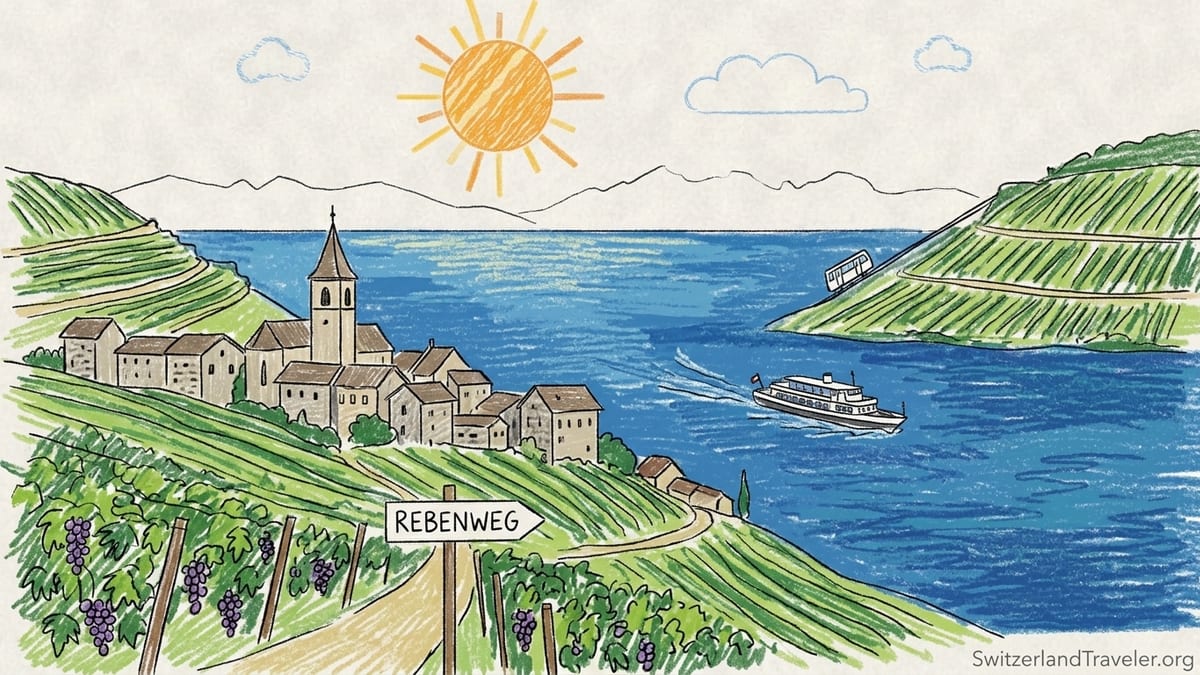
If you only have one day in the Three Lakes wine region, the southern shore of Lake Biel is the easiest place to start. Between Biel/Bienne and La Neuveville, terraced vineyards rise almost straight from the water, threaded by the Rebenweg, a signposted vineyard path that locals also call the Twann–Ligerz wine trail. The route is reachable from every lakeside train station and boat pier between Biel and La Neuveville, which means you can shorten or lengthen your hike on the fly depending on the weather and your tasting schedule.
A classic car-free day links Biel and Ligerz. From Biel/Bienne’s main station it is only a few minutes by regional train to Twann or Ligerz, or you can start with a morning boat across the lake to Twann pier. From Twann you climb gently through the village and onto the Rebenweg, then contour above the lake through terraced vines to Ligerz in about 1.5 hours of easy walking. From here you can either continue toward Schafis and La Neuveville or ride the small vinifuni funicular up to the hamlet of Prêles for broader views and extra walking options across the Jura plateau.
With so many wineries strung along this path it can be tempting to turn the walk into a continuous tasting crawl, but in practice two prearranged visits and one casual glass en route is a comfortable maximum without a car. Several Bielersee estates keep limited “open cellar” hours posted through regional tourism sites, often with walk-in tasting rooms open on Friday afternoons and Saturdays, while the rest welcome visitors by phone or email reservation. During spring and early summer, Rebenweg events occasionally see two or more producers open temporary wine bars outdoors for hikers, but on a normal day you might plan, for example, a late-morning visit in Twann, a picnic lunch overlooking the lake, and an afternoon tasting in Ligerz before drifting down to the pier for a boat back to Biel.
Boats on Lake Biel run more frequently in summer, generally from late April through October, and schedules are timed to be useful for hikers, but service can thin out to every couple of hours on shoulder-season weekdays. Because you are moving on foot and public transport, you can relax about designated-driver planning: nobody in the group needs to drive, so you are free to share tasting flights and split bottles with your meal. The main constraint is time. Tastings in the region are unhurried, and if you accept a winemaker’s offer of a cellar tour or a few extra samples it is easy to spend 90 minutes at a single stop. Allow at least 45 minutes per tasting plus walking and transport time, and aim to be off the higher paths if afternoon storms are forecast, as sudden showers can make stone steps and vineyard tracks slick.
Lake Murten: Vully’s Sunlit Slopes Above the Water
Vully, on the north shore of Lake Murten, feels more intimate than the Bielersee slopes but offers some of the region’s widest open views. The vineyards sit on the flanks of Mont Vully, a low sandstone ridge that falls gently to the lake. This is one of Switzerland’s rare cross-cantonal appellations, recognized in both Vaud and Fribourg, and the villages of Praz, Môtier and Sugiez form a string of lakeside bases that work well without a car. Trains on the Lausanne–Bern line stop in nearby Murten/Morat, and from there bilingual buses and boats reach the Vully villages.
For travelers, the big draw is how easily you can combine walking, wine and swimming. One practical itinerary starts in Murten’s walled old town, where you can grab picnic supplies, then takes the late-morning boat across Lake Murten to Praz. From the pier you are already beneath the vines, and well-marked footpaths climb in 15 to 20 minutes to viewpoints such as the Mont Vully belvedere, where benches and picnic tables overlook both Lake Murten and, on clear days, the Alps. Short vineyard loops such as the Sentier Viticole du Vully pass educational panels about grapes and soil types, and drop you back among cellar doors in Praz or Môtier.
Because Vully is so compact, you can feasibly fit two, and sometimes three, tastings around a half-day hike if you keep distances short. Many producers here list specific open hours on weekends and one or two afternoons in the week, with tastings starting around mid-afternoon. Outside those slots, you usually arrange visits directly with the estate. Local specialties worth seeking out include Chasselas labeled under the Vully AOC, structured Pinot Noir and the aromatic Freiburger and Traminer whites that thrive in the sandstone soils. Prices by the glass in simple village wine bars are often moderate by Swiss standards, and buying a couple of bottles directly at the cellar is one of the more affordable ways to bring home a taste of the region.
Public transport makes designated-driver questions simple in Vully as well. Boats typically connect Murten with Praz, Môtier and Sugiez several times a day in summer, while buses run along the lakeshore and up toward the ridge. Late evening connections thin out, so if you linger over dinner in a lakeside restaurant, check the last boat or bus in advance and be prepared for a short taxi ride back to Murten if you miss it. Weather matters here too. On hot July and August days, exposed paths between the vines can feel intense by mid-afternoon, so consider starting your vineyard walk early, retreating to the lake for a swim at midday, then doing tastings indoors in the cooler late afternoon.
Lake Neuchâtel: Bonvillars, Auvernier and Classic Lakeside Villages
Lake Neuchâtel is the largest of the three lakes and has the broadest range of vineyard experiences. On the northwestern shore, between Yverdon-les-Bains and Concise, the Bonvillars appellation spreads across gentle slopes that catch long evening light over the lake. Tourism boards in northern Vaud actively promote Bonvillars as a wine-tourism destination, highlighting cellar visits, harvest experiences and walking routes that thread between small villages and the lakeshore. Farther north and east, between Auvernier and Le Landeron, Neuchâtel’s own vineyards line the rail route, so that even a simple local train ride offers classic sequences of vines, lake and Jura ridges.
Bonvillars works best if you base yourself in or near Yverdon-les-Bains, then move by train, bike or car out to the villages. Yverdon is on mainline rail routes and has bus links into the countryside, but frequencies can be limited beyond the larger villages, so many wine travelers choose to hire bikes or e-bikes through local rental schemes. A realistic car-free day might involve a morning train to Grandson, where you can explore the lakeside castle and medieval streets, followed by a gentle walk or short taxi hop into the nearest vines for a pre-arranged cellar visit and lunch at a country restaurant. Some estates in Bonvillars and the wider Yverdon region occasionally advertise harvest-and-aperitif packages in September and early October, where visitors help pick grapes in the morning and then share a tasting and simple meal among the vines.
On the Neuchâtel side of the lake, access is simpler. Local trains from Neuchâtel station reach vineyard villages such as Auvernier, Cortaillod and Boudry in a matter of minutes, and footpaths link the stations directly with vineyards and lakeside promenades. Auvernier in particular has become a favorite for photographers and walkers, with its narrow streets, lakeside harbor and layers of vines between the village and the railway line. Because trains are frequent on this corridor, you can comfortably plan two or three short tastings in different villages, separated by 20 to 30 minutes of walking or a five-minute train hop, and still avoid any driving.
Throughout the Neuchâtel area, Non‑Filtré and Œil‑de‑Perdrix remain anchor wines. Many estates celebrate the January release of the new vintage of Non‑Filtré with events in the city, and bottles appear in wine bars and shops across Switzerland soon after. If you visit in winter or early spring, it is an ideal time to get to know this style, often poured alongside more classic, clear Chasselas from the previous vintage. In warmer months, tastings tend to lean toward rosés and lighter Pinot Noir, especially in bars and restaurants that pair them with lake fish dishes served on terraces overlooking the water.
Moving Between Lakes: Trains, Ferries and the Three Lakes Cruise
One of the practical delights of the Three Lakes wine region is how well connected it is by public transport. Biel/Bienne, Neuchâtel and Murten/Morat all sit on major Swiss Federal Railways routes, and fast intercity or interregional trains link them with Bern, Lausanne and Zurich. Between them, regional trains and buses hug the lakeshores, stopping in small vineyard villages where a two-minute walk puts you among the vines. For visitors, this means that renting a car is optional rather than essential, and that everyone in the group can enjoy tastings if you plan with the timetable in mind.
For a broader perspective, boat companies offer seasonal cruises on each lake, and, when water levels and timetables allow, a through Three Lakes cruise that stitches Biel, Murten and Neuchâtel together via connecting canals. On peak-season days, you can ride all three lakes in one direction in roughly five to six unrushed hours, stepping off at selected piers such as Erlach, Praz or Auvernier to visit villages or nearby wineries. This works particularly well if you treat the boat as moving scenery rather than transport to a fixed schedule, building in long gaps that let you disembark for a meal or a walk among the vines before catching the next sailing.
From a planning point of view, ferries and trains can often substitute for driving, but there are trade-offs. Boats are slower and more weather dependent; windy days can bring choppy water and delays, and early or late-season sailings may run only on weekends. Regional trains and buses are more robust in bad weather, but vineyard trailheads are not always right at the station. On Lake Biel, for example, short but quite steep lanes lead from Twann or Ligerz station up through the houses to the Rebenweg, which can be awkward in heavy rain. Allow a buffer in your schedule between tastings, especially if you are relying on the last evening ferry or a tight train connection back to your base.
Because Swiss public transport is integrated, a day pass or regional travel card can often cover a combination of train, bus and boat, bringing down the cost of hopping between villages. Before you travel, check whether special Three Lakes or regional lake passes are valid on the routes you plan to use, and whether supplement tickets are required on certain long-distance or panorama boats. Even if you hold a pass, it is worth making seat reservations on the most popular weekend cruises in high summer, particularly if you want to sit on the upper deck with uninterrupted vineyard views.
Seasons, Weather and How Many Tastings Fit in a Day
The Three Lakes wine region is technically a year-round destination, but the character of a trip changes markedly with the seasons. From April to early June, you will mostly walk through bright green vines and quiet cellars, with moderate temperatures that are ideal for hiking. July and August bring more heat, busy lakeside beaches and longer opening hours in restaurants and wine bars, while from mid-September to mid-October harvest transforms the landscape with golden leaves, picking teams among the rows and, in some years, temporary grape trailers parked along vineyard lanes.
Harvest is both magical and challenging for visitors. On the plus side, you are likely to see cellar activity up close, and some regions, such as Bonvillars and parts of Lake Biel, schedule public harvest days or vineyard aperitifs. On the downside, many small estates focus entirely on bringing in the grapes, and may close their tasting rooms or accept only pre-booked visits for several weeks. If you plan a harvest-season trip, contact a handful of wineries a month or so in advance, be flexible about days and times, and be prepared for last-minute changes if the weather forces growers to pick earlier than expected.
Weather is a bigger factor in how pleasant vineyard walks feel than in whether tastings are possible. Paths above Lake Biel and on Mont Vully are often exposed and can feel several degrees warmer than lakeside streets on sunny days. In summer, aim to hike in the morning or late afternoon and schedule indoor tastings during the hottest hours. In spring and autumn, showers can arrive suddenly from the Jura, turning gravel tracks muddy and making wooden steps slippery. Carry light waterproofs and shoes with good grip, and have a bad-weather backup that leans more on trains, buses and village strolls than on long ridge walks.
When it comes to tastings, the main planning question is not how many wineries exist along your route but how many meaningful stops you can enjoy in one day. Around the Three Lakes, a focused tasting with a short introduction and four to six wines usually lasts at least 45 minutes. Add travel, conversation and time to buy bottles, and each stop can easily stretch to an hour. In practice, most travelers find that two planned tastings plus one spontaneous glass in a village wine bar or lakeside terrace feel relaxed without becoming a blur. Trying to cram in four or five cellar visits, especially across more than one lake in the same day, tends to turn the day into a race against the timetable.
Suggested Profiles: Matching Lakes and Routes to Traveler Types
Not every part of the Three Lakes wine region suits every traveler equally well. For wine beginners, the most accessible option is often a day on Lake Biel based in Biel/Bienne or Neuchâtel, combining an easy section of the Rebenweg with one guided tasting. Some Bielersee wineries and local tourism offices arrange introductory sessions where staff explain the key grapes of the region, the influence of the lakes on the climate and the difference between, for example, a crisp Chasselas and a light Pinot Noir, all without assuming prior knowledge. Pair this with a short boat ride to see the vineyards from the water and you have a gentle introduction that stays memorable without feeling technical.
Walkers and hikers gravitate naturally toward the Twann–Ligerz trail and the longer Jura balcony paths above Lake Biel, or to the circuits on Mont Vully above Lake Murten. These allow you to walk for several hours on undulating paths with almost continuous lake views, dropping into villages for tastings or meals. A practical walking-focused day might link Magglingen, Twannberg and Ligerz on an 11-kilometer route, then finish with a ferry ride back to Biel. For couples, the combination of vine-covered slopes, old stone villages and soft evening light on the lakes makes both Vully and the Neuchâtel shore appealing. Small hotels and guesthouses in villages such as Auvernier, La Neuveville or Praz offer quieter bases than the larger towns, with the option of dinner in a restaurant that serves local fish and wines on a terrace above the water.
Photographers will find rewards on all three lakes but for different reasons. On Lake Biel, the church of Ligerz perched among the vines above the shore is one of the region’s most iconic scenes, especially at sunrise or in autumn when the leaves turn yellow and orange. Around Lake Neuchâtel, long perspectives of trains threading between vine-covered slopes and the lake make for dynamic compositions, while in Vully, the soft, layered light over both Lakes Murten and Neuchâtel from the Mont Vully ridge invites wide, panoramic frames. Because weather can change quickly, it is worth planning two dawn or dusk sessions in different villages so that if one is cloudy you still have another chance.
Travelers who specifically want to combine tastings with a lake cruise should target the main Three Lakes cruise days in high season, or design their own “mini cruise” by combining shorter point-to-point boat rides. One realistic plan is to start in Neuchâtel, taste in Auvernier in the late morning, then take an afternoon boat to Cudrefin or Praz on Lake Murten, where you can visit a Vully cellar and have dinner before returning to Murten by boat or bus. Another is to base in Biel/Bienne, ride the morning boat to Erlach or St. Peter’s Island for a walk and picnic, then continue in the afternoon to Ligerz or Twann for a tasting and sunset over the lake. In all these profiles, the key is to keep distances short and connections simple so that your day stays anchored in the vineyards rather than in transport logistics.
FAQ
Q1. Do I need a car to visit the Three Lakes wine region?
Most travelers do not need a car. Trains, buses and boats link Biel/Bienne, Neuchâtel, Murten and the main vineyard villages, and many of the best wine trails such as the Rebenweg above Lake Biel or the paths on Mont Vully start within walking distance of stations and piers. A car can help in more rural parts of Bonvillars, but even there, basing in Yverdon-les-Bains and using a mix of trains, buses, bikes and short taxis usually works well.
Q2. How many wine tastings can I realistically fit into one day?
For a relaxed day that still allows for walking and enjoying lake views, plan on two pre-booked tastings plus perhaps one informal glass of wine in a village bar or restaurant. Each proper cellar visit usually lasts about an hour once introductions, the tasting itself and bottle purchases are included. Trying to visit more than three wineries in a day often leaves little time for the vineyard trails or boat rides that make the region distinctive.
Q3. Do I need to reserve tastings in advance?
In most cases, yes. Some wineries, especially around Lake Biel and in Vully, publish regular open-cellar hours when visitors can walk in, typically on Friday afternoons and weekends. Outside those slots, it is polite and often necessary to contact the estate in advance by email or phone to arrange a visit. During harvest between roughly mid-September and mid-October, advance reservations become even more important, since many small growers adjust or reduce visitor hours to focus on picking and vinification.
Q4. When is the best season to visit for vineyard walks?
Late April to June and September to mid-October are ideal for walking. Spring brings fresh green vines and cooler temperatures, while early autumn offers golden foliage and the atmosphere of harvest. July and August can be beautiful but hot, particularly on exposed paths above Lake Biel and on Mont Vully, so in high summer it is best to walk early or late in the day and use the hotter hours for swimming or shaded tastings indoors.
Q5. Can I combine all three lakes in a single day?
It is technically possible, especially on peak-season days when the full Three Lakes cruise operates, but it makes for a long and somewhat rushed itinerary. If your priority is wine and vineyard walks, it is usually better to focus on one lake per day. For example, you might devote one day to Lake Biel, another to Vully and Lake Murten, and a third to Bonvillars or the Neuchâtel shore, connecting them by train in the mornings or evenings.
Q6. What are the key local grapes and wines I should look for?
Across the region, Chasselas is the signature white grape and Pinot Noir the main red. Around Lake Neuchâtel, do not miss Non‑Filtré, a lightly cloudy young Chasselas released in January, and Œil‑de‑Perdrix, a pale rosé from Pinot Noir. In Vully, look for aromatic Freiburger and Traminer whites alongside Chasselas and Pinot Noir, while along Lake Biel you will find mineral-driven Chasselas, elegant Pinot Noir and small quantities of varieties like Chardonnay and Gewürztraminer.
Q7. How should we handle designated-driver planning?
Because the region is so well served by public transport, the simplest solution is not to drive at all on tasting days. Plan your routes around trains, buses and boats, and everyone in the group can share tasting flights. If you do choose to drive, agree in advance who will abstain or spit during tastings, and keep winery visits few and focused. Remember that some lakeside roads and village streets are narrow, so driving after dark or in bad weather can be tiring even without alcohol.
Q8. Are the vineyard walks suitable for casual walkers and families?
Most vineyard paths around the Three Lakes are classed as easy hiking trails, with modest distances but some short, steep climbs between lakeside villages and terraces. The section of the Rebenweg between Twann and Ligerz, for instance, is well within reach of reasonably fit adults and older children. Good walking shoes, water and sun protection are important, and families should be ready to shorten walks if the weather turns hot or stormy. For very young children or travelers with limited mobility, lakeside promenades and short strolls between piers and village centers may be more comfortable.
Q9. What happens in bad weather or if a storm is forecast?
If heavy rain or storms are forecast, it is wise to shorten or skip exposed vineyard walks, since stone steps and earth tracks can become slippery and thunderstorms above the lakes can be intense. Instead, you can focus on tastings reachable by train or bus with only brief outdoor sections, explore old towns like Biel/Bienne, Neuchâtel or Murten, or visit lakeside museums and cafés. Boat services may be reduced or canceled in extreme conditions, so check updates on the morning of travel and be ready to switch to trains or buses if needed.
Q10. How far in advance should I book accommodation and tastings?
Outside peak summer and harvest weekends, booking accommodation a few weeks ahead usually provides a good choice of rooms in towns like Biel/Bienne, Neuchâtel and Murten. In small villages with only a handful of guesthouses, or if you want specific lake-view rooms, booking one to three months ahead is prudent. For tastings, contacting wineries two to four weeks before your visit works well in most cases, though last-minute arrangements are sometimes possible midweek outside harvest. Around major local wine festivals and public holidays, both beds and cellar slots can book out much earlier, so early planning pays off if your dates are fixed.