


In 2026, Schilthorn is no longer just a classic Swiss peak with Bond nostalgia. It is one of Europe’s most modern high-alpine transport experiences, thanks to the completed SCHILTHORNBAHN 20XX project. With a record-breaking direct link from Stechelberg to Mürren and twin Funifor cableways all the way to the 2,970 metre summit, the journey has been shortened, smoothed and reimagined as much as the destination itself.
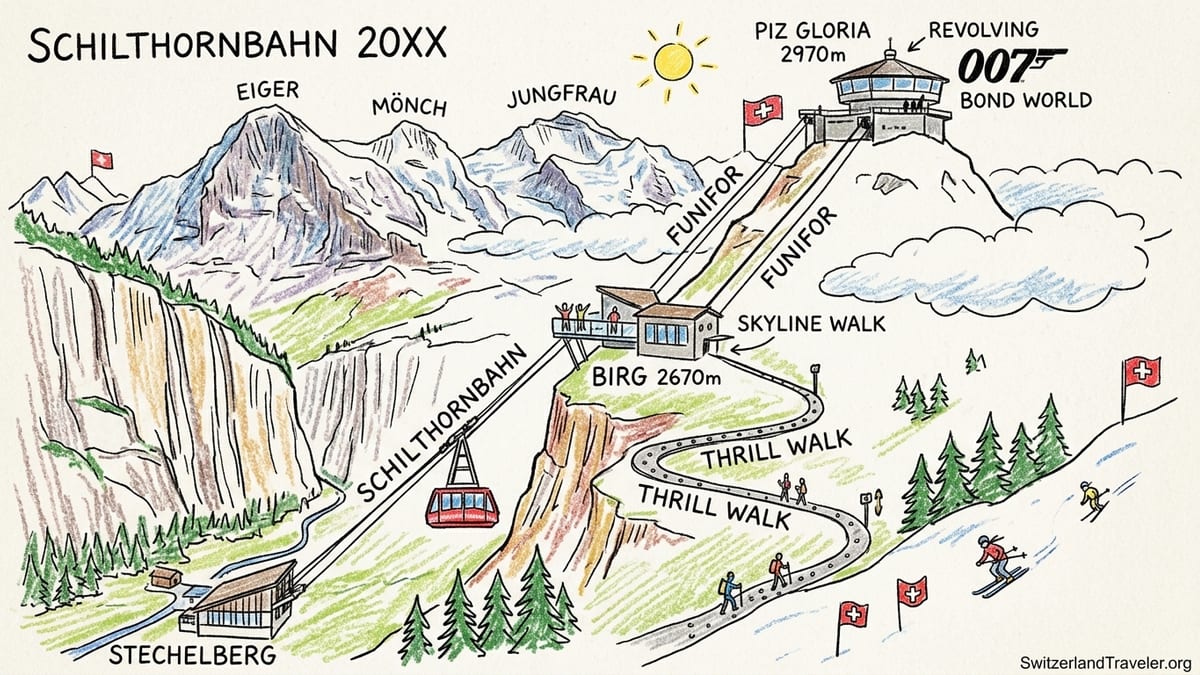
The New Schilthornbahn 20XX: What Changed by 2026
The SCHILTHORNBAHN 20XX project was conceived to completely rebuild the link from the valley floor at Stechelberg to the summit station at Schilthorn. By early April 2026 the final major piece was in place with the second Birg to Schilthorn Funifor line entering service, allowing fully redundant, high-capacity operation on the top sections. The result is that a route which once felt like a chain of older lifts has become a fast, coherent transport system designed for heavy year-round visitor traffic.
Instead of four older segments with tight capacity and occasional bottlenecks, the new system uses a very steep single span from Stechelberg to Mürren, then state-of-the-art Funifor cableways from Mürren to Birg and from Birg to Schilthorn. Funifor technology uses widely spaced track ropes and independent cable loops, which improves wind stability and allows the cabins to continue running when older pendulum cars might have to stop. For visitors this matters on marginal weather days, when a modern cableway can be the difference between making it to Piz Gloria or being turned around at the mid station.
The engineering focus has a clear outcome for travellers in 2026. Schilthorn is now about speed, reliability and spectacle from the moment you step into the valley station. Stechelberg sits in a deep glacial valley at the end of the Lauterbrunnen road, but within around 24 minutes of cableway time you step out nearly 2,000 vertical metres higher into a panorama of the Eiger, Mönch and Jungfrau. That combination of fast access and big-mountain setting is what now sets Schilthorn apart from many other Bernese Oberland excursions.
The New Travel Sequence: From Stechelberg to the 2,970 m Summit
The rebuilt route is designed to feel almost seamless. You begin in Stechelberg, a tiny settlement at the southern end of the Lauterbrunnen Valley, reached by bus or car from Lauterbrunnen in about 15 to 20 minutes. The new valley station houses modern ticket counters, storage lockers and clear digital displays showing cabin departure times and weather conditions up the line. From here you board the record-breaking direct cable car to Mürren, currently marketed as the steepest aerial cableway in the world, with a gradient of roughly 160 percent on its most dramatic section.
The ride from Stechelberg to Mürren lasts only a few minutes but feels like a vertical leap. The cabin swings out of the station, skims above sheer limestone cliffs and gains over 700 metres of altitude in one shot. As you climb, you see the Staubbach and Mürrenbach waterfall lines and small farm buildings far below, while Mürren appears ahead on its sunny terrace. Arriving in the traffic-free village, you stay inside the system: wayfinding keeps you moving directly from the arrival platform to the departure area for the next section without needing to go outside unless you want to.
From Mürren the journey continues on the first Funifor segment to Birg. This section is shorter but feels distinctly alpine, crossing above ski slopes in winter and hiking terrain in summer. Cabins are wide and stable, with large windows that give clear views across the Lauterbrunnen Valley. At Birg, most visitors break their journey to explore the Thrill Walk and Skyline Walk platforms, but if you prefer you can stay on schedule and connect almost immediately to the top section. The second Funifor between Birg and Schilthorn, fully operational since April 2026, climbs the final 400 vertical metres or so to the summit ridge with impressive smoothness, even in moderate wind.
Overall, Bern region tourism offices now quote a valley-to-summit cableway journey time of about 24 minutes, excluding transfer time at intermediate stations. In practice, if you walk straight through and catch the next lift at each point, you can often go from Stechelberg car park to Schilthorn summit platform in roughly 35 to 45 minutes. If you choose to pause at Birg for the Thrill Walk, or to wander through Mürren for a coffee, expect the total ascent to take closer to 90 minutes door to door.
How Much Faster and Easier is Schilthorn in 2026?
Compared with the pre-project set up, the 20XX rebuild cuts both the total cable length and the number of transfers. Technical project documents indicate that the line length has been reduced by close to a fifth, mainly because of the direct Stechelberg to Mürren link and more efficient routing of the upper sections. For visitors, the biggest difference is not the exact number of minutes saved, but the feeling that travel is now brisk and uninterrupted rather than a sequence of slow climbs with queues at each stage.
Concrete examples make this clear. A traveller staying in Interlaken in summer 2026 can now take an early morning train to Lauterbrunnen, walk straight to the bus stand and ride to Stechelberg, then ascend by the new cableway system in time for a mid-morning brunch sitting in the revolving restaurant. Before the rebuild, they needed to allow more margin for older lifts and transfers, especially on busy days when coach groups filled cabins. Today, modern passenger handling at Stechelberg, real-time capacity information and the higher-speed Funifors at the top reduce those friction points.
Convenience has improved in practical ways too. The new valley and mountain stations were built with level access for luggage and strollers, clearer signage and more indoor circulation space. Families with young children no longer need to wrestle prams through as many doorways or squeeze into cramped waiting areas at Birg. In winter, skiers arriving with equipment benefit from covered access between sections and more generous ski racks at each station, which shortens changeover times when the weather is cold or snowy.
For many travellers the psychological difference is also important. Because the valley to summit journey is now shorter and more predictable, it becomes easier to plan Schilthorn as a morning or afternoon side trip rather than a full-day commitment. For example, a couple based in Mürren can ride to the summit for lunch and Bond World, return to Birg for the Thrill Walk, and still spend the late afternoon hiking between Grütschalp and Mürren or relaxing on a terrace. That flexibility is what makes the 2026 experience feel distinctly modern.
Birg: Skyline Walk, Thrill Walk and Mid-Mountain Drama
Birg is the middle station perched on a rock outcrop at around 2,670 metres. With the new Funifor system in place, it serves not only as a transfer point but as a destination in its own right. The viewing terraces here provide a classic frontal view of the Eiger, Mönch and Jungfrau trio, with layers of lesser-known peaks behind them. On clear days you can see deep into the Bernese Alps and feel the full depth of the Lauterbrunnen Valley below.
The Skyline Walk is the large, stepped viewing platform that projects outward from the building and hangs over the cliffs. Sections of the floor are made from glass, so you can look directly down on the rocky slope and snowfields beneath your feet. Photos from Birg often show people posing at the edge with the valley dropping away behind them. It is a favourite stop for visitors who want dramatic views but are not keen on the more exposed Thrill Walk.
The Thrill Walk is a loop-style pathway bolted onto the vertical rock face below the terrace. It includes mesh-floored sections, narrow ledges, a short crawl-through “tunnel” built from metal mesh and occasionally seasonal features like a balance rope or hanging elements. It is not technically difficult, and no climbing gear is needed, but those with strong fear of heights can find it challenging because of the constant sense of exposure. On busy summer days it becomes a self-paced procession where families, casual hikers and social media photographers all move along at their own speed.
In planning a 2026 visit, it is worth allowing enough time at Birg. A realistic estimate is 45 to 60 minutes if you would like to walk the Thrill Walk, spend a while on the Skyline Walk, and take photos from different angles. If you also plan to order drinks or a snack at the Birg bistro, or simply sit outside watching paragliders and changing clouds, 90 minutes can pass surprisingly quickly. Skipping Birg entirely is technically possible but would mean missing one of the most atmospheric parts of the new Schilthorn journey.
Piz Gloria Summit: Bond World, Revolving Restaurant and Views
At 2,970 metres, the Schilthorn summit station and Piz Gloria complex are where the journey culminates. The building’s claim to fame is its starring role in the 1969 James Bond film “On Her Majesty’s Secret Service.” Inside you will find the interactive Bond World exhibition, a cinema space that screens film sequences, and a range of displays about the movie and the mountain’s history. For Bond fans, this alone can justify the ticket cost; for others, it is a light, entertaining diversion between time on the viewing platforms.
The revolving Piz Gloria restaurant is the other major draw. It completes a full 360 degree rotation roughly each hour, which means that if you linger over brunch or lunch you will see every face of the surrounding mountain panorama without leaving your seat. Menus typically combine Swiss staples such as rösti and cheese dishes with more international options. Many visitors choose the well publicised brunch service, which is often packaged together with the cableway ticket at a combined price slightly lower than buying separate components on the day.
Outside, open-air terraces wrap around the building, giving you different vantage points on the surrounding peaks. The Eiger, Mönch and Jungfrau dominate one side, while in other directions you see the Kiental and the long ridge of the Blümlisalp massif. On very clear days, staff report that visitors can pick out distant ranges in Valais and even the Jura. There are also themed features such as mock 007 silhouettes, a short outdoor walk with Bond-inspired panels, and photo spots that frame the famous skyline.
Because Schilthorn sits close to 3,000 metres, altitude is a factor. Some people feel mild shortness of breath or a light headache after spending an hour or more on the summit, especially if they went from sea level to the top within the same day. It is sensible to move a little slower, drink water and step back indoors if you feel dizzy. If you have significant heart or lung conditions, discuss high-altitude cableway trips with a medical professional before travelling.
Tickets, Prices and 2026 Discounts
Schilthorn remains one of the more expensive outings in the region, though still slightly cheaper than a full Jungfraujoch excursion. In 2026, public information from regional ticketing partners indicates that a standard adult round trip from Stechelberg to Schilthorn costs in the region of 115 Swiss francs. This covers all sections from the valley to the summit and back via the cableway system. Children, teenagers and groups of more than ten usually receive reduced fares, and child reductions can be substantial when combined with family cards on Swiss rail passes.
Rail passes have a big effect on what you pay. Travellers with a Swiss Travel Pass typically ride the public transport from Interlaken or Bern to Lauterbrunnen for no extra cost, take the bus to Stechelberg included as public transport, and then receive around 50 percent off the cableway portion above Mürren. Some products marketed specifically for the Jungfrau Region, such as the Jungfrau Travel Pass and the Berner Oberland Pass, offer discounts of roughly 20 to 50 percent on the Schilthorn sector depending on the product and the current promotion period. Exact 2026 discounts can change year by year, so it is wise to check the current tables when planning your budget.
Concrete examples help illustrate the difference. A visitor without any rail pass might pay the full approximate 115 francs from Stechelberg. A traveller with a Swiss Travel Pass could see that drop roughly by half on the cableway portion, leaving them with perhaps 50 to 60 francs to pay out of pocket for the summit trip. Someone who already holds a regional pass that includes travel to Mürren could find that only the upper section above Mürren remains chargeable at a discounted rate. Over a family of four these differences can easily amount to 150 to 250 francs saved or spent, so it is worth aligning your mountain days with the validity of your chosen pass.
Combination offers are common. For example, in summer the cableway company has historically sold packages that include a return trip to Schilthorn plus the revolving restaurant brunch at a modest saving over buying them separately. Other offers may combine Schilthorn with the Allmendhubel funicular from Mürren or with ski passes in winter. Because such deals change frequently, particularly between winter and summer seasons, it is best to treat examples as indicative and verify specific prices shortly before you travel.
When Clouds Make Schilthorn Poor Value
The biggest risk with any expensive high-mountain excursion is spending significant money only to find yourself inside a cloud with no views at the top. Schilthorn is particularly exposed to this risk because its summit is free-standing and subject to frequent weather changes. On overcast days, the cloud base can sit exactly at Piz Gloria’s level, hiding the Eiger, Mönch and Jungfrau almost completely while leaving the valleys below in patchy sunshine.
To manage this, you should treat live webcams and real-time weather information as essential planning tools, not optional extras. The Schilthorn cableway operator maintains summit and Birg cameras that update regularly throughout the day. Regional tourism sites and television networks also show these images. Before you buy tickets at Stechelberg, look at the current summit image on your phone or on the monitors in the station building. If you see a solid grey wall with no visible peaks, consider delaying your trip for a few hours or moving it to another day.
A concrete scenario makes this clearer. Imagine arriving in Lauterbrunnen in the morning to bright sunshine in the valley but noticing that the upper slopes are hidden behind clouds. You check the summit webcam and see that visibility above Birg is down to a few dozen metres. In this situation, it can make more sense to ride the cableway only as far as Mürren or Birg, where you might still have good views, and leave the expensive final section for another time. The mid-mountain experiences, especially the Thrill Walk, remain enjoyable even under mixed weather.
If your schedule is inflexible, it may still be worth going up despite partial cloud, but manage your expectations. Bond World and the revolving restaurant continue to function in any weather, so you can treat the excursion as an indoor themed visit with occasional glimpses outside. Nevertheless, for many travellers the real value of Schilthorn lies in its panorama. If forecasts suggest an entire day of heavy cloud or snowfall at altitude, it can be more rewarding to redirect your budget to lower-level outings such as lakeside cruises, waterfalls or short valley walks, and save Schilthorn for a clearer visit in a future year.
Schilthorn or Another Bernese Mountain Trip?
By 2026, travellers choosing a major Bernese Oberland mountain excursion are usually weighing Schilthorn against a handful of alternatives such as Jungfraujoch, First above Grindelwald, or the Schynige Platte and Harder Kulm viewpoints. Each offers a different mix of travel time, cost, altitude and activities. Schilthorn’s rebuilt cableway system gives it a clearer identity within that mix: it is the peak for those who want fast access to near-3,000 metre altitude, strong Bond branding, and the thrill elements at Birg.
Consider some real-world distinctions. Jungfraujoch is higher and built around glacier access, snow attractions and an ice tunnel complex; Schilthorn is lower in elevation but offers a classic open-air mountain panorama plus the Bond theme and revolving restaurant. First in Grindelwald emphasises zip lines, cliff walks and adventure sports, with a more modest altitude but a broad range of summer activities. Harder Kulm is essentially a quick viewpoint over Interlaken reachable in under ten minutes by funicular, often at a much lower ticket price but without high-alpine terrain.
Budget and pass coverage also play a role. In 2026 the most expensive Bernese outings, such as Jungfraujoch, can reach toward the 200 to 250 franc range for a full round trip without discounts. Schilthorn, at around 115 francs from Stechelberg, sits in the middle of the price spectrum. With rail passes and promotions, both can be reduced substantially. If you already hold a pass that gives a particularly good deal on one excursion, that can tip the balance. For example, some regional passes provide stronger discounts on Schilthorn than on Jungfraujoch, making Piz Gloria a more cost-efficient way to experience high-altitude scenery.
Personal interests may be the deciding factor. Travellers fascinated by classic Bond films often describe Schilthorn as a “must,” while those primarily interested in seeing glaciers up close may prioritise Jungfraujoch or another glacier excursion. Families with small children might prefer Schilthorn and Birg because of the shorter overall journey time on the new cableways than the longer mountain railway route to Jungfraujoch. Conversely, train enthusiasts may feel more drawn to the cogwheel railways and historical infrastructure of the Jungfrau line.
How Long to Spend and Practical Planning Tips
With the faster 2026 system, the minimum practical time from Stechelberg to Schilthorn summit and back, including short photo stops, is around three to four hours. This assumes a straightforward ride up, 60 to 90 minutes at the top, a concise visit at Birg and then a direct return. For many travellers, that is enough if the goal is to catch the views, sample the revolving restaurant and walk the Thrill Walk once.
However, you will likely get more from the experience if you allocate at least half a day. One popular pattern is to depart Stechelberg in the morning, reach Piz Gloria in time for late breakfast or early lunch, then spend an hour exploring Bond World and the outdoor terraces. After descending to Birg, you can devote a relaxed 60 to 90 minutes to the Skyline Walk and Thrill Walk before continuing down to Mürren. Here, it is pleasant to stroll through the car-free lanes, visit a café, or ride the short funicular to Allmendhubel for additional views, before finally heading back to the valley.
Access logistics are straightforward but worth understanding. Travellers based in Interlaken can ride frequent trains to Lauterbrunnen, then connect to the bus that terminates outside the Stechelberg valley station. If you stay in Mürren or Gimmelwald, you can join or leave the cableway system mid-route. In winter, remember that ski equipment may restrict which cabins you can board at busy times; early departures often feel quieter and give more space for skis and snowboards.
Altitude, sun and temperature require basic preparation. Even on warm summer days in the valley, the summit can be close to freezing, especially with wind. Carry a warm layer, hat and gloves, along with sunglasses and sunscreen to handle strong reflection from snow or rock. In shoulder seasons such as May and October, expect rapidly changing conditions: you might see bare hiking trails around Mürren while the terrain above Birg remains snow-covered.
FAQ
Q1. How long does the new cableway take from Stechelberg to Schilthorn in 2026?
The cableway sections themselves add up to about 24 minutes from valley to summit, but including transfers and walking through stations most visitors should plan on 35 to 45 minutes for the ascent if they do not stop at Birg or Mürren.
Q2. What exactly is new in the SCHILTHORNBAHN 20XX project?
The project replaced the entire previous system from Stechelberg to Schilthorn with a new steep direct cable car from Stechelberg to Mürren and modern Funifor cableways between Mürren, Birg and the summit, with the second Birg to Schilthorn Funifor entering service in April 2026.
Q3. Why is the Stechelberg to Mürren cable car called the world’s steepest?
Engineering data show that the direct section from Stechelberg to Mürren reaches a gradient of roughly 160 percent, which is steeper than other comparable aerial cableways and has led the operator to promote it as the steepest cable car in the world.
Q4. Is it worth stopping at Birg or should I go straight to the summit?
Most travellers find Birg well worth a stop because of the Skyline Walk viewing deck and the Thrill Walk along the cliffs; allowing at least 45 to 60 minutes here turns the ascent into a richer experience rather than just a transfer point.
Q5. What do I actually get at Piz Gloria besides the view?
At the summit you can visit the Bond World exhibition, enjoy food or drinks in the revolving Piz Gloria restaurant, explore outdoor viewing terraces, and follow short themed walks and photo spots that celebrate the James Bond film connection.
Q6. How much does a Schilthorn ticket cost in 2026?
Publicly available 2026 figures indicate that a standard round trip from Stechelberg to Schilthorn for one adult is in the region of 115 Swiss francs, with various discounts for rail pass holders, children and some regional passes.
Q7. Which rail passes give the best discount on Schilthorn?
Holders of the Swiss Travel Pass usually receive a significant reduction on the cableway above Mürren, and several regional passes for the Bernese Oberland offer partial discounts, so the best value depends on which pass you already plan to use for your wider itinerary.
Q8. How can I avoid going up when it is cloudy with no views?
Before buying or using a Schilthorn ticket, check the live summit and Birg webcams on your phone or on station monitors; if the images show thick cloud and no visible peaks, it is usually better to wait for conditions to improve or choose a lower-level activity for that day.
Q9. Is Schilthorn suitable for anyone afraid of heights?
The cableway rides and summit terraces are manageable for many people with mild height anxiety, but the Birg Thrill Walk in particular can feel very exposed; if you or someone in your group is nervous, you can skip the Thrill Walk and still enjoy the Skyline Walk and summit platforms.
Q10. How does Schilthorn compare with Jungfraujoch as a mountain excursion?
Schilthorn is slightly lower and centred on panoramic views, Bond World and cliffside attractions, with a faster cableway-based approach, while Jungfraujoch is higher and focused on glacier access and ice-themed attractions reached by a longer, more expensive train journey, so the better choice depends on your interests, budget and time.