


Visiting Oeschinensee in 2026 is no longer as simple as showing up and buying a gondola ticket. For the 2026 summer season through 8 November 2026, Bergbahnen Oeschinensee has introduced mandatory uphill time slot reservations for the cable car from Kandersteg, even for travelers holding valid public transport tickets such as SBB tickets or a Swiss Travel Pass. If you rely on older blog posts or guidebooks, you risk misunderstandings that can derail your day. This article explains, in practical detail, how the new system works and how to plan a smooth visit.
How the 2026 Oeschinensee Reservation Rules Actually Work
The critical change for 2026 is that an uphill time slot on the Kandersteg–Oeschinensee gondola is required during the summer operating season through 8 November 2026. The operator states clearly that this reservation requirement applies to the uphill ride on the cable car during the summer season, including for guests who already hold a valid public transport ticket. You can no longer assume that a rail or combo ticket alone guarantees you a seat on the gondola at your preferred time.
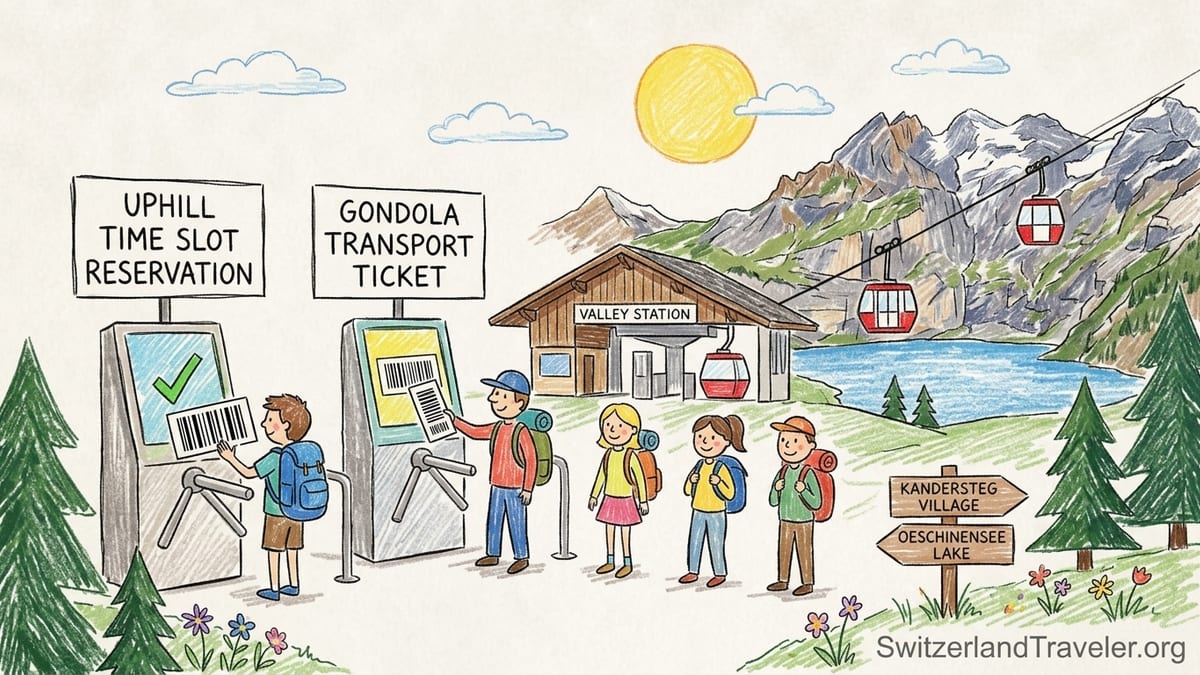
The system separates transport tickets from time slot reservations. One element is the gondola transport ticket, which can be bought through the official Oeschinensee online shop, at the valley station ticket windows or in some cases via SBB channels. This ticket is your proof of payment for the cable car ride. The second element is the uphill time slot, sometimes described as a time window, which allocates capacity on a specific day within a defined interval for the ascent. The cable car company emphasizes that a valid public transport ticket may cover the fare but does not include this required time slot.
In practice, this means that a traveler arriving from Interlaken or Bern with a train ticket plus a SBB-issued gondola ticket still needs to show a separate reservation at the time slot reader before boarding the cable car. If the reservations for the late morning are sold out, that traveler may have a fully paid ticket on their phone yet still be unable to board until a later time window. The operator’s reservation information makes it explicit that the time slot obligation runs through 8 November 2026, and that time slots can sell out, especially on peak days with good weather.
Downhill travel from Oeschinensee back to Kandersteg remains simpler. According to the official guidance, there is no time slot requirement for the downhill ride. You still need a valid ticket or pass that covers the gondola, but you can generally descend at any time within operating hours, which gives you flexibility to adjust your hiking or lunch plans at the lake without having to watch the clock too closely.
Two-Part System: Tickets, Time Slots and What Happens at the Gate
The two-part system can feel confusing until you understand what happens at the valley station. At the turnstiles, there are separate readers for the time slot reservation and the gondola transport ticket. First, you scan the QR code or barcode for your reserved uphill time window. This confirms that you are boarding within the correct period and that the system has capacity for you. Then you scan your actual transport ticket, whether that is a point-to-point gondola ticket, a discounted ticket bought with a Half Fare Card, or a pass that covers the route.
If you arrive at 10:15 with a time slot reservation for 10:00 to 10:30, you join the line for that window and will normally be allowed through, subject to any operational delays. If you arrive outside your window, staff may ask you to rebook to the next available slot, which could be later in the morning or afternoon on busy days. The terms and conditions clarify that a time slot reservation ensures transport capacity within the booked time frame but does not guarantee an immediate ride at a precise minute or a specific gondola cabin.
Crucially, if you only have a gondola ticket without a reservation during the mandatory period, you may be turned away from the uphill boarding area until you obtain a time slot, either online or at the ticket machines, and there is no guarantee that slots will still be available. For example, on a sunny Saturday in August, it is quite realistic that the 9:00 to 12:00 windows could be fully booked by the previous day. Walk-up visitors might find that the next available slot is after 13:00, forcing them to compress their hiking plans or reconsider their visit.
The operator encourages visitors to book time slots online before arrival. However, the official information notes that additional slots are also released on site via ticket machines as long as capacity remains. On peak days, they highlight that the best last-minute chances are usually for early slots before 09:00 or for afternoon slots after 13:00, when demand is less concentrated around the late-morning rush. If you are flexible, targeting those periods can make a same-day reservation more achievable.
Swiss Travel Pass, Half Fare Card and Other Rail Products
Many international visitors arrive at Oeschinensee with a Swiss Travel Pass, a Swiss Half Fare Card or a regional rail pass. It is important to separate the questions of price reduction from the issue of reservations. Official information states that holders of the Swiss Travel Pass, the Half Fare Card or a GA travelcard receive a 50 percent reduction on the gondola fare. In practical terms, a traveler with a Swiss Travel Pass can purchase a discounted gondola ticket at the valley station or online, and their pass will determine the reduced price they pay.
However, this price benefit does not exempt them from the uphill time slot requirement. A Swiss Travel Pass or Half Fare Card covers the fare element or discount but does not include a time slot. The reservation must be made separately, using the Oeschinensee reservation system. The operator explains that even tickets purchased via the SBB Mobile app do not automatically contain a time slot, so you should not assume that a digital ticket marked “valid Kandersteg–Oeschinensee” includes boarding rights at any chosen time.
Some travelers also use regional passes such as the Bernese Oberland Pass or other excursion tickets that include Oeschinensee. It is advisable to check the current conditions of your specific pass, but as of the current information the general rule still applies: if your product includes the gondola fare, it replaces the need to buy a separate ticket, yet you remain subject to the uphill reservation rule through 8 November 2026. That means you will still need to select a time window on the Oeschinensee system before riding up.
One practical example illustrates this clearly. A couple traveling from Interlaken with Swiss Travel Passes decides to visit Oeschinensee on a sunny July Sunday. Their passes give them 50 percent off the gondola fare, so they buy discounted gondola tickets online the night before. When they reach Kandersteg valley station without having booked a time slot, they discover that the mid-morning windows are fully booked. Staff direct them to a ticket machine where they find that the first available uphill slot is at 13:30. Their passes still save them money, but the lack of an advance reservation cuts their time at the lake nearly in half.
Driving, Parking Reservations and Why Early Arrival Matters
The new logistics do not stop at the gondola. Parking at Kandersteg has also become more structured, and travelers who rely on outdated descriptions risk confusion. Parking lots P1 to P3 are located near the valley station at Oeschistrasse 50 in Kandersteg and are normally available daily from 07:00 to 21:00. Parking is paid, and there is no overnight parking in these lots. Importantly, there are no spaces for campers at the valley station, and the maximum vehicle height is limited to approximately 2 meters, which rules out many campervans and rooftop box setups.
A limited number of premium parking spaces can be reserved in advance, but the rules are quite specific. According to the current arrival information, a parking reservation is only possible for a premium parking space and only in combination with at least one gondola ticket that includes an uphill time window between 08:30 and 10:00. In other words, you cannot reserve a standard parking spot by itself, and you cannot book a premium space without also holding an early-morning uphill gondola slot connected to that booking.
This creates a key asymmetry travelers need to understand. Having a gondola time slot does not guarantee parking in P1 to P3. Standard parking at the valley station remains first come, first served, regardless of your gondola reservation. On busy dates in July and August, or on long autumn weekends with clear skies, the parking areas can fill by late morning. The cable car company explicitly recommends arriving by public transport or, if driving, arriving before 10:00 to reduce the risk of circling for a space or being forced to park further away.
For drivers, a realistic scenario might look like this. You secure an 11:00 to 11:30 gondola slot online for a sunny Saturday. You leave Interlaken around 08:45, expecting to reach Kandersteg just after 10:00 by car. Heavy traffic or a stop for fuel delays you, and you reach the valley station around 10:30. P1 and P2 are already full, and P3 is nearly at capacity. You spend fifteen minutes searching for parking, then end up in a more distant lot and walk back to the station, reaching the gondola at 11:20 with little margin for error. A minor delay would have pushed you outside your reserved window. The operator’s advice to use trains whenever possible, or to arrive early if you drive, reflects these very real timing pressures.
Public Transport, Gondola Operations and Weather Closures
Public transport to Kandersteg is straightforward and is strongly encouraged by the operator. Kandersteg railway station lies on the Lötschberg line between Bern and Brig, with regular trains in both directions. From the station, it is roughly a 15 to 20 minute walk to the gondola valley station at Oeschistrasse, or a short ride on the local bus when in operation. Using the train avoids parking uncertainty and also sidesteps concerns about vehicle height limits and overnight parking restrictions.
The gondola operates daily during the main summer season, with exact timetable details published on the official site. In recent summers, first departures have typically been in the 08:30 range, with last downhill rides around late afternoon to early evening depending on the month. These hours can change slightly year to year, so for a trip in July or October 2026 you should check the current timetable shortly before you travel. The important fixed point is that, until 8 November 2026, the uphill time slot requirement applies during the summer operating period whenever the gondola is running for lake access rather than purely for winter activities.
Weather remains a significant variable. The operator reserves the right to reduce or suspend operations in the event of high winds, thunderstorms, heavy snowfall or other safety concerns. On days with unstable weather forecasts, time slots may run as usual in the morning and then be disrupted in the afternoon. In some cases, Oeschinensee will announce operational changes early in the day, but conditions in the Alps can change quickly. A traveler who has booked a mid-afternoon slot during a forecast storm window should be prepared for adjustments and should monitor the operating status before leaving their base in Interlaken, Thun or Bern.
Where weather risks are high, flexible planning can help. For example, if you see a forecast calling for thunderstorms after 14:00, it would be wise to book an uphill slot between 08:30 and 10:00, using the clearer morning conditions for the hike and the lake, and leaving time to descend before storms develop. Because the gondola does not require time slots for downhill travel, you can usually come down earlier than planned if the sky darkens, as long as the lift is operating. Always carry a waterproof layer and expect cooler temperatures at the lake and surrounding trails than in the valley floor.
From Gondola to Lake: Hiking Options, Coaster and Time Planning
From the Kandersteg–Oeschinensee gondola mountain station, the walk to the lakeshore is a core part of the experience. The most direct route to the main lakefront restaurant and boat rental area is a gently descending wide path that typically takes around 20 to 30 minutes at a relaxed pace. While this track is not technically difficult, it is not entirely flat, and it can be muddy after rain or snowmelt. Sturdy walking shoes or lightweight hiking boots with good grip are recommended over fashion sneakers or sandals.
There is a small electric shuttle vehicle that offers paid rides between the gondola station and the lakeshore for visitors with limited mobility, young children or heavy luggage. However, capacity is limited and schedules can vary, so it should be viewed as a helpful service rather than a guaranteed alternative to walking. Most reasonably fit visitors should plan to walk both ways and include this in their time budgeting for the day.
For hikers, Oeschinensee offers a range of trails, from short lakeside strolls to more strenuous routes like the Heuberg loop or the circuits to Oberbärgli and Underbärgli. A classic outing is to hike from the gondola station via Heuberg to Oberbärgli for panoramic views and then down to the lake, allowing three to four hours including photo stops and a snack. Another option is to walk from Kandersteg village all the way up to the lake, skipping the gondola. The ascent from the valley to the lake is a solid uphill hike, often taking 1.5 to 2 hours depending on fitness. If you choose this route, you avoid the need for an uphill gondola reservation, but you should still account for the time and effort required and consider taking the gondola back down to save your knees.
The summer toboggan run, often called the mountain coaster, is located near the gondola mountain station and is a popular add-on, especially for families and teenagers. It typically operates in suitable weather on summer days, but closures can occur in rain or snow for safety. Tickets for the coaster are separate from gondola fares and time slots, and you pay on site. Because it sits close to the gondola station rather than at the lake itself, many visitors either ride it soon after arrival before walking to the lake, or save it for the end of the day before their downhill gondola.
How Much Time to Allow and What to Wear
For a standard visit that includes gondola up and down, a walk to the lake, time at the shore and perhaps a short lakeside hike, most visitors should allow a minimum of four to five hours from arrival at Kandersteg station or parking to departure. This breaks down into roughly 30 minutes each way for walking between the gondola top station and the lake, 30 to 60 minutes of waiting and transit time around the gondola and time slot window, and at least two to three hours at the lake itself for photos, a simple walk, lunch or boat rental if available.
For those planning longer hikes such as the Heuberg ridge loop or an extended route to Oberbärgli and Underbärgli, a full day is more realistic. You might, for instance, book an 08:30 to 09:00 uphill slot, reach the lake around 09:30 after stopping at the first viewpoint, complete a three to four hour hike with generous pauses, and still have time for a late lakeside lunch and a downhill gondola in the mid-afternoon. In that case, you would reasonably plan from around 08:00 to 16:00 door to door if based in Interlaken, including train connections.
Clothing should reflect mountain conditions rather than city temperatures. Even on warm July afternoons, lakeside air can feel cool when clouds build or wind picks up over the water. A breathable waterproof shell, a midlayer such as a fleece or light sweater, and quick-drying hiking trousers or shorts paired with proper footwear make sense for almost every visitor. Flip-flops, ballet flats and smooth-soled street shoes are not ideal on gravel paths or wet rocks along the lakeshore and can turn a relaxed walk into a slippery experience.
If you plan to rent a rowboat, sit on rocks close to the water or explore less trodden side paths, consider bringing a small daypack with a dry bag for cameras and phones, a refillable water bottle and simple snacks. There are restaurants and kiosks at both the gondola upper station and the lakeshore, but on busy days they can be crowded. Having your own water and a small picnic gives you flexibility to enjoy quieter spots away from the main terraces.
Missed Ideal Slots, Same-Day Options and Off-Peak Strategies
Even with careful planning, it is easy to end up without the perfect gondola reservation. Perhaps you only decide to visit Oeschinensee after checking the morning sky in Interlaken, or your original travel day is washed out by rain and you switch at the last minute. The good news is that same-day and last-minute options still exist, especially if you understand when demand is highest and where the system has more flexibility.
Official reservation guidance notes that, on peak days, the best chances for free same-day uphill time slots are before 09:00 and after 13:00. Mid-morning, roughly between 09:00 and 12:00, tends to concentrate families, tour groups and travelers doing day trips from further afield. If you are willing to start earlier or pivot to an afternoon visit, you may find that slots open up even on dates that appear very crowded in the middle of the day. This pattern is especially useful for travelers staying in Kandersteg or nearby, who can check late the previous evening or first thing in the morning and adapt.
For example, imagine you wake in Interlaken on a blue-sky Saturday in August without any reservation. An online check shows that all uphill slots between 09:00 and 12:30 are booked, but there is still availability for 08:30 to 09:00 and again from 13:30 onward. If you can catch an early train and be in Kandersteg by 08:15, the early morning slot remains feasible. Alternatively, you might enjoy a late breakfast, take a mid-morning train, and aim for an afternoon visit with a 13:30 or 14:00 ascent. In that scenario, you still enjoy several hours at the lake, just with a different light and slightly fewer crowds than the midday peak.
If no suitable uphill slot exists at all for your date, hiking from Kandersteg to the lake becomes a meaningful backup plan for strong walkers. Since the reservation obligation only applies to the uphill gondola, those who choose to walk are free to follow the well-marked trail up through forest and alpine pasture, reaching the lake in about 1.5 to 2 hours. You can then either hike back down or purchase a downhill-only gondola ticket at the upper station and ride without a time slot. This option saves both the gondola fare and the reservation but requires adequate fitness, time and appropriate footwear.
The Takeaway
By 2026, Oeschinensee has shifted from a mostly spontaneous excursion to a destination where logistics matter as much as weather and views. The uphill time slot requirement through 8 November 2026, separate from gondola tickets and even from public transport passes, is at the heart of this new reality. Travelers who understand the two-step system, the parking limitations and the timing patterns will be far better positioned to enjoy the lake calmly rather than queue anxiously at the valley station.
The most resilient plan is to decide your Oeschinensee day early in your itinerary, secure an uphill time slot online tied to your likely train or driving schedule, and favor early-morning or afternoon windows on busy dates. If you drive, arrive before 10:00 and do not assume your reservation guarantees parking; if you travel by train, allow enough margin between your train arrival and gondola window to walk or bus to the valley station. Once you are at the gondola top station, give yourself time for the gentle walk to the lake, potential side hikes and perhaps a ride on the mountain coaster, all while dressed for alpine paths rather than city streets.
Because the operator has already extended and modified the reservation policy into 2026, it is wise to recheck current rules in the weeks before you travel. The fundamentals described here are based on the latest official information for the season through 8 November 2026, but alpine operations evolve in response to visitor numbers, weather patterns and experience with the time slot system. Treat your logistics as part of the adventure, and Oeschinensee will reward the effort with one of the most memorable lakeside days in the Swiss Alps.
FAQ
Q1. Do I need a gondola reservation for Oeschinensee in 2026 if I already have a Swiss Travel Pass?
The Swiss Travel Pass gives you a 50 percent reduction on the Kandersteg–Oeschinensee gondola fare, but it does not include an uphill time slot. For the 2026 summer season through 8 November 2026, you must still book a separate uphill reservation for the cable car, even if your pass covers or discounts the fare.
Q2. Does a time slot reservation guarantee that I can park at the Oeschinensee valley station?
No. A gondola time slot guarantees only transport capacity within your booked time window, not a parking space. Standard parking at P1 to P3 is first come, first served. Only a small number of premium spaces can be reserved, and even those require an early-morning uphill slot and a linked gondola ticket.
Q3. If I buy a gondola ticket through SBB or another rail app, do I still need a time slot?
Yes. Official guidance specifies that even tickets issued through SBB channels or combined with public transport are valid only as fare payment. They do not automatically include the mandatory uphill time slot, which must be booked separately in the Oeschinensee system during the reservation period.
Q4. Can I visit Oeschinensee without using the gondola at all?
Yes. You can hike from Kandersteg village up to the lake on marked trails, typically in about 1.5 to 2 hours of steady uphill walking. This option avoids the need for an uphill gondola reservation, but it requires good footwear, reasonable fitness and enough time to complete the ascent and whatever walk or rest you plan at the lake.
Q5. How much time should I plan for a standard Oeschinensee visit with the gondola?
Most visitors should allow four to five hours from arrival in Kandersteg to departure. This covers the uphill gondola ride within your time slot, the 20 to 30 minute walk each way between the gondola top station and the lake, time at the shore or in a restaurant, and some margin for queues and photos.
Q6. What kind of shoes and clothing are best for Oeschinensee?
Sturdy walking shoes or lightweight hiking boots with good grip are strongly recommended. Paths can be uneven, gravelly or muddy, and smooth-soled street shoes, sandals or flip-flops are not ideal. Bring layers, including a light waterproof jacket, as weather at the lake is cooler and more changeable than in the valley.
Q7. Is the mountain coaster included in the gondola ticket or time slot?
No. The summer toboggan run near the gondola mountain station is a separate attraction with its own ticket, purchased on site. It is not tied to your gondola reservation, though its opening hours depend on weather and season, so you should be prepared for temporary closures in rain or strong winds.
Q8. What happens if I miss my uphill time slot window?
If you arrive outside your booked window, staff may ask you to rebook to the next available slot. On quieter days this might mean only a short delay, but on busy days in July or August it could push your ascent back by hours or make it impossible if all later slots are sold out.
Q9. Are early morning or afternoon visits really better for last-minute reservations?
Yes. The operator notes that on peak days, last-minute availability is usually best before 09:00 and after 13:00. Mid-morning windows tend to sell out first. If you are flexible, targeting the earliest or later afternoon slots improves your chances of finding same-day capacity.
Q10. Do I need a reservation for the downhill gondola from Oeschinensee back to Kandersteg?
No uphill-only time slots are required for the descent. You do need a valid ticket or a pass that covers the gondola, but you can usually ride down at any time during operating hours, subject to weather or operational restrictions, without an additional reservation.