

Type “Blausee” into any social platform and your screen fills with glass-clear turquoise water, mossy rocks and rowboats floating over tree trunks that seem suspended in mid-air. It looks like the kind of Alpine lake you could spend a whole day exploring. But Blausee in Switzerland’s Bernese Oberland is also a privately run, ticketed nature park built around a very small lake. When you strip away the wide-angle lenses and heavy editing, is it actually worth visiting, or is it an Instagram trap?
First Impressions: From Viral Photos to the Entrance Gate
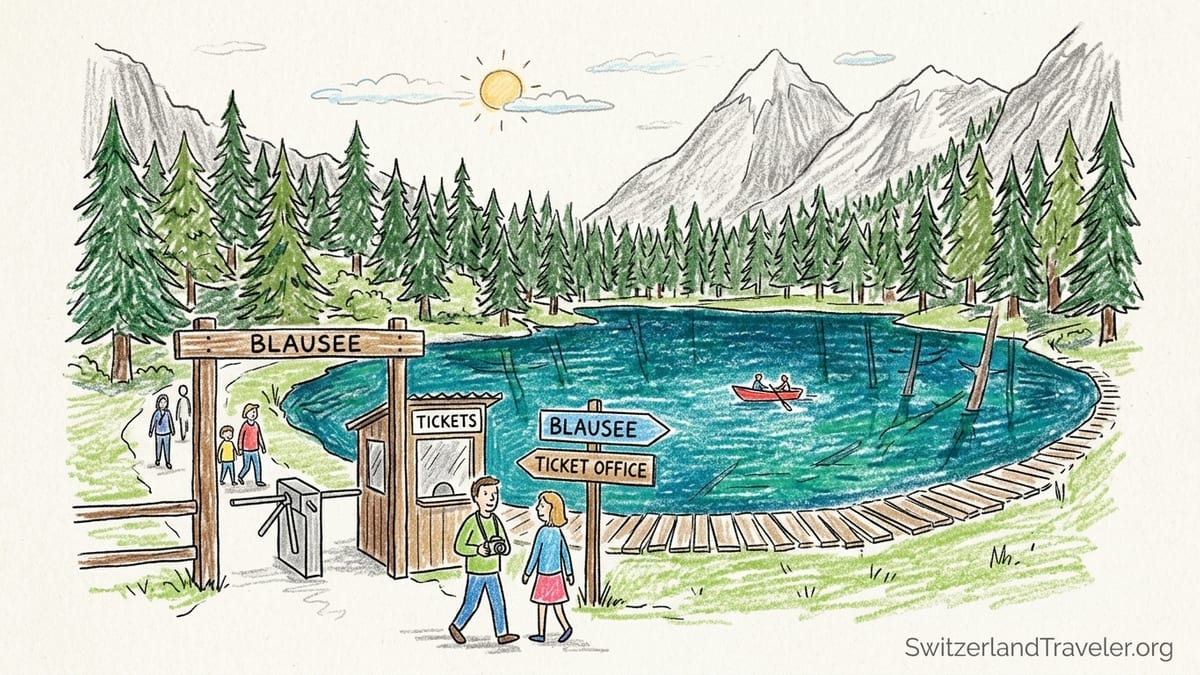
Blausee’s online presence sets the bar high. On Instagram and TikTok, the lake appears vast and intensely turquoise, often photographed tight to the waterline so you see only luminous color, a wooden rowboat and thick forest framing the scene. Arriving at the actual entrance, however, feels surprisingly modest. Blausee sits in a narrow section of the Kandertal between Frutigen and Kandersteg, just off the main road, with a signed parking lot, a hotel and the park gate all very close together. You are not hiking deep into the backcountry. You are walking into a compact, commercial nature park that happens to contain a truly beautiful pool of mineral-rich spring water.
The nature park around the lake covers about 20 hectares of forest, but the lake itself is tiny in real-world terms, roughly 0.64 hectares with a maximum depth of around 12 metres. In practice, that means you can walk slowly around it in well under 20 minutes, even if you stop often to take photos. The shock for many visitors is not that the images are “fake,” but that they carry the visual weight of a large Alpine lake while the real place feels more like a jewel-box pond in a landscaped forest. Knowing this before you arrive is crucial for judging whether the entry fee and travel time will feel worthwhile.
At the gate, you purchase a ticket for the Blausee Nature Park. As of autumn 2026, official information and recent visitor reports indicate adult entry is in the region of 10 to 12 Swiss francs depending on season, with reduced rates for children and families. Parking in the adjacent lot typically costs around 5 francs for several hours, charged at pay machines. Exact tariffs can change, so it is worth checking the current price boards when you arrive, but expect your baseline cost for two adults with a car to sit somewhere in the 25 to 30 franc range once entry and parking are combined.
The walk from the parking area and ticket booth to the water is short and simple. A paved path of about 300 metres leads into the forest and drops slightly down to lake level. The path is described by the park operator as accessible for wheelchairs and strollers, with some undulation but no long, steep slopes. You do not need hiking gear, and you will not be sweating by the time the famous blue water comes into view. For some travellers this easy access is a plus. For those hoping for a sense of remoteness and effort, the ease of arrival can contribute to a feeling that the experience ends almost as soon as it begins.
Entry Fee, Parking and Time on the Ground
One of the most common questions visitors ask after seeing heavily edited photos is whether it is really worth paying a dedicated entry fee for such a small lake. Unlike many Swiss lakes that sit on open public land, Blausee is on private property managed as a nature park, and access is controlled through turnstiles. The adult admission of roughly 10 to 12 francs includes access to the forest paths, picnic areas, small playground, trout farm and, during daytime summer operations, a short glass-bottom boat ride across the lake. Children, students and groups pay less, and hotel guests have their own arrangements, but the key point is that this is a ticketed attraction, not a free roadside stop.
Parking is an additional cost. The signed lot right by the entrance is the most convenient option and is priced on a time basis. Recent traveller accounts reference about 5 francs for four hours, which is usually more than enough for a standard visit that includes a slow circuit of the lake, photographs, the boat ride and a coffee or ice cream. There is no long walk from car to entrance; it is simply a case of feeding the machine, displaying your ticket if required and stepping across to the gate. Visitors arriving by public transport step off bus 230 at “Blausee BE” and walk only a few minutes down to the entrance.
In terms of time commitment inside the park, expectations again need calibration. It is entirely realistic for many visitors to feel they have “seen” Blausee in 60 to 90 minutes. A very relaxed visit might stretch to two or three hours if you take the boat ride, sit in the restaurant or at the lakeside kiosk, wander every path, and pause at several benches to watch the light change on the water. You would need to consciously slow yourself down to stay longer. Travellers sometimes imagine an all-day destination based on the drama of the photos; in reality, Blausee is usually one stop in a broader Bernese Oberland itinerary.
This relatively short dwell time affects how you evaluate the value of the entry fee. If you are travelling on a tight budget and comparing Blausee to many free river walks and mountain viewpoints in Switzerland, paying 10-plus francs to access such a small, quickly experienced lake may feel steep. If, on the other hand, you already expect Swiss prices, view the fee as supporting a carefully maintained pocket of nature and appreciate the included amenities, you may find the cost reasonable for a compact but memorable stop.
The Walk, the Lake Size and How Crowded It Feels
Once inside, most people instinctively follow the obvious loop along the lakeshore. The main circuit path is well maintained and mostly flat, weaving through tall trees, over small bridges and past viewpoints that are clearly designed for photography. Benches and low fences guide you toward specific angles: the classic view toward the small island with its statue, the side-on perspective where the submerged tree trunks are most visible, and the jetty where the glass-bottom boat loads and unloads.
Because the lake is so compact, you are almost never more than a few steps from other visitors. Even on a relatively quiet weekday morning outside peak season, you may find yourself waiting politely for a prime rock or railing spot to clear before you step in for your own photos. On sunny weekend afternoons in July and August, the paths can feel surprisingly busy for what looks online like a serene forest pool. Groups gather around the water’s edge, children run between viewpoints, and the queue for the boat ride can spill back along the shore. The size of the lake means that every additional tour group or family is visually and audibly present; there is no “other bay” you can simply walk around to if one area feels crowded.
This crowding effect ties directly into how visitors perceive value. Someone who arrives at 9:00 in the morning on a clear weekday, pays the same admission and finds the paths quiet, may walk away glowing about the atmosphere. Another traveller who arrives at 14:00 on a Saturday in school holidays and spends half an hour waiting for a turn on the glass-bottom boat, pressed shoulder to shoulder on narrow paths, may conclude that the experience felt more like lining up for a ride in a small theme park than visiting a lake. Because the attraction is small, crowd levels change the mood far more dramatically than at large lakes where people can disperse.
If you want Blausee to match the contemplative mood of the famous photographs, timing your visit is one of the most powerful tools you have. Early morning and late afternoon generally see fewer bus tours. In winter, when days are short and the site still charges entry, crowd levels can drop significantly, though the light and the lake colour behave differently than in high summer.
The Water Colour: When Blausee Really Looks Turquoise
The heart of Blausee’s appeal is its water. Fed by underground springs loaded with minerals, the lake has a clarity and pale blue-green hue that comes from both the chemistry and the light-scattering effect of very fine suspended particles. Under the right conditions it really does look as intense as the most striking images online. Under different conditions it can appear flatter, greener or surprisingly muted, which can leave visitors wondering whether the photos they saw were deceptive.
Three main factors influence how “blue” Blausee appears: light, weather and viewpoint. On a clear day when the sun is high enough to penetrate the canyon-like valley, light reaches deep into the water column and bounces back off the pale rocks and submerged tree trunks, enhancing the turquoise tone. Around late morning to early afternoon in summer, when the sun has cleared the surrounding slopes but is not yet dropping behind them again, the colour tends to be at its most vibrant. On overcast days the lake still looks clear and unusual, but the tones shift toward a subtler, glassy blue-green rather than the electric turquoise you see on postcards.
Season also plays a role. In winter, with snow on the banks and bare trees, the contrast between white snow, dark trunks and blue water can be very striking in photographs, even if the sun is lower and the water appears a little darker. In transitional seasons with mixed weather, heavy rain in the surrounding forest may introduce organic material that temporarily softens the clarity until the springs flush it through. Because Blausee is spring-fed rather than a large inflow-outflow lake, its basic clarity remains high year-round, but some travellers who saw viral images shot in ideal midsummer conditions in bright sun can feel slightly underwhelmed when visiting in flat November light.
Viewpoint matters as well. Standing at water level and shooting across the surface often produces more saturated colour than looking down from directly above, where reflections from the sky and trees can dominate. The famous shots that appear to show boats floating in air are typically taken from slightly above waterline with a polarising filter to cut surface glare, then edited to lift saturation and contrast. Without a filter, on a busy day with many people and boats, your camera will also pick up reflections, ripples and shadows that make the water appear darker. Understanding that many iconic images represent the lake at its absolute photogenic peak helps align expectations with what any random one-hour window can offer.
Boat Ride, Trout Farm and Forest Walks: Do They Add Depth?
Included in standard daytime admission during the main season is a short ride on a staff-operated glass-bottom boat. The boat follows a simple loop across the lake, typically lasting under 15 minutes. You sit on benches while an attendant slowly rows or uses a small motor to glide past the central island and over the deepest sections where the submerged tree trunks lie. The glass panels in the hull let you look directly down into the clear water, which can feel surprisingly vertiginous as the trunks drop away several metres below.
The ride is certainly scenic, and for many first-time visitors it provides their favourite view: looking back toward the shore, seeing people standing among tall trees while your boat seems to float on air. However, you should not expect a long narrated tour or a sense of exploration. The circuit is short, the route fixed, and on busy days the boat can feel full. Some photographers also find that the glass bottom is less compelling in practice than the simple views from the shore, because any smudges, bubbles or reflected light reduce clarity in photos. If you already feel you have “your shot” from land, the boat ride is a pleasant extra rather than a game-changer.
Adjacent to the lake you find Blausee’s organic trout farm, where cold spring water is channeled through a series of pools. Visitors can peer into the tanks to see trout schooling and occasionally watch feeding. The facility supplies fish to the on-site restaurant, which features Blausee trout on its menu, along with typical Swiss dishes and seasonal specials. For some travellers, connecting the clear lake water with the trout on the plate adds a sense of place. For others, especially those not particularly interested in aquaculture or not planning to dine on-site, the farm is more of a brief curiosity than a primary attraction.
The wider forest park offers short walking paths, small clearings, picnic tables and fire pits where visitors can grill their own food. There are interpretive boards in German and other languages explaining the geology of the rockfall that created the basin and the folklore of the “Blausee maiden.” These features are thoughtfully presented but scaled to the limited size of the park. You might walk every path in under an hour, including detours to little bridges and viewpoints. Whether this feels like a rich half-day in nature or an overdeveloped frame around a single pretty pool depends heavily on your personal tastes and how many alpine landscapes you have already seen on your trip.
Restaurants, Picnics and How Long You Actually Stay
The presence of a hotel and full-service restaurant right on the shore shapes the way many visitors use Blausee. The main restaurant has indoor and terrace seating with views toward the lake, and there is also a lakeside bistro or kiosk that sells simpler options like sausages, soups, pastries and drinks. Prices are in line with Swiss resort expectations; a trout dish, a glass of wine and a coffee can quickly take a couple to 70 francs or more. For some travellers, lingering over lunch with a view is precisely the added depth that makes the entry fee feel justified. For others, the restaurant reads more as a convenience, especially if they prefer to spend their dining budget elsewhere.
Picnic areas change the equation. Inside the park you will find tables and designated grill spots in small clearings. Many Swiss families bring their own supplies, make a modest barbecue and let children play near the water or in the small playground. Because the park is fenced and traffic-free once inside, parents often feel comfortable letting older kids roam the short paths while they relax. If you adopt this slower mode, Blausee can easily absorb two to three hours as a sheltered, semi-structured outdoor space rather than purely as a photo stop.
For international visitors with packed itineraries, though, the reality is that Blausee competes with countless other sights. After completing the shoreline loop, the boat ride and a snack, many find themselves looking at their watch and realising they are ready to move on. They may feel conflicted: the place is undeniably beautiful, but they have extracted the essence of the experience much faster than they expected based on social media. That discrepancy between imagined all-day destination and real-world one- to two-hour stop often underpins post-visit comments that the admission felt high relative to time spent.
When planning, it can help to be explicit: if you intend to treat Blausee as a full half-day, build that around a sit-down meal, a leisurely picnic, a quiet reading break on a bench or exploratory time for children. If you know you prefer to keep moving, accept that this will be a short but intense visual stop, and weigh whether the entry fee makes sense for that style of visit.
Managing Expectations: Who Will Love Blausee and Who May Not
Blausee shines brightest for travellers who enjoy intimate, composed landscapes and are comfortable treating the entry fee as payment for a carefully curated nature vignette. Photographers who relish details like submerged tree trunks, reflections in still water and the interplay of light through forest canopy will find several rewarding compositions packed into a small area. Couples or solo travellers staying at the on-site hotel, with 24-hour access to the park, often report especially positive experiences, because they can enjoy the lake before day visitors arrive or after the gates close in the evening, when the atmosphere is quiet and the lights around the water give it a different character.
Families with younger children also tend to rate Blausee highly. The manageable scale means kids can walk around the lake without fatigue, and features such as the boat ride, trout farm, small playground and short forest bridges break up the visit with varied stimuli. Parents appreciate having toilets, food, flat paths and clear boundaries, which make for an easier outing than a longer mountain hike. For a Swiss family arriving by car from Bern or Thun, paying entrance and parking for a several-hour picnic and play session can feel like a reasonable use of a weekend day.
On the other hand, some visitors are disappointed. Independent hikers used to wide-open, free-access landscapes can resent paying to enter such a small enclave, especially if they visit in very busy periods. Backpackers on tight budgets may prefer to allocate funds to cable cars or longer excursions instead of a short lake stroll. Travellers who primarily want sweeping Alpine panoramas may also find that, beautiful as it is, Blausee does not deliver the sense of scale they expected from its online portrayal. For them, the contrast between spectacular social media photos and the compact reality can feel like a bait-and-switch, even though the images are technically of the real place.
The key is to align your reasons for going with what Blausee actually offers: a meticulously framed, highly photogenic micro-landscape with soft infrastructure, not a vast wilderness lake. If that sounds like the kind of experience you value, the admission will likely feel fair. If your ideal day involves long, free hikes and big horizons, you might see the same fee as poor value for money.
The Takeaway
So, is Blausee worth it? The answer depends less on the lake itself and more on the role you expect it to play in your trip. Visually, the place delivers. Under clear light the water truly glows, the submerged trunks are as eerie as the photos suggest, and the tight framing of forest and rock creates a cinematic quality that feels almost unreal. The paths are easy, the facilities are well kept, and the included glass-bottom boat ride during the main season is a fun, if brief, way to see the lake from another angle.
Yet the online imagery omits two truths that matter. First, Blausee is small enough that many visitors feel they have experienced it fully in 60 to 90 minutes. Second, the combination of paid entry and limited shoreline concentrates people in a way that can quickly erode the sense of tranquility on busy days. If you arrive expecting a free, sprawling Alpine lake where you can wander for hours, you are likely to walk away questioning the value. If you arrive expecting a compact, curated nature park wrapped around a jewel of a spring-fed pool, your experience is more likely to match reality.
For travellers who love photography, compact destinations and amenities such as restaurants and picnic areas, Blausee can be a highly satisfying stop. Plan for around two hours on-site if you want time for the shoreline loop, boat ride and a relaxed drink or snack. Aim for a clear day and arrive early or late to see the water at its most vibrant with fewer people in frame. For budget-conscious hikers focused on big landscapes and long days outdoors, Blausee may feel like a pricey detour, better admired in passing images than visited in person.
Personally, I would return under specific conditions: on a bright weekday outside peak summer, with time to sit quietly and watch the light play through the water, and ideally with friends who understand exactly what Blausee is and what it is not. Treated as a small, polished cameo in a broader Swiss itinerary rather than a headline act, this famous blue lake can still justify its place on your map.
FAQ
Q1. How much is the Blausee entry fee?
As of late 2026, adult day admission is reported in the range of 10 to 12 Swiss francs depending on season, with discounts for children and families. Exact prices can change, so always check the current tariff at the entrance or on official information boards when you arrive.
Q2. Is the boat ride at Blausee included in the ticket?
During daytime opening hours in the main summer season, a short glass-bottom boat ride across the lake is generally included in the standard entry ticket. Outside that period or in poor weather, operations may be limited, so ask at the gate on the day of your visit.
Q3. How long does a typical visit to Blausee take?
Most visitors spend 60 to 90 minutes in the park, enough time to walk the loop around the lake, take photos and join the boat ride. If you add a restaurant meal or picnic and let children play in the forest, you can easily extend your stay to two or three hours.
Q4. How far is the walk from the parking lot to the lake?
The paved path from the main entrance to the lakeshore is about 300 metres. It undulates slightly but is short, generally wheelchair-accessible and suitable for strollers, so you reach the water in just a few minutes at a relaxed pace.
Q5. When is the water colour at its most impressive?
The lake’s turquoise tone looks strongest on clear days when the sun is high enough to reach into the basin, typically from late morning to early afternoon in summer. In overcast or low-light conditions the water still appears clear but takes on softer blue-green shades.
Q6. How crowded does Blausee get?
On sunny weekends and during school holidays the small paths and viewpoints can feel quite busy, with short queues for the boat and popular photo spots. Early mornings, weekdays and off-season visits are noticeably quieter and closer to the tranquil atmosphere shown in many photos.
Q7. Can you swim in Blausee?
No, swimming is not allowed in Blausee. The lake is protected both for environmental reasons and because its clear spring water is used for the trout farm, so visitors enjoy the water visually from the shore, bridges and boat only.
Q8. Is Blausee suitable for young children and strollers?
Yes. The compact size, short paths, playground, boat ride and picnic spots make Blausee popular with families. The main route from the entrance to the lake and around much of the shore is stroller-friendly, and there are toilets and food options on-site.
Q9. Are there places to eat at Blausee or should I bring my own food?
There is an on-site restaurant with lake views and a simpler bistro or kiosk offering snacks and drinks, both priced in line with Swiss resort norms. You can also bring your own food and use the designated picnic tables and grill areas within the park.
Q10. Is Blausee worth visiting if I am on a tight budget?
If you are very budget-conscious and prefer long, free hikes and large mountain lakes, you may feel the entry fee is high for a relatively short, small-scale visit. If you value unique photo opportunities, easy access and amenities, the cost can be justified as a focused, visually memorable stop within a wider Swiss itinerary.