


Interlaken is one of those names that pops up on almost every first-time Switzerland itinerary. Wedged between Lake Thun and Lake Brienz, promoted by Switzerland Tourism as an ideal starting point for Bernese Oberland outdoor activities, and marketed heavily as the country’s adventure capital, it sounds like the obvious place to stay. After several trips to the region, though, I have learned that “ideal starting point” does not automatically mean “best place to sleep every night.” Interlaken is absolutely worth visiting, but I would not spend my entire Bernese Oberland trip there.
What Interlaken Really Does Exceptionally Well
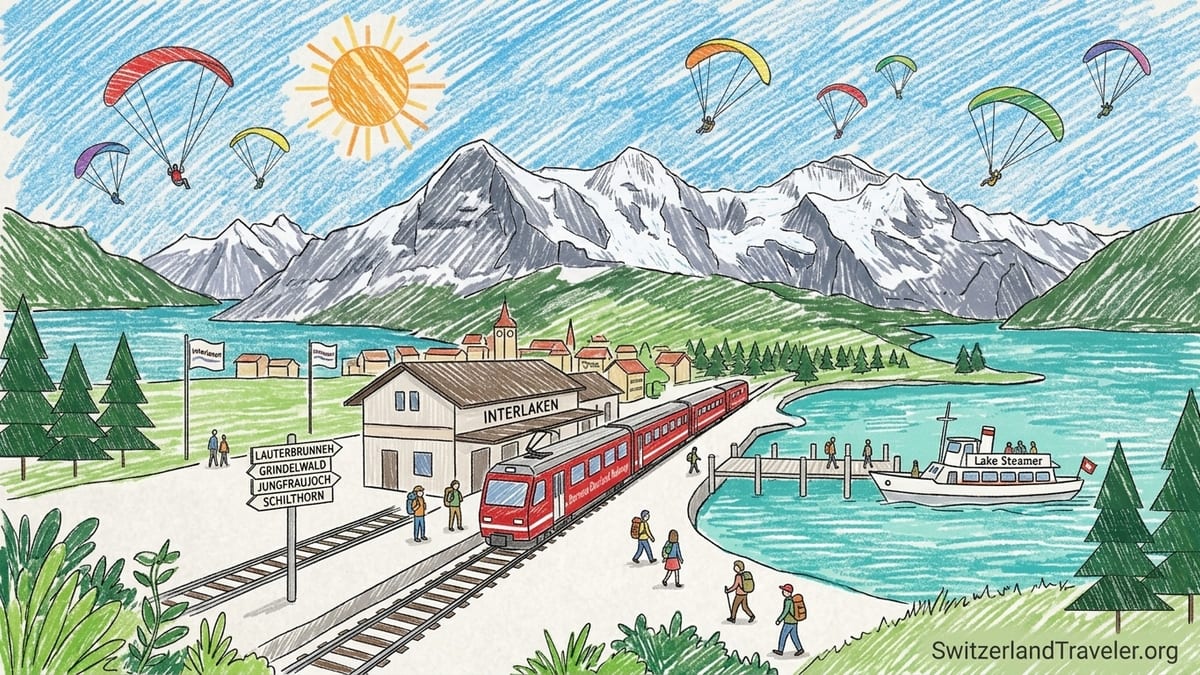
Interlaken’s biggest strength is simple: logistics. Interlaken Ost and Interlaken West stations sit on the main Bernese Oberland Railway line that fans out toward Lauterbrunnen and Grindelwald, and also connects easily to Thun, Spiez and Bern. Trains between Interlaken Ost and Lauterbrunnen or Grindelwald usually take roughly 35 minutes, with departures typically twice per hour in the main season. That means day trips to the Jungfraujoch, Schilthorn, Mürren, Wengen, Grindelwald First and Kleine Scheidegg are all very realistic from a single base.
Official regional marketing calls Interlaken “an ideal starting point for your outdoor activities” in the Bernese Oberland, and that wording is accurate. The town sits between two large lakes and below a ring of accessible mountains, with boats, funiculars and cable cars radiating out in multiple directions. From one hotel you can walk to trains bound for high Alpine terrain one morning, then step aboard a lake steamer that afternoon without changing bases or hauling luggage.
Interlaken also shines when it comes to sheer choice. The local tourist board promotes a wide menu of excursions from Interlaken Ost: classic mountain railways, easy lakeside walks, scenic cruises, and rainy-day options in nearby cities. On a recent July visit, I watched backpackers in the same hostel lobby choose between morning paragliding, an afternoon cruise on Lake Brienz, or a late start to Schynige Platte. Very few towns in the Alps give you that kind of same-day flexibility without long transfers.
This density of options matters if your party has mixed interests or abilities. A family might send one person to skydive over the lakes while others choose a gentle stroll in Zweisimmen or a short train ride to the UNESCO‑listed old town of Bern. The entire system is built to funnel people through Interlaken, and for certain travelers that is precisely what makes the town valuable.
Adventure Capital Between Two Lakes
Interlaken’s second big selling point is its adventure-sports scene. The town has become known as an “adventurer’s playground,” with operators offering tandem paragliding, skydiving, canyoning, rafting, bungee jumping and lake kayaking. On a clear afternoon you can stand on the Höheweg park and see dozens of paragliders spiraling overhead, landing in the meadow in front of the grand hotels while onlookers lounge on benches or eat ice cream.
Many of these activities start and finish in or near Interlaken. Paragliding companies usually meet customers close to Interlaken West or Ost, drive them to launch sites above town, then land them back on the meadow. Canyoning and rafting outfits often run shuttles from central pick-up points to the Lütschine or Saxeten valleys. Interlaken’s role as a hub means you can often book at the last minute, which is helpful when the weather only stabilizes the night before.
Then there is the lake setting. Interlaken itself sits on the Aare River between Lake Thun and Lake Brienz, with boat piers a short walk or bus ride from the center. In summer you can take a morning cruise from Interlaken West across Lake Thun toward Spiez and Thun, or from Interlaken Ost across the milky turquoise water of Lake Brienz toward Iseltwald or Brienz. Even if you never leave town, an evening stroll along the river with views up to the Hardergrat ridge hints at the wild scenery all around.
For travelers who want that combination of highly organized adventure sports and easy water access, Interlaken is almost unbeatable in the Bernese Oberland. It feels made for people who want to be busy every day without worrying much about logistics, and who are happy to trade a bit of authenticity for convenience and adrenaline.
Where Interlaken Felt Less Special Than the Mountain Villages
As a base, Interlaken works beautifully. As a destination in its own right, my feelings are more mixed. Walking along the Höheweg in July, the town center felt dominated by tour buses lining up in front of big hotels, large groups following guides with flags, and rows of watch shops and souvenir stores. Compared with places like Mürren or Wengen, where cows graze above car-free streets and mountains tower almost straight out of the village, Interlaken’s main promenades felt more generic and commercial.
This is not to say Interlaken has no charm at all. There are pleasant corners, especially if you duck into side streets near Unterseen, where traditional chalets and quieter restaurants give a hint of local life. But the central strip between Interlaken West and the Höhematte is clearly shaped around short-stay tourism, with menus in multiple languages and storefronts geared to impulse purchases before or after coach excursions. If you arrive expecting a quintessential Alpine village, the first impression can be jarring.
By contrast, in car-free Mürren I woke to cowbells and saw the sun hit the Eiger, Mönch and Jungfrau from my balcony. In Wengen, I walked ten minutes from the station and was already on a forest path with almost no one around, despite peak season in the valley below. In Grindelwald, even though it is busy, the steep slopes above town and the massive north face of the Eiger create a sense of immersion in the mountains that Interlaken simply does not match on its flat river plain.
Interlaken gives you views toward the high peaks on a clear day, and the Harder Kulm viewpoint above town offers a genuine “wow” panorama. But you are looking at the mountains across a distance rather than living among them. For travelers seeking strong high-Alpine atmosphere and village character, that separation is exactly what makes some nights in the higher villages so memorable.
Costs in Interlaken Versus the Villages
Switzerland is never a budget destination, and Interlaken is no exception. Recent price surveys that track real bookings across dozens of properties suggest that midrange hotel rooms in Interlaken often cluster in the range of roughly 260 to 330 US dollars per night for a double room in high season, with many popular choices trending higher during busy summer and autumn weekends. Simple but well-located three-star hotels can sometimes be found for something closer to 220 to 250 dollars if you book well ahead or target shoulder-season dates, while upscale lake-view properties and historic grand hotels can easily exceed 500 dollars per night in July and August.
In the mountain villages, prices are not dramatically lower but feel a bit more balanced with the experience. In Grindelwald or Wengen, comfortable three-star hotels and guesthouses often fall in the broad band between roughly 230 and 300 dollars per night in summer, with small family-run places occasionally undercutting Interlaken by a noticeable margin outside peak weekends. Many of these come with sweeping mountain views as standard, which changes how that nightly rate feels when you step onto your balcony at sunrise.
Daily food costs also add up quickly. In central Interlaken, a casual sit-down dinner of a main course like rösti, a drink and perhaps a shared dessert will commonly land in the range of 35 to 50 Swiss francs per person in 2026, similar to other touristy Swiss towns. A quick takeaway kebab or simple Asian noodle dish might come closer to 15 to 20 francs, while a coffee and pastry at a café might sit around 6 to 10 francs. Prices in the high villages tend to be comparable or slightly higher, largely because everything must be transported up the mountain, though simple mountain huts often offer hearty one-plate meals that feel like better value for hikers and skiers.
The gap is not that Interlaken is uniquely expensive by Swiss standards, but that the prices you pay there buy less distinctive surroundings than they do in the villages higher up. When I compared what I spent on a night in Interlaken versus a night in Mürren in late summer, the difference was small, yet the emotional return on investment from waking up above a cliff-ringed valley rather than a busy tour bus strip was significant.
The Hidden Cost: Time Spent Commuting From Interlaken
The other cost of basing entirely in Interlaken is time, particularly if your real interest lies in the Jungfrau region. On paper, a 35-minute train from Interlaken Ost to Lauterbrunnen or Grindelwald does not sound like much. In practice, you often end up adding walks to and from the station, short waits for connections and occasional crowds that slow boarding. It is very easy to spend around one hour each way, from hotel door in Interlaken to trailhead or cable-car station in a mountain village.
For example, on a day trip from Interlaken to Mürren, I walked about 10 minutes to Interlaken Ost, waited 10 minutes for the next Bernese Oberland Railway train, rode about 35 minutes to Lauterbrunnen, then changed to the Grütschalp cable car and the short mountain railway to Mürren. Even moving efficiently, the whole journey took close to 1 hour 15 minutes door to door. At the end of a long hike, that same sequence in reverse felt noticeably longer, especially standing in late-afternoon queues.
That commuting time matters on a three or four night stay, because it quietly subtracts from your actual hours in the mountains. If you base in Lauterbrunnen or Grindelwald instead, you step out of your accommodation and are almost immediately on a trail, a gondola or a rack railway. In Wengen or Mürren the effect is even stronger. Your mornings start in the landscape you came to see, not in transit between hotels and mountain transport.
Interlaken’s train frequency softens the inconvenience, and for certain itineraries it really does make sense as a hub. But if you plan to spend four or five consecutive days hiking, riding gondolas and wandering through high pastures, it can be frustrating to watch the same scenery roll past your train window twice every day simply because you chose the lower, flatter base.
Who Benefits Most From Staying in Interlaken
With all of that in mind, Interlaken is still an excellent choice for some travelers. If you are visiting Switzerland for the first time, have limited days and want maximum flexibility, Interlaken simplifies almost everything. You can reach Bern in roughly an hour, ride boats on both lakes, book adventure activities without renting a car, and access both sides of the Jungfrau region without changing hotels. For people nervous about logistics, that peace of mind is worth a lot.
Interlaken is also a smart base for groups with very different priorities. On a multigenerational family trip, perhaps one couple wants to take on technical hikes around Grindelwald while grandparents prefer a gentle lakeside promenade and time in a café. From Interlaken, splitting up for the day is straightforward. Everyone still sleeps in the same hotel and can swap stories over dinner without puzzling over timetables or luggage transfers.
Travelers focused on adventure sports should also consider Interlaken strongly. The density of operators means you can compare offers for canyoning or rafting in person, adjust plans around the weather, and fill gaps in your schedule with spontaneous bookings. Late-spring and late-summer shoulder seasons are particularly appealing here, because prices often ease a bit while many activities still run and the hiking trails higher up are open.
I would also recommend Interlaken to those who value evening variety. Compared with the small mountain villages, Interlaken has more bars, a casino, larger supermarkets and a broader range of cuisines, from Swiss to Korean barbecue and Indian curries. If you want to finish each day with a different style of meal or need nightlife beyond a hotel bar, you will find more choice along Interlaken’s main streets than in Mürren after dark.
Who Should Base Themselves Deeper in the Mountains
On the other hand, if your mental picture of the Bernese Oberland involves waking up to silence, cowbells and a wall of rock outside your window, then a mountain village is likely to fit better. Lauterbrunnen, Wengen, Mürren and Grindelwald sit much closer to the valley walls and ridges that make this region world-famous. Simply stepping outside to buy bread in the morning feels like an experience. That mundane magic is harder to find in Interlaken’s flatter, busier streets.
Hikers and landscape photographers in particular benefit from sleeping higher up. Sunrises and sunsets transform the cliffs and glaciers above Lauterbrunnen and the peaks around Grindelwald, yet these moments are easy to miss if you are sitting on a train to or from Interlaken. By basing in the villages, you can wander out for a blue-hour walk or a last look at the snowfields after dinner, then be back in your room in minutes.
Couples looking for a romantic or slow-travel experience often report that Interlaken feels more like a staging area than a place to linger. In villages like Wengen or Mürren, evenings slow down naturally. There are fewer neon signs and souvenir shops, and more balconies, quiet hotel lounges and short dusk strolls to viewpoints. If your priority is atmosphere and a sense of place rather than diversions and restaurants, the extra effort of reaching these higher bases pays off every hour you are there.
Finally, if you already know that almost every day in your plan involves the Jungfrau lifts, the Eiger Express or the Schilthorn cable cars, it is simply practical to wake up closer to them. You still have the option of a day trip down to Interlaken for a boat ride or a change of scenery, but the bulk of your transport time is spent going vertically into the landscape rather than back and forth along the valley floor.
How I Now Divide My Own Time in the Bernese Oberland
After experimenting with different bases over multiple trips, I have settled on a split approach that tries to capture the best of both worlds. On a week-long stay in the Bernese Oberland, I now like to spend two or three nights in or near Interlaken at the start or end of the trip, and the remaining four or five nights in one of the higher villages such as Mürren, Wengen or Grindelwald.
Those Interlaken nights work well when I am arriving from or departing to other parts of Switzerland. They give me time to ride at least one of the lake boats, fit in a half-day of paragliding or a walk along the Aare, and take advantage of the easier rail connections for long-distance travel days. Because I am not trying to squeeze all my mountain hikes into those specific days, I do not feel the same frustration about commuting times.
Once I move up to a village, I then shift into a different rhythm: early starts on the trails, quiet afternoons on hotel balconies, and evenings watching the light change on the peaks. On one recent trip I spent three nights in Lauterbrunnen, three in Mürren and two at the end in Interlaken. The contrast was helpful. By the time I descended from the high paths, I appreciated Interlaken’s bigger supermarkets and restaurant choice, but I was also glad that most of my hiking days had not started and ended on packed commuter-style trains.
If your total Bernese Oberland time is shorter, perhaps four or five nights, I would still hesitate to spend all of it in Interlaken. One night on either end and the middle spent higher up can make the region feel more like a place you experienced deeply rather than a series of outings from a busy transit hub.
The Takeaway
So, is Interlaken worth visiting? Absolutely. It is a powerful transport hub, a genuine global center for adventure sports, and a scenic town between two beautiful lakes. Switzerland Tourism is right to describe it as an ideal starting point for outdoor activities in the Bernese Oberland. If you want options, flexibility and easy connections, few places in the Alps will serve you as efficiently.
At the same time, Interlaken is not the single best destination within the Bernese Oberland for every traveler. Its central streets can feel heavily oriented toward mass tourism, hotel and meal prices are high for surroundings that are less atmospheric than the car-free villages higher up, and staying there exclusively often means quietly sacrificing several hours of precious mountain time to daily commuting.
My own recommendation is to treat Interlaken as an excellent base and gateway rather than the star of the show. Spend a night or two there at the start or end of your trip to enjoy the lakes, sort out passes and sample an adventure activity or two, then move your base into the mountains if views, hiking and village atmosphere are what brought you to the Bernese Oberland in the first place.
If I had one week in the region, I would personally allocate two or at most three nights in or around Interlaken and four to five nights in a village like Lauterbrunnen, Wengen, Mürren or Grindelwald. With four or five total nights, I would probably spend just one in Interlaken and the rest higher up. Used this way, Interlaken becomes what it is best at: a remarkably efficient springboard into one of the most beautiful mountain landscapes in Europe, rather than the place you remember mainly for its souvenir-lined streets.
FAQ
Q1. Is Interlaken actually a good base for exploring the Bernese Oberland?
Yes. Interlaken is extremely well connected by train and boat, with frequent services toward Lauterbrunnen, Grindelwald, Thun, Spiez and Bern. It works especially well if you want to combine lake cruises, city day trips and mountain excursions without changing hotels.
Q2. How many nights should I spend in Interlaken versus the mountain villages?
For a week in the Bernese Oberland, a balanced split is two or three nights in or near Interlaken and four or five nights in a higher village such as Lauterbrunnen, Wengen, Mürren or Grindelwald. With only four or five nights total, I would limit Interlaken to one night and sleep the rest in the mountains.
Q3. Are hotels in Interlaken more expensive than in Grindelwald or Wengen?
Prices vary by date and category, but midrange hotels in Interlaken often cost a similar amount to those in Grindelwald or Wengen during high season. The main difference is value for atmosphere. For roughly the same nightly rate, rooms in the mountain villages usually offer more immersive views and a stronger sense of place.
Q4. How long does it take to reach Lauterbrunnen or Grindelwald from Interlaken?
The train ride from Interlaken Ost to Lauterbrunnen or Grindelwald typically takes about 35 minutes. Once you add walking to and from stations and making connections to cable cars or mountain trains, plan on roughly an hour each way between your Interlaken hotel and a village trailhead.
Q5. Is Interlaken a good choice for hikers?
Interlaken is fine for hikers who also want lake activities or city day trips, but serious hiking-focused travelers are usually happier basing in Lauterbrunnen, Wengen, Mürren or Grindelwald. From those villages you start and end each day much closer to the trails, which means more time in the landscape and less on trains.
Q6. What kind of food and nightlife can I expect in Interlaken?
Interlaken has a broad mix of restaurants, from Swiss and Italian to Asian and Middle Eastern, plus bars and a casino. Dinner at a casual sit-down spot often falls somewhere around 35 to 50 Swiss francs per person. Nightlife in the high villages is quieter, so Interlaken is preferable if you want more evening variety.
Q7. Is Interlaken suitable for families with children?
Yes. Families appreciate Interlaken’s easy transport, wide choice of activities and flatter terrain. It is simple to organize boat trips, gentle walks, playground visits and beginner-friendly mountain excursions from a single base, and supermarkets in town make self-catering easier than in smaller villages.
Q8. Will Interlaken feel too crowded or commercial?
In peak summer and during popular holiday periods, the central streets and main park can feel busy and strongly oriented toward short-stay tourism. If you are sensitive to crowds and souvenir-heavy shopping streets, you may prefer to limit your time there and spend more nights in quieter mountain villages.
Q9. Is Interlaken a good base in winter, or should I stay in a ski village instead?
Interlaken can work in winter if you want to sample several ski areas and still have non-ski activities such as lake walks or day trips to cities. Dedicated skiers, however, often prefer staying directly in Grindelwald, Wengen or Mürren to maximize time on the slopes and enjoy ski-in, ski-out convenience where available.
Q10. If I only have two nights in the Bernese Oberland, should I stay in Interlaken?
With just two nights, it usually makes more sense to base directly in the area you most want to see, such as Lauterbrunnen or Grindelwald, and visit Interlaken as a half-day stop if time allows. That way your limited time is spent inside the mountains rather than commuting from the main hub.