


I have visited German-speaking Switzerland in sticky August heat, in crisp October light, and on short, blue-shadowed January days. Each trip rewired how I think about “the best time to go.” The mountains were not a postcard backdrop but a moving system of snow lines, closed hiking paths, half-empty trains, and price swings you will feel in your budget. This guide combines what I experienced on the ground in the Jungfrau region, around Lake Lucerne and in Engelberg with live-checked 2026 operations and prices, and it clearly flags where I am switching from personal experience to researched guidance.
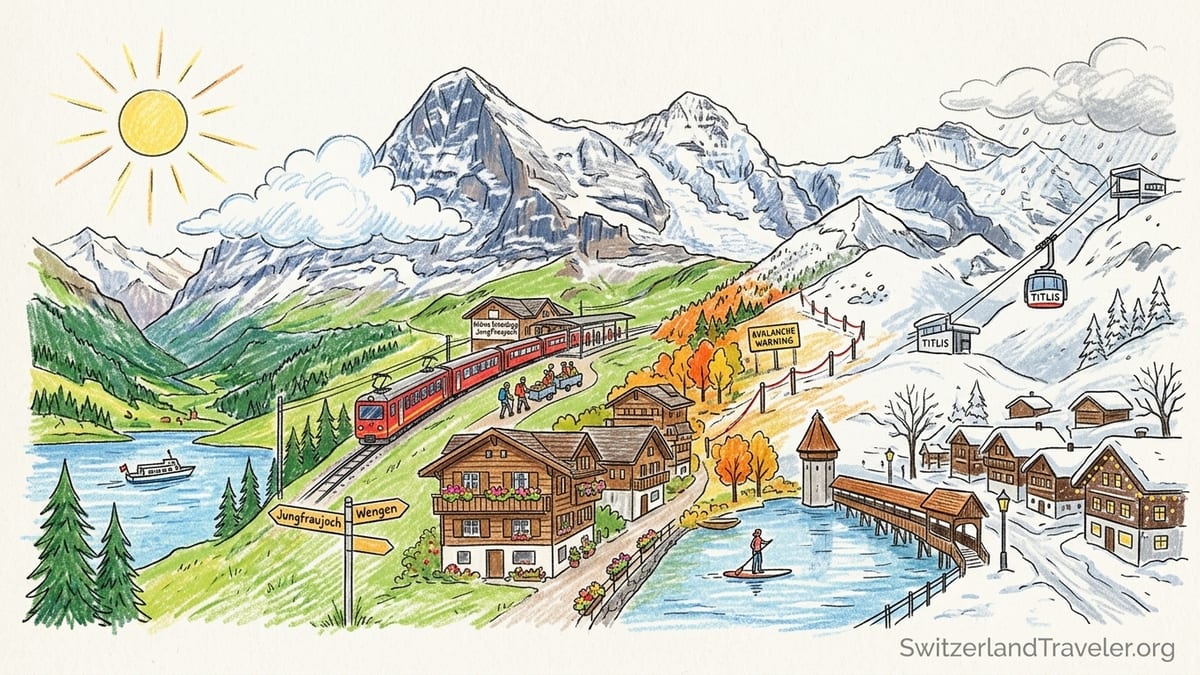
How Seasons Really Feel in German-Speaking Switzerland
On my first summer trip to the Jungfrau region I arrived in Interlaken to find the Hardergrat ridge perfectly visible but the Jungfrau itself smeared in milky cloud by midday. Down in town it was warm enough for short sleeves, around the mid-20s Celsius in the afternoon, but the snow line sat high above Kleine Scheidegg. By contrast, an October visit a few years later brought air so clear that from Männlichen I could trace every glacier crease on the Eiger, yet the first snow patches were already starting to dust shaded north-facing slopes and some higher hiking paths were roped off with avalanche warning signs. A winter stay in Engelberg was different again: limited daylight, hard-packed snow in the village, and mountains that sometimes vanished entirely behind a snowstorm wall until the clouds tore open for an hour of sun.
Across these trips I learned that in German-speaking Switzerland, the question is not “summer, autumn or winter?” but “what do you want to see and pay for?” Summer brought long hiking days but dense crowds and the highest accommodation prices, especially in August. Autumn rewarded me with cheaper hotel rates and quieter trains but also the risk of lift revisions and early snow shutting off certain passes. Winter gave reliable snow at altitude and festive town atmospheres, yet short days and storm cycles could erase mountain views entirely. In the sections that follow I anchor each season in real conditions I experienced, then layer in 2026 operations and prices where they materially affect what you can actually book.
Summer: Long Days, Big Views and Peak Prices
My main summer experience was a late August stay split between Interlaken and Grindelwald. Mornings were usually the best for mountain visibility. On one clear day I was on the 8:00 train up toward Kleine Scheidegg. The Eiger North Face glowed pink in the early light and I could see the Jungfraujoch buildings perched on the saddle. By around noon, white cumulus clouds had built up, wrapping the summit so completely that people going up in the early afternoon saw little beyond the Sphinx terrace railings. Down in Grindelwald, the village stayed hot but bearable, and the valley remained green with no snow in sight apart from distant glaciers.
Lakes in summer were very much alive. On Lake Brienz I watched stand-up paddleboarders launch from the grassy bank while excursion boats departed Interlaken Ost on an almost cruise-like schedule. Water levels felt normal and there was no trace of the winter ice I later saw on smaller alpine lakes. Trails from Grindelwald First and Männlichen were completely open when I visited, with only a few muddy sections after afternoon showers. I passed families hiking in trainers rather than boots, which gives a sense of how dry and tame most main routes can be in late summer.
Crowds were the trade-off. Interlaken’s main streets in August felt busy in the afternoon, with tour groups waiting outside chain restaurants and tour buses stacked near the station. When I priced a mid-range double room in Grindelwald during that stay, I found many options close to 300 to 350 Swiss francs per night including breakfast, and lakefront hotels in Lucerne were often higher. In smaller villages like Wengen and Mürren I could still find pensions under 250 francs, but the best-located rooms were usually full weeks ahead. Summer in the core school-holiday window is very much peak-season pricing.
For mountain operations in 2026, the Jungfraujoch remains open all year, but the Good Morning Ticket, which cuts the price if you travel up early, is only available from 1 May to 31 October 2026, according to current Jungfrau Railways information. During the same period, seat reservations for Jungfraujoch trains are mandatory in 2026, with a small extra charge and limited quotas per departure. In practical terms, this means that in high summer your ideal 9:00 train from Grindelwald Terminal or Kleine Scheidegg can sell out for reservations even if standard tickets remain available, so you should secure your time slot at least a day in advance if the forecast looks promising. Summer is therefore excellent for daylight and open hiking, but it is the season where you must plan and pre-book the most if Jungfraujoch is a priority.
Autumn: Clear Light, Quieter Towns and Shoulder-Season Closures
My clearest alpine views came on an October trip centered on Wengen and Lucerne. In early to mid-October the air often felt freshly scrubbed after rain, and distant peaks popped with a level of detail I never saw in August haze. From Männlichen, I could look not only at the Eiger, Mönch and Jungfrau but also down-valley toward Interlaken, with both Lakes Thun and Brienz clearly visible. The snow line sat above 2,500 meters when I visited, so most mid-altitude trails remained open, but there were signs at Wengernalp warning that paths could close without notice after early snowfalls. By late afternoon the sun dropped earlier behind the ridges and shady sections cooled fast, so I wore a fleece even on otherwise bright days.
Rain felt more concentrated but manageable. One day in Wengen started with fine drizzle that turned into steady rain by midday, obscuring the peaks completely. The valley paths between Lauterbrunnen and Stechelberg stayed open, and I spent the afternoon visiting waterfalls instead of viewpoints. Streams ran higher and muddier than in summer, but there were no flooding issues when I was there. In Lucerne a couple of October days brought low, grey cloud hanging just over the city but did not fully obscure Mount Pilatus, and Lake Lucerne stayed entirely ice free with regular boat services and only light chop.
Crowds dropped noticeably compared with summer. Wengen’s car-free streets were busy enough to feel lively at breakfast and late afternoon, yet I could wander at midday without jostling. Accommodation costs softened. I paid roughly 20 to 30 percent less for a similar class of room in Wengen than what I had paid in Grindelwald the previous August. In Lucerne, lake-view hotels that were quoting near 400 francs in summer dropped to the low 300s in October shoulder season. Popular restaurants still recommended reservations on Friday and Saturday nights, but midweek walk-ins were rarely a problem.
Autumn also brought my first real encounter with lift revisions. On that October trip, some smaller chairlifts near Wengen and Mürren had already closed for the season, even though the main Wengernalp railway and Jungfraujoch trains were running. For 2026, live-checked timetables show that many core Jungfrau lines, including the Wengernalp Railway between Lauterbrunnen, Wengen, Kleine Scheidegg and Grindelwald, continue through autumn, although headways can shift from half-hourly to hourly on certain sections in late October and November. On Mount Pilatus, the 2026 timetable lists the cogwheel railway operating roughly from 11 May to 29 November, but the aerial cableways can have different maintenance windows, which might affect shoulder-season planning. The overall message is that autumn can be superb for photography and lower hotel costs, but you must confirm which specific lifts and cable cars are still open for your exact dates.
Winter: Snow Reliability, Limited Light and Storm Risk
My deepest winter impressions come from Engelberg and a January stop in Lucerne. In Engelberg the village streets alternated between packed snow and wet slush depending on the week’s storm track. On clear mornings I woke to see Titlis glowing white against a dark blue sky, but there were also days when the entire mountain disappeared in flat grey and visibility at the mid-station felt like being inside a ping-pong ball. Daylight was the biggest constraint. Even on clear days the usable mountain-light window ran roughly from 9:30 to 15:30 for photography, after which the sun slid behind surrounding peaks and temperatures dropped quickly.
Snow conditions in Engelberg during that trip were solid at altitude, with well-covered pistes and off-piste terrain open for guided groups, but in the lower meadows around 1,000 meters the cover thinned after mild spells. Lake Lucerne itself stayed entirely liquid in January, though there was rime and frost along shaded banks. Walking the lakeside promenade in Lucerne, I needed a proper winter jacket, hat and gloves, but it remained comfortable to be outside for hours at a time when the wind was light.
Crowds were very different from summer. Engelberg on a January weekend felt busy around the Titlis valley station in the morning, with a clear rush between 8:30 and 9:30 as skiers queued for the gondolas, but the village in the evening was calm. Hotels there priced rooms in a band similar to high summer in the Bernese Oberland, often around 250 to 350 francs for a mid-range double, though packages including lift passes could improve the value. Lucerne in winter felt less touristy than in August or October. Day-trip groups still arrived by bus, yet the old town streets were never packed and restaurant staff often had time to chat.
For 2026, Engelberg and Titlis come with a special operational footnote. After a fatal gondola accident on the Titlis Xpress line in March 2026, operators rerouted passenger flows and issued new planning guidance. Current official information indicates that from August 2026 visitors can optionally reserve a boarding time for the Trübsee to Titlis section to reduce waiting during busy periods. Official communications also outline that the revolving Titlis Rotair cable car is closed for maintenance from mid-August to early or mid-December 2026, with access to the summit plateau handled via the Titlis Connect system instead. This means that if you are planning a late-autumn or early-winter Titlis visit in 2026 specifically, your experience will differ slightly from the traditional Rotair ride I took in a previous winter, though the valley start in Engelberg and the glacier arrival point remain essentially the same.
Mountain Operations in 2026: What Has Changed and What I Experienced
In the Jungfrau region, my summer and autumn trips taught me how much daily train frequency and reservation policy shape the feel of a visit. I have personally ridden the Wengernalp Railway between Lauterbrunnen, Wengen, Kleine Scheidegg and Grindelwald on both a packed August day and a quieter October afternoon. In summer, standing in the corridor was normal between Wengen and Kleine Scheidegg in late morning, with people shoulder to shoulder near the windows. In October I could choose my seat and move from one side of the carriage to the other to photograph waterfalls and peaks. That was with no seat reservation system in place at the time.
For 2026, live-checked Jungfrau sources confirm that Jungfraujoch still operates year-round and that the Good Morning Ticket is available from 1 May to 31 October 2026. They also state that between 1 May and 31 October 2026 a seat reservation is mandatory for the journey to Jungfraujoch, with a small extra fee per person. This is a formalization of the crowd-management I saw informally a few years ago, when staff encouraged people to spread out across departures. The key practical shift for summer and shoulder-season visitors in 2026 is that you now plan your Jungfraujoch ascent like a timed museum visit rather than a turn-up-and-ride mountain train.
Outside the Jungfrau, my winter visit to Engelberg involved the standard Titlis Xpress gondola to Trübsee and then the Rotair cable car to the summit. That sequence remains broadly similar in 2026, but current operator documents show that from spring 2026 more gastronomy and retail functions are concentrated at Trübsee, strengthening it as a base if higher lifts are on weather hold. They also confirm that during the annual Rotair maintenance period in late 2026, summit access is handled via alternative cable car arrangements using the Titlis Connect system. For travelers this means winter 2026 and early spring 2027 may feel slightly more like a conventional gondola-based ski mountain at the top section, even though the glacier plateau remains accessible.
On Mount Rigi above Lake Lucerne, where I have ridden the cogwheel train from Vitznau in autumn, live-checked sales manuals for 2026 state that the core cogwheel railways from Vitznau and Arth-Goldau operate 365 days a year. During my October ride the summit offered a mix of green pasture and the first sugar-dusting of snow, with cows still on some slopes and only light frost at sunrise. In 2026 you can expect similar shoulder-season access, but cable cars like Weggis to Rigi Kaltbad have defined maintenance closures in March and November. This is exactly the kind of operational fine print that caught me out once when a secondary lift on another mountain shut before my arrival in late autumn, forcing an hour of extra hiking.
City Experiences by Season: Zurich and Lucerne
Most travelers to German-speaking Switzerland will connect through at least one major city, usually Zurich or Lucerne, and their character changes with the seasons I experienced. In Zurich during an August stay the river baths were packed after work, and people sunbathed along the Limmat until late evening. Daylight felt generous, and it was easy to tack on a lakeside stroll after a full day of museums or a side trip. Accommodation was at a premium, with business and leisure demand overlapping: a functional but central business hotel room near the main station cost similar to a characterful guesthouse in the Bernese Oberland, often in the 250 to 350 franc range.
In October Zurich shifted gears. Trees along the lakefront turned orange and yellow, afternoons still reached comfortable walking temperatures, and visibility toward the distant Alps sharpened. Crowds thinned on weekday mornings, and I found it more pleasant to explore neighborhoods like Zurich West or the Viadukt without weaving around group tours. Hotel rates were still not low, but advance-purchase offers and shoulder-season deals appeared more often. Lucerne in October felt particularly photogenic, with the Kapellbrücke reflected in calmer water and fewer people in the frame.
Winter city trips I took were quieter in a different way. Lucerne in January offered short days but atmospheric evenings, with lights reflected in dark water and occasional light snow adding texture to the old town. Shops kept regular hours and city museums were fully open, so bad weather on the lake or surrounding peaks did not wipe out the day’s options. Hotel prices in winter were mixed, slightly lower than in high summer but buoyed by Christmas market periods and weekend city breaks. Zurich in winter had less of a tourist buzz but remained expensive in absolute terms, with centrally located rooms still often above 230 to 250 francs even in lower-demand weeks.
In 2026 there are no dramatic seasonal shifts in basic city operations to flag. Trains on the main intercity network run year-round, and the S-Bahn connections that link Zurich and Lucerne to nearby mountains such as Rigi and Pilatus follow national timetables rather than tourist-only seasons. What changes for visitors is more subtle: availability of lake cruises on reduced winter schedules, earlier sunset times limiting photo windows, and the timing of regional festivals, such as the Lauberhorn ski races near Wengen in January, which can briefly spike accommodation prices and train loads on certain weekends.
Matching Your Priorities to a Season
Looking back over my trips, the “best” season in German-speaking Switzerland depended entirely on what I valued most on that visit. When my priority was long hiking days and ticking off as many viewpoints as possible in one trip, late summer worked best despite the crowds. I could hike from Männlichen to Kleine Scheidegg in a T-shirt, ride the First cable car for afternoon cliff walks, and finish the day with a sunset over Lake Brienz without thinking much about daylight. The trade-off was needing to book key mountain experiences like Jungfraujoch early and to accept that panoramic photos might show clouds enveloping the very peaks I had paid to see.
On a photography-focused trip, early to mid-October comfortably won. The cooler temperatures and clearer air around Wengen and Lucerne produced crisp outlines and glowing late-afternoon side light on the Eiger and Pilatus. Crowds were light enough that I could set up a tripod on quieter streets without being in the way, and hotel prices, while never cheap, stretched my budget noticeably further. The main management task was tracking which lifts and boat routes were winding down for the season so I did not plan a sunrise on a platform that was already closed.
For snow sports, Engelberg in winter showed me the advantages of committing to the season rather than chasing fringe months. Snow coverage on higher pistes was deep, avalanche control routines were clearly in effect, and the whole village ran on winter rhythm. If skiing or snowboarding is your primary goal in 2026, I would personally target mid-January to early March rather than the shoulder weeks of December or late March, when warm spells or early spring can thin the snow line. In 2026 you will also want to keep a close eye on Titlis-specific operational updates, given the changed infrastructure and ongoing responses to safety events.
Where I have not personally visited in a given season, for example Zurich in peak winter or Wengen mid-summer school holidays, I rely on a combination of Swiss tourism statistics and operator guidance that consistently show July and August as the busiest tourist months, and January to early March as the core winter sports season in German-speaking Switzerland. Travelers who crave quiet trails and are willing to accept some closure risk may find late May, June and late September to early October particularly rewarding. However, mountain railways and cable cars publish their exact 2026 opening and maintenance windows, and those official timetables should always override generalized seasonal advice when you lock in dates.
The Takeaway
Across my own trips to German-speaking Switzerland, three broad lessons emerged. First, the romantic idea of “the Alps in summer” hides both practical highs and lows. August gave me warm hiking, buzzing lakes and long days, but also the highest prices, thickest crowds and the greatest need to pre-book mountain trains like Jungfraujoch under the 2026 reservation rules. Second, autumn delivered the most satisfying combination of clear views and bearable costs, at the price of shorter days and the constant need to verify which lifts and boats still operated that week. Third, winter in places like Engelberg and Lucerne felt most rewarding when I leaned into it as a snow and atmosphere season rather than treating it as an off-brand version of summer.
If you value big mountain panoramas and do not mind carrying a warm layer, an early to mid-October window in the Jungfrau region or above Lake Lucerne would be my personal pick, combined with a city like Zurich or Lucerne for weather-proof culture days. If your dream is grassy pastures and cowbells under hot sun, late August still works beautifully provided you budget for top-tier prices and plan ahead for 2026’s timed mountain operations. For skiers and snowboarders, a mid-winter Engelberg or Jungfrau stay lines up best with snow reliability and full lift operations, keeping in mind specific 2026 infrastructure changes at Titlis and the continuing need to check avalanche and weather reports in real time.
What has changed in 2026 is not the core personality of the seasons but the fine print: mandatory seat reservations for Jungfraujoch in the extended warm season, defined maintenance periods for headline cable cars, and small shifts in where services like restaurants cluster on mountains such as Titlis. Those are manageable constraints if you treat them as part of the planning rather than as annoyances. Combine them with an honest appraisal of what you want most from the trip, and German-speaking Switzerland will reward you in any season with exactly the version of the Alps you came for.
FAQ
Q1. Is summer or autumn better for visiting Jungfraujoch in 2026?
Summer offers longer days and more open hiking but also bigger crowds and mandatory seat reservations from May to October 2026. Autumn, especially early October, can bring clearer skies and lower hotel prices, though you still need a reservation for Jungfraujoch and some lifts start their maintenance closures.
Q2. How far in advance should I reserve Jungfraujoch trains under the 2026 rules?
If you want a prime morning departure in July or August 2026, aim to reserve at least several days ahead once you see a stable good-weather window. Outside peak weeks, booking one or two days in advance often works, but you should still check availability as soon as you know your preferred date.
Q3. Are lakes in German-speaking Switzerland swimmable in summer?
Yes, in my August visits Lake Brienz and Lake Lucerne were comfortably used for swimming and paddleboarding, with official swimming areas and floating platforms in some places. Water remains cold by some standards, but locals and visitors alike are in the water on warm afternoons.
Q4. Will I see snow in autumn around Wengen or Lucerne?
In early to mid-October I saw only patchy snow above about 2,500 meters in the Jungfrau region, with villages like Wengen and cities like Lucerne remaining snow free. Later in autumn, especially from November onward, early snowfalls become more likely at mid altitudes, and some hiking paths can close.
Q5. How does winter weather affect mountain visibility in Engelberg and the Jungfrau region?
In winter I experienced a mix of crystal-clear blue-sky days with outstanding visibility and stormy days when peaks vanished completely into cloud. Conditions can change quickly, so it is worth checking live webcams each morning and keeping a flexible plan that can switch between viewpoints and indoor activities.
Q6. Are accommodation prices significantly cheaper in autumn than in summer?
On my trips, comparable mid-range rooms in October were often roughly 20 to 30 percent cheaper than in August in car-free villages like Wengen and in cities such as Lucerne. Exact differences in 2026 will depend on demand and events, but autumn has consistently felt like better value than peak summer.
Q7. What should I watch for in 2026 if I plan to visit Mount Titlis?
For 2026, operators have announced a maintenance closure for the Titlis Rotair cable car from around mid-August to early or mid-December, with access handled via the Titlis Connect system during that time. You should also expect boarding-time reservations on busy days and stay alert to ongoing safety-related changes following the 2026 gondola accident.
Q8. Is winter a good time to visit Zurich and Lucerne if I am not skiing?
Yes, both cities remain fully functional with open museums, restaurants and shops, and they gain a cozy, atmospheric feel in winter evenings. The main compromises are shorter daylight for photography and reduced frequency of some lake cruises compared with summer schedules.
Q9. How early does it get dark in winter, and how does that affect day trips?
Around January, usable daylight in mountain areas I visited effectively ran from late morning to mid-afternoon, roughly 9:30 to 15:30. This limits how many viewpoints you can combine in a single winter day trip, so it is usually better to focus on one main mountain or activity rather than trying to replicate a summer-style multi-stop itinerary.
Q10. If I want quieter trails but still good lift access, which months are best?
Based on my experiences and current 2026 timetables, late June, September and early October often strike a good balance between open lifts, manageable crowds and milder prices. You still need to double-check specific lift and cable car opening dates for your chosen mountains, but these windows have repeatedly given me quieter yet well-connected days.