


I arrived in Zurich with a rolling suitcase, a Swiss Travel Pass in my email, and a simple goal: connect the big German-speaking hubs of Zurich, Lucerne and Bern with several days in the Alps, without ever renting a car. Over two different trips I tested both approaches: one itinerary anchored by a Swiss Travel Pass, and another stitched together with individual SBB tickets and a couple of mountain railway splurges. What surprised me was not just how easy the rail network made a multi-base trip, but how often the train rides became the best part of the day.
Starting in Zurich: First Steps into the Network
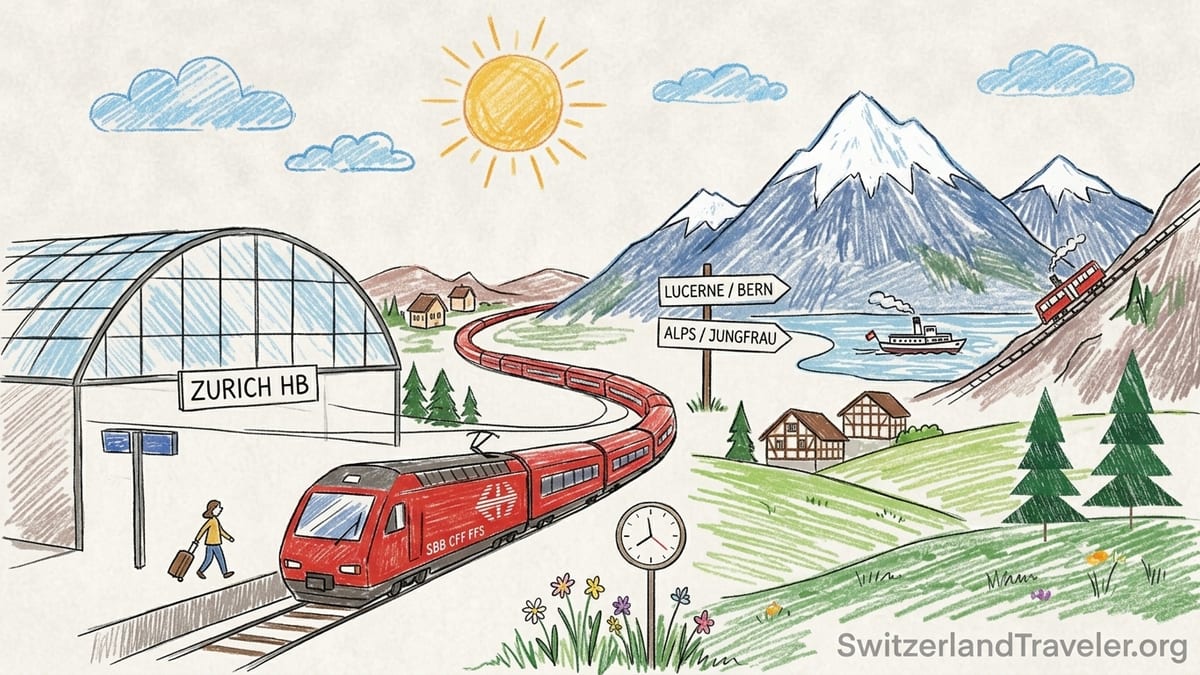
My base on the first trip was a small hotel a few minutes’ walk from Zurich Hauptbahnhof, the glass-roofed nerve center of Swiss rail. The station looks intimidating from the outside, but it is surprisingly legible once you walk in with a purpose. Overhead boards list departures chronologically, each line showing the train category (IC, IR, RE, S), number, final destination, intermediate stops and platform. For a first hop to Lucerne, I followed the line reading “IR 70 Luzern” and the platform number, which usually falls between 5 and 12 for these central Swiss routes.
Zurich HB spreads across multiple levels, but the intercity and InterRegio trains I used to reach Lucerne, Bern and beyond all left from ground-level platforms. Escalators from the main hall spill directly onto each platform, and there are lifts large enough for big suitcases at the ends of the concourse. I was traveling with a medium checked bag and a small daypack, and there was no point where I had to haul luggage up stairs; this set the tone for the rest of the trip.
On my Swiss Travel Pass trip, I never visited a ticket machine at Zurich HB. Inspectors on SBB and Zentralbahn services accepted the pass on my phone without issue, scanning the QR code and moving on. On my point-to-point trip, I bought digital tickets in the SBB Mobile app before even landing in Switzerland. In both cases, there was no need to “tap in” or validate: you simply walk to the platform and board. The lack of ticket gates keeps the station feeling like a public square that trains happen to run through.
Punctuality was my first tangible difference from other European systems. On the Zurich departure board, trains change from “on time” to “boarding” to “departed” with almost metronomic precision. Over both trips, across more than a dozen intercity and regional legs, I experienced only one notable delay, a ten-minute late arrival from Bern caused by a line interruption elsewhere. Connections were planned with five to ten minutes of margin, and even this small buffer proved sufficient.
Zurich to Lucerne: A Short Hop that Feels Like an Upgrade
The 45 to 50 minute rail link between Zurich and Lucerne was my first leg on both itineraries. On the Swiss Travel Pass trip, I simply boarded the next InterRegio heading south, taking whichever seat I liked in second class. On the point-to-point trip, my standard ticket bought through the SBB app cost just under 15 Swiss francs for the non-refundable, pre-selected train, and around 25 francs for a fully flexible ticket bought on the day. Exact prices flex slightly based on time and promotions, but that range aligned with what I saw repeatedly.
Boarding the Zurich to Lucerne train with luggage is straightforward. Cars are clearly labeled with large “1” or “2” digits for class, and just inside each door are multi-level luggage racks, including lower shelves where heavier suitcases can slide in without lifting. Overhead shelves above the seats comfortably fit small cabin bags. The seats in second class on these InterRegio trains are arranged mostly in 2+2 configurations, with a mix of forward-facing pairs, table bays of four, and occasional airline rows; I never struggled to find an empty pair even with a mid-sized suitcase beside me.
Scenically, the Zurich to Lucerne route is not the most dramatic line in Switzerland, but it is a gentle, confidence-building first ride. Suburban Zurich yields to low hills, dairy pastures and clusters of timber houses, and on clear days the Alps appear as a jagged blue line above the closer green ridges. Windows on modern SBB stock are large, and even in second class the sense of moving through a connected landscape is strong. This is where I began to understand that the transition between cities mattered as much as the destinations.
In terms of cost comparison, this leg alone did not justify a Swiss Travel Pass. If you only plan to shuttle between Zurich and Lucerne and perhaps add a local boat trip, individual tickets and a regional pass such as the Tell-Pass in central Switzerland can be cheaper. Over a week that also included Bern, the Jungfrau region and several lakes, the all-inclusive nature of the Swiss Travel Pass started to change the equation.
Lucerne as a Rail Hub: Boats, Narrow Gauge Lines and Mountain Add-Ons
Lucerne’s station is compact compared to Zurich’s but functions as a true multimodal hub. All the mainline platforms sit side by side under a glass canopy, with the lake boats departing directly from the quay outside. When I arrived from Zurich, I stepped off on one of the central platforms, followed bilingual signs toward “Ausgang See” and was standing at the water’s edge in under five minutes. For travelers with luggage, elevators connect each platform to the concourse, and the walkways are smooth enough for standard rolling suitcases.
Lucerne was where the fine print of the Swiss Travel Pass and of individual tickets became meaningful. On my pass trip, the boat across Lake Lucerne to Vitznau was fully covered. From there, the cogwheel railway up Mount Rigi was either fully included or half-price depending on the exact section and validity calendar at the time; when I traveled, the popular Vitznau to Rigi Kulm stretch was included, turning what is usually a ticket of roughly 70 francs for a round trip into a no-cost spur of the day. On my point-to-point trip, without a nationwide pass, that same outing became the largest single-ticket expense of the week.
I also sampled Mount Pilatus, which is marketed through the “Golden Round Trip” that strings together a boat from Lucerne to Alpnachstad, a steep cogwheel train to the summit, a cable car descent to Fräkmüntegg and a gondola down to Kriens, then a bus back to the station. The Swiss Travel Pass covered the boat and the bus at 100 percent and gave a fixed reduction on the mountain segment. Even after the discount, the combined Pilatus mountain ticket still required a substantial additional payment on top of my rail pass, highlighting one of the core truths of Swiss travel: mountain railways and cableways are financially distinct from the regular SBB system, and their costs accumulate quickly.
In Lucerne itself, trams are absent, but buses fan out from the station forecourt, fully integrated with the national timetable. With the Swiss Travel Pass, I simply boarded without tapping; inspectors on local routes checked the pass on the same basis as the intercity trains. With point-to-point tickets, I either used a contactless card at the ticket machine or, more often, walked when distances were under 15 minutes. The key operational point is that you can base yourself in Lucerne, use it as a hub for surrounding mountains and lakes, and never wish you had a car, provided you accept that iconic peaks like Pilatus, Rigi or Stanserhorn come with their own ticket structures.
Lucerne to Bern and into the Alps: Scenic Segments Without Reservations
Leaving Lucerne for Bern, I traveled twice via two different routes. The more direct path is a standard intercity line that runs through Zofingen and Olten, taking about 1 hour 15 minutes with a simple platform change in Olten. This is the route my point-to-point ticket defaulted to in the SBB app, with a fare of around 30 to 40 francs in second class when bought close to departure. The transfer at Olten is functional rather than glamorous: you step off, check the overhead sign for the next Bern IC, and often simply cross the island platform to the other side. Elevators and ramps are available, but many changes are at-grade.
On my Swiss Travel Pass trip, I opted for the more scenic variant for part of the way, taking the Zentralbahn’s narrow-gauge line from Lucerne to Interlaken Ost over the Brünig Pass, then continuing onward toward Bern the following day. The Lucerne to Interlaken Express is a classic of Swiss scenic rail, with panoramic windows and long stretches along Lake Lucerne, the Sarnersee and Lake Brienz. The Swiss Travel Pass covered the entire segment without the need for any reservation or extra fee, and I deliberately chose an early afternoon departure to have enough daylight on the lake sections.
With luggage, the Lucerne to Interlaken trains are forgiving. Low floors or short internal steps make boarding manageable with a suitcase in one hand, and there are vertical luggage stacks at the ends of carriages that handle several large bags each. I traveled in second class both times and always found space to sit in the direction of travel. Even in high summer the carriages were busy but never uncomfortably full; the complaints I heard nearby, in English and German, tended to be about the views being too distracting for reading.
From Interlaken Ost to the Alpine villages of Lauterbrunnen and Grindelwald, the connections are across the platform. The Berner Oberland Bahn trains wait adjacent to the arriving mainline services, and the timetables are synchronized so that you step off an SBB train and onto a regional one in under five minutes. With both the Swiss Travel Pass and individual tickets, the system assumes you can make these transfers even with luggage; when platforms are not aligned, elevators are positioned within a few steps of each staircase. Here again, the regular rail pass covers up to key mountain gateways, while further lifts and mountain railways, such as to Kleine Scheidegg or Jungfraujoch, require separate, often pricey add-ons.
Bern and Urban Rail Rhythm: Multi-Base Itineraries in Practice
Bern’s station feels more compact than Zurich’s but more bustling than Lucerne’s. My trains from both Lucerne and Interlaken arrived on the lower-numbered platforms, with easy escalator access to the main concourse and tram stops outside. The platforms are straight, well lit and signed clearly, which mattered on the day my incoming train from Interlaken arrived nearly ten minutes late. I had a planned five-minute transfer to a northbound InterCity, and the information screens updated quickly to show that the connecting train was held a few minutes to preserve the connection. This was the only occasion where I saw Swiss punctuality flex in the service of system reliability.
With Bern as a base, the practical benefit of a Swiss Travel Pass became sharper. The pass covered not only the intercity links to Zurich and Lucerne, but also Bern’s trams and buses. A spontaneous sunset trip up to the Gurten funicular, for example, had its lower segment fully included with the pass and a discounted rate higher up. On the point-to-point itinerary, every one of these moves required either an additional ticket or a calculated decision to forgo an outing. When I tallied receipts from that non-pass week, the accumulation of 3 to 6 franc local rides and regional hops rivalled the cost of the longer intercity segments.
That said, Bern is also a city where individual tickets can make sense for slower, more focused travel. On one trip, I stayed three full days and left the station area only twice by train, once to nearby Thun and once to return to Zurich airport. In that narrower pattern, I used single tickets on SBB and a regional day pass for the local transport, and even with a day trip to Lake Thun the total still came out below the cost of a nationwide pass for the same period.
Seat availability from Bern to Zurich and back was never a problem. These core trunk lines run at least twice per hour, usually with long double-decker IC trains. I preferred second class on the lower deck, where the ride feels marginally quieter and the luggage racks are closer to eye level. Even at Friday rush hour there were empty seats in the center of each coach, and the only time I had to stand briefly was the first two minutes before people rearranged bags from seats to overhead shelves.
Living on Timetables: Building a Car-Free Multi-Base Trip
Across both trips, what struck me most was how easy it was to build a multi-base itinerary that stayed entirely on rails. In one eight-day stretch I slept in Zurich, Lucerne, Wengen and Bern, always within a ten-minute walk of a station. The longest single journey, Lucerne to Wengen via Interlaken Ost, took under three hours including changes. None of the other legs exceeded ninety minutes. The effect was that travel days never felt like lost days; I would check out after breakfast, roll my suitcase to the station, ride a scenic line, check in at the next base by lunchtime and explore on foot for the rest of the afternoon.
The SBB Mobile app was central to this style of travel on both the pass and point-to-point itineraries. Every station in my orbit, from Zurich HB down to Lauterbrunnen and Grindelwald, appeared in the planner with real-time track information. When a platform changed in Bern, my phone buzzed before the station loudspeakers finished announcing it. Buying tickets in the app for my non-pass trip took under a minute each time, and the same interface stored my Swiss Travel Pass when I used it, which made document checks uniform regardless of the underlying ticket type.
From a practical perspective, luggage management improved over the course of the trip as I learned the carriage layouts. On SBB intercity trains, the zones between classes and at the ends of coaches tend to have the largest open spaces for bulky suitcases. On the narrower mountain lines, such as Lauterbrunnen to Kleine Scheidegg, luggage capacity is more limited, but most passengers on those routes are similarly burdened with hiking gear or ski bags in winter, and the train staff are used to helping people slide bags into corners and shared racks.
What surprised many first-time visitors I met on the platforms was that reservations are not only unnecessary on most of these routes, they are not even offered. Unlike named panoramic services such as the Glacier Express, the regular intercity, InterRegio and regional trains I used between Zurich, Lucerne, Bern and the Bernese Oberland are designed for turn-up-and-go travel. The Swiss Travel Pass reinforces that mindset; you become accustomed to the idea that any train headcode matching your route is valid, and that you never need to sprint for a particular departure if a connection looks tight. Another service will follow shortly.
Counting the Francs: Swiss Travel Pass vs Individual Tickets
Financially, the Swiss Travel Pass is a significant upfront purchase. When I bought an 8-day second class pass in 2025, it was priced in the vicinity of 430 to 450 francs, according to official Swiss Travel System materials valid through December 2026. By comparison, my individually purchased tickets for a non-pass week covering Zurich to Lucerne, Lucerne to Bern, Bern to Interlaken Ost, plus several shorter hops and airport transfers, added up to somewhat less than that figure, even with a couple of spontaneous extra rides.
The key difference was how many mountain excursions and local urban days I layered on top. On the pass trip, I used lake boats in Zurich, Lucerne and Thun, rode city trams and buses in three cities, and took two fully covered or heavily discounted mountain railways. If I assigned approximate market prices to each of those covered trips, the value recovered from the pass at least matched and probably slightly exceeded its purchase price. On the non-pass trip, I was more selective. I paid cash for one major mountain outing and skipped a second, choosing a low-altitude hike instead. Subjectively, that reduced my spontaneity even as it saved money.
An intermediate strategy that I also tested on a shorter visit was pairing individual tickets with a Half Fare Card, which is a Swiss discount product that gives 50 percent off most regular fares for a set period. The Half Fare Card itself is not free, and you need to accumulate a reasonable basket of journeys to make it pay for itself, but in a pattern of frequent intercity hops without many mountain lifts it can rival or beat the cost of the Swiss Travel Pass. The decision point for me became simple: if my plans involved several long-distance trips plus more than two major mountain or lake excursions in a week, the Swiss Travel Pass felt right. If I was anchoring in one or two cities with only a couple of regional rides, individual SBB tickets or regional passes worked better.
One practical point that I confirmed in receipts is that the Swiss Travel Pass rarely makes expensive mountain top stations completely free. In the Bernese Oberland, for example, the pass covered me up to certain mid-mountain points, with a 25 to 50 percent discount beyond. My individually bought Jungfraujoch excursion on a non-pass trip cost several hundred francs for the round trip from Wengen, even after a regional pass discount. The Swiss Travel Pass would have trimmed that, but not erased it. It is important to budget mountain railways as a separate line item rather than assume they disappear into the national pass.
Rail as the Heart of the Experience, Not Just the Transfer
On paper, my itinerary across Zurich, Lucerne, Bern and the Alps looked like a list of city names linked by practical transfers. In reality, some of the strongest memories happened in motion: the pastel evening light over Lake Brienz from the Lucerne to Interlaken Express, the moment the Eiger’s north face filled the window on the climb from Grindelwald, the rhythms of commuters boarding in Bern while I continued through to Zurich, watching brief slices of their lives through carriage windows.
Switzerland’s trains are designed to let you watch the landscape, not escape it. Large picture windows, quiet electric traction and frequent services mean you can treat each leg as a moving terrace cafe. I often brought supermarket picnic lunches aboard, using the tables in second class to lay out bread, Gruyère and fruit as the countryside slipped by. On the Lucerne to Interlaken line, tourists swapped tips on hiking trails, while in the early morning from Wengen down to Lauterbrunnen the carriage was shared between hikers, hotel workers and schoolchildren.
The reliability of the rail network also changes how you plan days in the mountains. Knowing that the final connection from Interlaken back to Bern or from Lucerne back to Zurich airport would almost certainly run on time, I felt comfortable hiking until late afternoon, descending on the last cable car, and trusting the chain of trains. In countries where missed connections can cascade, I would build in buffers of an hour or more. In German-speaking Switzerland, twenty to thirty minutes felt sufficient, and in practice I never once missed a planned intercity link.
Most of all, traveling by train removed an entire layer of stress associated with driving in mountainous terrain, finding parking in medieval city centers, and navigating unfamiliar traffic rules. Instead, I learned station layouts, became familiar with platform numbering quirks, and began to recognize the regular crews on certain intercity diagrams. By the end of the second trip, walking into Zurich HB felt almost like returning to a home station rather than entering a foreign transport hub.
The Takeaway
Connecting Zurich, Lucerne, Bern and the Alps without a car is not a compromise in Switzerland; it is arguably the most natural way to see this part of the country. The rail network operates as both a practical backbone and a scenic attraction in its own right. Station changes are predictable, platforms and elevators make travel with luggage straightforward, and high frequencies keep stress low even when delays occur.
From a budgeting perspective, the choice between a Swiss Travel Pass and individually purchased tickets depends on how intensively you plan to use the network and how many mountain and lake outings you will add. My own receipts showed that with frequent long-distance trips and multiple major excursions, the pass roughly paid for itself and increased my willingness to be spontaneous. With a narrower, city-focused plan, carefully chosen point-to-point tickets and occasional regional passes proved slightly cheaper.
What remained constant across both approaches was the feeling that I was not merely getting from A to B. Watching the Alps move from the horizon to the window, stepping off trains directly into lakeside promenades, and arriving in medieval old towns without ever worrying about a car space made rail integral to the story of the trip. In German-speaking Switzerland, the train is not just transport. It is the stage on which much of the journey unfolds.
FAQ
Q1. Do I need seat reservations on trains between Zurich, Lucerne and Bern?
For the standard InterCity, InterRegio and regional trains linking Zurich, Lucerne and Bern, seat reservations are not required and in most cases not even available. You simply board with your valid ticket or pass and choose any free seat in your class.
Q2. Is a Swiss Travel Pass worth it if I only visit Zurich and Lucerne?
If your trip is limited to shuttling between Zurich and Lucerne with a few local bus or boat rides, individual SBB tickets and perhaps a regional pass in central Switzerland will usually be cheaper than a nationwide Swiss Travel Pass. The pass starts to make sense once you add multiple intercity journeys and several mountain or lake excursions in one week.
Q3. How easy is it to manage luggage on Swiss trains?
Most long-distance and regional trains have dedicated luggage racks near the doors and above the seats, as well as level or low-step boarding. Traveling with a medium suitcase and a daypack, I found it straightforward to roll on and off, even when making connections in large stations like Zurich and Bern.
Q4. Are mountain railways like Pilatus and Rigi included in the Swiss Travel Pass?
The Swiss Travel Pass fully covers some boats and lower mountain segments and provides discounts, often around 50 percent, on many cogwheel railways and cable cars. However, flagship mountain trips such as Pilatus, Rigi or Jungfraujoch still involve substantial extra cost even with the pass, so it is important to budget them separately.
Q5. Can I build a multi-base itinerary without worrying about car access?
Yes. Cities like Zurich, Lucerne and Bern are built around their main stations, and Alpine bases such as Interlaken, Wengen or Grindelwald are tightly integrated with the rail network. Over multiple trips I moved between several bases entirely by train and on foot, without any point where a car would have been more convenient.
Q6. How punctual are Swiss trains in practice?
In my experience, intercity and regional trains in German-speaking Switzerland were highly punctual, with only one delay of about ten minutes across more than a dozen legs. Timetables are designed with short but realistic transfer windows, and in some cases onward trains were briefly held to preserve important connections.
Q7. Is second class comfortable enough for long scenic rides?
Second class on Swiss trains offers ample legroom, large windows and a mix of seating layouts, including table bays and forward-facing rows. On scenic segments such as Lucerne to Interlaken, I had clear views and enough space for snacks and cameras without feeling any need to upgrade to first class.
Q8. How do I buy tickets if I am not using a Swiss Travel Pass?
You can buy point-to-point tickets from SBB ticket machines, staffed counters or through the SBB Mobile app. I preferred the app, which stored my tickets digitally, displayed real-time platform information and made it easy to compare flexible and saver fare options for each route.
Q9. Are Swiss stations difficult to navigate for first-time visitors?
Major stations such as Zurich, Lucerne and Bern are well signposted in multiple languages, with clear platform numbers, departure boards and icons for elevators and exits. After one or two transfers, I found it easy to interpret the signage and move between platforms, even with luggage and limited German.
Q10. Can I spontaneously take extra trips with a Swiss Travel Pass?
Yes. One of the main advantages of the Swiss Travel Pass is the ability to board most trains, boats and many local buses without buying additional tickets. On my pass trip I often added unplanned lake cruises or short regional rides simply because no new ticket purchase was required, which made the trip feel more flexible and exploratory.