


When I finally tapped my card for Jungfraujoch tickets and that mandatory 10 franc seat reservation, I knew I was paying for one of the most expensive single-day excursions of my life. What I did not yet know was whether the “Top of Europe” marketing would feel like smart money or an overhyped splurge once I stepped off the train at 3,454 metres above sea level. This is exactly how my 2026 Jungfraujoch trip unfolded, from the first train at Interlaken Ost to the Sphinx viewpoint in thin air, and what I learned about tickets, timing, weather and whether I would pay for it again.
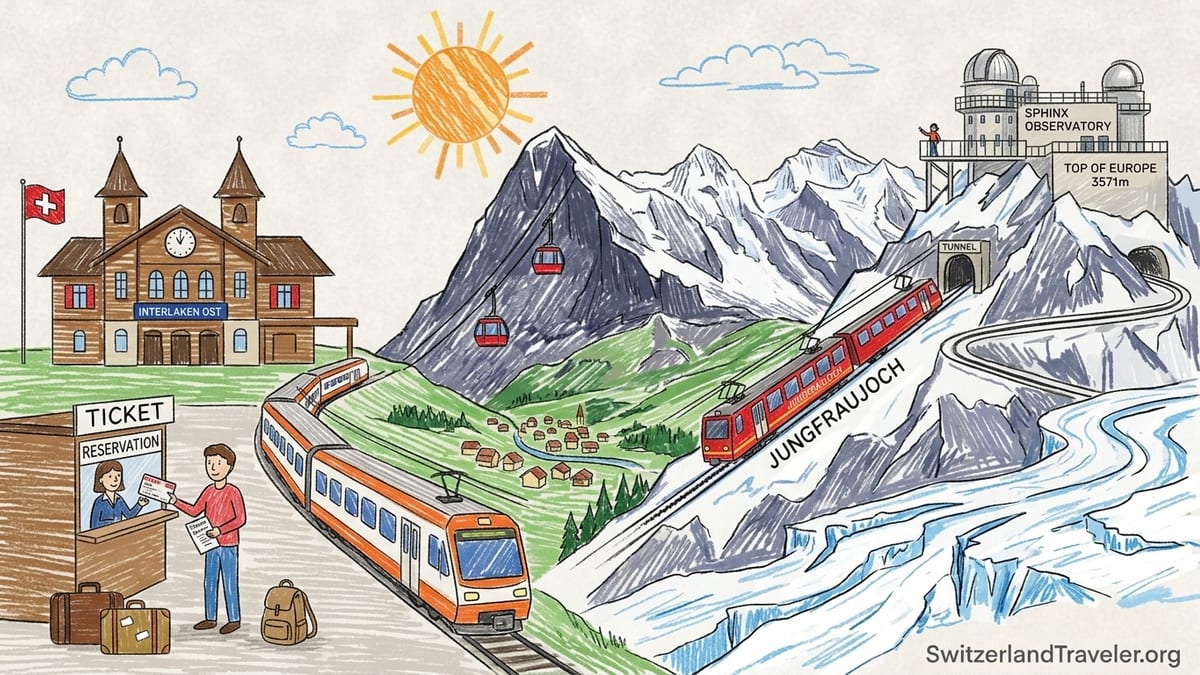
Starting in Interlaken: Buying the Ticket and Reservation
My Jungfraujoch day started at Interlaken Ost, which is the usual jumping-off point for the Top of Europe trip. I arrived just after 7:30 in the morning, partly because every local I had spoken to warned me about crowds on clear days between May and October. For 2026, Jungfrau Railways confirms that a seat reservation is mandatory between 1 May and 31 October for the journey to Jungfraujoch, and it costs 10 Swiss francs on top of the regular ticket. I had already booked my seat the night before for a mid-morning ascent, watching the webcams and forecast like a stock trader checking live charts.
The base ticket price from Interlaken Ost through Grindelwald Terminal, up the Eiger Express to Eigergletscher and then on to Jungfraujoch started from 129.60 francs at the time of my visit, depending on the season and reductions. That fare covered the transportation and admission to the Jungfraujoch attractions such as the Sphinx observation deck and Ice Palace, but not food or any paid activities in the snow area. I used a Swiss Travel Pass, which reduced my cost but did not exempt me from the 10 franc reservation. At the counter in Interlaken Ost, the agent carefully checked both: my travel pass for the transport discount, then my printed seat reservation with its time window for the reserved train segment higher up.
Booking in advance felt slightly against my usual travel style. I like to respond to the weather on the day, and Jungfraujoch is particularly sensitive to clouds and storms. However, with mandatory reservations in 2026 and such a high base fare, I was not ready to risk turning up and finding only time slots left in bad weather or none that matched my schedule. The reservation itself did not assign me a specific seat number but guaranteed a place on the train in a defined time window on the critical stretch between Eigergletscher or Kleine Scheidegg and Jungfraujoch, where capacity is tightest.
Before boarding my first train I did the mental math: between the discounted fare and the reservation, I was committing roughly the equivalent of several nice dinners in Switzerland for a single mountain day. That calculation set the tone for the rest of the trip. I spent the entire day quietly asking myself whether each step justified the cost, which is exactly the kind of question future visitors will ask as prices continue to rise.
Interlaken to Eigergletscher: Trains, the Eiger Express and Travel Time
The journey from Interlaken Ost to the actual high-alpine experience unfolds in distinct stages. My first leg was a regular Bernese Oberland regional train from Interlaken Ost to Grindelwald Terminal, which took around 30 minutes through dairy farms and wooden chalets. Even this early, the carriages were busy with a mix of day-trippers, tour groups and hikers. Many were holding the same Jungfraujoch brochures, and I could hear a dozen different languages in my carriage.
Grindelwald Terminal felt more like a small airport than a mountain station. There is a shopping center, rental shops and cafeterias, and prominently posted signs for the Eiger Express tricable gondola. The Eiger Express is key to the modern Jungfraujoch itinerary because it cuts roughly 45 minutes off the traditional route via Kleine Scheidegg alone. The gondola whisks you from Grindelwald Terminal to Eigergletscher in about 15 minutes, suspended in front of the dark north face of the Eiger. Inside the cabin, people were moving from side to side trying to capture views of the village shrinking below and glaciers above.
From Eigergletscher the trip switches from cableway to cogwheel train. This is the Jungfrau Railway proper, famous for tunneling through the Eiger and Mönch to reach the Jungfraujoch station at 3,454 metres. From Eigergletscher to Jungfraujoch the ride took about 35 minutes, including brief stops at windowed galleries inside the mountain where passengers could step out, take photos and acclimatise. My reserved time applied on this leg, which meant I followed signs for passengers with reservations and queued in a dedicated area before boarding.
Door to door, including changes and short waits, the journey from Interlaken Ost to Jungfraujoch took just under two and a half hours. That matches typical schedules that show around 2 hours 16 minutes via Grindelwald Terminal and Eiger Express on an optimised connection. It is possible to travel via Lauterbrunnen and Kleine Scheidegg with more of the route by cogwheel train and without the gondola, but that generally adds time and I wanted to maximise minutes in the high-altitude zone instead of on intermediate trains. For budget travellers the time difference may not justify the cableway, but with my already high ticket cost, I valued the efficiency.
First Steps at 3,454 Metres: Weather, Altitude and Crowds
Stepping off the train at Jungfraujoch after the tunnel ride felt a bit like arriving inside an international airport that happens to be cut into ice and rock. The station hall is underground, connected by tunnels to restaurants, shops and attractions. Only later do you emerge outdoors onto snowy plateaus and viewing decks. It is easy to forget for a moment that you are standing at 3,454 metres, the highest railway station in Europe, until the first flight of stairs leaves you slightly short of breath.
Altitude was a real factor in how I experienced the day. I am reasonably fit and live at sea level, and within 10 minutes of arriving I felt a light pressure in my temples and a subtle wobble in my legs. There were oxygen warning signs and advice to move slowly and drink water. Some visitors, particularly older travellers and small children, were clearly feeling it more. One woman in my group sat down on a bench near the station hall entrance, saying she was dizzy. Staff were used to this and gently suggested she rest before continuing. This is not the place to sprint up stairs for a selfie.
The weather on my June visit was a classic alpine mix. In Interlaken that morning it had been mild and overcast, around 18 degrees Celsius, with low cloud sitting on the higher peaks. At Jungfraujoch the temperature was just below freezing with a biting wind on the exposed terraces. Clouds moved fast, obscuring and then revealing the Aletsch Glacier in minutes. When the sun broke through, the snowfields blazed white and people pulled off gloves to take photos. When the clouds rolled back over the ridge, visibility dropped to a few dozen metres and the crowd instinctively moved indoors.
Crowds are unavoidable in peak season and doubly so under the mandatory reservation regime from early May to the end of October. Trains and gondolas were full, and once on the top complex I noticed that the flow of people had a certain rhythm aligned to each arriving train. Immediately after a train arrived, corridors to the Sphinx elevator and Ice Palace were busy. Thirty to forty minutes later, the crush eased until the next arrival. The reservations controlled total numbers to a degree, but this was still one of the most touristic experiences I had in Switzerland. Anyone expecting solitude should adjust their expectations accordingly.
The Sphinx Viewpoint and Glacier Vistas
The highlight for me, and for most visitors I spoke to, was the Sphinx viewpoint. Located above the Jungfraujoch station, the Sphinx Observatory sits at roughly 3,571 metres, with an outdoor viewing platform reached via a fast elevator from the main complex. This is also one of Switzerland’s highest research stations, but for day visitors the key attraction is the wraparound balcony over cliffs and glaciers.
On my first attempt to reach the deck, the queue for the elevator spilled into the corridor. It took nearly 15 minutes to get into the lift. This is another place where reservations indirectly shape the experience: because capacity is limited, the crowd arriving on each train tends to funnel toward the Sphinx quickly. I deliberately stayed indoors for a while, exploring the exhibition areas and checking the webcams. When I saw clearer skies outside, I returned to the elevator and waited less than five minutes. Timing is everything at 3,500 metres.
When the elevator doors opened at the top, the sudden transition from tunnel to open panorama caught me off guard. The platform looks down onto the immense Aletsch Glacier, part of a UNESCO World Heritage site. On my visit the glacier surface was a patchwork of snow and ice with fissures and darker stripes of debris. To one side, the peaks of Jungfrau and Mönch rose against a shifting curtain of clouds. Tourists lined the railings, phones and cameras raised, while a stiff wind snapped at jackets and hats. I watched a man from Singapore simply put his phone away, close his eyes and stand quietly for several minutes.
The Sphinx deck made the cost of the day trip feel more rational. The combination of engineering, altitude and scenery is rare even by Swiss standards. I have ridden many mountain railways, but here the sense of being literally on top of a high alpine world is stronger than most. The observatory building, with its domes and antennas, added a science fiction flavour to an otherwise very real landscape. After about 20 minutes in the cold, the chill in my fingers reminded me that this is still a harsh environment despite the infrastructure.
Snow, Ice and Indoor Attractions
After the exhilaration of the Sphinx deck, I descended back into the main complex and followed signs to the Ice Palace and Glacier Plateau. Both experiences are included in the Jungfraujoch ticket, which softened the sting of the overall price. The Ice Palace is a warren of tunnels carved into the glacier, with polished ice floors and walls illuminated by blue-toned lighting. I walked past ice sculptures of animals and mountain scenes while trying not to slip. The air inside was colder than in the station, and the crowds moved more slowly.
The Glacier Plateau, by contrast, is an outdoor snowfield area that you reach through a tunnel and short ramp. On my June visit, the snow underfoot was compacted and occasionally slushy on top, with safety ropes marking the accessible zone. People threw snowballs, posed with flags and attempted small jumps for photos. There were optional paid activities in a designated snow park area further away, including sledging and a short zipline, but these had separate charges and fixed times so I skipped them, focusing instead on the free-to-access viewpoints.
The mix of indoor and outdoor elements turned out to be important in managing the weather. When clouds thickened and light snow started to fall, I retreated from the plateau and wandered through the “Alpine Sensation” walk, a corridor-like attraction with historical displays about the construction of the Jungfrau Railway. Old photos showed workers drilling through ice and rock in conditions that made the modern visitor flow seem very comfortable. That historical context deepened my appreciation of the infrastructure I was using so casually.
By early afternoon I felt the cumulative effect of altitude and sensory overload. I had been at or above 3,400 metres for close to three hours, walking between decks, tunnels and platforms. A mild headache had settled in, and I was more than ready to sit down somewhere warm, which brings the story logically to food.
Food, Prices and Warming Up at the Top
Like everything at Jungfraujoch, food comes at a premium. The Top of Europe complex includes several restaurants and snack bars, from cafeteria-style self-service outlets to more formal seating. I opted for a self-service restaurant overlooking the mountains, partly for the views and partly for quicker service in a limited time window before my reserved descent. I paid just under 30 francs for a simple meal of rösti with cheese and a soft drink. Coffee and cake would easily have added another 10 francs.
The quality of the food was solid but not remarkable. What I was really paying for was a warm seat and floor-to-ceiling windows looking down toward the glacier. Around me, international tour groups moved through in waves, their guides holding up small flags. A family from India at the next table compared the price of this lunch to their hotel buffet in Interlaken, concluding with a shrug that “this is what you sign up for at 3,500 metres.” I felt much the same. It did not feel like good value in any conventional sense, but it did feel like the cost of staying warm and functional in a remote, highly engineered environment.
For travellers on a tighter budget, bringing snacks and a water bottle is an obvious strategy, and one I partly followed. I supplemented my purchased meal with nuts and a sandwich from a bakery in Interlaken. There are drinking water points in the complex, and staff had no issue with people eating their own packed food in some public seating zones, though not in the main restaurant areas. If I were repeating the trip, I would likely still buy at least a hot drink at the top for the warmth and small psychological boost, but I would rely more heavily on food brought up from the valley.
One subtle benefit of sitting in the restaurant for a longer stretch was acclimatisation. The enclosed, warmer environment made it easier to shake off the altitude symptoms, and by the time I stood up to leave, my headache had nearly disappeared. That made the idea of the long descent by train and gondola much less daunting.
Heading Down: Managing Time Slots and Crowds
The descent from Jungfraujoch back to Interlaken follows the same basic route in reverse: cogwheel train back to Eigergletscher or Kleine Scheidegg, then either the Eiger Express gondola down to Grindelwald Terminal or trains toward Grindelwald or Lauterbrunnen. Although the mandatory reservations in 2026 focus primarily on the journey up, the down trains and gondolas were just as busy on my visit. Staff encouraged people to stagger their departure and not all rush for the same departure immediately after lunch.
My reservation had defined an outbound time slot, and while the return segment was more flexible, there were still recommended departure windows printed on my confirmation. I decided to leave before the absolute last recommended train to keep some buffer in case of delays. On boarding the cogwheel train down to Eigergletscher, I was glad I did. Even mid-afternoon, nearly every seat was taken. At one point a group without visible reservations was turned away from a specific departure and asked to wait for the next, which underlined that in peak season, flexibility only goes so far.
The Eiger Express ride down to Grindelwald Terminal in late afternoon light felt more relaxed than the morning ascent. The frantic energy of “getting to the top” had faded, replaced by a pleasant tiredness. From the gondola cabin I watched the Eiger’s north face slowly rise above us and the valley open out below. By the time I reached Interlaken again, just after 17:00, the full excursion had taken close to nine hours from hotel door back to hotel door, including transit, waiting times and several hours at altitude.
Looking back, one of the practical lessons I learned is that travellers should think of Jungfraujoch as a full-day commitment from Interlaken, Grindelwald or Lauterbrunnen, rather than trying to combine it with ambitious hiking or additional long excursions on the same day. The ticket is expensive enough that you want to linger, but your body at 3,454 metres may have different ideas. Building in space to rest, eat and descend before evening trains or onward travel is not a luxury; it is common sense.
Was the Expense Worth It, and Would I Reserve Again?
The financial side of this excursion is impossible to ignore. Even starting from the lowest advertised price point of about 129.60 francs for a Jungfraujoch ticket, adding the mandatory 10 franc seat reservation, food, and travel to and from Interlaken or other bases quickly moves the total into the high hundreds of francs for a couple or family. For many travellers, that represents a significant slice of their Switzerland budget.
For me, the answer to whether it felt justified is a qualified yes. The uniqueness of arriving by train at the highest railway station in Europe, walking out onto a glacier plateau, and standing on the Sphinx viewpoint looking across the Aletsch Glacier is hard to price against ordinary activities. The combination of engineering, history, science and raw alpine scenery delivered something I had not experienced elsewhere. In that sense, it did feel like a once-in-a-lifetime purchase rather than a routine cable car ticket.
However, it is not a perfect experience. The crowds and strictly managed flow, necessary to protect both safety and infrastructure at altitude, remove some of the spontaneity that hikers and independent travellers might crave. You are very aware at each stage that you are part of a large, choreographed operation. If your idea of a mountain day is quiet trails and unmarked viewpoints, you may find the regimented nature of Jungfraujoch frustrating, regardless of the scenery.
As for reservations, I would absolutely book them again during the mandatory period from May through October. The small extra cost relative to the overall fare buys predictability at the most bottlenecked section of the journey. It also aligns with how the operator manages capacity, so attempting to avoid the system will only add stress or even prevent you from travelling at your ideal time. In the shoulder and winter seasons, when reservations are historically not required or may be more flexible, I might be more relaxed about booking last minute, but in 2026’s framework the reservation felt like a non-negotiable part of the package.
The Takeaway
My Jungfraujoch day taught me that the “Top of Europe” brand is more than just a marketing slogan but also that the experience is closely tied to careful logistics and a willingness to pay premium prices. From Interlaken Ost to the Eiger Express gondola and finally the Jungfrau Railway through the mountain, every step is polished, punctual and engineered, yet nothing can fully tame the reality of high altitude and fast-changing alpine weather.
If you are considering this trip in 2026 or beyond, start by acknowledging the cost and deciding whether this is the one big alpine splurge of your itinerary. Pay close attention to the current rules around seat reservations between May and October, book your time slot in advance, and keep a flexible attitude toward exact timing on the day. Check webcams and forecasts the evening before, and be prepared to reframe your expectations if clouds roll in once you are already on the mountain.
Bring snacks and water to soften the impact of high on-site food prices, but budget for at least one hot drink or meal at the top for comfort and acclimatisation. Move slowly when you arrive at 3,454 metres, listen to your body, and do not feel pressure to tick off every attraction if the altitude hits you harder than expected. Prioritise the Sphinx viewpoint and Glacier Plateau, then add the Ice Palace and exhibitions if your energy allows.
On the train back down to Interlaken, watching the mountains recede through the window, I realised that my lingering memory would not be the amount debited from my card but the sharp wind on my face at the Sphinx deck, the hum of the cogwheel under my feet inside the tunnel, and the moment the Aletsch Glacier emerged from the clouds. Those are the moments that, in hindsight, made paying for the Top of Europe experience feel worthwhile.
FAQ
Q1. How much did my Jungfraujoch trip cost in total?
Including a discounted Jungfraujoch ticket starting from around 129.60 francs, the mandatory 10 franc seat reservation, and food at the top, my full day from Interlaken cost roughly the equivalent of a high-end Swiss restaurant meal for one. Travellers without rail passes or with more substantial on-site spending should budget more, especially for families.
Q2. Do I really need to book a seat reservation for Jungfraujoch in 2026?
Yes, in 2026 a seat reservation is mandatory between 1 May and 31 October for the journey to Jungfraujoch. Skipping it is not practical, as staff check reservations for the key train segments and can refuse boarding for people outside their booked time slots when services are busy.
Q3. How long does it take to get from Interlaken Ost to Jungfraujoch?
On my itinerary, using the train to Grindelwald Terminal, the Eiger Express gondola to Eigergletscher, and the Jungfrau Railway to the top, the journey took just under two and a half hours each way. That included normal connection times but no long waits. Travellers should plan on a full day for the entire round trip and time at the top.
Q4. Is the Eiger Express worth taking instead of the older route via Kleine Scheidegg only?
For me, yes. The Eiger Express cut around three quarters of an hour off the traditional ascent and gave spectacular views of the Eiger’s north face. It also streamlined connections from Grindelwald Terminal. Travellers who prioritise scenic cogwheel trains over cable cars might prefer the classic route, but in terms of time and convenience, the gondola was a strong addition.
Q5. How bad were the crowds at Jungfraujoch?
In June, during the reservation period, trains and decks were busy but manageable. The heaviest congestion coincided with each arriving train, especially at the Sphinx elevator and main viewpoints. By timing my movements away from the immediate arrivals, I found quieter windows even on a popular day, but anyone expecting solitude should reset their expectations.
Q6. Did I experience any altitude sickness at 3,454 metres?
I felt mild symptoms: a light headache, faster breathing on stairs and a slight feeling of unsteadiness. Rest, hydration and moving slowly kept it under control. I saw a few other visitors feeling more affected and choosing to sit indoors. If you have known issues with altitude, discussing the trip with a doctor before travelling is wise.
Q7. What should I wear and bring for a Jungfraujoch visit?
Even in summer I was glad to have a warm insulated jacket, hat, gloves and sturdy shoes with good grip for snow and ice. Sunglasses and sunscreen are important because snow reflects sunlight strongly. I also brought snacks and a refillable water bottle, which helped limit spending on food at the top and kept me comfortable between meals.
Q8. Which attractions at Jungfraujoch felt most worthwhile?
The Sphinx viewpoint and Glacier Plateau were the clear highlights, offering open-air exposure to the high alpine environment and glacier views. The Ice Palace and historical “Alpine Sensation” walk added context and variety, especially when weather on the terraces turned cloudy or cold, but if time or energy is limited, I would prioritise the outdoor viewpoints first.
Q9. Is Jungfraujoch suitable for young children or older travellers?
It can be, but altitude and crowds require extra care. During my visit I saw families with toddlers and older visitors using walking sticks. Many did well by taking it slowly, resting often and spending more time indoors. However, anyone with heart, lung or serious mobility issues should get personalised medical advice before planning the trip.
Q10. Would I do the Jungfraujoch Top of Europe trip again?
For me it felt like a once-in-a-lifetime experience rather than something to repeat annually. I would consider returning if travelling with someone who had never been, especially on a very clear-weather day, and I would book the reservation again during the mandatory period. But for a second visit I might balance the cost against exploring less crowded, lower-priced mountain areas in the Bernese Oberland.