

I arrived in Gstaad expecting not a village, but a brand. In my mind it was all private jets at Saanen Airport, fur coats on the car-free promenade and hotel lobbies that smell faintly of old money. As a mid-budget traveler with a regular backpack and a rail pass, I honestly wondered whether I would spend the day feeling like an intruder. Instead, what I found was more complicated, more human and, in some corners, surprisingly affordable. This is not a love letter to luxury or a budget guide pretending Switzerland is cheap. It is a first-person look at whether an ordinary traveler can enjoy Gstaad without a black card or a five-star suite.
Arriving With Luxury Expectations
My train rolled into Gstaad on the same narrow-gauge Montreux Oberland Bernois line that delivers both backpackers and billionaires. Knowing Gstaad’s reputation as one of Switzerland’s most expensive resorts, I expected to feel underdressed the moment I stepped onto the platform. There were, indeed, designer suitcases and impeccably tailored coats, but there were also families in hiking gear and day-trippers with supermarket sandwiches. The station itself felt like a regular Swiss village stop wrapped in chalet-style wood, not an airport lounge for the elite.
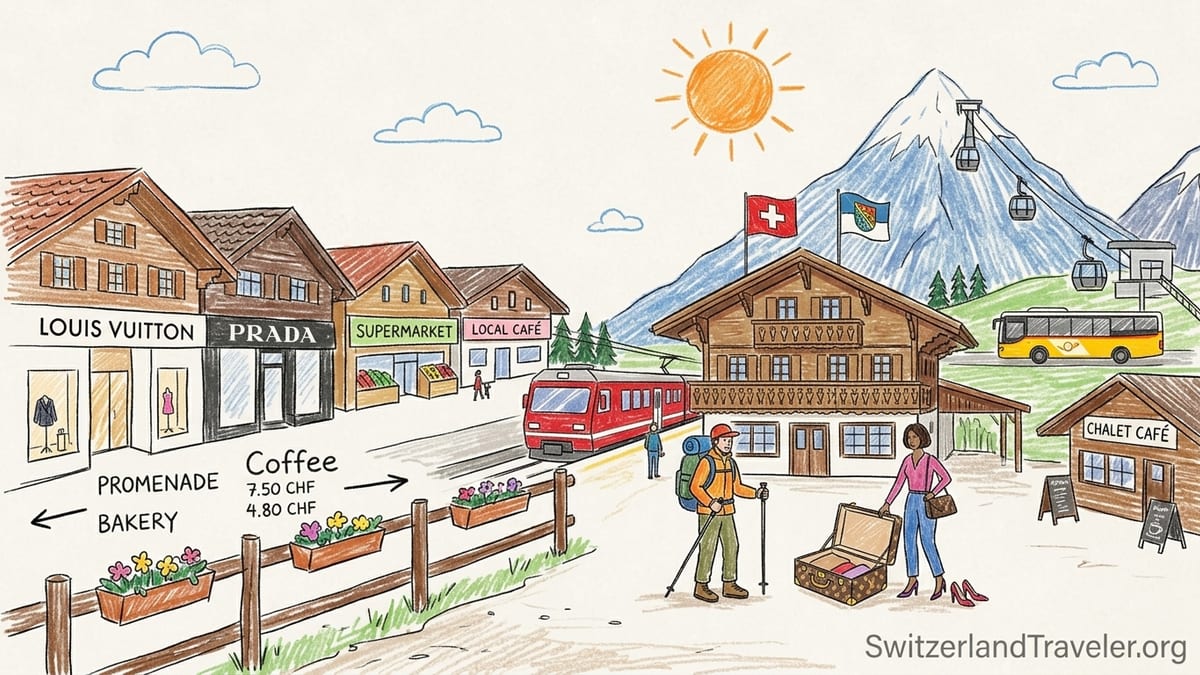
I checked prices before I came, which did not exactly calm my nerves. Guide-style articles describe Gstaad as one of the priciest rural towns in the country, and they are not exaggerating when they mention coffee on the promenade at around 6 to 8 Swiss francs and simple lunches nudging 30 to 45 francs per person if you sit down at a central restaurant. On paper those numbers are intimidating. On the ground, they are very visible on menus outside, which at least means you can make informed decisions before you walk in.
I arrived with a Swiss Travel Pass in my pocket, bought online from the national rail operator, which cost just over 300 francs for four days in second class in 2024. That is a lot of money up front, but it meant my journey to Gstaad from Montreux did not add any extra cost that day. For many visitors, that kind of pass or the Swiss Half Fare Card becomes a quiet equalizer. In public transport at least, I was not priced out by luxury branding, and I stood in the same queue as everyone else for the yellow PostBus to the nearby valleys.
Walking out of the station into the village, the contrast was immediate. Gstaad’s chalet roofs and carved balconies are the picture of Alpine charm, but the first signs you see are for brands like Louis Vuitton and Moncler. It felt a little surreal to cross the tracks out of a perfectly normal regional train and within two minutes stand in front of boutiques where a jacket might cost more than my entire week in Switzerland. This dissonance is exactly why Gstaad fascinates and intimidates at the same time.
Beyond the Promenade: Where Gstaad Feels Like a Village Again
Gstaad’s car-free promenade is the glossy face that appears in magazines. It is short, concentrated and carefully curated. Rents here are among the highest in rural Switzerland, and you feel it the moment you read a menu board. Yet if you turn just a couple of corners away from the central stretch, Gstaad becomes much more like the other Bernese Oberland villages I know: quiet side streets, chalet gardens, locals cycling home from work.
My first hour was simply a walk through these back lanes. I passed the village church, wooden houses with flower boxes and a few small guesthouses that did not advertise spas or Michelin stars, but had handwritten signs in the window. In these streets I spotted a bakery-café where a takeaway espresso was listed at around 4.50 francs and a plain croissant at roughly 2.20 francs. It was still Switzerland, still not cheap, but it was noticeably less than the flagship cafés on the promenade asking 6 or 7 francs for the same caffeine hit in a more polished setting.
That pattern repeated with food. On the promenade, a plate of pasta or a burger in a sit-down restaurant regularly sat in the 30 to 40 franc range, and mains above 50 francs were not rare in hotel dining rooms. Two streets away, a simpler café served a plate of rösti with cheese and an egg for under 25 francs, and the local supermarket’s hot counter offered generous takeout portions of gratin or roast chicken for under 15 francs. Those lower-key options are not obvious in glossy coverage of Gstaad, but they exist if you treat the place like a village and not an open-air luxury mall.
For me, the most important discovery was psychological rather than financial. Once I stopped treating the promenade as the only “real” part of Gstaad, the whole town felt more accessible. I could appreciate the pretty shop windows and quietly walk past the watch boutiques without feeling as though I had failed at the destination. My money and my attention flowed into the ordinary side streets, the supermarket and the small café terrace just off the main drag, where my coffee cost closer to what I was paying elsewhere in Switzerland.
Paying for Views: Cable Cars, Passes and Where Costs Bite
Even if you avoid high-end shopping and fine dining, Gstaad’s mountain scenery still costs money to reach. Cable cars and gondolas in Switzerland are rarely cheap, and Gstaad is no exception. Prices change from season to season, and the area now uses a dynamic pricing system for some passes, but the broad pattern is clear. A return ticket on a local cable car, such as the Wispile gondola above Gstaad or the Eggli lift, tends to land somewhere between 40 and 60 francs for a standard adult fare, depending on route and season. Glacier 3000, the high-altitude highlight reached from nearby Col du Pillon, is more expensive again, with recent adult returns in the 60-franc-plus bracket before any extras at the top.
I visited Wispile on a clear summer morning. My Swiss Travel Pass did not cover the lift, but it did unlock a small discount compared with the rack rate, and holding a Swiss Half Fare Card would have reduced the price by roughly half on many local mountain transports. Buying a single adult return at the ticket window felt like a moment where Gstaad’s reputation for cost was fully justified. For a couple or a family, lifting everyone into the high pastures for the day can eat through a budget in minutes.
On the other hand, once I reached the top and started hiking, everything slowed down and opened up. The ridge path looking across to Les Diablerets and over the Saanenland countryside did not have a VIP section or a roped-off deck. Children chased each other along the trail, hikers unpacked homemade sandwiches on the grass and more than a few clearly well-off guests huffed up the same inclines in high-tech outdoor gear. The only genuinely segregated area was the seating at the most upscale mountain restaurant terrace, where a glass of wine and a main course easily pushed a lunch past 50 francs. A few steps away, people sat on public benches with grocery store picnic spreads and the exact same view.
Public transport around Gstaad helped soften some of these costs. The regional trains and PostBuses that run to Saanen, Schönried, Zweisimmen and the smaller hamlets are integrated into the wider Swiss network. With my pass, hopping to the next village or returning to my guesthouse after a hike cost nothing extra. Without a pass, a short regional train hop of under 15 minutes typically sits in the range of 3 to 6 francs with a Half Fare Card and around double that at full price. Those are real, manageable numbers compared with what luxury coverage often emphasizes, and they are the same prices locals pay.
Everyday Costs: Coffee, Meals, Parking and the Price of Just Being There
Because I wanted to test Gstaad’s reputation honestly, I made a point of writing down what I actually paid on an ordinary travel day. My breakfast coffee at a modest side-street café was 4.80 francs for a small cappuccino, ordered at the counter and drunk at a simple wooden table. Later, I sat down on the promenade for a mid-morning espresso in a stylish establishment, and the same caffeine hit climbed to just under 6.50 francs. Neither price is a bargain by global standards, but the jump between streets illustrated how much you pay for address and atmosphere here.
For lunch I chose not to treat myself to white tablecloth dining. Instead I bought a hot meal from the supermarket’s self-service bistro just off the main street. A generous portion of pasta with vegetables and a side salad came to around 14 francs, and a 0.5-litre bottle of mineral water added another 2.50 francs. Had I chosen a sit-down restaurant on the promenade, I would have been looking at closer to 30 or 35 francs for a plated main, plus 5 or 6 francs for the same water served at the table. That is the kind of difference that turns a destination from theoretically affordable into practically manageable.
Parking costs are another hidden line on the bill, especially if you drive in just for the day. Official information for the region lists multiple public car parks in Gstaad and neighbouring villages. Municipal and lift-operated lots often use digital payment systems such as ParkingPay. Exact hourly rates vary between locations and seasons, but on my visit a central outdoor lot was charging in the region of 1.50 to 2 francs per hour, with higher flat fees in place for major events. The bottom line is that bringing a car into Gstaad does not require billionaire status, but leaving it all day absolutely adds to what is already an expensive country.
One area where I felt genuinely excluded was accommodation in the most famous hotels. Looking online ahead of my trip, I saw five-star properties in Gstaad quoting mid-season double rooms for several hundred francs per night, often reaching four figures during peak winter weeks or around big events like the Swiss Open tennis tournament. Those are their market prices, and there is no need to mock the guests who happily pay them, but for an ordinary traveler they put a full-scale Gstaad hotel experience firmly out of reach. More modest three-star hotels and guesthouses in the wider Saanenland region, including villages like Saanen or Schönried, offered doubles from roughly 180 to 250 francs per night on the same dates. Still a significant outlay, but within reach for a special trip if you plan carefully.
Free and Nearly Free: Walks, Villages and Viewpoints That Cost Nothing
The most encouraging part of my Gstaad experience was how many of my favourite moments cost nothing once I had paid to get there. The entire village is wrapped in accessible walking paths that follow the river, weave between chalets and climb gently into the surrounding hills. One evening I followed a signed path along the Saane river out of the village, past community sports fields and wooden barns. Children played, dogs splashed in the water and the sunset turned chalet roofs gold. I did not see a single logo or price tag during that walk.
Taking the train five minutes down the line to Saanen opened up another character entirely. Saanen’s old centre is quieter, with cobbled lanes and a church that predates Gstaad’s luxury story by centuries. I wandered here for an hour, watching locals chat outside the grocery store and admiring the painted facades. My rail pass covered the journey, and my only expense was a coffee at a simple café that came in just under 4 francs. If Gstaad’s brand feels overwhelming, these neighbouring villages offer a way to base yourself in the same landscape with slightly softer prices and a more everyday rhythm.
Back in Gstaad, one of the best free viewpoints required no lift ticket at all. From the station, a signed path leads uphill through residential streets to a small hillside chapel and a bench overlooking the village. In fifteen unhurried minutes I climbed high enough to see across the chalets to the surrounding peaks. Joggers and parents with strollers passed me; no one checked room keys or ski passes. It was a reminder that in the Alps, altitude and exclusivity are not always connected.
Public fountains provide another tiny but meaningful saving. Swiss tap water is drinkable and excellent, and Gstaad’s fountains are no exception. Refilling my bottle here rather than purchasing multiple drinks across the day kept a few extra francs in my pocket. Over several days, those marginal savings add up to at least one more cable car ride or a meal upgrade somewhere else on your route.
What Really Felt Exclusive in Gstaad
For all its accessible walks and ordinary cafés, there are elements of Gstaad that remain firmly pointed at wealth. Designer boutiques are the most obvious example. Window shopping costs nothing, but these are not places built around browsing backpackers. Many items do not carry visible price tags, and the few that do sit at levels that would fund months of regular travel. It is not hostile, exactly, but it is not for everyone, and it is worth acknowledging that without resentment.
The atmosphere in certain hotel bars and lobbies carries a similar quiet exclusivity. One evening I stepped into a famous five-star hotel just to see the interior. Staff were unfailingly polite, and no one made me feel unwelcome, but the drink menu did that job on its own. Cocktails began around 25 francs, and a glass of champagne climbed far beyond that. The plush armchairs, live piano and discreetly attentive service are part of what some guests travel here for. As a mid-budget visitor, I chose to appreciate the glimpse and then return to a more modest bar where a beer cost closer to 7 or 8 francs.
Event culture adds another layer. Gstaad hosts exclusive gatherings, from polo on snow to classical music festivals and high-profile sports tournaments. Tickets for prime seats at headline performances, VIP packages and hospitality boxes are marketed to a clientele for whom several hundred francs for an evening is acceptable. For everyone else, free fringe concerts or simply enjoying the lively village atmosphere outside the venues are more realistic options. During my visit, I watched workers setting up for a summer tournament and saw clearly how the village infrastructure flexes to serve both the global circuit and the local community.
Luxury accommodation is, perhaps, the clearest line. Walking past the gates of a chalet that looks more like a private lodge than a family home, or seeing a row of black vehicles waiting outside a hotel entrance, it is obvious that many of Gstaad’s visitors inhabit a different financial universe. Yet those same streets carry delivery vans, postal workers and teenagers cycling home from school. The exclusivity is real, but it coexists with a functioning village that still has a school, a supermarket and a train timetable pinned up at the station.
A Low-to-Mid-Budget Day in Gstaad That Still Feels Like Gstaad
So what does an enjoyable, honest day in Gstaad look like if you are travelling on a low to mid-range budget and not staying in a five-star hotel? Mine started with an early regional train from a less expensive base in Zweisimmen, just up the valley, where accommodation prices were around a third lower than in Gstaad on the dates I checked. With my rail pass, the half-hour ride into Gstaad cost nothing extra and delivered the same postcard arrival.
After a quick wander through the village to watch Gstaad waking up, I ducked into a side-street bakery for breakfast. A cappuccino and a fresh pastry together came in under 8 francs, enjoyed at a small table where locals stopped in on their way to work. From there I followed the riverside path for an hour, looping back into the centre in time for the mid-morning bus to the Wispile gondola station. I bought a discounted return ticket with my travel pass, aware that this would be my big spend of the day, and reminded myself that sometimes paying for a view is exactly why you come to the Alps.
At the top I resisted the lure of the restaurant terrace and hiked the ridge trail instead, stopping at a public bench to eat a simple picnic I had assembled from Gstaad’s supermarket that morning for around 10 francs. The view over green pastures and distant glaciers did not require a reservation. In the afternoon, back in the village, I allowed myself one indulgence: a scoop of gelato from a promenade parlour for just under 5 francs, eaten while I watched an effortless mix of high fashion shoppers, parents with strollers and hikers drifting past.
Before catching the train back to my base, I took the short uphill walk to the chapel viewpoint and sat on the bench overlooking the village, checking my notes. All in, my spending in Gstaad that day, excluding transport already covered by my pass, landed around 45 to 55 francs: breakfast, picnic ingredients, one cable car excursion, a treat on the promenade and a modest drink at a local bar by the station before departure. It was not a shoestring backpacker day, but it was also far from the stratospheric bills that Gstaad’s image might lead you to expect.
Most importantly, the day still felt like Gstaad. I walked past the same legendary hotels, saw the same watch boutiques and breathed the same Alpine air as people whose room keys opened penthouse suites. The difference lay in where I chose to sit down, what I ordered and which parts of the experience I was willing to pay for. Luxury remained present but optional.
The Takeaway
Stripped of its branding, is Gstaad worth visiting if you are not rich? After walking its lanes, riding its lifts and counting my receipts, my answer is yes, with conditions. If your expectation is to experience Gstaad exactly as its wealthiest visitors do, then a normal budget will always fall short. You are unlikely to dine nightly in palace-style restaurants, spend freely on designer shopping or book a private guide for every hike. In that sense, the destination’s glossy reputation reflects a very real tier of travel that most of us simply do not inhabit.
However, if what you seek is a beautiful Alpine village with strong public transport connections, excellent hiking and a curious blend of everyday Swiss life and high-end sheen, then Gstaad can absolutely work without a five-star hotel key in your pocket. You will pay more here for coffee and casual meals than in many other places, and certain experiences, particularly premium accommodation and event hospitality, remain financially out of reach for ordinary travelers. At the same time, village walks, riverside paths, free viewpoints, affordable bakeries just off the main drag and reasonably priced regional trains all offer access points that are not gated by wealth.
Ultimately, Gstaad challenged my assumptions more than my bank account. It reminded me that luxury destinations are rarely as one-dimensional as their reputations, and that branding can obscure both the real costs and the genuine, simple joys of a place. If you approach Gstaad with open eyes, a realistic budget and a willingness to step one street away from the glossy promenade, you can leave with something far more interesting than a shopping bag: a clear sense that this famous resort is, at heart, still a village you can walk, watch and enjoy without being rich.
FAQ
Q1. Can I enjoy Gstaad on a mid-range budget without feeling out of place?
Yes. If you stay in simpler accommodation, use public transport, choose bakeries and supermarkets for some meals and limit pricey cable car rides, you can experience Gstaad comfortably without luxury spending.
Q2. How expensive is food and coffee in Gstaad for an ordinary visitor?
On the central promenade, expect coffee in the 6 to 8 franc range and sit-down mains often above 30 francs. A short walk away, cafés, bakeries and supermarkets offer meals and drinks closer to wider Swiss norms.
Q3. Are there genuinely free things to do in Gstaad?
Yes. Village walks, riverside paths, visits to nearby Saanen, hillside viewpoints and simply exploring the chalet streets are all free once you have travelled to the region.
Q4. Do I need to stay in Gstaad itself, or can I base in a cheaper village?
You can absolutely base in nearby villages such as Saanen, Schönried or Zweisimmen, where room rates often run lower, and use frequent regional trains to reach Gstaad in minutes.
Q5. Are cable cars and mountain lifts in Gstaad worth the cost?
They are a significant expense, often running 40 francs or more for an adult return, but they unlock outstanding scenery. Many travelers choose one key lift, then focus on free hiking once at altitude.
Q6. How does public transport help manage costs in Gstaad?
Rail passes or the Swiss Half Fare Card reduce the cost of reaching Gstaad and moving around the Saanenland region. Once you have a pass, short hops between villages feel affordable and flexible.
Q7. Is there affordable food if I do not want to eat in luxury hotels?
Yes. Supermarket hot counters, modest cafés off the main street and bakery takeout options provide filling meals at far lower prices than fine-dining hotel restaurants.
Q8. Will I feel uncomfortable around luxury travelers if my budget is limited?
Most likely not. Gstaad attracts a wide mix of visitors, from wealthy holidaymakers to day-trippers and hikers. As long as you are respectful, you can coexist comfortably regardless of budget.
Q9. Is Gstaad more expensive than other Swiss mountain villages?
Central Gstaad tends to charge higher prices for food, drinks and accommodation than many comparable villages, especially on the promenade. The surrounding Saanenland offers more moderate options.
Q10. If I only have one day in Gstaad on a budget, what should I prioritise?
Arrive by train, stroll the village and promenade, walk a riverside or hillside path, treat yourself to one viewpoint by cable car if funds allow and enjoy a picnic from the supermarket with mountain views.