


Choosing the right rail pass in the Bernese Oberland can easily save or waste several hundred francs on a single trip. With 2026 prices for the Berner Oberland Pass, Jungfrau Travel Pass, Swiss Travel Pass and Swiss Half Fare Card now published, it is possible to compare them using concrete, real-world itineraries instead of abstract theory. This guide walks through what each pass really covers, then tests them on typical stays in Interlaken, Grindelwald and Lauterbrunnen so you can decide with confidence before you book expensive mountain excursions.
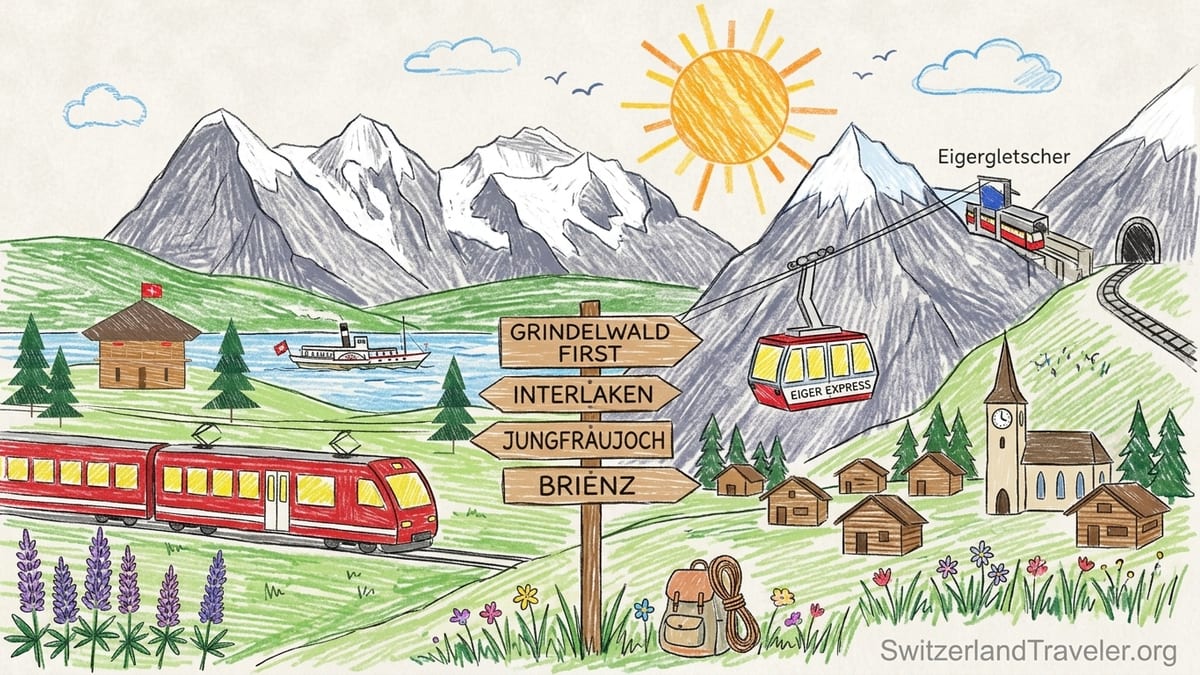
How the main Swiss passes work in the Bernese Oberland in 2026
Three products dominate trip planning for the Jungfrau region in 2026: the Regional Pass Berner Oberland (often called the Berner Oberland Pass), the Jungfrau Travel Pass and the nationwide Swiss Travel Pass. All three work on the same trains, boats and mountain railways but treat the most expensive sections differently, especially around Jungfraujoch and the frontier between Interlaken, Grindelwald and Lauterbrunnen.
The Berner Oberland Pass is a regional pass valid for 3, 4, 6, 8 or 10 consecutive days and covers a network stretching from Bern and Lucerne down to Kandersteg, Gstaad, Meiringen, Interlaken, Grindelwald, Lauterbrunnen and Mürren. Its 2026 fact sheet confirms that it gives free travel on most regional trains, postbuses and the lake boats on Thun and Brienz, plus free or discounted travel on many mountain railways within the region.
The Jungfrau Travel Pass is focused purely on the Jungfrau Region. The current 2026 area of validity shows unlimited travel on key routes such as Interlaken Ost to Grindelwald and Lauterbrunnen, the Wengen and Mürren branches, the Eiger Express cableway and the gondola to Grindelwald First. Jungfraujoch is not fully included but offered with a reduced connecting ticket from Eigergletscher. The pass is sold for several durations in the summer season and is priced to appeal to visitors spending at least three intensive mountain days.
The Swiss Travel Pass is the national product. It includes unlimited travel on the regular Swiss rail, bus and boat network and many city trams and local buses. In the Bernese Oberland it fully covers intercity travel to Bern, Lucerne, Zurich or Geneva, plus regional trains to Interlaken and the lake boats. On many mountain railways, including several in the Jungfrau region, it offers a 50 percent discount instead of full coverage, so its value depends heavily on how many long intercity trips you combine with your Bernese Oberland stay.
Key 2026 prices, validity and child rules
For adults without any other discount card, the Berner Oberland Pass 2026 tariff sheet lists prices that vary by duration and whether you qualify for the “reduced” tier. The reduced tier, roughly 30 percent off, is open to holders of a Swiss Travel Pass or Swiss Half Fare Card and makes this regional pass much cheaper for those already investing in a national product. Children aged 6 to under 16 can obtain a Berner Oberland child pass for a flat 30 francs when accompanying an adult pass holder, or travel free if they hold a Swiss Family Card, Junior Card or Children’s Co-Travelcard together with that adult.
The Jungfrau Travel Pass 2026 promotion material confirms a similar child rule: children aged 6 to 15 pay 30 francs for the full validity of the adult’s pass, which is extremely attractive for families planning multiple gondola rides. Pricing for adults scales with duration. As an example, published 2026 material around Grindelwald First notes that a 3 day Jungfrau Travel Pass costs in the low 200s in francs, while holders of a Swiss Travel Pass or Half Fare Card can buy it at a reduced rate in the mid 100s.
The Swiss Travel Pass is sold for 3, 4, 6, 8 and longer durations in first or second class. In 2026, a typical 3 day second class pass for adults is a little above 250 francs at published rates, with longer passes discounted per day. Crucially for families, the Swiss Travel Pass comes with a free Swiss Family Card for children aged 6 to under 16, which gives them free travel on the same routes as the accompanying adult and free or discounted travel on mountain railways according to the same rules.
Alongside these passes, the Swiss Half Fare Card remains a powerful competitor. For a fixed price valid for one month, visitors can buy point to point tickets at half price across most of the Swiss Travel System, including many mountain railways. The official description notes that children with a complimentary Swiss Family Card travel free on the same half price basis. In 2026, many regional passes, including the Berner Oberland and Jungfrau passes, are sold at special reduced prices to Half Fare Card holders, which changes several break even calculations.
What is actually included on the ground: sample routes and coverage
To understand which pass saves the most money, it helps to look at specific 2026 prices for key excursions. Take the Grindelwald First gondola, one of the classic day trips from Grindelwald. The operator’s current price table lists a return adult ticket at 76 francs. Holders of the Half Fare Card, Swiss Travel Pass, GA or Berner Oberland Pass receive a 50 percent discount and pay 38 francs. With a Jungfrau Travel Pass, rides on the First gondola are fully included during the pass validity.
The same pattern appears for other Jungfrau operated lifts. Routes such as Interlaken Ost to Grindelwald or Lauterbrunnen and on to Wengen or Mürren are included on the Jungfrau Travel Pass during its season. Jungfraujoch, however, is only offered as a discounted add on. The 2025 brochure for the Jungfrau Travel Pass mentions a connecting ticket from Eigergletscher to Jungfraujoch in the 60 to 80 franc range depending on the period, which suggests that for 2026 travelers should budget a substantial but discounted supplement on top of the pass.
The Berner Oberland Pass network map for 2026 shows full coverage on regular trains between Bern, Thun, Interlaken, Spiez and Meiringen, as well as on both lake fleets on Thun and Brienz. It includes full travel on certain mountain railways such as Brienzer Rothorn and Niesen, and offers discounts on others where Jungfrau Railways set the tariffs. That means a day trip from Interlaken to Brienzer Rothorn by boat and steam train could be almost entirely covered by a Berner Oberland Pass, while an excursion to Jungfraujoch or Schilthorn would still require a reduced fare supplement.
The Swiss Travel Pass behaves differently. It fully covers intercity and regional trains, including long runs from Zurich Airport to Interlaken via Bern, and gives free travel on the two lakes. On many mountain railways it offers 50 percent off, which matches the discount level for the Half Fare Card. In practice, that means that a visitor with a Swiss Travel Pass might pay half price for Grindelwald First or the Schilthorn cable car, free for some smaller lifts, and a significant but reduced supplement for Jungfraujoch. When combined with the pass’s value on long distance routes outside the Bernese Oberland, this discount structure can still be very attractive.
Interlaken base: 3 and 4 day break even examples
Consider a solo traveler staying three nights in Interlaken in July 2026. They plan to visit Grindelwald First on one day, cruise Lake Brienz and ride the Brienzer Rothorn on the second day, and keep a flexible third day for a combination of Lauterbrunnen valley walks and the Harder Kulm funicular. All other transfers are short hops between Interlaken Ost and accommodation.
Using point to point fares at current 2026 levels, Grindelwald First would cost roughly 76 francs return from Grindelwald for the gondola alone, plus regional train fares between Interlaken and Grindelwald. A full lake cruise on Brienz with a return on the Brienzer Rothorn steam train can approach or exceed 100 francs at regular adult prices. Adding local trains and another paid excursion such as Harder Kulm can push the three day transport budget into the high 200s or low 300s in francs, even before a Jungfraujoch trip.
For this Interlaken pattern, a 3 day Berner Oberland Pass for adults without any other discount card is usually pitched below that combined number while giving full coverage for almost every element of the itinerary. The pass covers the lake boats, Interlaken to Brienz and Brienzer Rothorn, Interlaken to Grindelwald and often grants at least a discount on local lifts like Harder Kulm. If the same traveler already holds a Swiss Half Fare Card or Swiss Travel Pass, the reduced price for the Berner Oberland Pass drops further and quickly becomes cheaper than buying three days of half price point to point tickets.
On the other hand, suppose that same traveler also needs transfers from Zurich Airport to Interlaken and from Interlaken to Geneva at the start and end of their stay. In that case, a 4 day Swiss Travel Pass, which includes both long distance journeys and the lake cruises and regional trains, might come closer in cost once the intercity fares are added. The pass would still only discount Grindelwald First or Brienzer Rothorn by 50 percent, but the savings on airport and intercity legs could exceed what the Berner Oberland Pass offers solely within the region. For a 3 or 4 day Interlaken base that is part of a longer loop around Switzerland, the Swiss Travel Pass and a separate discounted Jungfrau excursion often break even with or beat the regional pass.
Grindelwald or Lauterbrunnen base: 6 and 8 day mountain heavy stays
Now consider a traveler or couple spending six or eight nights in Grindelwald or Lauterbrunnen with limited long distance travel. Their wish list in 2026 might include Grindelwald First, the Männlichen gondola, hikes from Kleine Scheidegg, at least one trip to Jungfraujoch, and perhaps the Schynige Platte cog railway. They may also want a lake cruise or a day in Thun but will spend most time on mountain transport in the Jungfrau region.
The published 2026 price for Grindelwald First return is 76 francs, while Jungfraujoch at full fare can easily exceed 200 francs for a return from the valley when all segments are added. Routes such as Schynige Platte and Männlichen also run to several dozen francs per person. A week of buying each of these separately, even with a Half Fare Card, can climb into the high hundreds or beyond a thousand francs per person when multiple high mountain days are included.
For this kind of itinerary, the Jungfrau Travel Pass begins to shine. Current information confirms that the pass fully includes Grindelwald First, Schynige Platte, Harder Kulm, the Männlichen gondola, and travel between Interlaken Ost, Grindelwald, Lauterbrunnen, Wengen and Mürren during its validity. The only major extra cost is the Jungfraujoch connecting ticket. With a 6 or 8 day pass priced to cover repeated use of these lines, a traveler who rides more than two or three big lifts plus frequent valley trains can often recoup the price and more.
By contrast, a Berner Oberland Pass for 6 or 8 days will fully cover many of the same valley and lake routes, and some mountain journeys, but it typically gives only a percentage discount on key Jungfrau Railways lifts. If your focus is almost entirely on those specific mountains, you could end up paying the pass price plus multiple discounted tickets, which may approach or exceed the cost of the Jungfrau Travel Pass plus Jungfraujoch supplement. The Berner Oberland Pass becomes more competitive again if you also plan days out to Kandersteg and Oeschinensee, Gstaad, or repeated cruises on both lakes.
Adding the Swiss Half Fare Card into the equation
The Swiss Half Fare Card complicates but often improves the calculation. The official description states that holders can buy tickets for trains, buses, boats and most mountain railways at half price for one month. In the Bernese Oberland, that includes half price on Grindelwald First, Schynige Platte, and many other lifts and funiculars. When you combine this with the card’s relatively modest price for a month, it can pay off on a single intense week of travel.
Several 2026 sales channels show that the Berner Oberland Pass offers a reduced adult price for holders of a Swiss Travel Pass or Swiss Half Fare Card. That reduction is roughly a third off the standard price. In practice, a traveler who knows they will use rail elsewhere in Switzerland could purchase a Swiss Half Fare Card, then buy a reduced price Berner Oberland Pass, then still receive half price where the regional pass only gives a discount instead of full coverage. For a 6 to 8 day stay that mixes Jungfrau lifts with out of region trains, this combination can undercut both a standalone Swiss Travel Pass and a full price Berner Oberland Pass.
The Jungfrau Travel Pass can also be discounted for holders of Half Fare or a Swiss Travel Pass, bringing a 3 day version into the mid 100s in francs for adults. A frequently mentioned strategy for 2026 is to pair a Swiss Travel Pass or Half Fare Card with a discounted Jungfrau Travel Pass for the core mountain days, then rely on the national product for the rest of the itinerary. That way, a visitor pays once for national rail coverage and again for unlimited local mountains, instead of buying multiple separate point to point mountain tickets at half price.
Families benefit even more. The Swiss Family Card linked to a Swiss Travel Pass or Half Fare Card gives children aged 6 to under 16 free travel on the same routes as the adult. When combined with child products tied to the regional passes at 30 francs for the full validity, the marginal cost of taking children on expensive lifts becomes relatively small. On an 8 day stay that includes multiple rides to First and Männlichen plus a Jungfraujoch visit, saving or spending only a small supplement for each child can change the choice of pass more than the adult calculations.
Break even summaries for 3, 4, 6 and 8 days
Because individual fares vary by route and season and some 2026 mountain tariffs can still change, any break even figures should be read as examples, not universal formulas. However, patterns emerge when comparing realistic baskets of journeys for typical trip lengths of 3, 4, 6 and 8 days based on current listed prices.
For 3 days based in Interlaken with at least one lake cruise and one major lift such as Grindelwald First but no Jungfraujoch, a full price 3 day Berner Oberland Pass often comes close to or slightly under the cost of separate regular tickets. If that traveler also needs long distance transfers to and from other Swiss cities, a 3 day Swiss Travel Pass can break even or win, especially when the mountain days are limited to one or two discounted excursions. If the plan is mountain heavy around Grindelwald, a 3 day Jungfrau Travel Pass, especially at the reduced price for Half Fare or Swiss Travel Pass holders, tends to be cheaper than buying a single First ticket plus several valley segments.
At 4 days, many visitors add either Jungfraujoch or a second big mountain excursion. In that scenario, the Jungfrau Travel Pass plus Jungfraujoch connecting ticket starts to compare favorably to buying every lift at half price with a Half Fare Card. The Berner Oberland Pass is still compelling if two of those days involve long boat trips, Brienzer Rothorn or excursions outside the strict Jungfrau core. The Swiss Travel Pass becomes more appealing once you add more intercity legs like Lucerne to Interlaken and onward to Zermatt or Montreux. For a 4 day itinerary completely within the Jungfrau region, however, the regional products usually beat a national pass in pure cost.
For 6 or 8 day trips, the cumulative effect of high mountain fares becomes decisive. If a traveler staying in Grindelwald or Lauterbrunnen plans almost a mountain excursion every day, including First, Männlichen, Schynige Platte and at least one trip to Jungfraujoch, a 6 or 7 day Jungfrau Travel Pass plus connecting ticket has a strong chance of being the cheapest option, especially when bought at the reduced rate tied to Half Fare or Swiss Travel Pass. A Berner Oberland Pass over the same period can be better if the plan includes additional long days to Kandersteg, Gstaad or repeated use of the lake boats.
When strong national rail needs are mixed into a 6 or 8 day plan, the Swiss Half Fare Card plus a reduced regional pass often wins. Buying a full price Swiss Travel Pass for such a period mostly pays off if there are multiple long jumps across Switzerland on top of intensive Bernese Oberland travel. In every case, the most accurate approach is to list every planned day and price out each leg using current 2026 tariffs on the official Swiss Federal Railways and Jungfrau Region tools, then compare the sum with the published pass prices and discounts.
The Takeaway
There is no single universal winner among the Berner Oberland Pass, Jungfrau Travel Pass, Swiss Travel Pass and Swiss Half Fare Card for 2026. Each can be the cheapest in a different situation. The Berner Oberland Pass is a strong default for travelers spending 3 to 8 days mostly within the wider Bernese Oberland who want freedom to ride trains, boats and many mountain lines without thinking about individual ticket prices.
The Jungfrau Travel Pass is designed for visitors whose priority is to ride the main Jungfrau Region lifts repeatedly from bases in Grindelwald, Wengen, Lauterbrunnen or Mürren. Its inclusion of Grindelwald First and other expensive lifts, plus straightforward child pricing, makes it especially persuasive for mountain heavy 3 to 8 day stays focused on the core valleys, with Jungfraujoch as an added discounted extra.
The Swiss Travel Pass is a national backbone product. It works best for itineraries that string the Bernese Oberland together with other Swiss highlights such as Lucerne, Zermatt, Montreux or Ticino, and where the total distance on regular trains and boats is large. Within the Jungfrau region it often behaves like a Half Fare Card on lifts, so its advantage lies in covering long distance journeys and museums rather than maximizing savings on gondolas.
The Half Fare Card itself, especially when combined with reduced prices on regional passes, can outperform a Swiss Travel Pass on many 6 to 8 day itineraries that involve both the Bernese Oberland and other parts of the country. The best approach for 2026 is to write down your exact base, day by day excursions and long distance transfers, then test two or three options using real tariffs and current pass prices. By matching the product to your true itinerary instead of relying on general advice, you stand the best chance of keeping your Jungfrau dreams high while your transport costs stay under control.
FAQ
Q1. Which pass is usually best if I stay only in Interlaken for three days?
For a three day stay focused on lake cruises and one or two mountain trips but no Jungfraujoch, the Berner Oberland Pass often comes closest to covering everything at the lowest total cost, unless you also have substantial long distance train rides before and after, in which case a Swiss Travel Pass might compete strongly.
Q2. I want to visit Jungfraujoch from Grindelwald in 2026. Which pass should I look at first?
If Jungfraujoch is your main goal and you also plan several other Jungfrau Region lifts like First, Männlichen or Schynige Platte, the Jungfrau Travel Pass plus the discounted Jungfraujoch connecting ticket is usually the first product to compare, then check if adding a Half Fare Card or Swiss Travel Pass reduces its price further.
Q3. Does the Swiss Travel Pass give free travel to Jungfraujoch?
No. The Swiss Travel Pass includes free travel on regular trains and boats but only discounts the higher mountain segments towards Jungfraujoch, so you must still buy a reduced ticket for the final and often most expensive part of the journey.
Q4. Are children really almost free with these passes?
In many cases yes. The Swiss Family Card that comes with a Swiss Travel Pass or Half Fare Card gives children aged 6 to under 16 free travel on the same routes as the adult, and both the Berner Oberland Pass and Jungfrau Travel Pass offer child products for 30 francs that cover the whole validity period when tied to an adult pass.
Q5. Is it worth buying both a Swiss Travel Pass and a Berner Oberland Pass?
Buying both only makes sense if you will travel widely across Switzerland and also spend several intensive days on mountain and boat trips within the Bernese Oberland; many travelers find that a Swiss Half Fare Card plus a reduced price Berner Oberland Pass achieves similar coverage at a lower combined cost.
Q6. How do I decide between the Jungfrau Travel Pass and Berner Oberland Pass?
Look at where you will sleep and what you will ride; if most days are in the Jungfrau core with repeated use of First, Männlichen and valley railways, the Jungfrau Travel Pass is usually stronger, while if you want to roam beyond to Kandersteg, Gstaad, Lucerne or spend time on both lakes, the Berner Oberland Pass tends to win.
Q7. Does the Half Fare Card alone ever beat all the passes?
Yes, particularly for shorter visits or flexible plans where you expect only one or two big mountain excursions and several long intercity journeys, in which case paying half price for individual tickets with the Half Fare Card can be cheaper than buying any flat rate pass.
Q8. Should I worry about seasonal validity dates when choosing a pass?
Absolutely; products like the Jungfrau Travel Pass only run in specific summer periods and some lifts have separate summer and winter tariffs, so always confirm your travel dates against the latest validity calendars before deciding.
Q9. Can I upgrade from one pass to another partway through my trip?
You cannot usually convert one pass into another, but you can combine them, for example by using a Swiss Travel Pass for the first part of your trip and then buying a Jungfrau Travel Pass just for the days based in Grindelwald or Lauterbrunnen.
Q10. Where should I check exact 2026 prices before I book?
Use the official fare calculators of Swiss Federal Railways for regular trains and the Jungfrau Region and Berner Oberland pass issuers for mountain and regional networks, then compare those precise numbers against the latest published pass prices for your exact dates.