

Switzerland’s lakes are often where first-time visitors fall in love with the country, and two names come up again and again: Lake Lucerne in Central Switzerland and Lake Geneva in the French-speaking west. Both combine water, mountains and charming towns, but they offer very different first impressions of the country. Choosing between them will shape how much Alpine drama you see, how easy day trips feel and even how much you spend on hotels and dining. This guide compares Lake Lucerne and Lake Geneva across scenery, lakeside cities, cruises, mountain excursions, swimming, transport and overall vibe to help you decide which one deserves priority on a first-time Swiss itinerary.
Big Picture: How the Two Lakes Feel
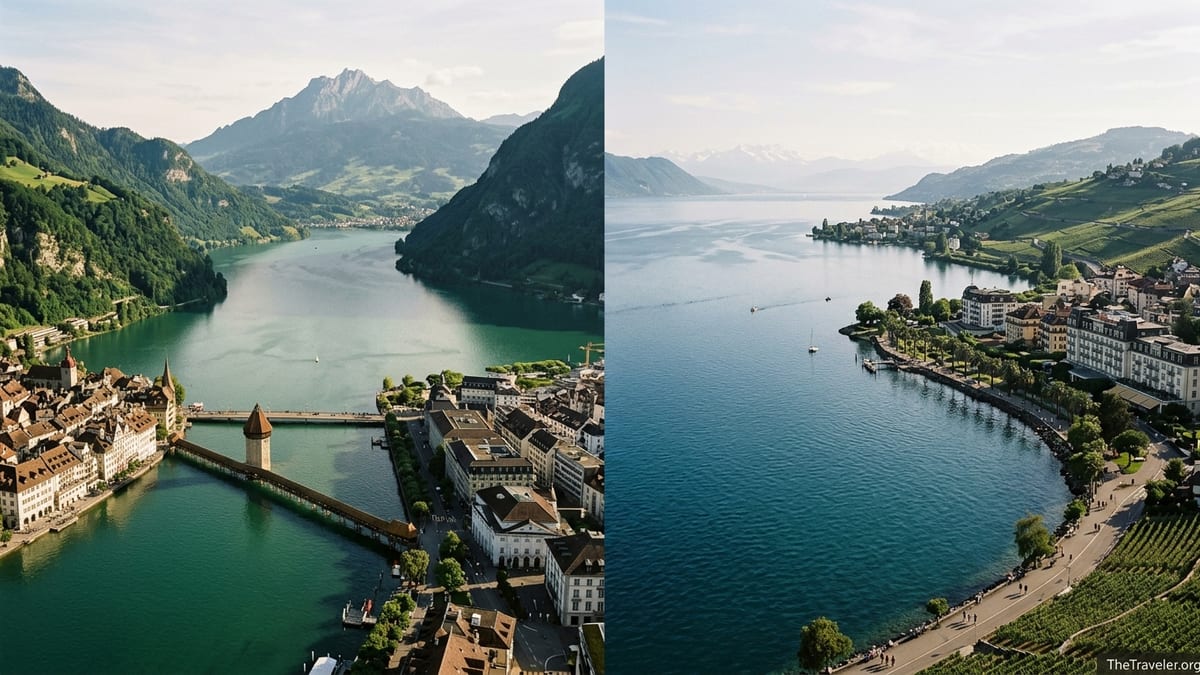
Lake Lucerne, wrapped in steep green slopes and sharp peaks, feels like a classic storybook Switzerland in compact form. The lake twists through narrow arms framed by cliffs, with historic villages such as Weggis, Vitznau and Brunnen clustered along the water. The city of Lucerne itself has covered wooden bridges, medieval towers and a walkable old town that many travelers can comfortably explore in one day. For a first trip, it often feels like an easy “Switzerland in miniature” where you can step off a train and be in the mountains or on a paddle steamer within the hour.
Lake Geneva, by contrast, is broad, grand and more urban. The lake is one of Western Europe’s largest, shared by Switzerland and France, with major cities such as Geneva and Lausanne on its shores and resort towns like Montreux and Vevey on the eastern “Swiss Riviera” side. Here the backdrop is vineyards and distant peaks rather than vertical cliffs at the water’s edge, and the mood is more cosmopolitan: international organizations in Geneva, university life in Lausanne, Belle Époque hotels in Montreux and relaxed lakeside promenades everywhere.
For a first-time visitor, the choice is partly about what “Switzerland” means to you. If you picture jagged mountains rising almost straight from the water and traditional lakeside villages, Lake Lucerne delivers that more directly. If you imagine café terraces, vineyards and a blend of city culture with lake views, Lake Geneva is more your scene. Both regions are well connected by Swiss trains and boats, but they structure an itinerary quite differently.
Budget can also play a role. Both lakes are expensive by global standards, but Geneva as a city is regularly cited as one of Europe’s pricier destinations for accommodation and dining, while Lucerne and smaller towns around Lake Lucerne can feel a little more manageable for mid-range budgets, especially outside peak summer dates.
Alpine Scenery and Lakeside Atmosphere
In scenic terms, Lake Lucerne wins on drama at close range. The water is hemmed in by peaks such as Pilatus, Rigi and the Bürgenstock, and several arms of the lake are narrow enough that forests and rock faces feel almost within touching distance from the boat. On a standard one-hour cruise from Lucerne to Weggis or Vitznau, you see a changing panorama of small coves, chapel-topped hills and snow-capped peaks further back, which gives first-time visitors exactly the sort of “Alps over the water” photographs they often hope for.
By comparison, Lake Geneva’s drama is more about breadth and layering. From the promenades in Montreux or Vevey, the lake stretches out like an inland sea, with the Rhône valley and Alpine peaks rising at the far end and the terraced Lavaux vineyards stepping down to the water on the north shore. On clear days in Geneva itself, you can see the Mont Blanc massif in the distance, though city structures and foreground hills mean it never frames the lake quite as tightly as the peaks around Lucerne do.
Atmosphere on shore is also distinct. Lucerne’s old town, with its riverside squares, painted facades and the iconic Chapel Bridge, feels intimate and easy to grasp in an afternoon. Lakeside villages such as Weggis have a resort feel but remain small enough that you quickly find the main promenade and a few restaurants along the water. Around Lake Geneva, the vibe shifts as you move. Geneva’s quays and parks feel formal and international, Lausanne’s Ouchy district is livelier and more youthful, while Montreux and Vevey combine palm-lined promenades, Belle Époque hotels and grand villas that feel more like the Côte d’Azur than Central Switzerland.
If you want nature to feel close and omnipresent, Lake Lucerne’s topography gives it the edge. If you like the idea of combining lake views with sophisticated city life, shopping and vineyards, Lake Geneva’s broader shores will appeal more.
Lakeside Cities, Towns and Hotels
Lucerne is the clear hub around Lake Lucerne. It is large enough to offer a range of hotels, from simple city properties near the station to five-star options with direct lake frontage and spa facilities, yet small enough that you can cross the old town on foot in under 20 minutes. Many first-time visitors choose Lucerne as a base because it simplifies logistics: lake piers, train station and old town are all clustered together, so you can roll your suitcase off a train and be at your hotel or on a boat in a matter of minutes.
Around the lake itself, Weggis and Vitznau stand out for resorts that feel semi-rural but still very accessible. In Weggis, for example, lakefront hotels with small private piers and lawns allow guests to swim directly from the property in summer or simply sit on terraces looking across to Mount Rigi. Prices vary with category, but a mid-range double room in high season can easily sit in the mid to upper hundreds of Swiss francs per night, while upscale spa resorts on the Bürgenstock or in Vitznau can run significantly higher.
Lake Geneva presents a more stratified hotel scene. Geneva city is dominated by business travelers and international organizations, so room rates in summer often reflect corporate rather than tourist demand. Many visitors on leisure trips therefore base themselves instead in Lausanne, Montreux or Vevey, where there is a broader spread of classic palace hotels, modern design properties and simpler guesthouses back from the water. Montreux in particular is known for grand Belle Époque lakeside hotels, some with ornate dining rooms, palm-fringed gardens and direct access to the lakeside promenade.
For a first-time visitor who wants a single base and simple navigation, Lucerne is slightly easier: there is one main lakeside city and the majority of boats and mountain excursions start there. Around Lake Geneva, the decision of whether to stay in Geneva, Lausanne or Montreux subtly changes the character of the trip, and the lake’s scale makes moving between bases more time-consuming.
Cruises, Boats and Being on the Water
Both lakes offer memorable cruises, but they are used in different ways. On Lake Lucerne, boats are a core part of how you move through the region and combine with mountain excursions. Historic paddle steamers and modern motor vessels depart from the piers just below Lucerne’s old town and call at multiple villages including Weggis, Vitznau, Beckenried, Brunnen and Flüelen. Many standard Swiss Travel Passes are valid on these services, so first-time visitors often find themselves stepping aboard without buying separate tickets, simply scanning their pass and choosing how far to ride.
Because of the lake’s shape, cruises here feel like journeys into the landscape rather than simply along it. A popular example for new visitors is to take a one-hour sailing from Lucerne to Vitznau, watching Mount Rigi grow larger as you approach, or to follow the longer route down to Flüelen at the far end, where cliffs close in and the scenery feels noticeably wilder. Combined tickets bundle boat travel with mountain railways, so you might buy a package that includes a lake cruise plus the rack railway up Rigi or the Golden Round Trip around Pilatus, simplifying what could otherwise be a complex set of tickets.
On Lake Geneva, regular boat services connect Geneva, Nyon, Lausanne, Vevey, Montreux and smaller towns, but the distances involved are greater. A full crossing from Geneva to the eastern lake can take most of a half day by boat, so many first-time visitors treat cruises here more as scenic outings than as day-to-day transport. Shorter legs, such as Lausanne to the French spa town of Évian, or Montreux to Chillon Castle, fit more easily into a busy itinerary.
If your dream is to ride an old-fashioned paddle steamer past close-up mountain slopes, Lake Lucerne is the better match. If you prefer broader vistas and the feeling of moving between sophisticated lakeside towns, a Lake Geneva cruise, perhaps between Lausanne, Vevey and Montreux, may be more appealing. In both regions, kiosk ticket offices at the piers make same-day planning straightforward as long as you are comfortable checking timetables.
Mountain Excursions, Vineyards and Day Trips
For straightforward access to high viewpoints, Lake Lucerne has a strong advantage. From Lucerne, you can reach the summits of Pilatus or Rigi in roughly half a day, combining boats, cogwheel trains and cable cars. The classic Pilatus Golden Round Trip typically involves a boat or train from Lucerne to Alpnachstad, the steep cogwheel railway up to Pilatus, panoramic walks on the summit and a return by cable car and gondola down to Kriens before a short bus ride back into town. Rigi excursions often start with a boat to Vitznau, a rack railway ride up to Rigi Kulm and walks along broad ridge paths with lake views in multiple directions.
Costs for these excursions vary with passes and promotions, but visitors using a Swiss Travel Pass usually find Rigi one of the most budget-friendly major mountains around Lucerne because several segments are fully covered by the pass. This can make a significant difference for families or couples planning multiple big-ticket outings in a short stay. Other nearby peaks such as the Stanserhorn and the Bürgenstock are accessible by combinations of train, boat and funicular, giving first-timers several high viewpoints to choose from without long transfers.
Around Lake Geneva, the most accessible “mountain” experiences are slightly different in character. From Montreux, the cogwheel train to Rochers de Naye climbs above the town to a summit above 2,000 meters, with broad views, simple walking paths and a distinctly quieter atmosphere than the busy promenade below. Vineyards are as important here as high peaks: the Lavaux terraces between Lausanne and Montreux, reached easily by local train to villages such as Cully or Rivaz, offer walking paths through vines, tasting rooms and views across the lake to the French shore.
Day trips from Lake Geneva bases also lean more toward culture and food than extreme Alpine terrain. From Montreux or Lausanne, it is straightforward to combine a morning exploring Chillon Castle, a medieval fortress projecting into the lake, with an afternoon wine tasting or a stroll in Vevey’s old town. From Geneva, travelers often take train day trips to Lausanne or even into France for spa towns and lakeside walks. If your priority for a first Swiss trip is to stand on a high ridge and feel surrounded by peaks on short notice, Lucerne makes that easier. If you want to mix vineyards, castles and moderate viewpoints, Lake Geneva works beautifully.
Swimming, Lakeside Walks and Seasons
Both lakes are swimmable in summer, although water temperatures are fresh even at the height of the season. Around Lake Lucerne, public lidos in Lucerne itself and in villages like Weggis offer lawns, jetties, changing facilities and in some cases shallow areas suitable for children. In August, the lake is typically comfortable enough for confident swimmers, and many visitors enjoy quick dips combined with lakeside picnics or café stops. The setting here feels close to the mountains, with forested slopes often rising directly behind the bathing area.
Lake Geneva’s swimming culture tends to be more urban and varied. Geneva has several popular public bathing spots along the city shoreline, with simple infrastructure such as changing cabins and diving platforms, and in summer the atmosphere can be lively, especially on warm evenings after work. In Lausanne’s Ouchy district, broad promenades and grassy patches make informal sunbathing easy, while in Montreux and Vevey a string of small beaches and lake access points allow you to dip into the water with vineyards or palace hotels as a backdrop.
Lakeside walks in both regions are excellent but again differ in feel. Around Lucerne, the most scenic stretches are often shorter promenades in individual villages or paths slightly above the shoreline, sometimes combined with cable cars or funiculars. Around Lake Geneva, there are long, almost continuous promenades, especially between Vevey and Villeneuve, where you can walk for hours with the lake on one side and gardens, villas and hotels on the other.
Seasonality plays a key role in the choice. Lucerne’s mountain excursions are highly weather dependent in winter and shoulder seasons, but even a grey summer day can still produce atmospheric lake scenes. Lake Geneva’s broader climate and lower altitude towns make it attractive earlier and later in the year, and events such as the Montreux Jazz Festival in early summer add a strong cultural draw, though they can also push hotel prices higher and make the area feel crowded.
Couples, Families, Budgets and Trip Length
For couples on a first European trip who want a mix of romance and simple logistics, Lake Lucerne is often the easier introduction. You can arrive in Lucerne by direct train from Zurich airport in roughly one hour, settle into a hotel within walking distance of the station and then plan each day over breakfast, adjusting to weather. A two or three night stay allows time for one classic mountain excursion, a lake cruise and unhurried evenings in the old town without feeling rushed.
Families often appreciate Lucerne for similar reasons. Distances are short, boats and trains can be treated as entertainment in themselves, and many mountain excursions offer playgrounds, easy walks and panoramic restaurants at the top. Being able to return to the same base each night, with predictable transport connections and plenty of casual restaurants, can reduce stress when traveling with children. Some families, however, choose smaller lakeside towns such as Weggis for more space, calmer streets and direct access to the water.
Lake Geneva works well for couples who enjoy culture, food and wine or who want to combine lake time with city sightseeing and perhaps work commitments in Geneva. Basing in Montreux or Vevey, for example, you can spend one day exploring Chillon Castle and the lakeside paths, another walking through Lavaux vines between village train stops and a third taking the mountain train to Rochers de Naye. Geneva itself is a good choice for those who want museums, international dining and nightlife combined with short evening walks along the quays.
As for budgets, neither lake is inexpensive, but Geneva city in particular is known for high accommodation and dining costs, especially midweek. Travelers watching their spend may find better value by basing in Montreux, Vevey or Lausanne and visiting Geneva as a day trip, or by focusing on Lucerne and its surroundings instead. First-time visitors with limited time, such as five or six days in Switzerland, often find that choosing one lake as a base rather than trying to see both yields a more relaxed and satisfying trip.
Getting Around and Practical Transport
Lake Lucerne is anchored by Lucerne’s main station, which sits directly beside the lake and the old town. Fast trains from Zurich airport and Zurich main station typically take around one hour, with departures at least twice per hour during the day. From the station, you can walk straight to the lake piers in a few minutes, making the transition from long-distance travel to local exploration particularly smooth for tired first-time visitors.
Once in the region, public transport is highly integrated. Boats, buses, local trains and mountain railways share timetables and in many cases accept the same passes. A typical day might involve leaving Lucerne by boat for an hour-long ride to Weggis, transferring to a cable car or rack railway up to Rigi, walking along the ridge, then descending to a different village and catching an afternoon boat back. With a comprehensive pass, you can often make these decisions flexibly without visiting ticket offices multiple times per day, which is a real advantage for new visitors who want spontaneity.
Lake Geneva’s transport picture is slightly more complex due to the size of the lake and the number of urban centers. Geneva and Lausanne both serve as major rail hubs, with frequent intercity trains to other Swiss cities and to France. The train ride from Geneva to Montreux, for example, usually takes around one hour, which makes it feasible as either a day trip or a transfer between bases. Boats on the lake provide scenic alternatives, but because they are slower than trains, many time-pressed first-timers default to rail for longer hops and use cruises only for specific scenic segments.
For visitors who are nervous about complex route planning, Lucerne’s compactness and the way its boat and train networks radiate from a single hub make it easier to understand at a glance. On Lake Geneva, deciding where to stay and which direction to travel on any given day requires a bit more advance thought, though the payoff is a wider range of urban experiences.
The Takeaway: Which Lake Should First-Time Visitors Prioritize?
If you are planning a first trip to Switzerland and can only choose one lake region, Lake Lucerne is generally the better all-round introduction. It concentrates many of the country’s classic experiences into a manageable area: a historic lake city, iconic wooden bridge, close-up mountain scenery, scenic cruises that double as transport and easy access to high viewpoints like Pilatus and Rigi without long transfers. For a first timer with five to seven days in Switzerland, spending two or three nights in Lucerne as a base works seamlessly alongside visits to other regions such as Zurich, Bern or the Bernese Oberland.
Lake Geneva is far from a second-choice destination. It shines for travelers who prioritize cosmopolitan cities, long lakeside promenades, vineyards and cultural events. If you have more time, enjoy wine and food and like the idea of mixing Switzerland with occasional forays into France, a base in Geneva, Lausanne, Montreux or Vevey can be extremely rewarding. For a return trip, many visitors who began in Lucerne choose Lake Geneva precisely because it offers a more expansive, less postcard-perfect but more varied take on Swiss lake life.
In practice, your decision might come down to trip length and what images you most want to bring home. If you have under a week, want simple logistics and dream of classic mountain-and-lake views, prioritize Lake Lucerne. If you have longer, or your interests lean more toward culture, vineyards and grand promenades, consider centering your lake time on the Geneva shore. Either way, the essential Swiss combination of water, mountains and efficient transport will be there waiting.
FAQ
Q1. Is Lake Lucerne or Lake Geneva better for a very short first trip, like 3 or 4 days?
Lake Lucerne usually works better for very short trips because Lucerne city is compact, the station, old town and boat piers sit together, and mountain excursions such as Pilatus and Rigi can be done in half a day each without long transfers.
Q2. Which lake has more dramatic mountain scenery right at the water’s edge?
Lake Lucerne has steeper slopes and narrower arms, so mountains and cliffs feel closer to the water. Lake Geneva’s views are broader, with vineyards and distant peaks rather than sharp walls dropping into the lake.
Q3. Where is it easier to combine a lake cruise with a mountain excursion in one day?
Lake Lucerne makes this combination very straightforward. Classic outings use a boat from Lucerne to a lakeside village, then a rack railway or cable car up to Rigi or Pilatus, and you can be back in the city by late afternoon or early evening.
Q4. Is Lake Geneva much more expensive than Lake Lucerne?
Geneva city in particular tends to have higher hotel and dining prices, especially during busy periods. Around both lakes, however, prices vary widely by town, hotel category and season, so travelers watching their budget often choose smaller towns or travel outside peak summer.
Q5. Which region is better for wine and food experiences?
Lake Geneva has an edge for vineyards and wine culture, especially in the Lavaux terraces between Lausanne and Montreux, where you can walk through vines, visit tasting rooms and enjoy lake views from terrace restaurants.
Q6. Which lake is better suited to families with children?
Both can work well, but many families find Lake Lucerne easier. Distances are short, boats and trains are part of the fun, and mountain trips often include playgrounds, easy walks and family-friendly restaurants at the top stations.
Q7. Can I comfortably swim in both lakes in summer?
Yes, in summer both lakes are swimmable, with a mix of public lidos and informal lake access points. Water temperatures are fresh rather than warm, so most people enjoy shorter dips rather than long swims.
Q8. If I am arriving by plane, which lake is more convenient from Zurich airport?
Lake Lucerne is more convenient from Zurich airport. Direct trains from the airport to Lucerne usually take about one hour, and from Lucerne station you are only a short walk from the lake and old town.
Q9. Does it make sense to try to see both lakes on a first trip?
It can, but only if you have enough time. With a week or less, most travelers are happier choosing one lake as a base and exploring it properly rather than splitting time and adding extra hotel changes and transfers.
Q10. Which lake would you recommend for a return visit after already seeing Lucerne?
If you have already experienced Lake Lucerne, Lake Geneva is a natural next step. It offers a different side of Switzerland, with larger cities, vineyards, long promenades and cultural events that contrast nicely with Central Switzerland’s more compact Alpine feel.