


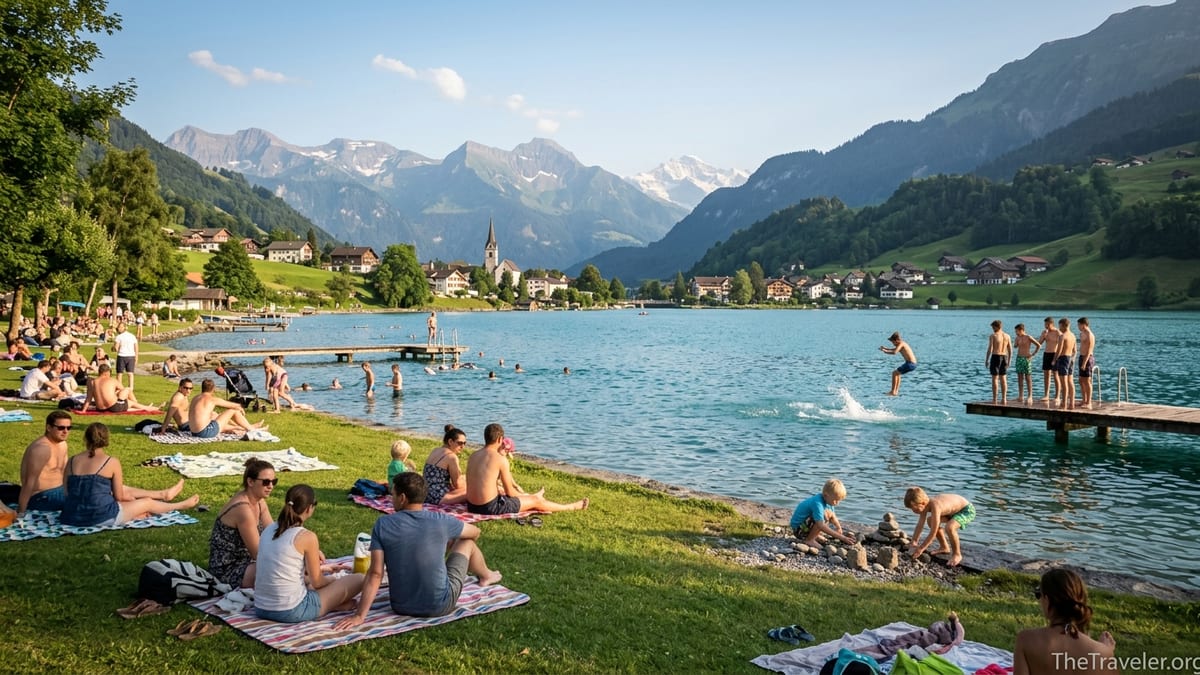
Switzerland is famous for mountains, but in summer it is the lakes that quietly steal the show. From palm-fringed shores in Ticino to neat family lidos on Lake Zurich, the country turns into a network of freshwater “seaside” resorts, complete with beaches, diving towers and lakeside hotels that feel made for barefoot holidays. This guide compares the best Swiss lakes and lakeside towns for swimming, focusing on where you actually want to stay: places with walkable access to lidos and beaches, reasonably warm water, facilities for families and enough scenery to make every morning dip feel like a postcard.
How Swiss Lakes Compare for Summer Swimming
Most major Swiss lakes are clean enough to drink from, but they are not all equal when it comes to swimming. Altitude, depth and glacier inflows all affect how quickly the water warms up, which is why a July plunge in turquoise Lake Brienz can feel bracing while Lake Geneva or Lake Zurich feel pleasantly mild. In broad terms, low-altitude lakes like Geneva, Zurich and the Ticino lakes warm earliest, often reaching the low 20s Celsius in mid-summer, while high, deep or heavily glacier-fed lakes stay several degrees cooler.
If your priority is long, lazy swims and kids splashing around for hours, look first at Lake Geneva (Lac Léman), Lake Zurich and the Ticino lakes Lugano and Maggiore. In a typical July or August, these often sit around the low 20s Celsius, with official bathing areas monitored for water quality and patrolled by lifeguards in peak season. By contrast, Lakes Thun and Brienz near Interlaken and the Aare and Rhine rivers are beautiful but better suited to confident swimmers who do not mind fresh water that can feel closer to 18 degrees.
Almost every sizeable Swiss lakefront town has at least one public lido or “Strandbad” where you pay a modest entry fee for lawns, changing rooms, showers and sometimes pools and slides. Prices are generally in the range of about 6 to 10 francs for adults and half that for children, with family passes and evening tariffs common. Many towns also keep stretches of shoreline completely free, with simple jetties and grass banks that fill up after work when locals cycle down for a quick swim before dinner.
For a summer base, think of lakes not just as bodies of water but as linear resort regions. Around Lake Geneva, for example, you can stay in Geneva, Lausanne, Montreux or smaller wine villages and still reach multiple beaches by local train or boat. The same is true on Lake Zurich, where an S-Bahn line threads past a string of lidos, and in Ticino, where lakeside promenades link bathing spots to town squares lined with gelato stands and cafes.
Lake Geneva: Big Water, Urban Beaches and Wine-Village Swims
Lake Geneva is Western Europe’s largest lake and one of the most versatile for swimmers. Around Geneva itself, official guides note that the lake typically reaches the low 20s Celsius by mid-July and stays pleasant into early September, with water quality closely monitored. City institutions like Bains des Pâquis on the main jetty and Genève-Plage east of the centre offer a mix of ladders into deep water, children’s pools, lawns and simple restaurants, all accessible on a city bus or even on foot from many central hotels. Entry fees remain modest, with Bains des Pâquis charging just a few francs in summer, and much of the shoreline remains free.
Further along the Swiss north shore, Lausanne’s lakeside suburb of Ouchy is one of the country’s best all-round summer bases. Promenades lined with plane trees link several swimming areas, from informal jetties where locals dive straight into the lake to structured lidos with pools for toddlers. Families often favour the open-air pools and lake access in neighbouring Pully, where the lakeside complex offers multiple basins, a paddling area for young children and direct views of the Savoy Alps across the water. With frequent trains up the hill, you can stay in central Lausanne and ride down to the lakefront in minutes.
For a more small-town feel, the Lavaux wine region between Lausanne and Montreux hides some of the most atmospheric lake swims in the country. At places like Cully or Lutry, tiny harbours give way to pebble or grass beaches tucked below terraced vineyards that hold UNESCO World Heritage status. In summer, a typical day might involve a train ride from Lausanne, a short walk through the vineyards, a lunch at a lakeside cafe and a mid-afternoon swim from a modest municipal beach that costs nothing to enter. Accommodation ranges from simple guesthouses set back from the lake to mid-range hotels right on the waterfront.
At the eastern end of Lake Geneva, Montreux and Vevey mix Belle Époque architecture with bathing spots suited to different tastes. Vevey’s promenade has floating platforms and stepped entries into the lake, plus a compact lido with showers and snack kiosks. Montreux offers ladders and small beaches within walking distance of the station, as well as access to quieter stretches in nearby villages like Clarens. Here the water can feel marginally cooler than in the shallow bays around Lausanne, but the reward is a skyline of jagged Alpine peaks that turns each swim into a scenic event.
Lake Zurich: Classic Lidos and Easy City Access
Lake Zurich is one of the best options if you want to combine urban sightseeing with daily swims. The city wraps around the lake’s northern end, and a chain of public baths lines both shores. Historic facilities like Strandbad Mythenquai on the left bank and Strandbad Tiefenbrunnen on the right have sandy or grassy areas, piers, diving platforms and lake-fed kids’ pools. These lidos were modernised in recent years, adding family-friendly features while keeping entry prices in the single digits for adults and lower for children.
Because Lake Zurich is at a modest altitude and relatively sheltered, it usually warms steadily over the summer. By July and August it often reaches a temperature where even cautious swimmers are happy to stay in for an extended dip. Locals buy season passes and treat the lidos like beach clubs, arriving early to claim a shady spot under the trees before work or lingering into the evening for lakeside barbecues and casual suppers from on-site cafes. Many of the city lidos also feature separate shallow areas for toddlers and non-swimmers, which makes them practical for multi-generation trips.
From a traveler’s perspective, the advantage of Lake Zurich is its transport network. S-Bahn trains follow both shores, with stations rarely more than a short walk from the water. You could, for example, base yourself in the compact lakeside town of Rapperswil at the eastern end of the lake, where a lakeside promenade leads to bathing lawns and a small beach. From there, regular trains or boats connect back to Zurich, turning day trips into scenic cruises. Rapperswil’s old town has enough small hotels and guesthouses to support a week-long stay, with most accommodation within easy strolling distance of the waterfront.
Smaller villages like Küsnacht, Meilen and Thalwil also have their own Strandbäder, often with fewer crowds than the city baths. These make good choices for travelers who prefer a quieter rhythm while keeping Zurich’s museums, restaurants and airport within easy reach. Accommodation is more limited and tends to book early for peak summer weekends, so planning ahead is wise if you want to stay close enough to walk from breakfast straight into the lake.
Ticino’s Lakes Lugano and Maggiore: Warm Water and Mediterranean Vibes
South of the Alps in the canton of Ticino, Lakes Lugano and Maggiore offer some of the warmest and most relaxed swimming in Switzerland. Lower altitude, sunnier weather and sheltered bays all help the water reach comfortable temperatures by early summer. Local discussions of “warmish” water in the region often cite around the high teens Celsius as a baseline, with surface temperatures edging upwards as the season progresses. Combined with palm trees, Italian-style promenades and gelato stands, the effect is more Mediterranean than Alpine.
On Lake Lugano, the town of Lugano itself is the obvious base. A lakeside promenade, the Lungolago, links landscaped parks with bathing areas and lidos. Public bathing establishments around the shores offer lawns, wooden piers and direct access into deep water, often alongside children’s pools and rental kiosks for paddle boards. From many central hotels, it is a matter of a ten-minute stroll past grand villas and gardens to reach the lake, towel over your shoulder, without needing to think about public transport.
Further north on Lake Maggiore, Locarno and Ascona blend an old-town feel with well-developed swimming infrastructure. Locarno’s lakeside has a large lido complex with pools, slides and direct lake access, popular with families who want the security of lifeguards and fenced-off swimming zones. Ascona, slightly quieter, offers small beaches and lawns where you can slip into the lake between strolls through its arcaded waterfront lined with cafes and boutiques. In high season, both towns run frequent boat services to nearby villages and islands, allowing you to combine swims with short cruises and even vineyard visits on the surrounding hillsides.
Accommodation in Ticino ranges from lakeside resorts with private jetties to bed-and-breakfasts tucked into hillside villages overlooking the water. For a car-free stay focused on swimming, aim for properties directly in Lugano, Locarno or Ascona; from there you can easily walk to multiple lidos and beaches. Families often appreciate hotels that provide discounted or included access to nearby bathing complexes, as well as extras like shaded gardens and playrooms for the hottest part of the afternoon.
Interlaken’s Lakes Thun and Brienz: Turquoise Water and Alpine Drama
Between the Bernese Alps, Lakes Thun and Brienz form the watery heart of the Interlaken region. They are famous for their intense blue-green colours and mountain backdrops, but from a swimmer’s perspective they are also among the cooler large lakes in Switzerland. Local guides note that Thun tends to run a few degrees warmer and more stable than Brienz because it sits downstream of much of the glacial inflow. That makes Thun the better bet if you want to alternate hikes with refreshing but manageable lake swims.
The town of Thun itself has lidos and grass beaches along its shoreline, including areas with diving boards, platforms and play zones for children. On hot days, locals swim both in the lake and in the Aare river as it flows out of Thun, although river swimming is only recommended for strong and experienced swimmers comfortable with currents and colder water. For most visitors, the controlled environment of a lido or official beach is the safer and more relaxing choice.
Lake Brienz, by contrast, often feels distinctly fresh even at the height of summer, thanks to its depth and glacier-fed inflows. The town of Iseltwald, perched on a small peninsula, has a compact lakeside area where you can bathe with spectacular views of steep forested slopes dropping straight into the water. Interlaken itself, on the plain between the two lakes, offers easy access by bus or boat to multiple swimming spots, but the emphasis here is more on scenery and mountain activities than on hours-long lake lounging.
For accommodation, Interlaken and Thun offer the widest range of options, from hostels and mid-range hotels within walking distance of the water to higher-end properties with private lawns and lake access. Smaller villages around both lakes often have a single hotel or guesthouse close to the shore, which can be idyllic but requires booking well ahead in school holidays. When planning, bear in mind that even in August a long swim in Brienz or a late evening dip in Thun can feel chilly, so pack extra layers and consider short, frequent dips rather than marathon sessions in the water.
Lake Lucerne and Central Switzerland: Fjord-Like Bays and Family Facilities
Lake Lucerne curls around the city of the same name in a series of deep, fjord-like arms, mixing sheltered bays with dramatic cliffs. While the lake is deep and can be cooler than shallower lowland waters, the Lucerne bays still see comfortable swimming conditions in high summer, particularly later in the season when the water has had time to warm. The city of Lucerne itself has several popular lakeside lidos and bathing areas, many within walking distance of the old town and transport hubs.
Lucerne’s main appeal for swimmers is the combination of infrastructure and scenery. You can spend a morning exploring the covered bridges and historic squares, then walk 15 to 20 minutes to a lakeside lido with lawns, floating rafts and facilities like cafes and changing rooms. Many of these establishments also offer shallow pools or cordoned-off sections for children, making them suitable for families who want to keep an eye on youngsters while enjoying the views across to Mount Pilatus and Rigi.
Outside the city, smaller lakeside communities around Lake Lucerne each manage their own modest beaches and lawns. In places like Weggis and Vitznau, hotels cluster close to the shore, some with private access ladders and small piers, others a short stroll from public bathing lawns. Because the terrain is steeper than around Lake Zurich or Geneva, beaches tend to be smaller and more intimate, often pebble rather than sand, but the trade-off is the sense of being right at the foot of towering mountains with boats and paddle steamers sliding by at close range.
Central Switzerland also has smaller warm-weather lakes used almost exclusively by locals. These can feel like secret swimming holes compared to the big-name destinations, but they usually lack the dense cluster of hotels and restaurants right on the water. For a visitor who wants a car-free holiday based on walking from accommodation to a lido and back again, Lucerne remains the most practical base in the region.
Choosing a Lakeside Base: Families, Facilities and Car-Free Stays
When comparing Swiss lakes for a summer base, it helps to think beyond water temperature to everyday convenience. Families with young children often prioritise shaded lawns, playgrounds, shallow entries and lifeguards. On that basis, city lakes like Zurich and Geneva, together with Lucerne and Lugano, stand out. Their main lidos have fenced areas, dedicated kids’ pools and on-site catering, and they sit within flat, buggy-friendly walks of central hotels, tram stops and supermarkets.
Couples or solo travelers may care more about atmosphere and variety than built-up facilities. For them, smaller towns such as Vevey, Montreux, Ascona, Rapperswil or Thun balance lakeside promenades and bathing spots with characterful old streets and easy day trips into surrounding hills. Staying in these places, you can often walk a few minutes from your guesthouse to a quiet corner of grass or a small municipal beach, plug into local life and still have access to boats and trains for exploring other parts of the lake.
Car-free travel is straightforward around the major lakes, and in many cases it is the more pleasant option. Lake Geneva, Lake Zurich and the Ticino lakes all have dense public transport, with boats, trains and buses linking towns and beaches. For example, on Lake Geneva you can stay in Lausanne and day-trip by train to wine-village swims in Lavaux or by boat to promenades in Montreux. On Lake Zurich, the S-Bahn network lets you “beach-hop” up and down the shore, while in Ticino regional trains and buses follow the lakes, stopping within easy walking distance of bathing spots.
Budget is also a factor. While entry to many lakeside lidos is relatively modest, accommodation on the most famous shores commands high summer prices, especially in resort towns like Montreux, Lucerne and Lugano. More economical options include suburban districts slightly back from the water, small inland villages a short bus ride from the lake or family-run guesthouses in lesser-known towns. In return for a ten or fifteen minute walk or bus ride, you may find rooms that free up budget for boat trips, ice creams and the occasional lakeside restaurant with a sunset view.
The Takeaway
No single Swiss lake is objectively “best” for swimming. Instead, each offers a different balance of warmth, scenery, facilities and atmosphere. Lake Geneva and Lake Zurich are the most versatile for combining city life with easy daily swims, and they work well for first-time visitors who want straightforward access to lidos, public transport and a range of accommodation within walking distance of the water.
Ticino’s Lakes Lugano and Maggiore suit travelers seeking reliably warmish water and a relaxed, Mediterranean feel, while Interlaken’s Lakes Thun and Brienz appeal more to those who value dramatic Alpine backdrops and do not mind water that can feel bracing even in August. Lake Lucerne sits somewhere in between, pairing fjord-like scenery with urban comforts in the city of Lucerne and more tranquil options in smaller lakeside villages.
Whichever lake you choose, a Swiss summer holiday by the water can be as simple as picking a town with a good lido, booking a hotel within a ten-minute walk of the shore and building each day around swims, strolls and sunsets. With clear, carefully monitored water, efficient transport and a long tradition of public lakeside access, Switzerland may not have a sea, but in summer its lakes offer all the ingredients of a classic beach break in an Alpine setting.
FAQ
Q1. Which Swiss lake has the warmest water for swimming in summer?
In typical summers, the lowest-altitude lakes such as Lake Geneva, Lake Zurich and the Ticino lakes Lugano and Maggiore tend to feel warmest, especially from mid-July to late August, while higher or glacier-fed lakes like Thun and Brienz stay noticeably cooler.
Q2. What is the best Swiss lake for families with young children?
Lakeside cities like Zurich, Geneva, Lucerne and Lugano are very family friendly because their main lidos have shallow pools, playgrounds, shaded lawns and lifeguards, all within short, flat walks of central hotels and public transport.
Q3. Are Swiss lake beaches sandy or pebbly?
Most Swiss lakeshores are grass, concrete platforms or pebbles, though some lidos have imported sand. Around Lake Geneva and Lake Zurich you will find a few sandy stretches, but it is best to assume you will be swimming from lawns, jetties or pebble beaches.
Q4. Do I have to pay to swim in Swiss lakes?
The lakes themselves are free, and many simple access points cost nothing. However, structured lidos with facilities usually charge a modest entry fee, often under 10 francs for adults and less for children, with discounted evening or family tickets.
Q5. Is it safe to swim anywhere in a Swiss lake?
It is safest to swim at official bathing areas marked by buoys, ladders and lifeguard stations, where water quality is monitored and boats are kept at a distance. Swimming outside these zones is common but requires more caution, particularly near harbours and ferry routes.
Q6. Which lakeside town is best if I do not want to rent a car?
Geneva, Lausanne, Montreux, Zurich, Lucerne, Lugano, Locarno and Ascona all work well without a car, as you can walk from many hotels to the lake and use dense networks of boats, trains and buses to reach other swimming spots.
Q7. Can I combine lake swimming with mountain hikes in one base?
Yes, places like Interlaken, Lucerne, Montreux and Thun are ideal for combining day hikes with post-trail swims, since cable cars, mountain trains and lakeside lidos all operate from the same towns or within a short boat or bus ride.
Q8. Are Swiss lakes warm enough for evening swims?
On the warmer lakes such as Geneva, Zurich and the Ticino lakes, evening swims in high summer are common and pleasant, though the air cools quickly after sunset in the mountains, so bringing a warm layer for the walk back is sensible.
Q9. How early in the year can I comfortably swim in Swiss lakes?
For most casual swimmers, June is when the larger lowland lakes start to feel comfortable, with the peak season for relaxed, long swims running from roughly early July through early September, depending on the year’s weather.
Q10. Do Swiss lakeside lidos provide sun loungers and food?
Many larger lidos on lakes like Geneva, Zurich, Lucerne and Lugano rent sun loungers or deckchairs and have snack bars or simple restaurants, so you can spend an entire day on site without needing to leave for meals.