


Lake Geneva is one of the few places in Europe where everyday public transport doubles as a scenic cruise. The CGN boats that shuttle between Geneva, Lausanne, Vevey, Montreux and Chillon are working ferries, heritage steamers and leisurely sightseeing vessels all at once. For travelers, that creates a pleasant dilemma: which cruise to choose, which ticket to buy and when it makes sense to take the boat instead of the train. This guide walks you through the 2026 CGN timetable, typical fares, Swiss Travel Pass and Half Fare coverage, plus concrete examples of routes that are worth planning your day around.
Understanding CGN Cruises on Lake Geneva
The Compagnie Générale de Navigation sur le Lac Léman, usually shortened to CGN, runs the network of boats that criss-cross Lake Geneva between Swiss and French ports. From short harbour loops in Geneva to long runs between Lausanne, Vevey, Montreux and the Château de Chillon, these services form part of the regular public transport system as well as offering classic sightseeing cruise experiences. On most days from spring through autumn, you can simply walk up to the pier at Geneva Mont-Blanc, Lausanne-Ouchy, Vevey Marché or Montreux and board a scheduled sailing.
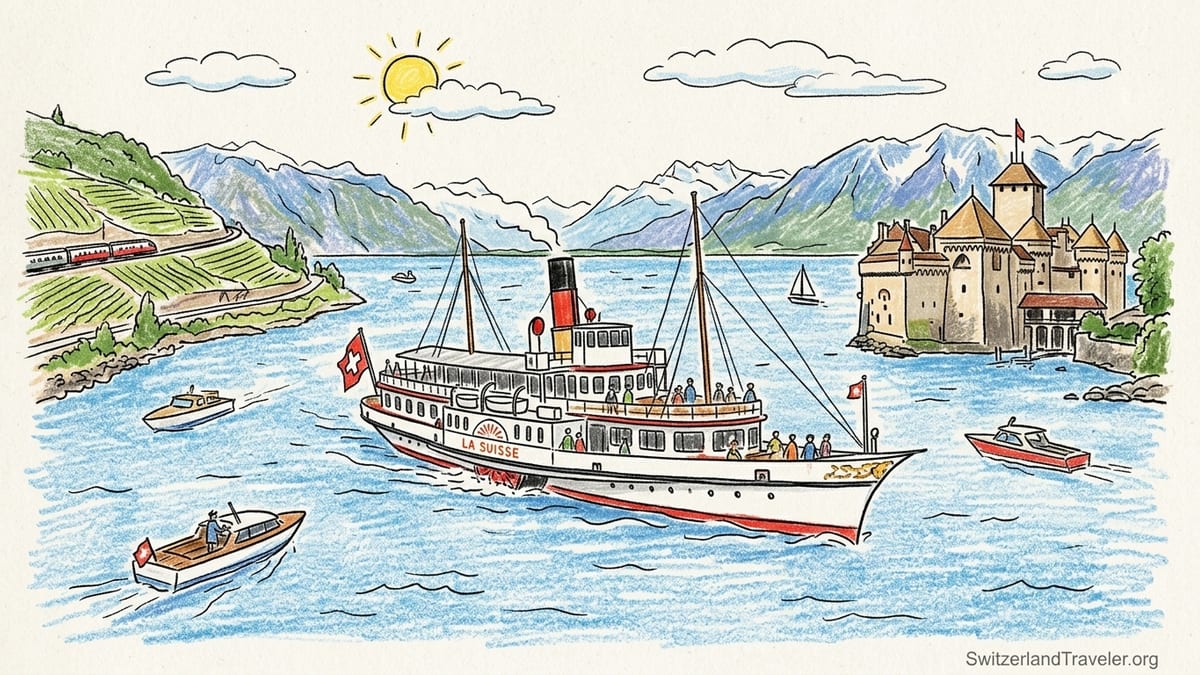
CGN operates a mixed fleet of modern motor vessels and a remarkable group of eight Belle Époque paddle wheelers, including La Suisse, Savoie, Montreux and Rhône. Several of these historic boats still run with visible paddle wheels and restored salons dating back to the early 20th century. In 2024, the Belle Époque fleet was again highlighted by Swiss and regional authorities as a protected cultural heritage, underlining that when you step aboard one of these steamers you are boarding a moving monument rather than a simple ferry.
The 2026 general timetable links all the key north shore towns — Geneva, Nyon, Morges, Lausanne, Vevey, Montreux and Villeneuve — and also reaches across to French ports such as Thonon-les-Bains, Évian-les-Bains and Yvoire. On the central section between Lausanne, Vevey, Montreux and Chillon, departures are frequent in high season, making it realistic to treat the boat like a hop-on hop-off service between wine villages and lakeside promenades. South shore services, such as Lausanne to Évian, function primarily as commuter ferries but still provide wide open views of the Alps.
For visitors, the most important distinction is that CGN offers three broad types of product on the same vessels. First, there are simple point-to-point journeys counted as public transport. Second, there are scenic “round trip” or “mini-cruise” itineraries sold as excursions, often with commentary. Third, there are special dining cruises, such as lunch or dinner on a Belle Époque steamer, where a restaurant supplement applies. Knowing which category your sailing falls into is crucial when checking whether your rail pass covers the fare and whether it is a smart use of your travel time.
Key Routes from Geneva, Lausanne, Vevey and Montreux
From Geneva, the classic outing is the half or full day cruise along the lake’s northern shore towards Nyon and Yvoire. A common pattern is to depart mid-morning from Geneva Mont-Blanc, cruise past Bellevue and Coppet, and either disembark at Nyon to visit the castle or continue across the border to the medieval French village of Yvoire. On busy summer days, one of the Belle Époque steamers is often rostered on at least one of these sailings, giving you paddle wheels and polished brass in addition to open decks and mountain views. You can then return by boat or, if short on time, by train from Nyon back to Geneva.
Lausanne-Ouchy is the best starting point for travelers who want to combine boat travel with visits to Vevey, Montreux and the Château de Chillon. In 2026, the timetable features repeated links along this stretch, with boats shuttling between Lausanne, Vevey, Montreux and the pier directly below Chillon’s walls. For example, a common day plan is to leave Lausanne mid-morning, cruise to Vevey for lunch on the lakeside, then continue by afternoon boat to Montreux and disembark at Chillon for a tour of the castle. From the Chillon pier you can either walk back along the lake promenade to Montreux station, take a regional train, or wait for a later sailing back towards Lausanne.
Vevey and Montreux are also excellent intermediate bases because you can head in either direction by boat. From Vevey Marché, it is only a short hop by water to the Lavaux vineyard terraces at Cully and Rivaz, which gives you the unusual experience of arriving in a wine village by boat before climbing into the vineyards on foot or by local train. From Montreux, the focus is usually the short but spectacular hop to Chillon and Villeneuve or the longer run back along the lake towards Lausanne and Nyon, often on one of the grand Belle Époque steamers when they operate the mainline services.
Because the 2026 timetable connects Lausanne, Vevey, Montreux and Chillon in a coordinated pattern, it is realistic to treat the boats as a flexible corridor rather than a single out-and-back excursion. A traveler might, for example, take the train from Geneva to Montreux in the morning, visit Chillon, then board an afternoon steamer from Chillon to Vevey and continue by boat to Lausanne-Ouchy in time for dinner. The key is to check in advance which specific departures are operated by heritage steamers if that experience matters to you, since not every sailing on these routes uses a Belle Époque vessel.
Cross-Border Ferries and Example Ticket Prices
Lake Geneva’s most intensely used boats are the cross-border ferries linking Switzerland and France. From Lausanne-Ouchy, fast catamarans and regular ferries run to Évian-les-Bains and Thonon-les-Bains across the lake, carrying commuters as well as day trippers heading for French spa towns and markets. Current pricing from Lausanne reflects this dual role. A typical return ticket from Lausanne to Thonon is around 44 Swiss francs in standard class, while returns to Évian are usually slightly lower. Prices can vary by specific product and season, but this Lausanne–Thonon example gives a realistic sense of cost for a cross-lake return in 2026.
Shorter hops, such as the compact crossing from Nyon to Yvoire or from Vevey to the French port of St-Gingolph, are normally cheaper, but they still cost more than an equivalent distance by train on land. That is because the boat operates as a premium mode of transport with higher operating costs and, in the case of the Geneva–Nyon–Yvoire section, a strong sightseeing component. When budgeting, it is sensible to compare a sample fare on the CGN website with the price of a regional train or bus, then decide whether the extra cost is justified by the experience of being on the lake.
From Geneva, one of the most popular cross-border outings is the loop to Yvoire. A typical scenario is to buy a return boat ticket from Geneva to Yvoire, spend a few hours exploring the walled village and gardens, then ride back in the late afternoon. The full return price can feel steep compared with the cost of a train from Geneva to Nyon plus a local bus along the French shore, but the slow approach to Yvoire’s ramparts by water and the open Alpine panorama along the way are what most visitors are paying for. If you hold a Swiss Travel Pass, the boat leg on the Swiss side of the lake is normally included, and you then pay only for the international stretch.
On the eastern end of the lake, CGN runs services between Villeneuve, Le Bouveret and St-Gingolph that touch the French border. These routes are less well known to foreign visitors but can be valuable to travelers staying at holiday parks or campsites near Le Bouveret. Here, the choice is often between a short regional train or bus and a boat that connects directly to the pier outside your accommodation. Even when the timetable is not as frequent as the trains, the convenience of stepping straight from the pier to your hotel terrace can make the boat option surprisingly practical.
Belle Époque Steamers and the Chillon Castle Routes
The romantic image of Lake Geneva cruising is closely tied to CGN’s Belle Époque steamers, some of which date from the first decades of the 20th century. Ships such as La Suisse, Savoie, Montreux and Rhône are fitted with broad open decks, wooden promenade rails and large paddle wheels, in some cases still powered by their original or carefully restored steam engines. These vessels form what many transport historians consider to be one of the most complete surviving Belle Époque lake fleets in the world. They are regularly rostered on the showcase routes between Geneva, Lausanne, Vevey, Montreux and Chillon, especially on weekends and in peak season.
A particularly iconic ride is the stretch between Montreux and the Château de Chillon. On some 2026 sailings, a paddle steamer leaves Montreux, rounds the bay past the lakeside promenades and pulls in at the pier directly below the castle walls. The view from the water gives a postcard-perfect angle of the medieval fortifications set against the Dent de Jaman and the peaks at the end of the lake. Many passengers simply ride this section out and back as a mini-cruise, even if they have already traveled the same distance by train along the shore.
Another atmospheric journey is the long panoramic run from Geneva or Lausanne towards Montreux on a Belle Époque vessel. When one of the historic steamers covers these routes, it essentially turns a point-to-point transfer into a half-day cruise. You can sit on the upper deck, watch the paddle wheels churning and hop off at intermediate stops such as Rolle, Morges, Vevey or Cully for short walks before boarding a later sailing. Because not every departure uses a heritage ship, checking the vessel type in the timetable is essential if your aim is specifically to experience a steam-powered cruise rather than a modern motor ferry.
Onboard, the Belle Époque ships usually offer both standard and first-class sections, sometimes spread over different decks. First class often occupies the upper decks or the most ornate salons with better views, while standard class has plenty of outdoor space. Food and drink are available at bars or in sit-down restaurants, and special meal cruises may require separate reservations or supplements in addition to the basic ticket. For travelers using passes such as the Swiss Travel Pass, the underlying transport segment is still covered, but any restaurant services or class upgrades are extra.
Tickets, Passes and When the Boat Beats the Train
For straightforward travel between towns on the north shore, regional trains are usually faster and sometimes cheaper than the boat, especially if you are buying full-fare point-to-point tickets. The rail line hugging the lake between Geneva, Lausanne and Montreux often provides beautiful views in its own right, particularly on the Lausanne to Montreux stretch through the Lavaux vineyards. If your priority is efficient transfers, you might choose the train for most moves and reserve the boat for one or two carefully chosen segments, such as Montreux to Chillon or Lausanne to Vevey.
Where boats begin to outperform trains is on trips where the lake itself is the main attraction or where the pier is closer to your final destination than any rail station. An example is a traveler staying in a hotel near Lausanne-Ouchy. To visit Vevey and Montreux, this person could take the metro up to Lausanne station and then a regional train, or they could simply stroll to the nearby CGN pier and board a boat that delivers them directly to the promenades in Vevey and Montreux. Door-to-door, the boat can be competitive on time and far more pleasant on a sunny morning.
Another scenario is the cross-border run from Lausanne to Thonon or Évian. There is no equivalent direct train under the lake, and the rail alternatives involve detours via Geneva or long road journeys. Here, even at around 44 francs return for Lausanne to Thonon, the boat is functionally the only convenient option for a day trip without a car. Similarly, from Geneva to Yvoire, a mixture of train and bus combinations technically exist, but none competes with the directness and views of the boat, which approaches the village right at its small harbor.
When time is limited, travelers often combine the strengths of both modes. For instance, someone staying in Geneva might take an early train to Montreux, visit Chillon, then ride a mid-afternoon Belle Époque steamer back as far as Lausanne or Morges, switching again to the train for the final segment. This pattern minimizes slow backtracking while still giving you a sizeable cruise. Thinking in terms of “one major lake segment per day” helps you avoid spending so long on the boat that you miss time on shore in the towns and vineyards you came to see.
Swiss Travel Pass, Half Fare Card and Other Discounts
One of the most common questions from international visitors is how CGN integrates with Swiss rail passes. In general, the Swiss Travel Pass is valid on most regular CGN services on Lake Geneva. That means that with a valid pass you can simply board boats between Geneva, Lausanne, Vevey, Montreux, Chillon and many other Swiss-side piers without buying an additional ticket, though you may need to show the pass when asked. For international stretches, such as the Lausanne–Thonon or Lausanne–Évian crossings, the Swiss Travel Pass typically grants free or heavily discounted travel on the Swiss portion and may still cover the full fare on certain designated “free lake routes,” but travelers should check current conditions at the time of purchase.
The Swiss Half Fare Card is also accepted on CGN boats, usually giving 50 percent off standard fares on covered routes. If you hold a Half Fare Card and buy a Lausanne to Thonon return ticket that would normally cost around 44 francs, in many cases you will pay about half of that. Similarly, a Half Fare Card can significantly reduce the cost of longer sightseeing runs, such as Geneva to Montreux or Lausanne to St-Gingolph, although supplements for dining or special excursions still apply in full. The Half Fare Card can be purchased at ticket offices in Lausanne and Geneva or online in combination with other rail products.
International rail passes, such as Eurail or Interrail, often provide discounts rather than full coverage on CGN services, especially on cross-border routes. The exact reduction can vary depending on the agreement in place in a given year, but a common pattern is that holders receive 50 percent off selected lake cruises upon showing a valid pass at the ticket window or on board. Because these arrangements change more often than the core Swiss Travel System products, it is wise to verify the current discount conditions shortly before your trip rather than relying on older guidebooks.
Local discount products can also be worthwhile. Residents of Geneva and Vaud sometimes use regional day passes that include unlimited boat travel on non-restaurant cruises, and some hotels on Lake Geneva offer guest cards that reduce fares on nearby CGN routes. While visitors may not always qualify for resident-only offers, it is worth asking at your accommodation whether any local transport cards or partnership discounts apply. On a trip involving multiple boat segments, even a modest percentage reduction can offset the cost of an extra drink or dessert in the ship’s restaurant.
How to Plan and Book Your Lake Geneva Cruise
Planning a CGN cruise around Lake Geneva begins with the timetable. The 2026 general timetable groups services by line number and clearly shows the main north shore corridor between Geneva, Lausanne, Vevey, Montreux and Chillon. Each column lists departure and arrival times, and many entries also indicate the type of vessel used, such as a standard motor ship or a Belle Époque steamer. If experiencing a historic paddle wheeler is a top priority, locate the symbol for these ships and then build your day around one or two of the departures where they appear.
For travelers based in Geneva, a practical plan is to reserve one full or half day for lake cruising and another for land-based sightseeing. One day could be dedicated to Geneva–Yvoire or Geneva–Nyon by boat, with time ashore in the old town or at lakeside beaches. Another day might focus on the eastern section of the lake, reached by train: travel by rail to Lausanne, Vevey or Montreux in the morning, then slot in a boat journey that returns you to your base. With this approach you see the lake from both the train line and the water, and you experience at least one Belle Époque steamer if you choose your timings carefully.
In Lausanne, Vevey and Montreux, ticket counters and self-service machines at the piers sell both point-to-point boat tickets and excursion products such as round-trip cruises. If you hold a Swiss Travel Pass or Half Fare Card, bring it to the counter so staff can apply the correct coverage and, if necessary, print a zero-fare boarding slip for routes where the pass grants full validity. At busy times in July and August, boarding lines for popular departures can be long, particularly when a heritage steamer is scheduled, so arriving 20 to 30 minutes before departure makes the process smoother.
For dining cruises and certain special events, advance booking is either recommended or required. These sailings often include a set menu and guaranteed restaurant seating in addition to the transport component. Because they share the same ships as regular services, you might see a Belle Époque vessel appear in the timetable at a different time than usual on evenings when dining cruises are planned. If you simply want to ride the ship without a meal, choose departures marked as ordinary scheduled services rather than special gastronomic trips.
The Takeaway
Choosing between Lake Geneva’s boats and trains is not a matter of one being better than the other, but of understanding what each does best. Trains are quick, frequent and often scenic in their own right, especially along the Lavaux vineyards. Boats are slower and usually more expensive for the same distance, but they deliver an experience none of the region’s rail lines can match: gliding between Geneva, Lausanne, Vevey, Montreux and Chillon with the Alps and terraced vineyards filling your field of vision.
If your time in the region is short, think of CGN cruises as a highlight to weave into your itinerary rather than as your only mode of transport. One or two carefully chosen segments, such as Geneva to Yvoire, Montreux to Chillon on a Belle Époque steamer, or Lausanne to Vevey and back at sunset, can provide the sense of being on holiday that straight point-to-point transfers sometimes lack. Travelers with passes like the Swiss Travel Pass or the Half Fare Card can take fuller advantage of the network, hopping between towns without worrying about individual ticket costs on many routes.
As you plan, check the latest 2026 timetable, note which departures are operated by Belle Époque ships and compare approximate boat and train fares for the legs that matter most to you. With a little advance thought, it becomes easy to pick the days when the boat is worth choosing over the train, and to experience Lake Geneva as locals have done for more than a century: from the deck of a ship, watching castles, vineyards and old resorts slide slowly by.
FAQ
Q1. Do I need to reserve seats for CGN boats on Lake Geneva?
Most regular CGN services between Geneva, Lausanne, Vevey, Montreux and Chillon do not require seat reservations. You simply buy a ticket or use your pass, then board and choose any available place, with first and second class separated on some vessels.
Q2. Is the Swiss Travel Pass valid on all Lake Geneva cruises?
The Swiss Travel Pass is generally valid on most standard CGN routes on Lake Geneva within Switzerland, such as Geneva to Lausanne or Lausanne to Montreux and Chillon. International crossings and special excursions may have different conditions, so you should confirm details when you buy the pass or at the pier.
Q3. How much does a typical Lake Geneva boat trip cost without a pass?
Prices vary by distance and route. As an example, a standard return ticket from Lausanne to Thonon across the lake is around 44 Swiss francs. Shorter segments like Lausanne to Vevey or Montreux to Chillon usually cost less, while long panoramic runs cost more.
Q4. When is it better to take the train instead of the boat?
If you are mainly interested in getting from one town to another quickly, especially between Geneva, Lausanne and Montreux, trains are usually faster and sometimes cheaper. Boats are most worthwhile when the cruise itself is the highlight, such as visiting Chillon Castle by water or enjoying a Belle Époque steamer ride.
Q5. How can I be sure I am booking a Belle Époque paddle steamer?
In the CGN timetable, departures operated by historic Belle Époque vessels are usually marked with a specific ship name or symbol. Before planning your day, look up the sailing you want and check that a steamer such as La Suisse, Savoie or Montreux is assigned to that departure.
Q6. Are CGN cross-border ferries included in Swiss passes?
Cross-border ferries, such as Lausanne to Thonon or Évian, often have different rules from domestic routes. The Swiss Travel Pass and Half Fare Card usually provide at least partial coverage or discounts, but the exact benefit can depend on the current agreement, so you should verify it shortly before traveling.
Q7. Can I use my Swiss Half Fare Card on all Lake Geneva boats?
The Swiss Half Fare Card is widely accepted on CGN services and usually allows you to buy tickets at half price on covered routes. Some special excursions or event cruises may not be reduced, so always ask at the ticket office if you are unsure.
Q8. What is the best starting point for a Lake Geneva cruise?
Geneva is ideal for cruises towards Nyon and Yvoire, while Lausanne-Ouchy, Vevey and Montreux are best for exploring the central and eastern parts of the lake and visiting Chillon. Your starting point should match the sections of shoreline you most want to see.
Q9. Do CGN boats run year-round?
CGN maintains services throughout the year, but the full network and most Belle Époque steamers operate mainly from spring to autumn. In winter, routes are reduced and more likely to be served by modern motor vessels, so off-season travelers should check the specific seasonal timetable.
Q10. Can I combine a Lake Geneva cruise with other public transport tickets?
Yes. It is common to use a train for one part of the journey and a boat for another, especially on Geneva–Lausanne–Montreux trips. With passes such as the Swiss Travel Pass or Half Fare Card, this intermodal travel is straightforward and often included or discounted on both trains and boats.