


Western Switzerland’s Lake Geneva arc offers three headline bases that sit barely an hour apart by train yet feel very different on the ground: Geneva, Lausanne and Montreux. All three give you easy access to lake, mountains and vineyards. The real question is not which city is “best,” but which one matches the way you actually travel: do you want airport convenience and an international city, a lively cultural hub in the middle of the rail network, or a relaxed Swiss Riviera resort with palm trees and castle views? This guide compares Geneva, Lausanne and Montreux in practical terms so you can confidently choose your base for Western Switzerland.
Big Picture: How Geneva, Lausanne and Montreux Feel
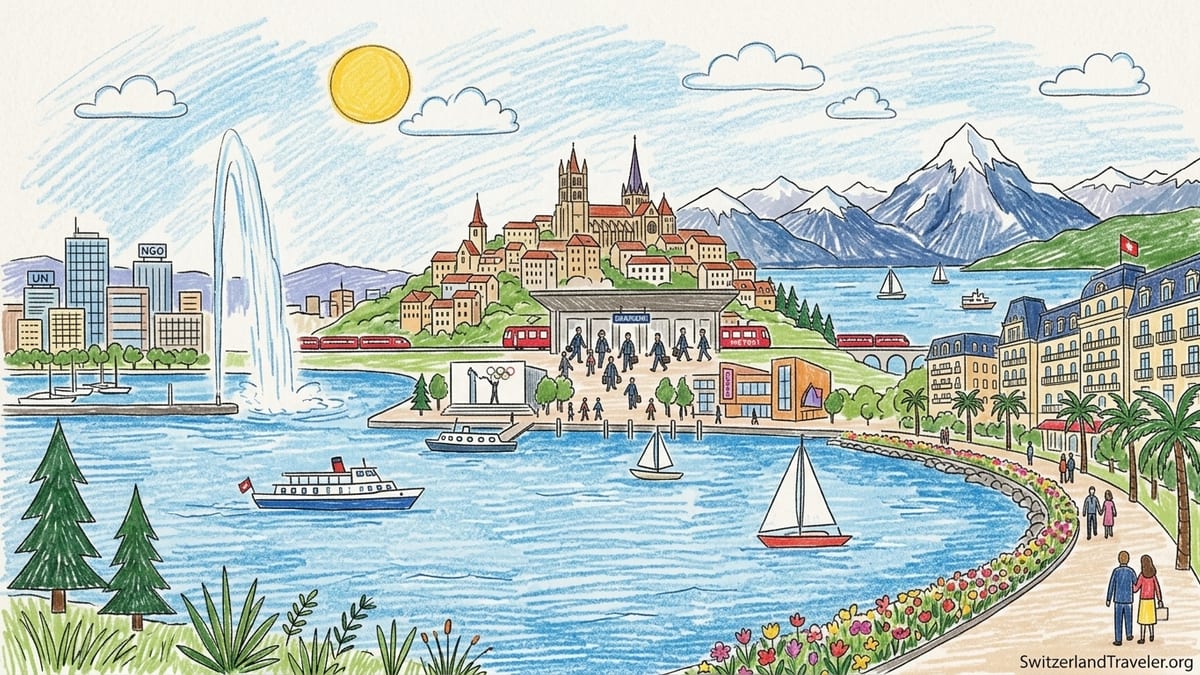
Geneva sits at the western end of Lake Geneva, minutes from Switzerland’s second‑busiest international airport. The city feels cosmopolitan and outward‑looking, with UN and NGO badges on lanyards, French spoken on every corner, and business travelers sharing the lakefront promenades with short‑break visitors. The old town and the famous water jet are compact enough for a one‑ or two‑day stay, but Geneva’s atmosphere is more about international life and dining than postcard‑Swiss clichés.
Lausanne lies roughly in the middle of the north shore of the lake. It is a true university and business city, built on steep hills that tumble from the cathedral down to the Ouchy waterfront. You feel that mix in the streets: students filling bars around Riponne, commuters streaming out of the CFF rail station at rush hour, and visitors walking between the Olympic Museum and the new Plateforme 10 arts district. Compared with Montreux, Lausanne is livelier and more urban, with more nightlife and everyday city texture.
Montreux, at the eastern end of the canton of Vaud, is the Swiss Riviera distilled. The curve of the bay, palm trees along the promenade, and a necklace of Belle Époque hotels give it an unmistakably resort feel. The town center itself is small and relaxed. Outside major events like the Montreux Jazz Festival, you will find a slower pace than in Lausanne: people strolling the lakefront at sunset, quiet café terraces, and quick rail links up into the pre‑Alps rather than dense city life.
Because the three are only around 35 to 70 minutes apart by train, you can easily visit all of them in a single trip. Choosing where to sleep is about whether you want Geneva’s airport convenience and international city experiences, Lausanne’s culture and central connections, or Montreux’s scenic, resort‑style base with front‑row lake and mountain views.
Hotel Costs and What You Get for Your Money
In broad terms, Geneva is usually the most expensive place to stay, Lausanne sits in the middle, and Montreux can be similar to or slightly lower than Lausanne outside major events. Prices vary by season and by what is happening in town. During big trade fairs or diplomatic events in Geneva, a standard business hotel near Cornavin station can jump from roughly 220–260 CHF per night on a shoulder‑season weekday to well over 300 CHF. Lakeside luxury properties such as the Beau‑Rivage or Mandarin Oriental regularly command higher rates, especially in summer.
Lausanne still feels expensive by global standards but often offers better value than Geneva for what you get. Well‑located mid‑range hotels within a short walk of Lausanne Gare, such as business‑style chains and smaller independents, frequently start in the 180–230 CHF range in shoulder seasons, rising in summer. Down in Ouchy, lakefront properties like the Royal Savoy or Beau‑Rivage Palace belong squarely in the high‑end category, but they also offer resort‑level facilities: extensive spas, lake‑view pools, and formal restaurants that draw local diners as well as guests.
Montreux’s hotel scene is more resort‑driven. In July, during the Montreux Jazz Festival, prices shoot up across the board and availability is tight; it is not unusual to see simple three‑star rooms climbing towards 300 CHF and upscale waterfront hotels such as the Fairmont Le Montreux Palace or Eden Palace au Lac commanding premium festival rates. Outside peak festival and Christmas market periods, Montreux often becomes more affordable relative to Geneva, with decent three‑star lake‑adjacent hotels sometimes undercutting similar properties in Lausanne, particularly in spring and late autumn.
If you are budget‑conscious, Lausanne usually gives the best compromise between price, quality and access. You might pair a modest but modern hotel steps from Lausanne’s metro with lake days in Ouchy and day trips into Lavaux or Montreux. If you prefer to splurge on a classic grand hotel experience and wake up directly to lake views, then Montreux and Lausanne’s Ouchy quarter both excel, whereas Geneva’s lakeside luxury tends to cost a little more for a more urban, business‑heavy environment.
Nightlife, Dining and Lakefront Atmosphere
Nightlife and dining are areas where Lausanne typically outshines both Geneva and Montreux for visitors who want energy after dark. Lausanne’s student population and role as a regional hub mean a dense cluster of bars and clubs around Flon, Saint‑François and Rue de Bourg. On a Thursday or Friday night, streets fill with people moving between cocktail bars, live‑music venues and late‑night spots that stay open into the small hours. You can have an early dinner by the lake in Ouchy, take the metro back up the hill, and still find the city center buzzing.
Geneva’s nightlife is more dispersed and somewhat more polished. Around Eaux‑Vives and Pâquis you find wine bars, lakeside terraces and international restaurants serving everything from Levantine mezze to high‑end sushi. There are clubs and live venues, but the general feel is less of a compact party district and more of an after‑work and fine‑dining scene catering to diplomats, NGO staff and business travelers. If you want a long dinner followed by a couple of drinks in sophisticated surroundings, Geneva serves you well; if you want bar‑hopping on foot, Lausanne has the edge.
Montreux’s after‑dark scene is shaped by the calendar. During the Montreux Jazz Festival in early July, the lakefront explodes with stages, food stalls, bars and crowds that stay late into the night. Across the rest of the year, evenings are quieter. There are hotel bars, a few local favorites, and lakeside restaurants where you can linger over perch fillets or fondue with a view, but the town rarely feels as intense as Lausanne after dark. Travelers who prefer relaxed dinners and a walk on the promenade under the lights are in their element here.
For pure lakefront atmosphere, Montreux is hard to beat. The uninterrupted promenade, backed by palm trees and flower beds, runs for several kilometers to Chillon Castle. Many hotels and cafés sit almost at water level, with terraces just above the lake. Lausanne’s Ouchy waterfront, with its parks, piers and swimming spots, comes close and feels more local on summer evenings. Geneva’s lakeside is impressive, particularly around the Jet d’Eau and Parc de la Grange, but it is framed by a denser cityscape and heavier traffic, which slightly dilutes the resort feel.
Transport Connections, Rail Access and Airport Convenience
If arriving by plane, Geneva is clearly the easiest base. Geneva Airport effectively sits inside the city’s public transport network, with frequent trains taking around seven minutes to reach Genève‑Cornavin station. Many hotels near Cornavin, Pâquis or the lakefront are no more than a 10–15 minute walk or a short tram ride from your arrival platform. For trips where you land in the evening or have an early morning departure, staying in Geneva can remove a layer of logistical stress.
Lausanne is the stronger choice if you want to criss‑cross Western and Central Switzerland by train. Intercity and interregional services from Lausanne run directly to Geneva Airport, Bern, Zurich, Basel and Brig, and along the lake towards Montreux and the Valais. For example, a direct train from Lausanne to Bern typically takes just over an hour, making a day trip to the Swiss capital easy. From Lausanne to Montreux, regional trains run roughly every 15 minutes at peak times, usually taking around 20–25 minutes. The city itself has a small but efficient metro that links the lakeshore at Ouchy with the main station and the upper town, useful if you want to avoid steep uphill walks.
Montreux is perfectly connected along the lake corridor and shines for mountain access. Fast regional trains reach Lausanne in roughly 25 minutes and Geneva in about an hour, often without changes. From Montreux, the GoldenPass Express runs through the pre‑Alps towards Gstaad and Interlaken with through coaches, offering a convenient and scenic route to the Bernese Oberland with multiple departures per day. Local mountain railways and funiculars from Montreux reach viewpoints such as Rochers‑de‑Naye and Glion, and the Riviera Card that many overnight guests receive typically gives discounted or free use of parts of the local network and reduced entry to Chillon Castle and museums.
For travelers planning a rail‑heavy itinerary that continues beyond the lake region, Lausanne’s position in the national network is often more efficient than routing everything via Geneva, which sits on a spur at the western edge of the system. However, if your trip revolves around flying in and out with minimal hotel changes, Geneva’s airport convenience can outweigh a few extra minutes on the train for day trips.
Car or No Car: How Practical Is Each Base Without Driving?
All three cities work very well without a car, and in many cases a car becomes a liability rather than an asset. Parking in Geneva and Lausanne is expensive and often constrained, especially in central neighborhoods. Most visitors rely on trains, trams and boats, helped by the fact that many hotels in Switzerland include local public transport passes valid for buses and sometimes regional trains during your stay.
In Geneva, a car is generally unnecessary for city sightseeing or common day trips. Direct trains or buses reach lakeside towns, French destinations like Annecy and Chamonix, and Swiss spots such as Nyon or Lausanne. The trams and buses inside the city are reliable, and the compact lakefront core is walkable. Unless you have a specific reason, such as continuing into rural France or the Jura with luggage, you can comfortably skip renting a vehicle here.
Lausanne’s combination of a metro, buses and dense regional train service makes it particularly friendly to travelers without cars. The city’s hills can be steep, but the metro M2 runs from Ouchy up to the CFF station and through the upper town, letting you move from lakeshore to nightlife areas without a long climb. Frequent trains along the lake mean that wineries in Lavaux, Vevey and Montreux feel practically on your doorstep. If you stay near Lausanne Gare or one of the metro stops, even late‑evening returns from day trips are straightforward.
Montreux also works very well without a car, especially for visitors focused on the lake and nearby mountains. The train station is close to most hotels, the lakefront and ferry piers. You can walk or take a short bus ride to Chillon Castle, ride the cog railway up to Rochers‑de‑Naye, and catch the GoldenPass Express or regional trains into the pre‑Alps and Bernese Oberland. A car becomes more useful only if you plan to explore smaller wine villages off the main rail lines at odd hours or want maximum flexibility in the countryside, but for most itineraries centered on Montreux, rail and boat connections are more than sufficient.
Day Trips and Signature Experiences from Each City
Geneva works best as a base for international‑flavored day trips that combine Switzerland and France. Popular outings include Chamonix and Mont Blanc, reached in about 90 minutes by coach or car, and Annecy, whose canals and old town sit a similar transfer away. Within Switzerland, you can take lake boats to medieval Yvoire or regional trains east along the shore to Lausanne, Montreux and Nyon. Many organized tours depart directly from Geneva’s main bus station, which appeals to travelers who prefer not to manage logistics themselves.
From Lausanne, your day‑trip radius expands in multiple directions. The UNESCO‑listed Lavaux vineyard terraces are only minutes away by train to villages such as Cully, Epesses or Chexbres, followed by short walks through the vines and tastings in cellars or at wine bars that open seasonally. You can cruise by boat to the town of Vevey, visit the Alimentarium food museum, then continue by train to Montreux and Chillon Castle. Inland, direct trains take you to Bern, Fribourg or even the Gruyères region for cheese dairies and a hilltop castle, all within a comfortable day’s outing.
Montreux shines for classic Swiss Riviera and mountain experiences. The walk or bus ride to Chillon Castle, often combined with a lake cruise, is one of the region’s signature half‑day trips. From Montreux station you can ride the cog railway up to Rochers‑de‑Naye for panoramic views and hiking in summer or snow activities in winter, or take the GoldenPass line towards Gstaad and Interlaken for one of Switzerland’s best‑loved scenic rail journeys. Nearby Vevey offers Chaplin’s World museum and quieter lakeside promenades, easily combined into a relaxed full day without long transfers.
In practice, you can visit Chillon, Lavaux and even Gruyères from any of the three cities. The difference lies in travel times and how much of your day you spend on trains versus at your destination. Staying in Lausanne cuts the journey time to many Swiss sights, while basing in Montreux minimizes transfers for Chillon, the GoldenPass Express and mountain railways. Geneva works well if French destinations and airport proximity matter most, but involves longer rides to reach the heart of the Bernese Oberland or central Switzerland.
Geneva vs Lausanne vs Montreux: Matching Each City to Your Trip
For short trips of two to three nights where airport convenience and international‑city experiences are priorities, Geneva makes sense. You might land in the evening, check into a hotel near Cornavin or the lake, then spend the next day exploring the old town, lakeside parks, and international quarter with its UN and Red Cross sites. A day trip to Annecy or Chamonix rounds out the stay without changing hotels. This pattern suits conference‑tag‑on trips, quick getaways, or travelers who value minimizing transfers with luggage.
If you have four to six nights and want a hub that balances culture, nightlife and efficient rail links, Lausanne is usually the strongest overall base. You can treat it as your anchor city: sleep in Lausanne, spend one day in Lavaux and Vevey, another in Montreux and Chillon, a third in Bern or Gruyères, and still have evenings in a lively bar and restaurant scene. The city gives enough lakefront for restorative walks without losing the feel of a genuine working city, which many people appreciate after a day in quieter resort towns.
Montreux is ideal when scenery, a slower pace and direct access to the GoldenPass line are at the heart of your plan. It works particularly well for couples seeking a romantic base, travelers connecting the Swiss Riviera with the Bernese Oberland, and anyone who wants to wake up directly on the lake with mountains framing the horizon. A three‑night stay could include one day on the GoldenPass Express to Gstaad or Interlaken, one day split between Chillon and Vevey, and a third divided between the Rochers‑de‑Naye railway and time on the promenade. Evenings tend to be about wine on a terrace or a concert rather than club‑hopping.
If your decision is specifically Lausanne versus Montreux, ask whether you want your trip to feel more “city and culture with lake access” or “lake resort with easy side trips.” Lausanne is livelier and better for nightlife, a bit more central for train journeys, and more varied in its neighborhoods. Montreux is more scenic and relaxed, with nearly every walk centered on the lake and mountains. Many travelers ultimately choose to spend most nights in Lausanne and add one or two nights in Montreux at the end for a slower resort interlude.
The Takeaway
Choosing between Geneva, Lausanne and Montreux is less about picking the “best” destination and more about anchoring your Western Switzerland itinerary to the rhythm you prefer. Geneva places you right next to a major international airport and offers a polished, globally minded city with strong day trips into both Switzerland and France. Lausanne strikes a balance between culture, nightlife and rail connectivity, making it the most versatile base for travelers who want to explore widely without constantly repacking. Montreux foregrounds scenery and relaxation, wrapping you in Swiss Riviera atmosphere and delivering front‑row access to Chillon Castle, the GoldenPass Express and lakeside promenades.
If airport ease and international‑city ambiance matter most, stay in Geneva. If you want the liveliest urban base with the best mix of trains, museums and Lavaux vineyards, anchor yourself in Lausanne. If your priority is waking up to a postcard view, strolling a flower‑lined promenade and riding scenic trains into the mountains, then Montreux is your place. Thanks to Switzerland’s efficient rail system, you can always visit the others on day trips, but choosing the right base will shape how your entire Western Switzerland trip feels from morning coffee to your last walk by the lake.
FAQ
Q1. Which city is best for a first visit to Western Switzerland?
For a first visit that balances sightseeing, day trips and nightlife, Lausanne is often the best all‑round base. It is more central on the rail network than Geneva, livelier than Montreux, and gives you quick access to Lavaux vineyards, Vevey, Montreux and Chillon Castle while still feeling like a real city rather than a pure resort.
Q2. If I land late at Geneva Airport, should I still go on to Lausanne or Montreux the same night?
If your flight arrives very late or you are tired from a long journey, it is usually easier to spend the first night in Geneva and continue by train in the morning. Trains to Lausanne and Montreux run until late evening, but checking into a hotel near Geneva’s main station after a seven‑minute airport train can significantly reduce travel stress, especially with luggage or children.
Q3. Where are hotels generally cheaper: Lausanne or Montreux?
Outside peak events such as the Montreux Jazz Festival and Christmas market, typical mid‑range hotels in Lausanne and Montreux are often similar in price, with Lausanne sometimes slightly cheaper for central, business‑style properties. Montreux can offer good value in shoulder seasons for lakefront rooms, but during major events its prices can easily exceed comparable options in Lausanne.
Q4. Which base is best if I want strong nightlife?
Lausanne is the clear winner for nightlife, thanks to its university population and compact cluster of bars and clubs around Flon and the city center. Geneva offers polished dining and bar options but is more spread out, while Montreux is generally quiet outside festival periods, with evenings focused on lakeside dinners and hotel bars rather than late‑night clubbing.
Q5. Do I need a car to explore Lavaux, Chillon Castle and nearby towns?
No, you do not need a car for those highlights. Trains run frequently between Lausanne, the Lavaux villages, Vevey and Montreux, and local buses plus a lakeside path connect Montreux to Chillon Castle. Many visitors combine short rail hops with scenic walks through the vineyards or along the lake, and local transport passes from hotels often reduce or cover these journeys.
Q6. Which city is best as a base for the GoldenPass Express and the Bernese Oberland?
Montreux is the natural base if the GoldenPass Express and onward travel towards Gstaad or Interlaken are central to your plans. The line starts in Montreux, so you can board scenic trains without a prior transfer and return to the same hotel in the evening. Lausanne also connects easily to Montreux, but staying in Montreux removes one link in the chain.
Q7. Is Geneva a good base if I am mostly interested in typical Swiss scenery?
Geneva certainly offers lake views and access to nearby mountains, but it feels more international and less stereotypically Swiss than Lausanne or Montreux. If picture‑book Swiss scenery and a resort atmosphere are your main priorities, you are likely to prefer basing in Montreux and visiting Geneva as a day trip, or combining Lausanne with excursions into the surrounding countryside.
Q8. How many nights should I stay in Montreux versus Lausanne?
For many travelers, a balanced approach is to spend three or four nights in Lausanne and one or two nights in Montreux. This lets you use Lausanne as a central hub for wider day trips while still enjoying a short, slower‑paced resort interlude in Montreux focused on lakeside walks, Chillon Castle and perhaps a scenic train ride.
Q9. Which city works best for families with children?
Lausanne and Montreux both work well for families. Lausanne offers more varied urban activities, playgrounds and indoor attractions such as the Olympic Museum and major art museums. Montreux is excellent if your children enjoy simple pleasures like promenades, boat rides and short mountain trains. Geneva is practical for airport access and has good parks, but day‑to‑day it feels more like a grown‑up international city.
Q10. If I only have one night, which of the three should I choose?
If your primary concern is catching a flight or train the next day, stay in Geneva near the main station or airport. If you have a full free day and want the best snapshot of the region, Lausanne gives you the most flexibility to see both lake and city life. If your one night is meant to be a special, scenic treat, consider Montreux for the pure Swiss Riviera atmosphere and the chance to visit Chillon Castle or ride a short stretch of the GoldenPass line.