


A Western Switzerland road trip stitches together some of the country’s most appealing contrasts: cultured lakeside cities, terraced vineyards, Belle Époque resorts and raw Alpine limestone cliffs. This modular route links Geneva, Lausanne and Lavaux, Montreux, Gruyères, Fribourg and Neuchâtel with an optional finale at Creux du Van, a huge natural amphitheatre in the Jura. It is easy to adapt for three days or a week, to drive one way or loop back by train, and to shorten into Lake Geneva or Jura focused variants.
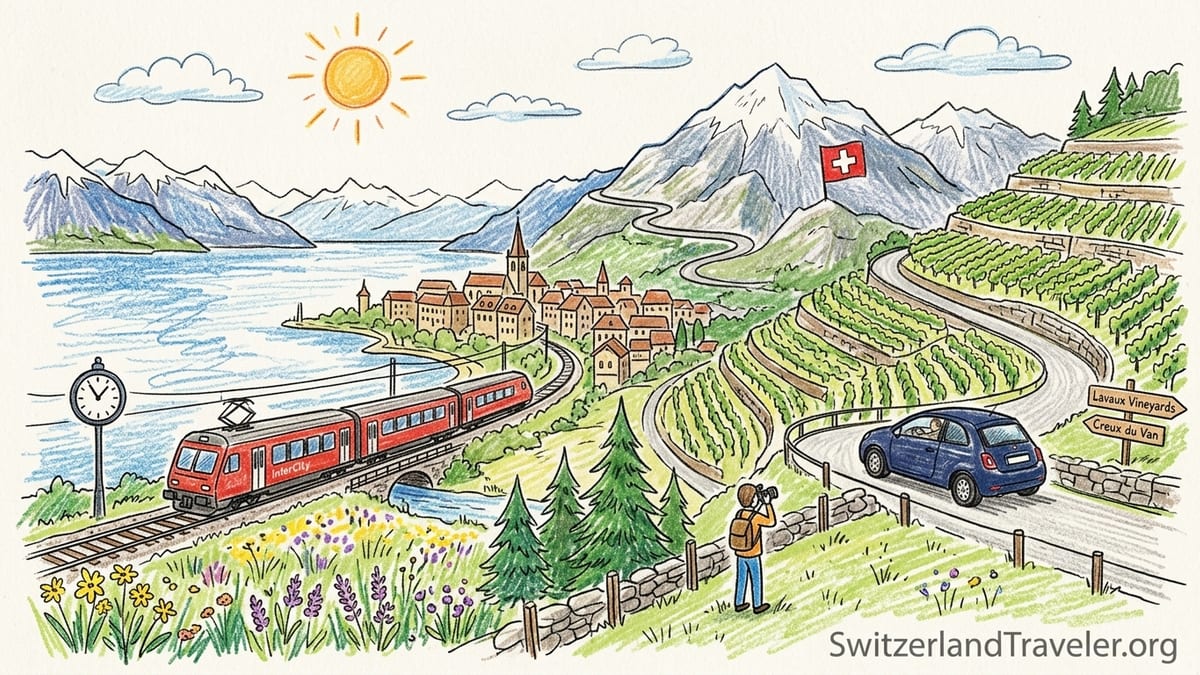
Why Drive Western Switzerland When the Trains Are So Good?
Switzerland’s rail network between Geneva, Lausanne, Montreux, Gruyères, Fribourg and Neuchâtel is frequent, clean and reliable. InterCity and regional trains run at least hourly along Lake Geneva and into the Fribourg and Neuchâtel regions, and classic excursions such as the GoldenPass route between Montreux and Zweisimmen are designed around rail, not the car. For a traveller staying mainly in cities and large towns, relying on trains and local buses is often cheaper and less stressful than renting a vehicle, especially when you factor in fuel at Swiss prices and paid parking in most urban centres.
A car does add real value once you move beyond the main rail corridors. The Lavaux terraced vineyards above Lake Geneva, the small wine villages between Lausanne and Montreux, and the narrow access roads to Creux du Van in the Jura are classic examples. The trains run at lake level and stop in larger communities, while the most scenic roads and viewpoints are higher up on the slopes. Having your own vehicle lets you follow signed panoramic routes, pull into a lay-by for a viewpoint, and time short hikes at sunrise or sunset that would be difficult with fixed rail timetables.
Cost-wise, a compact rental car in summer typically starts around the equivalent of 70 to 100 Swiss francs per day before fuel and parking. By comparison, a Swiss Travel Pass for one adult can be good value for intensive rail use, but a couple or family that wants vineyard back roads, castle detours and flexible photography stops will often find the convenience of a car justifies the extra spend on this route. A hybrid strategy also works well: use the car on days when you are exploring outside the rail spine, and leave it parked when you focus on compact city centres like Geneva or Lausanne.
Think carefully about your own priorities. If you are nervous about mountain or snow driving, visiting in midwinter mainly for cities and Christmas markets, or dislike paying for parking, the train will be the less stressful option. If you are comfortable on narrow country roads, keen to chase viewpoints at odd hours and happy to self-cater in vineyards or farm inns, then Western Switzerland is a particularly rewarding region to drive.
Designing a Modular Route: From Lake Geneva to the Jura
The core self-drive route runs Geneva → Lausanne and Lavaux → Montreux → Gruyères → Fribourg → Neuchâtel and Creux du Van. Driven in a straight line, this is only a few hours behind the wheel, but the appeal lies in how easily you can break it into short hops with walks, tastings and detours. Most travellers will want four to seven days to enjoy it at a relaxed pace, especially if you plan to explore vineyards or hike at Creux du Van.
As a compact Lake Geneva variant, you can keep the focus on Geneva, Lausanne, Lavaux and Montreux before looping back. For example, spend one night in Geneva, two in Lausanne or a Lavaux village, and one in Montreux. This gives you time for the Geneva lakefront and Old Town, a full day in the vineyards, and an excursion from Montreux to nearby peaks such as Rochers de Naye by cog railway rather than car. You can then return the vehicle at Geneva or continue by train into German-speaking Switzerland.
For a Jura-focused variant, concentrate your driving from Montreux or Lausanne north to Gruyères, Fribourg and Neuchâtel, adding one or two nights in the Jura foothills near Creux du Van. This part of the route moves away from the big lakes and delivers rolling farmland, gorges and high limestone plateaus. It particularly rewards self-drivers in late spring, summer and early autumn when minor roads and picnic spots are fully accessible and the high pasture roads above Creux du Van are free of snow.
The route works equally well as a one-way journey from Geneva to Zurich or Basel. In that case, pick up a car at Geneva Airport, follow the Lake Geneva and Jura sections, then continue by motorway towards your final city to drop the car. Just be aware of potential one-way rental surcharges and, if you cross a border to or from France or Germany, of cross-border fees and vignette requirements for motorways.
Geneva: Urban Arrival, Car Pick-up and Parking Realities
Most international visitors start in Geneva, flying into Geneva Airport or arriving by train at Cornavin station. The airport’s rental car desks are clustered in the terminal complex, offering a wide choice of major brands and a straightforward drive onto the A1 motorway towards Lausanne. If you arrive by air and plan to drive, it is usually simpler to collect your car at the airport and head straight out of the city rather than navigating central Geneva traffic on your first day.
If you choose to sightsee in Geneva before leaving, consider postponing your car pick-up until the day you depart for Lausanne. Geneva is compact and well served by trams and buses, and central parking is not cheap. Underground garages near the lakefront and Cornavin typically charge around 2.50 to 3.50 Swiss francs per hour with day caps that can easily reach 20 francs or more. Overnighting a rental car in a city garage for several days can add a significant sum to your trip budget with little benefit if you are mostly walking around the Old Town and lakefront.
If you do drive into Geneva, aim for an underground car park rather than hunting for street spaces around the Old Town, where most bays are either time-limited or reserved for residents. Some drivers use park and ride facilities on the outskirts, leaving the car near a tram or train stop and riding into the centre on public transport. This can be useful if you are staying in a hotel away from the lake or arriving late in the day when the main garages are busy.
From Geneva to Lausanne, the A1 motorway tracks the lake’s northern shore and delivers you to Lausanne in under an hour without stops. For a more scenic route, follow the lakeside road via Nyon and Morges, where you can pull off at small harbours for views across to the French Alps. This is a good gentle introduction to Swiss driving before you tackle narrower roads in the Lavaux vineyards later in the trip.
Lausanne and Lavaux: When a Car Beats the Train
Lausanne stands above Lake Geneva on steep hills, which makes for atmospheric views but also a network of one-way streets, tunnels and tight turns. If your hotel is in the city centre, it may provide guest parking or a discounted rate at a nearby garage, but it is very feasible to park once and then move around by metro and on foot. The real justification for your car here is the Lavaux vineyard terraces, just east of Lausanne, which are listed as a UNESCO World Heritage landscape.
The trains between Lausanne and Montreux largely hug the shoreline and run through tunnels and built-up areas. They are fast and convenient but do not take you into the heart of the vineyards. By contrast, the Route de la Corniche and other narrow roads that climb above villages like Lutry, Grandvaux, Riex and Epesses are classic self-drive territory. Here you share the road with tractors and occasional vineyard workers and stop at small pull-outs for photos over stone-walled terraces falling towards the lake, with the Savoy Alps behind.
Parking in Lavaux requires more attention than simply pulling into any verge. Several signposted photo spots along the Grand Tour of Switzerland provide a handful of marked spaces directly at viewpoints in the terraces, which are ideal for short stops. In some villages there are small paid or time-limited car parks near the church or station, often full at weekends during harvest and on sunny days. It is important not to block narrow lanes or private access to vineyard plots. As a practical example, many drivers leave the car in a small lot above a village like Cully or Epesses and then walk loop trails through the vines, returning to the same spot later in the day.
If you prefer not to drive the steepest lanes, you can still use your car to reach a mid-level village, park in a designated area, and continue on foot along well-marked paths that zigzag through the terraces. Travelling in autumn, when the vines turn gold, these paths can be busy, but the ability to arrive early or stay for sunset with your own vehicle is a notable advantage over the fixed rhythm of trains and tourist minibuses.
Montreux and the Lake Geneva Variant
From Lavaux it is a short coastal drive to Montreux, a Belle Époque resort town known for its flower-lined lakeside promenade and, in December, one of Switzerland’s most popular Christmas markets. The road skirts the lake and passes the famous Château de Chillon, where a signposted car park just off the main road allows you to leave your vehicle and visit the castle on foot. In peak summer and around major events such as the Montreux Jazz Festival, this car park fills quickly; arriving early in the morning or later in the afternoon helps you avoid queuing for a space.
Montreux itself has several multi-storey and underground car parks within walking distance of the lakeshore hotels. Expect similar tariffs to Geneva and Lausanne. If your accommodation includes parking, confirm in advance whether your space is reserved or first come, first served. Given the town’s narrow lakeside strip and the popularity of the promenade, it can be stressful to circle for a space at busy times, so many visitors prefer to check in, park and explore Montreux on foot or by local bus.
For travellers on a shorter schedule, Montreux can be the furthest point of a Lake Geneva focused circuit. One possible four-day plan is to arrive in Geneva, spend the first day without a car, then pick up a rental in the morning and drive to Lausanne and Lavaux for a full day among the vineyards. The next day, continue to Montreux and Château de Chillon, staying overnight, and on the fourth day drive directly back to Geneva along the motorway, returning the car at the airport before flying out. In this scenario you still experience the vineyard driving that trains cannot replicate but avoid the longer detour north into the Jura.
From Montreux, drivers with more time might be tempted to continue into the high Alps, but for the purposes of this Western Switzerland itinerary, the recommended next move is inland towards Gruyères. This transition takes you from the broad shores of Lake Geneva into greener pastures and a more rural landscape where a car again provides clear benefits over public transport.
Into the Countryside: Gruyères, Fribourg and Neuchâtel
The drive from Montreux to Gruyères takes you up the Sarine valley into the canton of Fribourg, passing green hills and dairy farms. The medieval hilltop town of Gruyères, famous for its cheese, allows limited vehicle access to the cobbled centre, so most drivers use the signed parking areas at the foot of the village. These lots are paid and can be busy on weekends, but they keep traffic out of the pedestrian core and make it easy to combine a visit to the castle, the cheese dairy and one of the village restaurants serving fondue or raclette without worrying about the car.
From Gruyères to Fribourg, you can remain on the motorway or choose slower regional roads that follow the river through smaller villages. Fribourg itself straddles a deep gorge and has both a modern upper town and a preserved lower town with Gothic architecture. Street parking in the historic centre is limited, so many visitors opt for underground garages near the train station or at the edge of the Old Town, then move around on foot. Trains between Gruyères and Fribourg run regularly, and if you plan to spend most of your time in Fribourg’s centre, you might even choose to leave the car parked at a rural hotel for a day and use rail to avoid city driving altogether.
Continuing to Neuchâtel, the landscape shifts again, with the city perched between the Jura foothills and Lake Neuchâtel. Here you begin to feel closer to the Creux du Van region, even if the main town is still firmly lakeside. Neuchâtel has several central car parks with hourly charges, and using them allows you to walk up through the traffic-calmed streets to the castle and collegiate church. For many drivers, Neuchâtel is the last urban overnight on this route before turning into the higher Jura for hikes and viewpoints.
If you are travelling by rail rather than car, this whole section between Gruyères, Fribourg and Neuchâtel is still very feasible. Regional trains connect the main towns, while local buses climb into nearby valleys. The trade-off is that you will lose time to transfers and walking from stations to viewpoints, whereas a car lets you fit more villages and rural stops into a single day.
Creux du Van and the Jura: Seasonal Roads, Parking and Winter Access
North of Lake Neuchâtel, the road climbs into the Jura plateau towards Creux du Van, a vast limestone cirque often described as a kind of Swiss natural amphitheatre. This is where having your own vehicle is most advantageous, especially in the warmer months from roughly May to October. A network of minor roads leads to official car parks from both the north and south, from villages such as Couvet, Noiraigue, Gorgier, Bevaix and Provence. From some of these lots you can be standing at the rim after as little as a five to fifteen minute walk, while others require a longer hike of up to 40 minutes or more.
Parking is tightly regulated because Creux du Van sits within a protected nature reserve. Drivers are expected to use only marked car parks and avoid stopping in meadows or farm tracks. In the main hiking season the most commonly used upper car park is near the Soliat area, reached by narrow roads that wind through pasture and forest from Couvet or from the lakeside. Another option is to leave your car near Noiraigue and approach on foot from below, following scenic but more strenuous trails.
Conditions change significantly in winter. Roughly from November to April, several higher roads in the Creux du Van area are not cleared of snow and are effectively closed to normal traffic. On the road between Provence and Couvet, winter tyres and sometimes snow chains are recommended when conditions are snowy or icy, and access to the uppermost car parks is restricted. Instead, parking is usually available lower down, for example near farms or valley villages, from where you must continue on foot. Paths can be extremely slippery, and daylight is short, so in midwinter some visitors choose to admire the region from lower viewpoints or skip Creux du Van entirely.
A practical approach for many self-drivers is to treat Creux du Van as a half-day or full-day excursion from Neuchâtel or a nearby village, timing your arrival early in the morning to secure parking. In summer, you might drive up from Lake Neuchâtel via Gorgier, park at a designated upper lot, walk the rim loop and picnic before retracing your route. In shoulder seasons like April or November, it is essential to check local tourism information in Neuchâtel or Val-de-Travers on current road status and whether snow remains on the trails, as conditions can change quickly with late storms or early frosts.
If you choose to visit without a car, you can still reach the area by taking a train to Noiraigue or other nearby stations, then following waymarked hiking routes to the cirque. This is fully realistic in spring and autumn for fit walkers who are comfortable with significant elevation gain. However, relying on buses and trains makes it harder to combine Creux du Van with multiple other stops in one day and forces you to adhere to timetables that may be sparse on weekends or in winter.
One-way Rentals, Motorway Vignettes and When to Switch Back to Rail
Many travellers consider starting their Western Switzerland road trip in Geneva and ending it in another Swiss city such as Zurich or Basel. Major rental agencies typically allow one-way hires within Switzerland, but a one-way surcharge is common. This fee can vary based on season and company, so when you are comparing offers it is important to look beyond the daily rate and note any additional cost for returning the vehicle to a different depot.
If your itinerary crosses into neighbouring France, for example to use the French sector of Geneva Airport or to connect with onward flights, check your rental agreement for cross-border permissions and possible extra charges. Some companies apply a specific cross-border fee per rental when you plan to drive in both France and Switzerland, and you remain responsible for any motorway tolls or vignettes required in each country. Switzerland uses an annual motorway vignette system, but most locally registered rental cars already include this. It is still worth confirming at the desk that the car is equipped and that you understand any restrictions.
A sensible pattern for many visitors is to use the car primarily in the Lavaux, Montreux, Gruyères, Fribourg, Neuchâtel and Creux du Van sections, then return it once you reach a larger rail hub for onward travel. For example, you might drop the car in Neuchâtel and continue by train to Zurich, or finish your driving loop back in Lausanne and travel to Bern or Lucerne by InterCity. This approach lets you enjoy rural flexibility while avoiding the need to drive and park in busy city centres where public transport is often quicker and more pleasant.
Remember that drop-off locations in smaller towns may have limited opening hours, especially on Sundays and public holidays. If you plan to return the car in a regional city like Neuchâtel or Fribourg, check collection and return times carefully so you are not left waiting with your luggage. Airport depots tend to offer longer hours and can be more forgiving when your schedule slips, which is another reason many travellers choose to pick up and drop off at Geneva Airport even if they spend most of their time elsewhere.
The Takeaway
A Western Switzerland road trip between Geneva, Lausanne, Lavaux, Montreux, Gruyères, Fribourg, Neuchâtel and Creux du Van is less about long distances and more about how you move through short ones. The trains will take you quickly between the main cities and towns, but a car lets you weave into vineyards, pause in small farm hamlets and reach Jura viewpoints that would otherwise demand long hikes or multiple bus connections. Used thoughtfully, your vehicle becomes a tool for accessing quieter, more atmospheric corners of a very well-visited region.
The key decisions are when to have the car and when to hand responsibility back to Switzerland’s excellent public transport. For many travellers, the sweet spot lies in combining both: arrive in Geneva by plane or train, see the city without a car, then rent a compact vehicle for the days when you plan to criss-cross Lavaux’s terraces, detour via Gruyères and finish above the forests at Creux du Van. After that, you can gladly sit back on an InterCity train and watch the landscape slide past, satisfied that you have explored both the headline sights and the quiet back roads in between.
Whether you choose the full Geneva to Creux du Van arc, a shorter Lake Geneva loop or a Jura-focused variant, the same principles apply. Respect local parking rules, be realistic about winter access, especially on high Jura roads, and give yourself enough time in each place that you are not constantly watching the clock. Western Switzerland rewards patience and curiosity, and a well-planned self-drive route is one of the most flexible ways to experience it.
FAQ
Q1. Do I really need a car for this Western Switzerland itinerary?
You can reach Geneva, Lausanne, Montreux, Gruyères, Fribourg and Neuchâtel entirely by train, which is fast and frequent. A car mainly adds value for exploring the Lavaux vineyard roads above Lake Geneva and the rural access routes to Creux du Van. If you are happy to hike longer distances from train stations and skip some viewpoints, you can rely on public transport alone.
Q2. When is the best time of year to drive to Creux du Van?
The most reliable period for easy road access and hiking is roughly from May to October, when higher roads and official car parks near the rim are normally free of snow. From November to April, some upper roads are not cleared, parking shifts lower down, and trails can be icy or slippery, so conditions are more challenging and plans should remain flexible.
Q3. How difficult are the vineyard roads in Lavaux to drive?
The main vineyard routes are paved but often narrow, steep and winding, with sharp bends and occasional farm traffic. Drivers comfortable with manual gearboxes and hill starts usually adapt quickly, but nervous or inexperienced drivers may prefer to park in one of the villages and explore the terraces on foot instead of driving the steepest lanes.
Q4. Is parking expensive in Geneva, Lausanne and Montreux?
Yes, central parking in these cities is a noticeable part of a trip budget. Underground or multi-storey garages near the lakefront or main stations typically charge a few Swiss francs per hour with daily caps that can easily reach several tens of francs. Whenever possible, it is worth choosing accommodation that includes guest parking or using park and ride facilities at the edge of the city.
Q5. Are one-way car rentals within Switzerland easy to arrange?
Most major rental companies allow one-way hires between Swiss cities, including pick-up in Geneva and drop-off in places like Zurich, Basel or sometimes larger regional centres. However, they often add a one-way surcharge, so you should check this cost when comparing offers. Availability can also be more limited for returns to smaller depots.
Q6. What kind of car is best for this road trip?
A compact or mid-size car is ideal, providing enough comfort for luggage while remaining easy to manoeuvre on narrow vineyard and Jura roads. Automatic transmission can reduce stress on steep climbs if you are not used to driving in hilly terrain, and in winter a car with good winter tyres is more important than size or power for safety.
Q7. Can I visit Lavaux by train instead of driving?
Yes, regional trains run frequently between Lausanne and stations such as Lutry, Grandvaux, Epesses and Cully at lake level, and from there you can walk up into the terraces. This is an excellent option if you prefer not to drive steep narrow roads, though you will spend more time walking uphill and may miss a few high viewpoints that are easiest to reach by car.
Q8. Is winter driving in this region safe for visitors?
Main motorways and primary roads between Geneva, Lausanne, Montreux, Gruyères, Fribourg and Neuchâtel are generally well cleared in winter, and a rental car equipped with proper winter tyres is usually adequate. Caution is needed on smaller Jura and vineyard roads, where snow and ice linger. In poor conditions, it is sensible to avoid minor high routes and switch to trains or lower-altitude excursions instead.
Q9. How many days do I need for the full Geneva to Creux du Van route?
A comfortable pace for the full arc from Geneva through Lausanne, Lavaux, Montreux, Gruyères, Fribourg, Neuchâtel and Creux du Van is five to seven days. This allows one or two nights each in Geneva and the Lake Geneva region, plus time for at least one night in the countryside near Gruyères or Fribourg and one near Neuchâtel or the Jura, without rushing.
Q10. Can I combine this itinerary with famous Swiss scenic trains?
Yes, it integrates well with routes such as the GoldenPass line from Montreux towards the Bernese Oberland or Interlaken. A common pattern is to complete the self-drive portion between Geneva and Creux du Van, return the car in a larger city, then board a scenic train for the next leg of your journey, letting someone else handle the driving while you enjoy the views.