


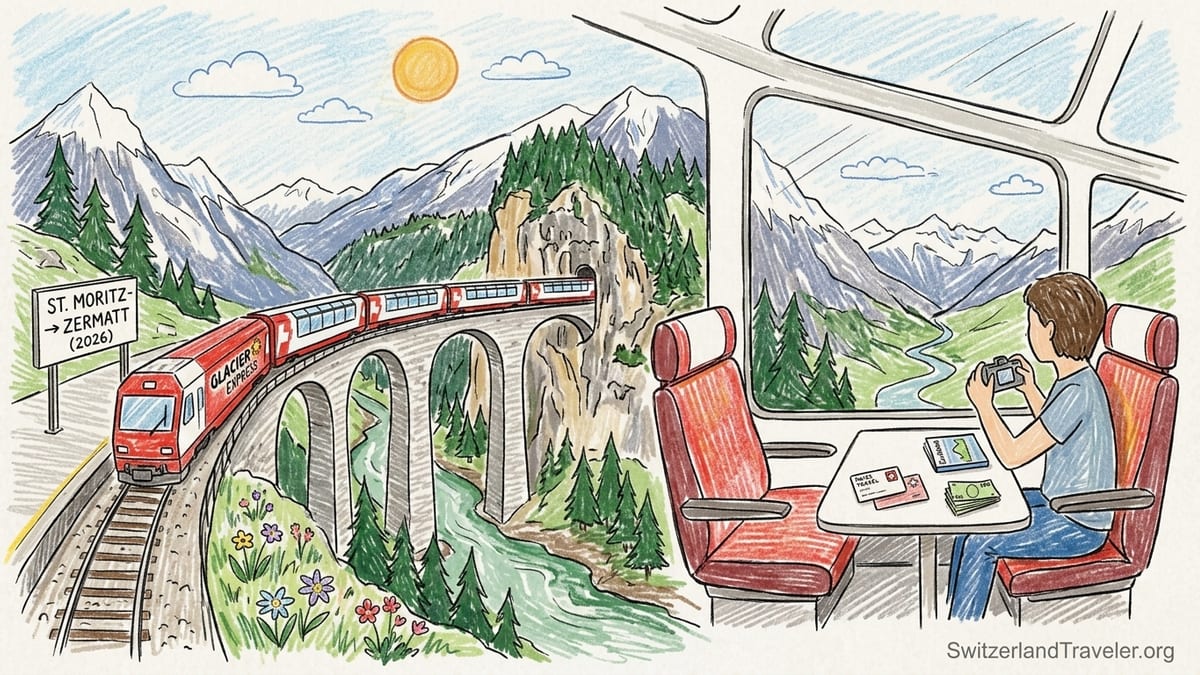
When Switzerland markets the Glacier Express as the “slowest express train in the world,” it sounds romantic. Seven and a half hours in glass-domed comfort from St. Moritz to Zermatt, crossing 291 bridges and 91 tunnels, with the Matterhorn as your finale. Valais tourism leans hard into that dream. Yet for a full-fare traveler paying around 220 Swiss francs in 2026 for a second-class ticket plus the mandatory reservation, it is fair to ask: is spending most of a day in a single train carriage actually worth it?
How I Booked It, What I Paid, and Where I Sat
I booked the classic full Glacier Express route in summer 2026, traveling east to west from St. Moritz to Zermatt in second class. I used the official Glacier Express booking engine rather than a reseller, in order to see the real-time coach layout and choose a specific seat. That layout matters more than many people realize, because your enjoyment of the day depends heavily on which side of the train you sit and how many people you share a table with.
For 2026 departures, the mandatory seat reservation for both first and second class is listed at 54 Swiss francs per person. On top of that, a full-fare second-class ticket for the complete St. Moritz to Zermatt stretch runs in the region of 160 to 170 francs according to current price tables, with one frequently cited example being 159 francs before the reservation supplement. Combined, a traveler without a rail pass can expect to pay around 210 to 225 francs for the journey in second class, before spending a single franc on food or drinks.
I opted for a forward-facing window seat at a four-seat table on the right-hand side leaving St. Moritz. In the current panoramic cars, second-class seating is arranged as two-by-two across the aisle, with large picture windows running into the ceiling and relatively generous leg room. Every pair of seats shares a small table, and each place has its own adjustable back rest and power socket. The seat map allowed me to avoid the few spots adjacent to pillars between windows, which can create awkwardly obstructed views in the middle of the glass panels.
The reservation process itself was straightforward but not instant. Demand on peak summer dates remains strong, and on my mid-July departure several window pairs were already blocked out four weeks in advance. Travelers relying on Swiss Travel Passes should note that the pass covers the base fare but not the reservation. You still need to go through the same process, pay the supplement, and carry both your pass and the Glacier Express seat confirmation.
First Impressions: Comfort, Space and Crowd Levels
Boarding in St. Moritz felt closer to a long-distance intercity service than a tourist excursion. Platform signage was clear, staff checked reservations at the carriage doors, and the train left on the posted minute. Inside, the first thing that hits you is the height of the panoramic windows and the brightness of the carriage. Even on a day that began with high cloud and filtered sun, it felt like stepping into a winter garden.
Second class did not feel cramped. On my run, the carriage was roughly 80 percent full between St. Moritz and Chur, then eased to around two-thirds occupancy once day-trippers peeled off at intermediate stations. At my table of four, there were three of us for the first few hours, then just two after Disentis. That made a real difference to comfort. With only two people per table, there was ample space to spread cameras, guidebooks and snack bags without playing elbow chess.
The seats themselves are comparable to modern European intercity trains: firm but well padded, with a reasonable recline and headrests that can be adjusted in height. Over seven-plus hours I never felt pressure points, though by the last hour before Zermatt I was shifting more often. The ride quality is remarkably smooth for a meter-gauge mountain railway. Even in the twistiest sections, such as the Albula line near Bergün and the descent through the Rhine Gorge, lateral sway was noticeable but not fatiguing.
Noise levels were lower than I expected for such a popular route. There were occasional bursts of excitement when the bilingual commentary announced a major landmark like the Landwasser Viaduct or the Oberalp Pass, but the general tone was relaxed. In the morning, the carriage hummed with quiet conversation in multiple languages and the soft clink of coffee cups. Later in the day, more people retreated into a kind of moving siesta, reading or just staring out of the window.
The Views: Which Sections Earn the 7.5 Hours
The Glacier Express is often described as one continuous highlight reel. In reality, the visual intensity rises and falls throughout the day. Certain stretches justify every franc and every minute. Others feel closer to an attractive but ordinary Swiss regional route, especially if you have already traveled widely in the Alps.
From St. Moritz to Chur, the line passes through some of the most celebrated engineering on the Rhaetian Railway network, including the Albula tunnel and a series of stone viaducts and spiral loops between Preda, Bergün and Filisur. The iconic Landwasser Viaduct, where the train curves onto a towering limestone bridge before plunging directly into a cliff-face tunnel, is as dramatic as the brochures suggest. Here, the Glacier Express excels because the commentary tells you exactly when to look up, and the panoramic glass really does make the valley drop away beneath you.
Between Chur and Disentis, the train follows the Anterior Rhine through the Ruinaulta, often marketed as the Swiss “Grand Canyon.” High limestone walls close in on both sides, dense forests cling to the slopes, and the river braids around gravel bars. On my trip, late morning sunlight illuminated the cliff faces while the carriage itself stayed shaded, making colors pop without harsh glare. This segment, in my view, is one of the main reasons to ride the named train instead of simply stringing together commuter services, because you can settle in and watch the gorge unfold without watching the clock for your next connection.
From Disentis over the Oberalp Pass to Andermatt, the atmosphere shifts again. The train climbs to more than 2,000 meters, the highest point on the whole Glacier Express route. Even in July, snow patches lingered above the rail line and alpine meadows were in full flower. This is a section where sitting on the right or left matters less than simply being on the mountain side of the carriage away from the direct midday sun, because the broader horizon steals the show. For me, this pass crossing, with its slow curves past tarns, ski lifts and lonely wayside chapels, was the emotional peak of the journey.
West of Andermatt, especially from Brig to Visp and up the Mattertal toward Zermatt, the scenery remains handsome but becomes more familiar to anyone who has used regular Swiss services in Valais. Vineyards, river flats and villages framed by big peaks alternate with tunnel sections. The approach to Zermatt does bring a welcome tightening of focus, with steep-sided valleys and ever denser clusters of chalets, yet the truly famous Matterhorn view does not appear from the Glacier Express itself. For that, you still need to ride the Gornergrat cog railway or hike above the village after you arrive.
Food, Service and the Reality of Dining On Board
The Glacier Express offers at-seat meal service, with three-course menus that must usually be pre-booked and a shorter bistro-style menu that can be ordered on the day. On my journey, a full three-course lunch ran to several dozen francs, while simpler dishes such as rösti, pasta or salads started in the high teens to low twenties. Drinks were priced on par with Swiss restaurant levels, with coffee in the low single digits and wine by the glass in the high single digits to low teens.
I chose not to commit to the full set menu and instead sampled the shorter offerings: a soup of the day, a plate of alpine cheese and cured meat, and a later afternoon dessert. The presentation exceeded typical train fare. Ceramic plates, proper cutlery and white tablecloth runners added a sense of occasion. The staff worked from a dedicated kitchen car, moving briskly up and down the aisles with trays. Service was friendly and unrushed even when most of the carriage ordered lunch within the same half-hour window after the Oberalp Pass.
Eating while the landscape slides past at walking pace turned out to be one of the best uses of time on a 7.5‑hour ride. Instead of treating the Glacier Express as pure sightseeing, I came to see the dining element as part of the value proposition. That said, travelers on tight budgets would be wise to pack at least some of their own provisions. There is no requirement to buy food on board, and a simple picnic at your table is perfectly acceptable. Water is available, but refilling your own bottle during station stops or from fountains before boarding will save a small but steady drain on funds.
Importantly for an assessment of comfort, meal service never turned chaotic. The aisles are wide enough for trolleys and people to pass with a bit of cooperation, and the staff did a good job of pacing courses to the rhythm of the route. They deliberately avoided serving or clearing during the most dramatic viewpoints, such as the Ruinaulta and Landwasser Viaduct, which helped prevent that classic travel frustration of missing the best photo because your main course arrived at the wrong second.
Photography, Reflections and the Limits of Panoramic Glass
Those huge panoramic windows are the Glacier Express signature, but they are also its main photographic limitation. From the moment we rolled out of St. Moritz, there were visible reflections of ceiling lights and the opposite windows in the glass, particularly on the sunlit side of the train. During the early stretches to Chur, cloud cover softened the effect, and careful positioning of the camera lens directly against the window removed most of the ghosting. Once the sun strengthened around midday, reflections from inside the carriage became unavoidable in many directions.
On the Glacier Express, the main windows do not open. That is a fundamental difference from many of the regional trains that cover the same route, where at least some carriages between Chur and Disentis and on older stock in Valais still have pull-down windows. For serious photographers, that is a decisive advantage of doing the journey in segments. Being able to lean out slightly, or at least shoot through a clear opening, can make or break images in the Ruinaulta or on the curves near Bergün.
The Glacier Express designers understand this to a point. Current promotional and technical documents make much of the small lowering windows at the end doors of the panoramic cars that can be opened briefly for mirror-free photography. In practice, reaching them requires leaving your seat, timing it between commentary segments and meal service, and accepting that in crowded periods you will share those vantage points with other camera-wielding passengers. On my trip, there was an informal rotation, but space remained limited and you had to be ready a few minutes in advance of major landmarks.
In practical terms, I came home with a mixed batch of photographs. Wide landscape shots fared reasonably well, especially when taken from the shaded side of the train, with the lens hood pressed gently to the glass and reflections minimized by wearing dark clothing. Shots that tried to include both interior and exterior, such as a glass of wine with a mountain backdrop, suffered more from ghost images and contrast loss. For travelers whose priority is gallery-quality images rather than the experience of a single through journey, the Glacier Express is therefore a compromise rather than a perfect solution.
How It Compares to Ordinary Regional Trains on the Same Route
Every kilometer of the Glacier Express line between St. Moritz and Zermatt is also served by ordinary regional trains operated mainly by the Rhaetian Railway and the Matterhorn Gotthard Bahn. Before committing to the panoramic train, I had previously traveled two key stretches on these regular services: Chur to Disentis through the Rhine Gorge, and Andermatt to Brig across the Oberalp Pass and down the Rhône valley. That gave a useful, real-world basis for comparison.
On the regional trains in Graubünden, particularly the RegioExpress services between Chur and Disentis, second-class carriages often have windows that can be partially opened. In my earlier trips through the Ruinaulta, this made all the difference for photography. Standing by an open window in a less crowded carriage, I captured sharper, contrast-rich shots of cliffs and river bends than anything I managed from behind the Glacier Express glass. The trade-off was comfort. Regional trains were busier with commuters at peak times, seat reservations were not possible, and luggage storage was more improvised.
Between Andermatt and Brig, my regional rides felt less curated but more flexible. Hourly services allowed spontaneous stops in places like Fiesch or small villages along the Rhône valley, with the option to continue later on the next train. That flexibility is simply not compatible with a single Glacier Express reservation. Once you board the panoramic train, you are committed to staying with it for the long haul unless you are prepared to forfeit the remainder of your reservation and improvise the rest of the journey.
In terms of raw seat comfort, the Glacier Express wins. Seats are newer, upholstery is fresher, and there is a subtly higher level of sound insulation. Regional stock can be older, with more worn fabrics and slightly noisier bogies. However, in the sections where scenery is most intense, such as the Albula line and the Oberalp Pass, regional trains closely match the panoramic train in window size and general visibility. The main difference is the absence of ceiling-height glass and the branded commentary track.
Crucially, cost structures diverge. Regional trains use the standard Swiss nationwide fare system. A point-to-point second class ticket from Zermatt to Chur or St. Moritz via the Glacier Express route costs about the same whether you take the named train or not, but the regional option does not add the 54‑franc reservation surcharge. For rail pass holders, both choices are technically covered, yet Glacier Express reservations remain compulsory. So from a pure budget perspective, assembling the journey from ordinary trains can save a two-figure amount per person that might be better spent on a Gornergrat excursion or a hotel upgrade.
Is Seven and a Half Hours on One Train Emotionally Worth It?
Monetary value is only one side of the question. The other is emotional value. Seven and a half hours is a long time to sit in any single environment. Even with changing views and the rhythm of station stops, there are stretches on the Glacier Express that feel like a long-distance flight with better scenery: comfortable but static, with a mild restlessness in the carriage by late afternoon.
The day began, for me, with a genuine sense of occasion. Leaving St. Moritz, the commentary introduced the Albula line’s UNESCO World Heritage status, fellow passengers traded itineraries, and cameras came out for every viaduct. The first three hours to Chur passed quickly. The middle part of the day, from Chur to Andermatt, settled into a quieter, almost meditative rhythm. I alternated between watching the gorge, reading, and simply daydreaming as villages slipped past. By the last two hours, particularly between Brig and Zermatt, I noticed more people checking watches and phones, repacking bags, and standing up to stretch.
Where the Glacier Express earns its reputation is in the sense of continuity. You witness whole river systems from source regions to major valleys, cross a significant alpine pass without the stress of driving, and feel a tangible progression from the Engadine’s airy plateau to the tight Mattertal funneling you toward Zermatt. It is a narrative journey. That narrative can be deeply satisfying if you lean into it, treat the train as a moving lounge, and do not expect constant adrenaline peaks.
However, travelers who are happiest hopping off regularly, exploring side valleys, or chasing one perfect hike after another may find the constraint frustrating. In the time the Glacier Express spends between St. Moritz and Zermatt, you could, for example, ride a morning segment through the Rhine Gorge on a regional train, hike a loop near Flims, then continue later to Andermatt or Brig and still arrive in Valais by evening. The single-sit experience is a specific kind of pleasure that fits some travel styles better than others.
For me personally, the journey felt long but not wasted. I stepped off in Zermatt with the mellow tiredness you get after a full day at an exhibition or on a slow river cruise. I did not feel the need to repeat the entire 7.5‑hour stretch immediately, but I was glad to have experienced it once, end to end, as a coherent story across the Alps.
Who Should Book the Glacier Express, Who Should Not, and Would I Do It Again?
Based on this 2026 journey and earlier experiences on the same lines by regional train, I would say the Glacier Express delivers clear value for certain travelers. Anyone who values comfort, simplicity and the romance of a named train will likely be happy they booked it. If you are planning a once-in-a-lifetime Swiss trip, have limited days, and want a single, spectacular line that stitches together Graubünden and Valais without worrying about connections, this ride does exactly that. Older travelers, families who prefer a fixed base for children during the day, and rail enthusiasts who appreciate the engineering and history will probably find the 220‑franc outlay justifiable.
On the other hand, budget-conscious backpackers and photographers obsessed with clean, reflection-free images will get better value from regional trains. Being able to open windows, break the day into segments, and divert into side valleys like the Aletsch Arena or the Flims area often matters more than having a single reserved seat and a curated commentary. The money saved by skipping the reservation charge can meaningfully reduce daily costs in a country as expensive as Switzerland, especially for solo travelers or small groups.
There is also a middle ground. Some travelers might ride only the most scenic sections on the Glacier Express, such as Chur to Andermatt, and cover the rest by ordinary trains. Others may choose to ride the Glacier Express in one direction and return on regional services, experiencing both approaches. The timetable and fare structure in 2026 make these hybrid strategies relatively easy to arrange, particularly with a Swiss Travel Pass or flexible point-to-point tickets.
Would I personally spend the money again? Not for the identical full route in the near future. I feel I have now “collected” the Glacier Express as a complete story, and if I return it would likely be for a specific segment in a different season, perhaps the winter timetable between Chur and Andermatt when snow cover transforms the Oberalp landscapes. For a first-time visitor weighing whether to try it once, my answer is yes, with the caveat that you should go in with realistic expectations: this is a day of slow, comfortable immersion, not a constant highlight reel or a photographer’s dream platform.
The Takeaway
So, is the Glacier Express worth it in 2026? For many travelers, yes, provided you understand what you are buying. You are not paying only for transport from St. Moritz to Zermatt. You are paying for seven and a half hours in a moving alpine lounge, with ceiling-height windows, curated commentary, at-seat dining and the convenience of a single seat from one iconic resort to another. The roughly 220‑franc price tag in second class reflects that experience rather than a simple point-to-point transfer.
The journey’s strongest sections, in my experience, are the Albula line around Bergün and Filisur, the Rhine Gorge between Chur and Disentis, and the Oberalp Pass between Disentis and Andermatt. These alone justify a significant investment of time. The western run from Brig to Zermatt provides a satisfying conclusion but is less unique compared with what ordinary regional trains in Valais already offer. Window reflections and non-opening glass limit photographic potential, yet for travelers more interested in soaking up scenery than in composing perfect shots, the drawbacks are manageable.
If you value reliability, comfort and the ease of a single-seat ride across the Alps, and if your budget allows for a one-day splurge, the Glacier Express can be a memorable highlight of a Swiss itinerary. If your priority is flexibility, in-depth exploration of side valleys, or serious landscape photography, you may be better off building your own version of the route on regional trains and using the savings on mountain excursions once you arrive. As with many premium travel experiences, the Glacier Express is at its best when you choose it consciously for what it is, rather than simply because it appears on a bucket list.
FAQ
Q1. How long does the full Glacier Express journey take between St. Moritz and Zermatt?
The end-to-end Glacier Express journey is typically scheduled at around seven and a half hours, depending on the specific seasonal timetable.
Q2. How much does the Glacier Express cost in 2026 for a full-fare second-class ticket?
In 2026, a full-fare adult in second class can expect to pay roughly 160 to 170 Swiss francs for the base ticket plus a mandatory 54‑franc reservation, for a total around 210 to 225 francs before food.
Q3. Is the seat reservation really mandatory if I have a Swiss Travel Pass or Eurail pass?
Yes. Rail passes cover the base fare but do not replace the compulsory Glacier Express reservation, which must be booked and paid in addition.
Q4. Which side of the train has the best views on the Glacier Express?
Views are good on both sides, but many travelers prefer the right-hand side leaving St. Moritz for certain viaducts and the Rhine Gorge. Over the Oberalp Pass, overall scenery matters more than side.
Q5. Can I get good photos from the Glacier Express despite the fixed panoramic windows?
You can get decent wide-angle shots, especially from the shaded side of the train or from the small opening windows at carriage doors, but reflections and non-opening main windows remain a limitation.
Q6. How does the Glacier Express compare with ordinary regional trains on the same route?
The Glacier Express offers more comfort, a single-seat journey and commentary, while regional trains provide more flexibility, often some opening windows, and avoid the extra reservation fee.
Q7. Is the food on board the Glacier Express worth the price?
Food is not cheap but is well presented, with proper table service and regional dishes. Many travelers find at least one on-board meal enhances the experience, while supplementing with their own snacks.
Q8. Will I see the Matterhorn from the Glacier Express itself?
You will travel up the valley toward Zermatt with impressive mountain views, but the classic Matterhorn panorama is not from the Glacier Express and is best seen after arrival, for example from Gornergrat.
Q9. Who is the Glacier Express best suited for?
It suits travelers who value comfort, simplicity and a curated, once-in-a-lifetime scenic rail journey, including older travelers, rail fans and visitors on a special Swiss holiday.
Q10. Would you personally ride the Glacier Express again and pay the same amount?
After one full St. Moritz to Zermatt journey, I would not repeat the entire route soon, but I would consider specific segments in another season. For a first-time visitor with the budget, I believe it is worth doing once.