


Crans-Montana in Switzerland is famous for winter skiing, luxury hotels and second homes that light up only on holiday weekends. I went in early summer as a non-skier, stayed on the plateau for a full day and ignored the pistes entirely. What I wanted to know was simple: if you do not ski, is Crans-Montana still worth your time and money, or is it better to base yourself in a humbler village in the Rhône Valley below?
Arriving Above the Rhône: First Impressions Without Snow
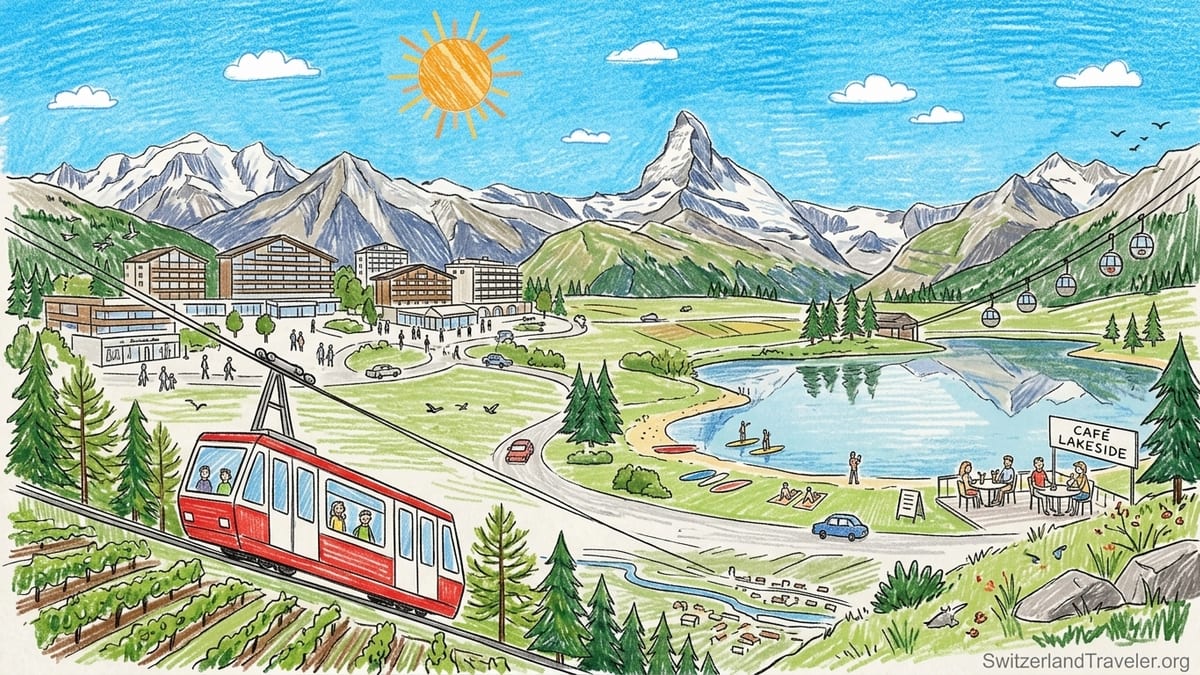
I arrived from Sierre on the Sierre–Montana–Crans funicular, which climbs more than 900 metres from the Rhône Valley vineyards to the resort plateau. The ride takes around 20 minutes and runs regularly through the day. It is an immediate reminder of how high and exposed Crans-Montana really is: the cabins rise past terraced vines and forests before easing into a landscape of apartment blocks, hotels and manicured lawns at roughly 1,500 metres above sea level.
Stepping out at Montana, there was no snow at all, just bright alpine light and a horizon of peaks that runs from the Matterhorn towards Mont Blanc on clear days. Marketing material boasts of more than 300 days of sunshine a year, and on my visit that claim felt plausible. The air was warm but noticeably drier and cooler than on the valley floor, which already justified the ascent for anyone seeking a break from the Rhône heat in summer.
The first impression is not a chocolate-box village. Crans-Montana is a spread-out plateau of several centres, with modern blocks, luxury boutiques and traffic on the main roads. It feels like a purpose-built resort, shaped over decades by skiing and high-end tourism. Yet between the buildings you constantly glimpse lakes, larch trees and huge views, which hint that there is more here for a non-skier than the architecture suggests.
I chose not to use a car. The plateau is served by local buses and resort shuttles, and the funicular links directly back to the mainline Swiss rail network in Sierre. That made it possible to treat Crans-Montana as a car-free base for the day, a useful consideration for travellers weighing it against villages where a car can feel almost essential.
Morning by the Lakes: Easy Beauty, High Prices
Crans-Montana has several small lakes scattered across the plateau, some dedicated to swimming, others to paddleboarding or lakeside cafés. Tourism information frequently calls them an alternative to the sea in summer, and for families or relaxed couples that is close to the truth. My morning revolved around two of them, Etang Grenon and Lac de la Moubra.
From Montana centre it is a short, almost flat walk to Etang Grenon, a lake framed by hotel facades, manicured lawns and a perimeter promenade. In the morning it was quiet, with locals walking dogs and a few joggers making loops. The scene is undeniably pretty, with reflections of peaks on calm water, but it also feels highly curated. Benches are plentiful and the path is stroller friendly, so it works well for families or travellers with limited mobility.
Coffee on the lakeside terrace made the first clear statement about pricing. For a simple espresso I paid around 4.50 Swiss francs. A cappuccino was closer to 6 francs, roughly in line with other Swiss resorts but higher than what you might pay in nearby towns such as Sierre. A glass of mineral water added about 4 francs more. These are not extreme prices for Switzerland, yet they quickly remind non-skiers that the resort’s luxury reputation is not just marketing language.
Later in the morning I continued on foot towards Lac de la Moubra, a more natural-feeling lake ringed by trees and small beaches. The walk takes around 25 to 30 minutes at an easy pace and stays almost level, making it accessible to most visitors. Here the atmosphere felt more relaxed and less polished. Families picnicked on the grass, paddleboards rested on the shore, and in warm weather people were swimming. For non-skiers, this lakeside time is one of Crans-Montana’s biggest strengths: you can spend half a day outdoors with very little effort and no need for technical gear.
Riding Up for the View: Cable Cars Without Skis
One question for non-skiers is whether buying a lift ticket is still worthwhile once the snow has gone. Crans-Montana promotes summer access to several lifts, including the Montana–Arnouva gondola and higher routes towards Cry d’Er and the Plaine Morte glacier at about 3,000 metres. On my visit I chose a simple return trip on a gondola rather than a full day pass.
Recent summer tariffs for pedestrians on the main lifts show return prices to the high alpine area around the Plaine Morte glacier in the region of 40 Swiss francs for adults in high season, with reduced fares for children and seniors. A more modest return from Montana to Arnouva costs noticeably less, roughly in the range of 15 to 25 francs depending on promotions and passes. I paid just under 20 francs for a return pedestrian ticket, which included access to marked walking paths at the top station.
The ride itself is part of the appeal. Cabins rise quickly over forests and ski runs into open slopes, and within minutes the resort architecture falls away behind you. At Arnouva the panorama is already impressive: a sweep of 4,000 metre peaks on the horizon, with the Rhône Valley almost vertically below. Sky is a dominant element, and on a clear day even non-hikers will feel they have reached a very different environment from the plateau.
However, the infrastructure around the top station betrays its winter focus. Restaurants and terraces are built to absorb ski crowds but can feel half empty in early summer weekdays. Some trails are open, and information boards detail hiking options, but if you are not prepared for longer walks you may find yourself taking a few photos, eating an expensive snack and returning down again quite quickly. For non-skiers, a single targeted lift ride on a clear day can be worthwhile, but a full multi-day lift pass is harder to justify unless you are committed to hiking or mountain biking.
Hiking and Viewpoints: How Far You Can Go Without Skis
Crans-Montana’s wider region advertises around 320 kilometres of marked summer hiking routes stretching from the vineyards at 500 metres to the Plaine Morte glacier near 3,000 metres. That density of trails is a major reason to consider the resort even if you never touch skis. For my non-ski day I aimed for moderate walks achievable in half a day, accessible on foot or by a single lift ride.
From Arnouva, several signposted paths contour across alpine meadows with limited elevation gain, offering wide views without committing to long mountain days. These are suitable for reasonably fit adults and older children. Under good weather I followed a route that took about two hours round trip, with the most challenging parts being loose stones on the path rather than steep climbs. Trail markings were clear and junctions well signed, typical of Swiss hiking standards.
Back on the plateau, another easy option connects several of the lakes via almost flat paths and sections of the historic irrigation channels known as bisses. These bisse-side walks, shaded by trees and accompanied by gentle running water, give a more traditional Valais feel than the polished shopping streets. Families with pushchairs or visitors unused to altitude can comfortably manage these walks, and they remain attractive in changeable weather when the high alpine zone might be cloudy.
For stronger hikers, Crans-Montana works as a starting point for full-day routes that climb towards higher ridges or descend through forests to the vineyards and villages below. Given the exposure and the potential for afternoon storms in summer, such hikes require appropriate gear and early starts. On my structured non-ski day I deliberately stayed with moderate terrain, but it was clear from trail maps and signage that ambitious hikers could easily fill several days here without repeating routes.
Art, Culture and a Different Kind of Plateau
Crans-Montana’s luxury image can overshadow its cultural side, but art is one of the more convincing reasons for non-skiers to visit. The standout is Fondation Opale, an art centre dedicated to contemporary and Indigenous art, located not in the main resort but in the village of Lens on the same plateau. Getting there without a car is relatively simple: from Crans-Montana you can take a regional bus towards Sion and get off near Lens, then walk a few minutes from the bus stop or nearby parking areas.
The foundation occupies a modern building above the village, with big windows looking towards the peaks. Current information indicates that exhibitions run across the year with specific dates for major shows, and that the museum keeps regular daytime opening hours with a weekly closing day, often Monday. Adult entry tickets are priced in the range of 15 to 20 Swiss francs, with reductions for students, seniors and children and occasional combined offers with local partners. On my visit, entry for one adult cost just under 20 francs.
Inside, the experience felt calm and thoughtfully curated, a clear contrast to the commercial energy of the resort streets. Exhibition texts were in French and English, and the building design encouraged slow looking and reflection rather than quick photo stops. For a non-skier, this offered a genuine half-day alternative to outdoor activities, particularly on days when clouds or storms reduce visibility in the mountains.
Back in Crans-Montana, smaller galleries and sculpture installations dot the resort, and occasional cultural events and classical concerts appear on the calendar through summer. These can provide evening interest, but they are secondary to the outdoor offer. If art and culture are a high priority for your trip, combining Crans-Montana with easy day trips to Sion or other Valais towns with historic centres would give you more variety.
Lunch, Coffee and the Cost of Feeling Polished
By midday I returned from the lakes towards Crans centre for lunch. Here, the resort’s upscale identity shows most clearly. Menus lean towards international mountain cuisine: pasta dishes, salads, burgers, local cheeses and meat plates. I chose a mid-range brasserie with terrace seating, not a fine-dining hotel restaurant but not a budget takeaway either.
For a simple meal of pasta with seasonal vegetables and a small side salad, the bill came to around 28 Swiss francs. Adding a non-alcoholic drink, lunch approached 35 francs for one person before tip. A main-course salad or burger hovered in the 25 to 35 franc range, while more elaborate meat dishes climbed above 40 francs. These figures are consistent with many Swiss resorts, yet compared with eateries in the valley towns they feel unquestionably premium. It is possible to eat more cheaply at bakeries, supermarkets or takeaway counters, but casual seated lunches will quickly raise the cost of a stay.
Later in the day, another lakeside coffee and a shared slice of cake at a different café cost just under 20 francs. In return you get an elegant terrace, precise service and mountain reflections in the water. Whether that feels like good value depends entirely on your budget and expectations. For some travellers, especially couples on a short break, this polished environment is an advantage. For others, especially families watching expenses, it will be a compelling reason to stay lower in the valley and visit Crans-Montana only for day trips.
One detail that stood out was how many surrounding buildings were clearly second homes or investment properties rather than lived-in year-round housing. Shutters were closed, balconies empty and names on doorbells sometimes indicated multiple owners. This contributes to a slightly hollow feeling outside peak periods: the infrastructure is substantial, but the lived everyday life of a mountain village is less visible on the streets.
Shopping, Golf and the Quiet Side of a Luxury Resort
Afternoon in Crans-Montana is when the resort’s shopping streets and sports branding come into sharp focus. The central area between Crans and Montana includes around 190 boutiques and businesses, along with cafés, bars and designer stores. Window displays combine sportswear with luxury fashion and watch brands. For travellers who enjoy high-end browsing, it is easy to fill an hour or two meandering through these streets.
At the same time, it can all feel remarkably quiet outside peak holiday weeks. On my weekday visit in early summer, some boutiques saw only a handful of visitors, and several high-end shopfronts appeared to rely more on their presence as a statement than on constant footfall. This underlines how closely the resort’s identity is tied to seasonal visitors and events, especially skiing and the high-profile golf tournaments that take over the plateau at certain times of year.
Golf itself is central to Crans-Montana’s brand. The plateau hosts multiple courses, including a championship layout that becomes the stage for one of the European golf circuit’s best-known tournaments. Walking near the fairways, you see immaculate greens and mountain backdrops that make for striking photographs. Yet if you do not play golf, this infrastructure can feel like an elegant but inaccessible landscape. Greens and tees are fenced, and during major events parts of the area are restricted, reinforcing the sense that the resort is optimised for a specific kind of visitor.
For non-golfers and non-shoppers, afternoons are better spent returning to the lakes, following another short hike or simply finding a quiet bench with a view. The upside is calm: even at the height of summer you can find peaceful corners with little traffic noise. The downside is that if you are looking for the bustle of a lived-in alpine town, you may find Crans-Montana too carefully managed and occasionally a little bland once the novelty of the views wears off.
What Worked Surprisingly Well Without Snow
Going in with a sceptical eye, I had assumed that much of Crans-Montana’s appeal would vanish once skiing ended. The experiment as a non-skier showed several genuine strengths that do not depend on snow or luxury spending.
The first is accessibility. The direct funicular link from Sierre means you can stay in the valley, where accommodation and restaurants can be less expensive, and still be on the plateau within about half an hour of leaving the train. That makes day trips viable for hikers, families and couples who prefer a quieter or more traditional base, and it reduces the need for a rental car.
Second, the combination of lakes, gentle walking and big views at relatively modest effort is unusual. Many high alpine resorts require steep climbs to reach scenery, but in Crans-Montana you can stroll around Lac de la Moubra in sandals or loop Etang Grenon with a stroller and still feel you are firmly in the mountains. Add a single lift ride on a clear morning and you have a full day of varied landscapes without undertaking demanding hikes.
Third, Fondation Opale and the smaller cultural offerings give the plateau depth beyond sport. On my visit the art centre in Lens felt like a self-contained reason to come up from the valley regardless of season, especially for travellers who like combining nature with time indoors. Paired with evening concerts or local festivals that appear through the summer, this can make Crans-Montana feel more rounded than its ski brochures suggest.
The Takeaway
So, is Crans-Montana worth visiting if you do not ski? After a full non-ski day on the plateau, my answer is yes, but with clear caveats that depend on what you want from the Alps.
For summer visitors focused on easy outdoor time, Crans-Montana is appealing. You can swim or paddle on lakes, follow accessible walks with valley and glacier views, and take a cable car high above the Rhône without the crowds of some better-known resorts. Couples who enjoy long coffees and polished terraces with views will find plenty of satisfying corners, and the art offering in Lens is strong enough to anchor a culture-focused afternoon.
Families benefit from the flat plateau, lake beaches and clear signage, but budgets will stretch quickly. Regular coffees at 5 to 6 francs, simple restaurant lunches around 30 to 40 francs per adult and individual lift tickets nearing 20 to 40 francs per person for higher routes add up fast over several days. If watching costs closely, basing yourselves in a valley village and coming up once or twice for specific activities will probably feel more sustainable.
Hikers with strong legs and a taste for wilder scenery may find that other Valais bases suit them better. Resorts deeper in side valleys, or classic villages closer to high peaks, feel more rooted in traditional alpine life and less structured around second homes and golf fairways. Crans-Montana offers an impressive trail network, but its built environment and quiet, polished streets can feel somewhat detached from the rugged landscape that surrounds it.
If I returned to the region with a non-skiing friend, I would likely stay in a more traditional valley town such as Sierre or one of the wine villages, using the funicular for targeted day trips to the plateau for lakes, viewpoints and the Fondation Opale. For a short romantic weekend focused on scenery, comfort and long terrace lunches, however, I would consider staying on the plateau itself, accepting the higher prices in exchange for sunrise and sunset walks by the lakes at 1,500 metres. Crans-Montana does not stop being a ski and golf resort in summer, but it offers enough beyond that identity for non-skiers to justify at least one carefully planned visit.
FAQ
Q1. Is Crans-Montana worth visiting in summer if I do not ski at all?
Yes, if you value lakeside walks, mountain views and a polished resort atmosphere. You can fill at least one or two days with lakes, easy hikes, a cable-car ride and a visit to Fondation Opale without ever touching the ski infrastructure in its winter role.
Q2. How expensive is Crans-Montana compared with nearby towns?
Prices for coffee, snacks and restaurant meals are higher than in valley towns such as Sierre. Expect to pay around 5 to 6 Swiss francs for a coffee on a lakeside terrace and around 30 to 40 francs for a simple sit-down lunch per person, which is typical for upscale Swiss resorts.
Q3. Do I need a car to enjoy Crans-Montana as a non-skier?
No. The funicular from Sierre connects directly to the plateau, and local buses and shuttles link the main centres and lakes. Travellers can comfortably arrive by train, ride the funicular and spend a full day walking or using occasional lifts without renting a car.
Q4. Are there enough things to do with children in summer?
Yes for a short stay. The flat promenade around the lakes, small beaches, paddleboarding, easy forest paths and playground-style areas provide gentle activities. However, some families may prefer to stay in the valley and visit Crans-Montana for day trips rather than paying plateau accommodation prices for a longer holiday.
Q5. Is Crans-Montana a good base for serious hiking?
It can be, thanks to a large network of marked trails from vineyards to glacier height. Strong hikers will find full-day routes that start or end on the plateau. That said, those looking for a more traditional mountain-village feel and immediate access to high peaks might prefer bases deeper in side valleys.
Q6. How much should I budget for lift tickets in summer?
As a rough guide, a return pedestrian trip on a mid-level gondola may cost around 15 to 25 Swiss francs per adult, while reaching the high area near the Plaine Morte glacier can approach or exceed 40 francs in high season. Exact prices change over time, so checking current tariffs before you travel is essential.
Q7. What is Fondation Opale, and is it worth the detour?
Fondation Opale is a contemporary art centre in Lens on the Crans-Montana plateau, known for exhibitions that highlight Indigenous and contemporary artists. Adult entry costs in the mid-teens to around 20 francs, and for travellers interested in art it provides a thoughtful, quiet counterpoint to the sport-focused resort atmosphere.
Q8. Does Crans-Montana feel like a real village or mainly a resort?
It feels primarily like a resort. There are year-round residents, but many properties are second homes or holiday apartments, and outside peak times some streets and buildings feel underused. If you are seeking a compact, lived-in old village core, other Valais settlements may suit you better.
Q9. How many days should a non-skier plan in Crans-Montana?
One full day is enough to experience lakes, a viewpoint via cable car and the general resort atmosphere. Two to three days work well if you want to add longer hikes or a visit to Fondation Opale. Beyond that, many non-skiers may prefer to combine Crans-Montana with other bases in Valais.
Q10. Would you personally stay in Crans-Montana again without skiing?
For a short, view-focused weekend with a partner, yes, I would consider staying on the plateau for the convenience of sunrise and sunset walks by the lakes. For a longer non-skiing trip with an emphasis on hiking and local life, I would choose a more traditional valley village and visit Crans-Montana by funicular for selected days.