


From glossy Instagram feeds you would think Leukerbad is a hushed mountain sanctuary where steam curls over silent pools and fluffy robes never meet reality. When I finally went to Switzerland’s most famous thermal spa village, I discovered something quite different: warm mineral water in spectacular quantities, yes, but also crowds, families, water slides and a village that feels more like a small resort town than a secluded wellness retreat. The question is not whether Leukerbad’s baths are impressive. They are. The real question for many travelers is whether the overall experience justifies the time and money, and if so, for how long.
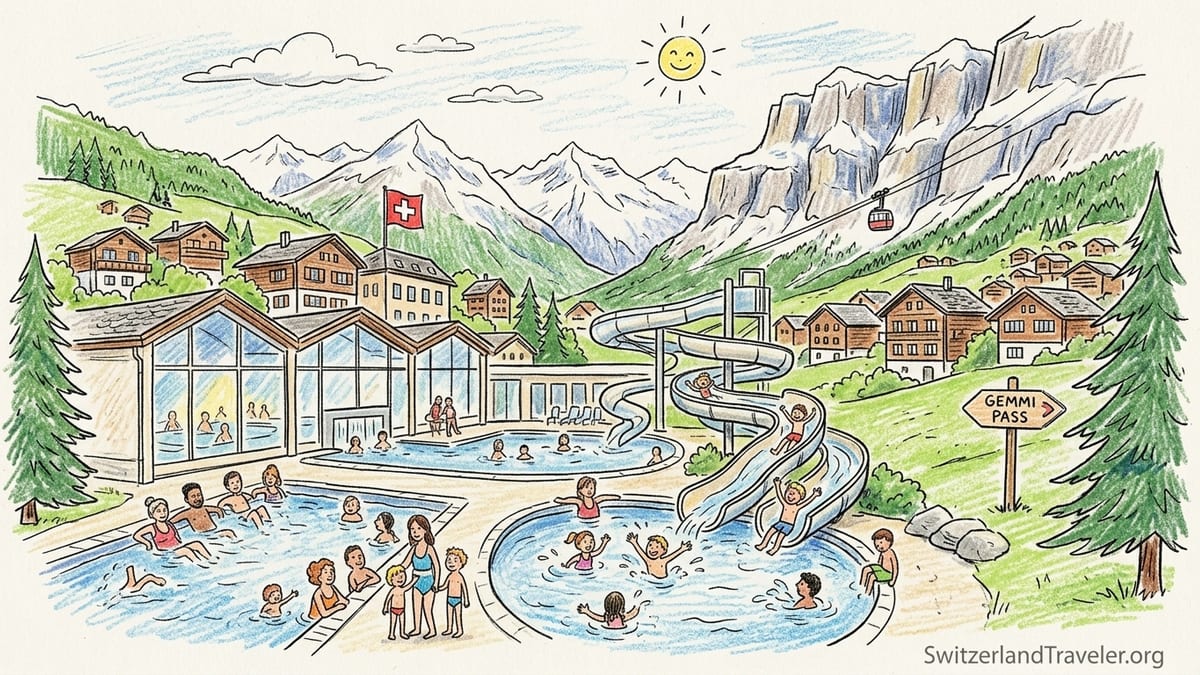
The Reality Behind Switzerland’s Biggest Alpine Baths
Leukerbad receives around 3.9 to 4 million litres of thermal water each day from its springs, which makes it one of the most water-rich spa destinations in the Alps. That abundance is most visible at Leukerbad Therme, the flagship public complex that dominates the village experience. Official information lists ten indoor and outdoor pools with temperatures ranging roughly from 28 to the low 40s Celsius, all supplied by water that emerges from the mountain at about 51 degrees before being cooled. Walking into the complex for the first time, you feel that scale immediately. It is closer to a municipal aquatic center crossed with a wellness facility than a boutique spa.
On my visit I bought a standard adult ticket at the desk, which in autumn 2026 cost 39 Swiss francs for a full day including the main pools area, with a separate surcharge for access to the sauna zone. There is also a cheaper three-hour option, but many people, like me, choose the day ticket to avoid clock-watching. Prices are on par with other major Swiss thermes, but if you are used to small hotel spas being included in the room rate, paying close to 40 francs per person just to enter will feel significant, especially for families.
Once through the turnstiles, the change from brochure fantasy to practical reality starts. The changing area is clean and functional rather than luxurious, with rows of locker rooms and an electronic wristband system that you scan to choose and secure a locker. The system is easy enough to use even if you do not speak German or French, and there are staff nearby to help. You shower before entering the pool area, as in any European spa, then step into a large, bright hall that leads to both indoor and outdoor basins.
The first thing that struck me was the atmosphere. Leukerbad Therme is not a whisper-only environment. During my daytime visit there were children splashing in the shallower areas, couples drifting through the warmer pools, and small groups chatting in normal voices. There is a dedicated kids’ zone and two long water slides that end in indoor landing basins, and their presence shapes the mood. If you arrive expecting a silent, adults-only sanctuary you will feel a jolt of culture shock. If you frame it instead as a public thermal park with wellness corners, the experience makes far more sense.
Inside Leukerbad Therme: Pools, Temperatures and Crowds
Leukerbad Therme’s layout is designed to keep you circulating between different water temperatures and settings. One indoor pool sits around the high 20s Celsius and feels closer to a conventional swimming pool, albeit slightly warmer. The more popular basins are in the 35 to 38 degree range, with massage jets and bubble benches where people cluster for long soaks. Outside, several pools look across to cliffs and alpine peaks, and at least one small corner basin edges toward about 40 to 43 degrees. After half an hour in the hotter water you notice your pulse and are glad for the cooler options.
In practical terms, this variety is what keeps Leukerbad Therme enjoyable over several hours. I spent close to four hours inside without getting bored, alternating between the hotter outdoor basin, the slightly cooler sports-style pool, and an indoor area where water cascades from neck-height spouts. Even on a cool mountain afternoon the outdoor pools were comfortable, and watching clouds drift across the Gemmi cliffs from steaming water is an experience that does feel as dreamy as the brochures suggest.
Crowding, however, matters. On my weekday visit outside the peak winter and summer holiday periods, there were still times when the most attractive outdoor basins felt busy, with most of the bubble loungers occupied and some families clustering around them. Friends who have visited during school holidays in February and July reported significantly denser crowds, with queues for the slides and difficulty finding loungers. That aligns with Leukerbad’s role as both a spa and a family-friendly mountain base. If you are sensitive to noise and proximity, plan your visit for a shoulder season weekday and arrive around opening time or late afternoon rather than mid-day.
In terms of how long thermal bathing remained enjoyable, my personal limit sat around three to four hours of alternating soak, rest and short breaks to drink water in the café. Beyond that, the combination of heat, mild dehydration and the monotony of water can lead to a fuzzy, drained feeling rather than deeper relaxation. Leukerbad Therme’s own information hints at these limits by offering popular three-hour offers and advising guests to take frequent pauses. Travelers hoping to spend an entire day doing nothing but soaking may find the idea more appealing than the physical reality.
Changing Rooms, Lockers and Sauna Culture Explained
Switzerland’s thermal baths run on a refined version of public pool logistics, and Leukerbad Therme is no exception. After paying at reception you receive a waterproof wristband that acts as both locker key and, in some cases, a cashless payment token inside the facility. You pass through gendered or mixed changing cabins, store your belongings in a self-chosen locker that locks with your wristband, and then follow arrows to the pre-swim showers. The system felt secure and intuitive within a few minutes. I appreciated that the lockers were full-height for larger bags and that there were clear hairdryer and mirror stations for afterwards.
The sauna area operates under a different set of cultural expectations that can surprise foreign visitors. In the broader German-speaking spa world, sauna and steam rooms are typically textile free for hygienic reasons, and many establishments in Switzerland follow that custom. At Leukerbad Therme, the sauna village is a separate, surcharge area for adults, with its own quieter relaxation rooms and a series of dry and wet cabins. Signage makes it clear that proper sauna etiquette is expected, including thorough showering beforehand and strict towel use to prevent bare skin contacting the wood.
If you are not used to mixed-gender nudity, this is where your expectations of a luxurious but modest spa can collide with Central European reality. Inside the sauna zone, swimsuits are generally not allowed. Guests wrap themselves in large sauna towels, disrobe in the changing area and then enter cabins nude, sitting or lying fully on their towel. Conversation is kept low, mobile phones are discouraged, and an attendant may perform timed infusions where aromatic water is ladled onto stones. Compared with the family-oriented pools area, the mood in the sauna village felt genuinely tranquil and adult, but it is an environment that travelers should consciously opt into rather than stumble into by accident.
From a value perspective, adding the sauna supplement on top of the regular ticket quickly brings the cost for an adult above 60 francs for a full day, especially if you factor in food and drinks inside. For serious sauna fans that can still feel fair, since similar complexes in Austria and Germany charge comparable amounts. For casual visitors who simply want a warm soak with mountain views, the base pools ticket is likely enough.
Food, Families and the Myth of the Silent Spa
One of the most persistent myths about Leukerbad is that it is a hushed luxury resort where everyone drifts around in silence. The reality inside Leukerbad Therme is livelier. Families are explicitly welcomed, with children’s pools, slides and shallow play areas clearly advertised, and that influences the soundscape. I shared several pools with parents holding toddlers, older kids drifting between the lazy river-style circuits and the slides, and multigenerational groups chatting in Swiss German, French and Italian. Lifeguards kept a close eye on boisterous play, but normal family noise is very much part of the scene.
If your personal wellness image leans toward adults-only calm, you have three realistic options. You can time your visit for school hours on a weekday when families are fewer, choose the Alpentherme complex in the village center that markets itself more strongly as a wellness sanctuary with a Valais sauna village and Roman-Irish baths, or book a hotel such as Therme 51° that has smaller in-house pools restricted to guests. All of these options still sit in the same village, but the immediate environment shifts from splash-park energy to something closer to the quiet retreat many people imagine.
Eating and drinking are handled in pragmatic fashion. Inside Leukerbad Therme there is a cafeteria-style restaurant and snack bar where you can buy simple hot dishes, salads, pastries and drinks and charge them to your wristband or pay at the counter. Expect prices in line with Swiss mountain resorts: around 15 to 25 francs for a plate of pasta or a hot dish, 5 to 7 francs for a soft drink, and more for wine or beer. The food is functional rather than memorable, aimed at keeping families fuelled between sessions rather than providing gourmet experiences. For a more atmospheric meal you are better off drying off and heading into the village restaurants once you are done bathing.
In terms of sheer comfort, I found that a rhythm of one hour in the water followed by a 20 to 30 minute break for tea, water and light food worked best. Staying submerged without pause for two or three hours left me lightheaded and very sleepy. If you are planning an overnight stay, be prepared for the possibility that you will not want to return to the baths again the same day after a long initial session. That can influence how you perceive the value of a hotel package that includes unlimited entry.
Beyond the Pools: Village Atmosphere, Food and Sleep
Step outside the steam and Leukerbad reveals itself as a compact, purpose-built resort village in the canton of Valais rather than a historic town. At around 1,400 meters above sea level and hemmed in by cliffs, it has a dramatic amphitheatre setting. The Dala river slices down the valley, the Gemmi pass towers above, and most streets converge around the spa complexes and hotels. Architecturally, expect a mix of traditional chalet-style buildings, mid-century apartment houses and a few modern hotels, more functional than postcard-perfect but undeniably alpine.
For a traveler considering whether to stay overnight, the immediate question is how much there is to do after you leave the baths. In the shoulder seasons outside high ski months, Leukerbad’s evening life is low key. There are several restaurants that focus on hearty Valais dishes such as cheese fondue, raclette and rösti, along with pizzerias and hotel dining rooms. Prices sit at typical Swiss resort levels; a main course in a mid-range restaurant commonly runs between 25 and 40 francs. I did not struggle to find a good dinner, but neither did I feel spoiled for choice once I had ruled out the more formal hotel venues.
Accommodation options range from simple apartments to classic spa hotels. At the higher end, properties linked with Alpentherme or with their own thermal facilities market themselves to wellness travellers with robe corridors leading directly to the baths, large spa areas and multi-course half-board dinners. Mid-range hotels sometimes bundle Leukerbad Therme entry or offer guest cards with transport benefits in summer. Budget-conscious visitors can find studios and guesthouses a short walk from the baths, though even the most basic options reflect Switzerland’s generally high room prices.
My overall impression of the village was that it feels designed for people who want to spend time in the water or on the surrounding trails rather than for flâneurs who enjoy wandering old streets and museums. There is a small parish church, a handful of shops for outdoor gear and souvenirs, and a modest central square, but most visitors drift between hotel, bath, restaurant and cable car station. For one or two nights this rhythm can feel pleasantly simple. For a longer stay without a clear plan of hikes, winter sports or spa routines, some travelers may find the village a little repetitive.
Dala Gorge and Gemmi: Proving Leukerbad Is More Than Pools
To understand Leukerbad properly, you have to leave the water and look up at the stone walls that feed it. I walked the Dala Gorge trail, a short but striking excursion that begins on the edge of the village and follows a series of metal walkways and bridges clinging to the cliff above the rushing Dala river. There is a modest entry fee at the gate, collected either by a person in season or via an honesty box system at quieter times, and within minutes you are surrounded by rock and spray. The route is short enough to fit easily between spa sessions, yet dramatic enough to feel like a true alpine outing.
Higher up, the cable car to Gemmi Pass carries you from Leukerbad’s floor to an altitude well above 2,000 meters in a matter of minutes. Up there, the scene changes from spa village to high plateau. On clear days you look across to the Valais peaks and down into the narrow gorge that leads to Kandersteg. Trails spread across the plateau, from easy lakeside loops suitable for families to longer hikes that descend toward other valleys. In winter, cross-country skiing and winter walking tracks crisscross the snow. I found that even a half-day on Gemmi reframed Leukerbad in my mind, from a place to soak to a base for active holidays that happen to end in hot water.
These excursions are important when considering whether Leukerbad is worth more than a simple day trip. If you arrive in the morning, spend three or four hours at Leukerbad Therme and then ride up to Gemmi or walk the Dala Gorge before dinner, an overnight stay can start to feel justified. Without these elements, your evening may shrink to little more than dinner and an early bedtime. For travelers who love mixing gentle adventure with wellness, Leukerbad has more range than it first appears, but that range only reveals itself if you intentionally step outside the pool area.
Weather can influence these decisions strongly. In poor conditions, exposed trails on Gemmi may be unappealing or closed, nudging visitors back toward the baths where crowds increase. On a glorious autumn or spring day, by contrast, the lure of a sunlit plateau or a rushing gorge can easily trump another hour submerged in hot water. My own favorite Leukerbad moments happened not in the spa but standing on the Gemmi viewing platform, then later slipping into an outdoor pool at dusk with legs pleasantly tired from walking.
Expectations vs Reality: Quiet Luxury or Lively Public Bath?
Before visiting, my mental image of Leukerbad drew more from glossy hotel brochures than from its actual role as a major public spa hub. I imagined a village sprinkled with boutique wellness hotels, each with calm, candlelit pools and discreet guests padding around in silence. The reality at Leukerbad Therme is far closer to a large, well-run public bath complex where relaxation intersects with recreation. Sliding doors to children’s areas, lifeguard whistles and the whoosh of water slides are as much part of the soundtrack as murmured conversations in the whirlpools.
This gap between expectation and reality matters, because it shapes whether Leukerbad feels worth the journey. Travelers seeking a quiet, couples-only hideaway may feel disappointed if they base their stay around Leukerbad Therme alone. On the other hand, families who arrive worried that a Swiss spa village will be too formal or hushed often find themselves pleasantly surprised by how relaxed and inclusive the environment feels. In that sense, Leukerbad occupies a middle ground between a traditional medical spa and a modern alpine water park.
Luxury exists here, but it is found more in hotel suites, private treatment rooms and the premium zones of complexes like Alpentherme than in the main public pools. The core product that almost every visitor encounters is communal: hot water shared with strangers under big skies. If you calibrate your expectations accordingly, it becomes easier to appreciate the strengths of Leukerbad. The water is genuinely abundant and pleasantly mineral, the mountain backdrop is impressive, and access by public transport from Swiss hubs is straightforward, involving a train ride up the Rhone valley to Leuk followed by a postbus that winds up to the village.
Noise and crowding are not constant, but they are ever-present possibilities. If absolute tranquillity is your priority, you may be better served by a smaller hotel spa in a quieter village, or by timing your Leukerbad visit very strategically. If you can accept that wellness here comes with a lively social dimension, the place feels less like a broken promise and more like a distinctive style of alpine relaxation.
The Takeaway
So, is Leukerbad worth it? From my experience, the answer depends less on the temperature of the pools and more on what kind of trip you are hoping for. As a day-trip destination, Leukerbad makes a compelling case. Arrive by mid-morning, spend three to four hours rotating between warm basins with cliff views, then either stroll through the Dala Gorge or ride up to Gemmi for an afternoon in the high mountains. Have dinner in the village and catch an evening bus and train back down the valley, pleasantly tired and heat-relaxed. In that configuration, the 39-franc day ticket for Leukerbad Therme and the journey both feel well spent.
For an overnight wellness break, Leukerbad begins to suit two particular profiles. The first is travelers who love the ritual of thermal bathing and sauna culture and are happy to structure a whole 24 to 48 hours around water, heat, meals and rest, possibly in a hotel with its own quieter pools or direct bath access. The second is active visitors who want to combine high-level hiking or winter sports on Gemmi and the surrounding slopes with guaranteed hot-water recovery at the end of the day. For these guests, one or two nights can feel exactly right, especially outside school holidays when the baths are less busy.
Where Leukerbad is less convincing, in my view, is as a long-stay destination for travelers who do not ski and who are lukewarm about both spa routines and mountain hiking. The village itself is pleasant but small, the dining scene solid but limited, and there are only so many hours you can spend in 38-degree water before diminishing returns set in. If you imagine a week of varied urban-style stimulation with the occasional spa dip, you may leave feeling that the thermal village did not quite justify the time compared with splitting your stay between several Swiss towns.
Personally, I would return to Leukerbad, but with a clear plan. I would come again for a focused overnight wellness break in shoulder season, ideally combining an afternoon at Leukerbad Therme with a half-day on the Gemmi plateau or a repeat walk through the Dala Gorge. I would not base a full week’s holiday here unless it was part of a wider Valais itinerary with multiple stops. Framed as a place to soak, look up at cliffs and briefly slow the pace of a Swiss trip, Leukerbad earns its reputation. Framed as an ultra-quiet luxury hideaway, it stumbles. Know which version you are booking, and you are far more likely to leave the village warm, relaxed and satisfied that it was, indeed, worth it.
FAQ
Q1. Is Leukerbad Therme suitable for visitors who want a quiet spa day?
Leukerbad Therme can be quiet at certain times, especially on weekday mornings outside school holidays, but it is fundamentally a public thermal complex that welcomes families and has slides and children’s areas. Travelers who want guaranteed tranquillity should either plan their visit for off-peak times, upgrade to the separate sauna area, or consider staying in a hotel with smaller, guests-only pools.
Q2. How much does it cost to visit Leukerbad Therme?
As of late 2026, an adult day ticket for the pools area at Leukerbad Therme is listed at 39 Swiss francs, with cheaper three-hour options also available and separate surcharges for the sauna zone. Package deals, guest cards and hotel partnerships can reduce the effective cost, but visitors should budget at least 40 francs per adult for a standard visit, not including food, drinks or treatments.
Q3. Are the saunas at Leukerbad textile free?
Yes, the sauna and steam areas in Leukerbad, including those at Leukerbad Therme and other wellness complexes, usually follow Central European sauna norms, which means they are textile free. Guests shower thoroughly, remove swimwear, wrap in a large towel and sit or lie with their entire body on the towel. Mixed-gender nudity is common, and swimsuits are generally not allowed in the cabins for hygiene reasons.
Q4. How long can I comfortably stay in the thermal pools?
Most visitors find that three to four hours of alternating soaking and resting feels comfortable and restorative. Longer sessions without adequate breaks for cooling down, hydration and food can lead to fatigue and lightheadedness. Many ticket types are structured around a few hours of bathing for this reason, and staff often encourage guests to take regular pauses between hotter pools.
Q5. Is Leukerbad worth an overnight stay or just a day trip?
Leukerbad works very well as a day trip that combines a few hours in the thermal baths with a short excursion such as the Dala Gorge walk or a ride up to Gemmi. An overnight stay becomes worthwhile if you either love thermal and sauna routines and want to stretch them over two days, or if you plan to hike or ski on the surrounding mountains and use the baths as recovery. For travelers who are not especially interested in either spas or outdoor activities, a simple day visit is usually enough.
Q6. What should I know about the changing and locker system?
At Leukerbad Therme, you receive a waterproof wristband at reception that acts as both your ticket and your locker key. You choose an available locker, close it and then tap your wristband to lock it. The same band may also be used to record purchases at the café or restaurant, which you pay for when leaving. The changing rooms are clean and functional, with showers you must use before entering the pools and hairdryers available for afterwards.
Q7. Are there good hiking options near Leukerbad?
Yes, Leukerbad is surrounded by trails. The Dala Gorge offers a short, dramatic walk on steel walkways above the river, suitable for most visitors with a basic level of fitness. The cable car to Gemmi Pass opens access to high-altitude plateau trails, from gentle lakeside circuits to more demanding routes. These hikes help justify longer stays by providing daytime activity to balance time in the thermal baths.
Q8. Is Leukerbad a good choice for families with children?
Leukerbad is very popular with families. Leukerbad Therme has children’s pools, slides and shallow areas, and the overall atmosphere is relaxed rather than strictly hushed. Many hotels cater to families with larger rooms or apartments, and in summer there are accessible walks and outdoor play areas around the village. Parents should still supervise children closely in the pools and be aware that the sauna zones are typically adults only.
Q9. What is the village of Leukerbad like outside the baths?
Leukerbad is a compact mountain resort at about 1,400 meters, ringed by cliffs and centred around its spa complexes. It has a small main square, a parish church, several restaurants and bars and a scattering of shops, mostly aimed at outdoor activities and local products. The atmosphere is relaxed and slightly utilitarian rather than grand or urban. Evenings are generally calm, with most visitors moving between hotel, restaurant and an early night after long days in the water or on the trails.
Q10. When is the best time to visit Leukerbad to avoid crowds?
The least crowded times are typically outside major Swiss and European school holidays, especially midweek in spring and autumn. Early mornings and later afternoons on these days tend to be quieter inside Leukerbad Therme. Peak periods include winter sports season weekends, Christmas and New Year, and school vacation weeks in February and July, when both the baths and village accommodation can feel busy and advance booking becomes important.