

Is Zermatt worth it, once you factor in five-figure peaks, four-star prices and the reality of sharing that first Matterhorn view with hundreds of other people? I went to find out, with a clear question in mind: if I were spending my own money again, how much of Zermatt would I happily pay for, and what would I skip next time?
When I Went, Where I Stayed and What I Actually Paid
I visited Zermatt in early September 2025, just after the Swiss summer school holidays but before the autumn lull. I stayed three nights, from a Thursday to a Sunday, which meant I saw the village on both its quieter and busier days. This timing matters for crowds and prices, so keep it in mind as you compare your own plans.
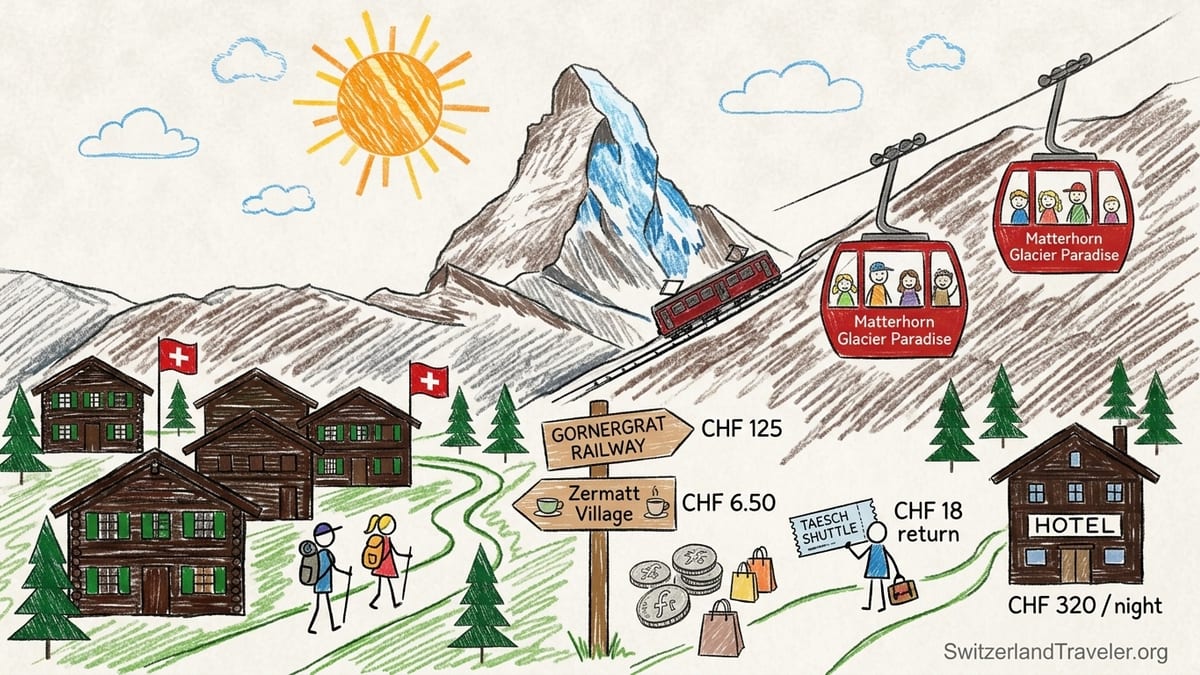
Because Zermatt is car free, I left my rental car in Täsch and used the shuttle train into the village. I based myself at a mid-range three-star hotel about eight minutes' walk from the main Bahnhofstrasse. For a double room with breakfast included, I paid the equivalent of about 320 Swiss francs per night, booked a couple of months ahead. Similar properties I checked at the same time ranged roughly between 280 and 380 francs per night for early September stays, with higher rates on peak weekends and during August.
Parking my car in Täsch cost 18 francs per 24 hours in a covered garage near the station, which is in line with what most of the larger garages charge. The shuttle train from Täsch to Zermatt, a 12 minute ride, cost about 8 to 9 francs per adult one way in second class, or around 16 to 18 francs return, depending on the exact ticket type and discounts. Trains ran every 20 minutes or so during the day, and I never waited long. In practice, that shuttle felt simple and efficient, but it did add a noticeable daily cost if you are coming and going.
Once in Zermatt, I spent real money on what Zermatt is famous for: mountain railways and cable cars. On one day I took the Gornergrat cog railway, on another I used the cable cars toward Matterhorn Glacier Paradise, and I also rode a couple of smaller lifts to access hiking trails. In September 2025, a standard return ticket from Zermatt to the Gornergrat summit was priced at around 120 to 130 francs per adult in second class, depending on time of day and season. The cable car journey to Matterhorn Glacier Paradise, via Furi and Trockener Steg to the highest station at 3,883 metres, came out to roughly 120 to 140 francs return at regular adult prices. There are a variety of regional passes and half-fare options that can reduce those costs, but if you buy them à la carte, it is realistic to expect to spend 200 to 300 francs per person on mountain transport over two or three sightseeing days.
Expectation: A Quiet Alpine Shrine to the Matterhorn
Before arriving, I imagined Zermatt as a sort of high Alpine shrine to the Matterhorn. In my mind, it would be a wooden-chalet village with a few bakeries, a church and some mountaineering shops, surrounded by grazing cows and nearly empty hiking trails. I expected that once I paid to get there, the village itself would feel relatively low key and that the real costs would be confined to the big ticket excursions like Gornergrat and Glacier Paradise.
I also assumed that early September, outside of school holidays, would feel calm. I pictured strolling along the car free main street in the late afternoon with plenty of space, stepping into a bar without reservations, and waking up to a mostly quiet village at sunrise. In my head, Zermatt was going to be polished but not overly commercial, like a well kept ski resort in its off season.
Finally, I expected the Matterhorn itself to be the awe moment that justified the money. I had seen the mountain on chocolate boxes and train posters all my life. I went in thinking that first full view in person would be one of those scenes that instantly makes you forget your credit card bill. On paper, Zermatt seemed like a place where scenery would easily outweigh any sticker shock.
Real Costs on the Ground: Food, Coffee and Mountain Transport
The reality is that Zermatt is one of the most expensive places in an already expensive country, and you feel it quickly. My morning coffee on the main street, at an ordinary café rather than a luxury hotel, cost about 5 to 6 francs for an espresso and 6 to 7 francs for a cappuccino. A simple bakery style breakfast of a coffee and a croissant or small pastry typically came to 8 to 10 francs per person if you avoided full hotel buffets.
Lunch at casual mountain restaurants, such as those around Sunnegga or along popular hiking routes, tended to land between 22 and 30 francs for a plate of rösti or pasta. Add a soft drink or a small beer and you are looking at 28 to 35 francs per person for a straightforward midday meal. In the village itself, a basic pizza in a mid-range pizzeria cost around 22 to 26 francs, while a burger with fries was in the 28 to 35 franc range. Sit down dinners at comfortable, non Michelin star places with a starter, main course and one drink per person very easily reached 60 to 80 francs per person, and substantially more at higher end restaurants.
What surprised me most was how the little extras added up. A slice of cake and a coffee after hiking might come to 12 to 15 francs. A glass of wine on a hotel terrace with a Matterhorn view could easily be 10 to 14 francs. Even buying snacks from small supermarkets in the village felt slightly marked up compared with towns further down the valley. None of these prices are shocking by Swiss standards, but taken together over three or four days in Zermatt, they push your daily budget higher than you might expect.
Mountain transport was the biggest single cost category after accommodation. Between the Gornergrat railway, the Glacier Paradise cable car and a couple of smaller lifts, my per person spending on uphill travel for three days was roughly equal to one more night in my hotel. This is the core of the Zermatt decision. The village itself is not cheap, but the real financial weight sits in the optional excursions up the surrounding peaks, which are exactly the things most visitors come for.
Täsch to Zermatt: A Convenient Shuttle That Still Shapes Your Stay
Because private cars cannot enter Zermatt, almost everyone arriving by road ends up parking in Täsch and using the shuttle train. My experience with that system was largely positive. The multi story garages are directly across from the small station, there are clear signs about train departures, and ticket machines are easy to use and available in multiple languages. With trains departing roughly every 20 minutes during busy hours, I never felt stranded or rushed.
However, the Täsch shuttle did change the psychology of my stay. I found myself planning days around the idea that once I was in Zermatt, I wanted to stay there rather than pop in and out. If you arrive late in the evening after a day of driving, you are paying for parking, then for the train, then for your hotel night, before you have even seen the village. That sequence makes the whole experience feel like a premium product from the very first hour.
The trains themselves were clean and functional, but not leisurely. At peak times, especially on Friday afternoon and Saturday morning during my visit, the shuttle cars were busy enough that finding a seat with luggage was not guaranteed. This was not unpleasant, but it reminded me that Zermatt is running near capacity much of the time. Early morning and later evening trains were calmer and more relaxed, similar to a commuter line after rush hour.
If you are used to driving right up to your accommodation in other Alpine villages, the Täsch shuttle will make Zermatt feel more like entering a managed park. That structure has clear environmental benefits and keeps the village streets quieter, but it also creates a psychological and financial gateway that you pass through every time you arrive.
The Best Experiences: What Truly Justified the Expense
Despite the costs, several moments in Zermatt felt absolutely worth the money. The first came barely ten minutes after I stepped off the shuttle train. Walking south along Bahnhofstrasse and turning toward the church square, the Matterhorn suddenly appeared at the end of the valley, sharp and impossibly steep against a clear late afternoon sky. It is one of the few famous mountains that looks even more dramatic in person than in photographs. That first view, framed by old wooden chalets and the river, instantly reminded me why people pay to be here.
Hiking was where Zermatt delivered its best value. Once you have paid to reach a certain altitude by cable car or funicular, the network of trails around Sunnegga, Blauherd, Riffelalp and Gornergrat opens up a day of almost continuous Matterhorn views. On one day, I took the Gornergrat railway partway up, then hiked along a balcony path overlooking the Gorner Glacier and the ring of 4,000 metre peaks. The panorama of Monte Rosa, Liskamm and the Breithorn, with glaciers tumbling into the valley, felt like a once in a decade landscape.
The village atmosphere also grew on me. In the early mornings before 9 a.m., the car free streets were quiet enough that the loudest sound was the river and the occasional electric taxi. Walking through the older Hinterdorf quarter, with its dark wooden barns and storehouses on stone stilts, felt like stepping into another century. Even on busy evenings, stepping a couple of streets away from Bahnhofstrasse brought me to lanes with only a handful of people and locals chatting outside small shops.
Gornergrat itself, which I visited on a clear morning, justified its high ticket price more than I expected. The ride up on the cog railway was scenic but not spectacular compared with other Swiss trains. The real payoff came at the summit, where you stand at 3,100 metres with the Matterhorn almost at eye level across the valley and the massive Gorner Glacier below. I spent nearly two hours just walking the short paths around the top station, watching clouds form and dissolve around the peaks. It felt like a genuine high alpine environment, even though I had arrived by train rather than by rope and ice axe.
Where Zermatt Felt Commercial, Overpriced or Too Crowded
At the same time, there were parts of Zermatt that felt more commercial than I had hoped. The main stretch of Bahnhofstrasse, especially in late afternoon, could have been almost any successful ski resort in the Alps. Luxury watch boutiques, designer clothing stores and high end sports shops lined the street, interspersed with busy bars and hotel terraces. While there are still local bakeries and small grocery stores, the overall impression was of a place carefully calibrated to affluent visitors.
Crowding was very noticeable on popular excursions in mid morning. When I rode the Gornergrat railway between roughly 9:30 and 10:00 a.m., the carriages were full, with people leaning into windows for photographs and standing in the aisles. At the summit terrace, there were times when it felt like every viewpoint had someone posing with a selfie stick. It was still possible to find quieter corners by walking a little further along the paths, but the immediate surroundings of the station felt congested.
Matterhorn Glacier Paradise felt even more like a high altitude attraction park. The sequence of glass sided cable cars, the shops and snack stands at intermediate stations, and the tunnel system at the top station all contributed to an experience that was technically impressive but less atmospheric than I had hoped. The ice sculptures and viewing platforms were busy enough that I often had to wait for a spot at the railing. Combined with the cost of the ticket, this made the excursion feel more like an expensive checklist item than a quiet encounter with the high Alps.
In the village, restaurant pricing sometimes tipped from understandable to uncomfortable. Paying 30 francs for a simple plate of pasta in a casual setting or nearly 20 francs for a basic cocktail on a busy terrace made me more conscious of every order. While service was generally professional and friendly, I occasionally felt that central locations and Matterhorn views were priced as much as the food and drink themselves. This is not unique to Zermatt, but in a place already carrying high baseline costs, it stood out.
Zermatt Village vs. Optional Mountain Excursions
One of the most important distinctions for anyone asking if Zermatt is worth it is the difference between simply being in the village and paying for the big excursions. Staying in Zermatt itself, walking its streets, enjoying views of the Matterhorn from the river path, and hiking on lower elevation trails like those toward Zmutt or along the valley floor can all be done with relatively modest extra spending beyond accommodation and basic meals.
If you chose to skip Gornergrat and Glacier Paradise entirely, you could still have two or three rich days in and around the village. You could take the funicular to Sunnegga once, which usually costs less than the full Gornergrat or Glacier Paradise trips, then hike to one of the small lakes that mirror the Matterhorn. Or you could stay entirely on free trails starting from the village, picnic with supermarket food instead of eating on mountain terraces, and use your budget for an extra night of accommodation instead.
The expensive part of Zermatt is very specifically the high elevation infrastructure. The cog railways and cable cars that take you to 3,000 metres and beyond are feats of engineering that cost a lot to build and maintain, and ticket prices reflect that. Whether they are worth the money for you depends on how much you value standing at those viewpoints compared with simply seeing the mountains from lower paths. For me, Gornergrat felt worth the price. Matterhorn Glacier Paradise, impressive as it was, felt less essential when I looked back at how much it had added to my overall bill.
If you are deciding on a budget, it helps to think in layers. First, decide if you are willing to pay Zermatt level accommodation and food prices for a car free mountain village with excellent low and mid level hiking. Then, separately, decide how much extra you are willing to spend on one or two headline excursions. That mental separation can make the Zermatt decision feel less like an all or nothing choice.
Biggest Frustrations and Who Zermatt Is Really For
My single biggest frustration in Zermatt was the feeling that some of its best views were effectively paywalled. Standing in the village and looking up at the mountains, you constantly see cable cars and trains gliding toward balconies you know will have incredible panoramas. While there are free or low cost trails that deliver wonderful scenery, the most dramatic viewpoints often require tickets that cost as much as a week of groceries in another European country.
The second frustration was the elasticity of time once I had paid for an expensive excursion. On Gornergrat day, I caught myself calculating the cost per hour as I lingered at the summit. I felt compelled to stay longer than I would have naturally, simply to feel I had extracted full value from the ticket. That mental arithmetic slightly diluted what should have been a purely joyful morning in the high mountains.
Despite these frustrations, Zermatt makes a lot of sense for certain types of travelers. If you are a landscape photographer, a mountain lover without technical climbing skills, or someone who appreciates polished infrastructure and wants high altitude experiences without hiking for hours uphill, Zermatt is almost uniquely suited to you. The ability to step from an electric taxi onto a cog railway and arrive at 3,000 metres with glaciers in front of you is precisely what you are paying for.
On the other hand, if you are a budget conscious hiker who enjoys quieter valleys and is happy to walk more to reach viewpoints, there are other places in the Valais region that may suit you better. Villages like Grimentz, Evolène or the Lötschental area offer strong mountain character, excellent hiking and lower overall prices for food and lodging, albeit without a Matterhorn equivalent.
Who Might Prefer Another Valais Valley Instead
Asking if Zermatt is worth it also means asking compared with what. If your main goal is to experience traditional Valais culture, wooden villages, and good hiking without paying premium resort prices, then the Matterhorn brand is not essential. In that case, you might find more satisfaction in a smaller valley where cows still outnumber tourists on most days of the year.
Villages in the Val d’Anniviers, such as Grimentz or Zinal, give you dark timber houses, narrow lanes and strong hiking networks without designer shopping streets. Accommodation there can be markedly cheaper than in Zermatt, and restaurant prices, while not low, feel more closely tied to local life rather than to international resort expectations. You will not have the instantly recognizable Matterhorn skyline, but you will have glaciers, high passes and lakes that are no less real or rewarding.
Similarly, places like Saas-Fee, while not exactly budget destinations, can offer an alternative to Zermatt with a slightly different balance of costs and crowds. They also rely on cable cars and lifts, but because their names are less globally iconic, you may find fewer people flying in purely for a two day photo stop. In these valleys, it felt easier for me to find quiet corners without needing to wake up at dawn.
If you read this and feel put off by the idea of sharing summit terraces with hundreds of others or paying triple what you might at home for basic restaurant meals, then redirecting your plans to another Valais valley is a sensible choice. You can still take a day trip into Zermatt for a single taste of the Matterhorn atmosphere, then retreat to a quieter base in the evenings.
The Takeaway: My Verdict, What I Would Pay For Again and What I Would Skip
So, is Zermatt worth it? For me, the answer is yes, but only within clear limits. I do not regret the three nights I spent there in September 2025, nor the money I paid to ride the Gornergrat railway. The village’s car free streets in the early morning, the first full view of the Matterhorn at the end of the valley, and the balcony hikes above the Gorner Glacier all felt like experiences I would remember for years.
At the same time, I would not try to turn Zermatt into a long, relaxed holiday base. If I returned on my own budget, I would pay for two nights rather than three or more. I would choose a mid-range hotel again, ideally with at least a partial Matterhorn view or a quiet balcony, even if that meant spending slightly more per night and cutting the stay shorter overall.
In terms of activities, I would happily pay for Gornergrat a second time, ideally early in the morning or later in the afternoon to avoid the worst of the crowds. I would focus the rest of my time on free or low cost hikes that start in or near the village, such as the path toward Zmutt and some of the lower circular walks that still offer strong Matterhorn views. I would skip the Glacier Paradise excursion next time and accept that I do not need to stand at every highest viewing platform to appreciate the mountain landscape.
If you value iconic scenery and are willing to invest in one or two big mountain days, Zermatt can be worth the high prices for a short, focused stay. If you are looking for an affordable, low key Alpine week with simple evenings and quiet trails, you may find better value and more peace in another Valais valley. In either case, going in with realistic expectations about costs, crowds and what you personally want from the mountains will do more than anything else to make your decision feel right.
FAQ
Q1. Is Zermatt worth it for a first time visitor to Switzerland?
For a first trip, Zermatt can be worth it if you have the budget for a short stay of two or three nights and want to see the Matterhorn specifically. If your budget is tight or you care more about general Alpine scenery than one famous peak, other regions like the Jungfrau area or less expensive Valais valleys might offer better overall value.
Q2. How many nights in Zermatt give a good experience without overspending?
Based on my visit, two or three nights is a sweet spot. That gives you one arrival day, one or two full days for major excursions and hikes, and a departure morning, without letting hotel and restaurant costs accumulate over a full week.
Q3. Do I need to pay for expensive excursions like Gornergrat or Glacier Paradise?
You do not have to, but those trips are where Zermatt’s most dramatic views are concentrated. If you are on a budget, consider choosing just one major excursion, such as Gornergrat, and then spending the rest of your time on free or low cost hikes starting from the village.
Q4. How crowded does Zermatt really get?
The village streets can feel pleasantly busy in high season, but the big excursions are where crowds concentrate. Mid mornings on the Gornergrat railway or Glacier Paradise cable cars often mean full carriages and busy viewing platforms. Early mornings, late afternoons and shoulder season visits outside school holidays are noticeably calmer.
Q5. Is food and drink in Zermatt as expensive as people say?
Food and drink are undeniably expensive by many travelers’ standards. Simple main courses at casual restaurants often cost between 25 and 35 francs, and dinner with a drink can easily reach 60 to 80 francs per person. You can manage costs by using bakeries and small supermarkets for some meals, but it is still a premium destination.
Q6. Can I enjoy Zermatt without taking lots of cable cars and trains?
Yes, especially if you enjoy walking. There are several good hiking trails that start directly from the village or from lower stations, and you can get strong Matterhorn views from free paths along the valley. You will miss the very highest viewpoints, but you will save a significant amount of money.
Q7. How does Zermatt compare with other Valais villages for atmosphere?
Zermatt feels more polished and international than smaller villages. You get car free streets, luxury shops and sophisticated hotels, but less of the everyday farming life you might encounter in places like Grimentz or Evolène. Whether that is a positive or negative depends on what kind of atmosphere you prefer.
Q8. Is the Täsch to Zermatt shuttle train a hassle?
For most people it works smoothly. Parking and ticketing in Täsch are straightforward, and the train ride is short. At peak times it can be busy and standing room only, but for the rest of the day it feels like a normal local train. It does, however, add a fixed extra cost to every visit.
Q9. When is the best time to visit Zermatt to balance weather and crowds?
Late June, early July and early September often strike a good balance between open hiking trails, relatively stable weather and slightly fewer crowds than peak August. Winter has its own appeal, but that is a different type of trip focused on skiing rather than hiking.
Q10. Who should probably choose another Valais valley instead of Zermatt?
Travelers with tight budgets, those who dislike busy viewpoints, and hikers who prefer quiet, less developed valleys may be happier basing themselves in other parts of Valais. Villages in the Val d’Anniviers, the Lötschental or around Evolène often provide strong scenery and authentic atmosphere at lower overall cost, even if they lack the Matterhorn’s iconic silhouette.