


I thought I knew Alpine lakes: bright blue bowls under high peaks, ringed with larches and picnic tables. The St-Léonard underground lake, hidden below the vineyards between Sion and Sierre in Valais, is the exact opposite. It is cold, dark, echoing and utterly enclosed, and you explore it not on foot but in a long, low boat that slides silently through the rock. On a recent visit I booked a guided tour, descended into the hillside and spent half an hour afloat under the mountain. This is what the experience was really like, from reservations and access to the way the cavern feels once you are inside.
Understanding What You Are Booking Into
The St-Léonard underground lake sounds abstract until you stand at the entrance and realize that the entire attraction is essentially one long, water-filled cavern cut into the hillside. The lake itself is around 300 metres long and roughly 20 metres wide at its broadest point, making it the largest natural navigable underground lake in Europe. The whole visit is structured around a single guided boat ride of about 30 minutes, during which you travel most of the lake’s length and back again. There are no side galleries to wander and no alternative activities once you are inside the cave, so it pays to know in advance what you are coming for.
The official operator has moved fully to timed online reservations. When I visited, “online booking compulsory” was printed in bold on every piece of information at the entrance and on their notices, and the staff at the ticket counter were clearly set up to manage pre-booked time slots rather than casual drop-ins. I reserved the evening before for a late-morning tour using their booking engine and received a confirmation with a QR code. At the entrance, this code was scanned and I was given a boarding number corresponding to a specific boat departure. People who tried to arrive without a reservation were politely told to check the next available slot, which on a busy school-holiday morning could be more than an hour later.
Prices are straightforward. At the time of my visit, adult tickets were listed at 12 Swiss francs for anyone 16 and over, with children from 5 to 15 paying 7 francs and those under 5 entering free. There were signs mentioning reductions in combination with certain public-transport offers, but the basic walk-up price for an adult was 12 francs. Payment was accepted by card and in cash, and the process after scanning the reservation was very quick. Within a few minutes of arriving at the ticket desk, I had my boarding number and time, and was pointed toward the waiting area to listen for the announcement for my boat.
This structure makes the experience feel more like boarding a small ferry than entering a traditional show cave. You are not free to roam. Instead, everything revolves around your assigned 30-minute slot: you check in, wait on the surface terrace until your number is called, then descend as a group for a tightly timed, continuous boat circuit on the lake.
Getting There, Parking and That First Approach
St-Léonard lies almost exactly between Sion and Sierre, two small cities on the main Rhone Valley rail line. I came by train from Sion and found the logistics simple. The ride to St-Léonard station took about five minutes on the regional train. From there, the underground lake is a walk of roughly 15 minutes through the village and up toward the vineyards. Signage is frequent, with brown tourist signs for “Lac souterrain” pointing the way at each junction. The last stretch climbs slightly, but it is on paved roads or paths that families with pushchairs were handling without visible trouble.
Arriving by car is even more straightforward. The site sits above the main valley road, and there is a large gravel-and-asphalt parking area beside the entrance building. On my mid-season weekday visit, about half of the spaces were occupied by Swiss plates and a scattering of French and German cars. Parking was free, and there were no barriers or ticket machines. I noticed a dedicated coach parking bay too, which explains the waves of school and tour groups that materialise at certain hours.
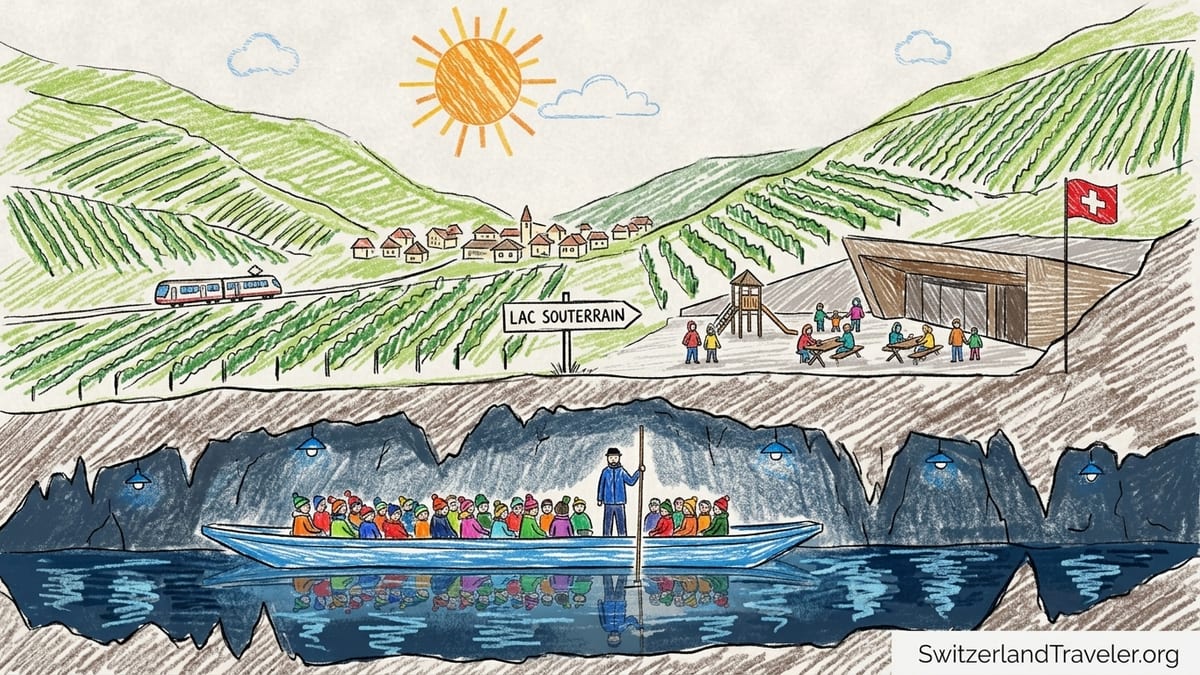
The entrance itself looks unassuming. You do not see any cave mouth from outside, only a low modern building dug slightly into the slope, fronted by a terrace planted with shrubs, picnic tables and a small playground. The terrace is where you wait for your tour, and it is where you first notice that you are beneath the vineyards: on three sides, steep rows of vines climb the sunlit hillside while you stand in the shade of the entrance structure about to head in the opposite direction, under the ground instead of up it.
Even before entering the cave proper, the temperature difference is obvious. On the October afternoon when I visited, the valley floor was around 18 degrees Celsius. As soon as I stepped inside the building, the air cooled; descending the first metal staircase toward the lake, the temperature dropped further until it was close to the constant 11 to 15 degrees reported for the cavern. Wearing a light fleece over a T-shirt, I was comfortable. People in shorts and thin tops, especially children coming straight from sunny vineyard walks, were visibly shivering as we reached the water.
Boarding the Boat Under the Mountain
When your departure time approaches, a staff member steps out onto the terrace and calls your boat number over a loudspeaker. The announcement is done first in French, then immediately repeated in German, with occasional English if there are many international visitors. Our group of about thirty people funnelled from the terrace through an interior corridor, where a short safety notice board reminded us not to stand up in the boat, not to touch the ceiling and to keep children seated at all times. After this, a metal staircase dropped in two flights to a floating wooden dock lit by cool white lamps reflecting off the cave wall.
This first glimpse of the lake is the most theatrical moment of the entire visit. You step off the staircase onto the dock and the ceiling of rock seems to drop low over the still, ink-dark water. Ahead, chained to the side, is a long, flat-bottomed boat shaped like an oversized canoe with low wooden sides and benches running crosswise from gunwale to gunwale. There is no engine. At the far end stands the guide, holding a long pole for punting. Along the opposite bank, the cave wall curves gently, lit in alternating washes of warm and cold light that reveal horizontal stripes in the gypsum and darker seams of other rock.
Boarding is surprisingly organised given the lack of formal seat numbers. The guide or shore staff invites those with mobility issues to board first, as the step down into the boat is slightly awkward and the benches are low. Families with small children were steered toward the middle of the boat, where the sides feel higher and there is less temptation to trail hands in the water. I ended up near the bow, facing inward with my back to the rock. The boat can hold up to about 40 people, but they do not fill every possible space. On my tour, every bench was occupied, yet there was enough room to twist slightly for photographs or to look over children’s heads without bumping elbows constantly.
Once everyone was seated, the fluorescent lights at the dock dimmed and a more subtle lighting scheme took over inside the cave. Discrete projectors mounted along the margins of the lake lit certain rock formations and sections of ceiling while leaving other parts in half-shadow. It never felt pitch dark, but the overwhelming impression was of a long, narrow space whose limits you sensed more than you saw, bounded above and around by stone and below by water that swallowed light quickly.
The Boat Ride: Silence, Echoes and Shifting Reflections
The boat slipped away from the dock with almost no sound. Because the cavern is entirely flooded along its axis, there is no path running alongside the lake; the only way to explore it is by gliding over the surface. The guide propelled us forward using a long pole, pushing against the bottom or the side walls, and occasionally pulling on discreetly fixed ropes in sections where the depth increases. The absence of an engine is not just an aesthetic choice. It makes a huge difference to the atmosphere. You hear water beading off the pole, the slight creak of wood under shifting weight, and the echo of the guide’s voice bouncing off the ceiling.
Commentary is multilingual. Our guide’s base language was French, but she shifted fluidly into German, then English for key sections. Rather than repeating every sentence in three languages, she alternated: a geological explanation in French, followed by a condensed version in German and English, then lighter anecdotes delivered once in the language most represented on board. She pointed out how the lake lies between 30 and 70 metres below the vineyards above, how the gypsum layers dissolved to form the cavity, and how an earthquake in the 1940s altered the lake level to the point where a boat passage became possible. She also used the laser pointer to highlight fissures in the ceiling and mineral deposits glowing faintly under the lamps.
The journey takes you almost the full length of the lake. From the dock, we moved steadily forward, passing under slightly varying ceiling heights, until we reached a point where the roof dipped lower and the walls appeared to converge. Here the guide paused, switched the lighting to a cooler palette and invited us to remain absolutely silent for a moment. In that brief pause, the acoustics of the chamber became apparent. A dropped whisper seemed to hang for a heartbeat longer than usual; the drip of water from the ceiling registered as individual notes. Then the guide turned the boat slowly, using a fixed cable as a pivot, and we began to retrace our route along the opposite side of the lake.
Reflections are what most photos try to capture, and they almost never succeed. From inside the boat, looking along the surface of the water, the illumination of the rock walls doubles itself so perfectly that it is difficult to see where the stone ends and its mirror image begins. In still sections, the water behaves more like black glass than a liquid, sharpening the outlines of stalactite-like features and the ripples in gypsum bands. When another boat passed us heading in the opposite direction near the dock, its lights and passengers appeared upside down among the reflections, like a parallel group moving along a ghost lake beneath ours.
What Photographs Miss: Smell, Cold and Scale
From the outside, images of the St-Léonard underground lake resemble many other show caves: long boats, a curved rock ceiling, slightly theatrical coloured lighting. Being inside the cavern reveals all the sensory details that photographs gloss over. The air has a faint mineral scent, neither unpleasant nor strong, but distinct from the resin and earth smells of Alpine forests above. It is also consistently cool and slightly damp. Over the half hour of the ride, I felt my hands and face chill, and a child opposite me pulled his hood up and tucked his hands inside his sleeves.
The scale of the space is also hard to grasp from images alone. At 300 metres long, the lake is not enormous by surface standards, and some visitors arrive expecting a vast, cathedral-like chamber. In reality, the cross-section feels modest. The ceiling is never extravagantly high. Instead, it slopes and curves in ways that make the space feel alternately snug and slightly claustrophobic, then suddenly more open as the walls recede behind zones of darkness. Because you are sitting at water level, only a metre or so above the surface, the rock feels closer than it looks in photographs taken from higher vantage points.
The lighting design tries to balance atmosphere with visibility. Along most of the route, the lamps use relatively neutral white light to bring out textures in the gypsum layers and the fracture lines where water has worked its way through the rock. In a few places, colored filters introduce warmer tones, which are striking in person but tend to produce overly saturated, almost gimmicky photos when shot on a phone in auto mode. I saw several people checking their screens and frowning, because their images looked more like a theme-park ride than the subdued, echoing place we were actually floating through.
On the human side, photographs do not convey how intimate the experience feels once the boat is in motion. Forty people in a confined, silent space create a particular kind of shared hush. Children who arrived noisy on the terrace fell quiet within the first five minutes, partly from parental reminders, partly from sheer fascination. When someone dropped a water bottle that rolled down the wooden floor, the clatter ricocheted off the rock in a way that made everyone wince. It is in these tiny, amplified sounds that you sense just how completely enclosed you are.
Is Half an Hour Underground Enough to Stay Interesting?
A common concern before I visited was whether a 30-minute boat ride on a single lake might become repetitive. In practice, the experience held my attention almost the entire time. The guide paced her explanations carefully, alternating geology with history and a couple of light jokes about local legends. She also varied the rhythm of the movement, sometimes gliding slowly along a particularly textured wall, sometimes standing still to let us absorb a reflection or trace the arc of a fracture above us.
About two-thirds of the way through, there was a moment when the novelty subsided. I had understood the basic shape of the cavern, and the view ahead did not appear to change much anymore. That lull coincided with the point where we paused in the far chamber and the guide asked us to be silent, then briefly switched some lamps off and on again to show how much the perception of space depends on where the light falls. That simple demonstration reset my attention. returning along the opposite wall, I noticed different details: fine cracks that had been in shadow before, tiny white deposits hanging from the ceiling, and faint ripples on the water surface betraying groundwater drips.
Children on board seemed to move through a similar arc of engagement. At the start, they were excited by the sheer fact of being in a boat inside a mountain. Midway, a few looked restless, especially when the guide spoke in a language they did not understand. Small adjustments helped, like parents pointing out shapes in the rock or reflections that looked like animals. By the time we neared the dock again and another boat slid past us in the dimness, curiosity kicked back in as they compared the size of “their” boat with the one passing. Overall, it felt like just the right duration for most families. Any longer and restlessness would probably dominate; any shorter and you might leave feeling you had not traversed the full length of the chamber.
It is worth stressing that this is a compact attraction physically. The lake’s 300 metres sound impressive, but your actual domain as a visitor is limited to the boat, the dock and the staircase. There is no network of galleries to explore before or after. Some people stepping off the boat expressed mild surprise at how quickly they seemed to return to the starting point. The value is in the uniqueness of navigating a genuine underground body of water by boat, not in the size or variety of chambers you traverse.
Practical Details: Temperature, Clothing, Language and Safety
Practical preparation has an outsized impact on how much you enjoy the boat ride. Inside the cavern, temperatures hover around the low teens Celsius. Official information mentions a constant 11 degrees in the lake itself; on my autumn visit, the air felt a touch warmer but still cool enough that a light jacket was welcome. I was comfortable in long trousers, closed shoes and a fleece. People in sandals and T-shirts coped, but several commented on the cold by the end of the tour. My advice would be to bring an extra layer even in high summer, particularly for children or anyone who feels the cold easily.
The boats are stable, and the movement is smooth. There is no choppiness or sudden swaying because the guide modulates speed carefully and the water surface is protected from wind. That said, the low ceiling in parts of the cave means there are moments when rock passes close above your head. The guide reminds everyone at the start not to stand up or lean out, and I never saw anyone come close to hitting the ceiling. Life jackets were not distributed on my tour, which might surprise visitors used to stricter regulations elsewhere, but the combination of shallow boats, calm water and controlled capacity seemed to make the operators confident in their procedures.
Language is another practical point. The core commentary is in French and German, reflecting the local linguistic reality of Valais, with English added as needed. On my boat the guide checked at the start which languages people understood and adjusted on the fly. If you only speak English, you will receive the essential information, but not necessarily every anecdote. From an experiential point of view, this did not bother me. Part of the appeal was letting the foreign-language explanations wash over me as ambient sound while I focused on the visual and sensory aspects of the cave.
In terms of timing, my entire visit lasted just under one hour from the moment I stepped out of the car park to the moment I returned there. Check-in took less than five minutes, I waited about ten minutes on the terrace for my slot, then spent roughly thirty-five minutes descending, boarding, riding the boat and climbing back out. On a rainy summer day or a peak holiday period, it is realistic to expect longer waits between arrival and boarding, especially if you have not reserved in advance. That is another reason why securing a timed ticket online is sensible; it pinned my waiting time to a narrow window and left room before and after to add another activity.
Children, Claustrophobia and Who This Is Really For
Underground attractions often raise questions about suitability for children or for anyone uncomfortable in enclosed spaces. On my visit, there were several families with kids aged between roughly five and twelve, plus a baby in a carrier. The five-year-old in front of me was visibly nervous walking down the metal staircase, clinging to his mother’s hand as the light dimmed and the sound of voices echoed. Once seated in the boat, though, his anxiety seemed to transform into concentration. He spent most of the trip staring at the reflections on the water and whispering comments to his parents. When we emerged back onto the dock, he announced very loudly that it had been “like being inside a secret river,” which struck me as an honest endorsement.
Younger children may find the combination of darkness, cool air and echoes unsettling at first. What seemed to help most families was clear preparation: explaining beforehand that it is not a scary ride with surprises, but a calm, slow glide on a boat where everyone stays seated. Because there are no sudden noises, flashing lights or jumps, any unease tends to dissipate rather than build. The guide’s calm tone of voice and the absence of engines or mechanical movements also contribute to a feeling of controlled stillness.
For adults with mild claustrophobia, the experience is more nuanced. The cavern is undeniably enclosed, and there are stretches where the rock sits relatively low above the boat. At the same time, the lengthy axis of the lake and the continuous view ahead prevent it from feeling like a tight tunnel. You can always see several boat lengths into the distance, and the lighting is sufficient to orient yourself. One person on my tour mentioned quietly to the guide at the dock that she sometimes felt uneasy underground. The guide suggested a seat near the stern, close to herself and facing the open direction of travel, and checked in with her once or twice during the ride. She completed the tour without visible distress.
In terms of audience, the St-Léonard underground lake seems to attract a broad mix: families from the region, couples visiting on a wider Valais trip, hiking groups breaking up a day on the nearby vineyard trails, and a few dedicated cave enthusiasts. It is probably less appealing if your idea of a perfect Alpine experience is expansive views and high-adrenaline activity. But if you are curious about the hidden underside of the landscape you see from trains and vineyards above, thirty minutes afloat in the cool, dark belly of the hill is a surprisingly memorable counterpoint.
Planning Your Visit in the Context of a Valais Trip
One of the key questions I asked myself afterward was whether I would travel to St-Léonard solely for the underground lake. Standing alone, the attraction occupies roughly an hour of your day, including check-in and a bit of terrace waiting time. It is compelling, but compact. For most travellers, I would suggest folding it into a broader itinerary encompassing nearby vineyards, Sion or Sierre rather than treating it as the only goal of a long journey from elsewhere in Switzerland.
The location makes such combinations easy. From Sion, regional trains and buses reach St-Léonard in about ten minutes, and there are walking trails, like sections of the Bisse de Clavau and other vineyard paths, that link the town to the hills above the lake. It is very feasible to spend the morning exploring Sion’s old town and castles, catch a midday train or bus to St-Léonard for an early afternoon underground lake tour, then continue onward to Sierre or Salgesch for a late-afternoon wine tasting or a visit to the Valais wine museum. Public-transport passes sometimes bundle discounted entry to the lake, which is worth checking when planning your day.
If you are driving, a simple loop works well. Start with the underground lake mid-morning before the busiest tour buses arrive, then move on to a vineyard lunch near Sierre or in the hills above Sion. In harvest season, the contrast between the bright, busy slopes and the cool, silent cavern beneath them is particularly striking. Allow half a day in your schedule for this cluster of experiences: about one hour on site at the lake, plus transport time and at least two to three hours for strolling among vines, tasting local wines or exploring one of the small valley towns.
Would I make a dedicated trip from, say, Geneva or Zurich only for St-Léonard? Personally, no. The boat ride, while unusual and atmospheric, is too short and self-contained to justify several hours of travel as a stand-alone objective. As part of a central Valais itinerary that might also include thermal baths in Leukerbad, hiking above Crans-Montana or exploring alpine passes, however, it fits beautifully as a concentrated, quietly dramatic experience. Think of it as one strong chapter in a multi-part Valais story, not the whole book.
The Takeaway
Visiting the St-Léonard underground lake is less about spectacle than about inhabiting a very particular slice of landscape for a short, intense period. You reserve a timed slot online, pay a modest fee, walk from bright vineyards into a shaded entrance building and descend a staircase to find yourself on a dock inside the mountain. For half an hour, your world consists of rock, water, reflected light and the measured voice of a guide poling a long, low boat along a flooded corridor sixty metres beneath the surface.
The attraction’s physical footprint is small. The lake is about 300 metres long and 20 metres wide, there is a single boat circuit, and the surface facilities comprise a terrace, a small playground and a few educational panels. Yet within that tight frame, the experience manages to feel both intimate and distinctive. Photographs cannot adequately communicate the chilled air, the mineral scent, the deep silence when the guide asks everyone to stop talking for a few seconds and the way reflections stretch the cave visually into something larger than it is.
If you are planning a visit, I would recommend booking your ticket in advance, dressing for cool, damp conditions and mentally framing the experience as a focused half hour rather than a half-day outing. Children with a basic tolerance for dim light and new environments are likely to enjoy it, especially if you prepare them for the calm, slow nature of the ride. Adults will find the commentary interesting enough to sustain attention, and even those with mild reservations about closed spaces often emerge more exhilarated than anxious.
In practical terms, set aside about one hour for the lake itself, plus travel time to and from St-Léonard and at least another couple of hours for whatever you pair it with on the surface, whether that is strolling Sion’s old streets, tasting Fendant in a nearby caveau or walking a stretch of vineyard trail. Taken on those terms, the St-Léonard underground lake becomes a highly worthwhile component of a broader Valais itinerary, a cool, reflective pause in a region otherwise defined by light, height and open horizons.
FAQ
Q1. Do I really need to book the St-Léonard underground lake in advance?
Yes. The operator now requires online reservations for specific time slots, and same-day walk-ins risk long waits or fully booked departures, especially in school holidays and on rainy days.
Q2. How much does the underground lake boat tour cost?
At the time of my visit, adult tickets were 12 Swiss francs for ages 16 and over, children from 5 to 15 paid 7 francs and children under 5 were free, with occasional discounts tied to public-transport offers.
Q3. How do I get to the underground lake by public transport?
From Sion or Sierre, take a short regional train or bus to St-Léonard, then walk about 15 minutes uphill following signs for “Lac souterrain” to reach the entrance above the village and vineyards.
Q4. Is parking available if I come by car?
Yes. There is a free car park next to the entrance building with space for cars and coaches, and on a normal mid-season day I saw plenty of available spots despite steady visitor traffic.
Q5. How cold is it inside the cave and what should I wear?
Inside the cavern, the air hovers around the low teens Celsius, cooler than outside in summer, so bring a light jacket or fleece and closed shoes to stay comfortable during the 30-minute ride.
Q6. How long does the visit take from arrival to departure?
The guided boat tour on the lake itself lasts a little over 30 minutes, and with check-in and short waiting time on the terrace you should plan on spending about one hour on site in total.
Q7. In which languages is the commentary given?
Guides typically speak French and German as main languages and add English where needed, summarising key information so monolingual visitors still understand the essentials about geology and history.
Q8. Is the underground lake suitable for young children?
Yes for most families; children around five and older usually enjoy the novelty of a calm boat ride inside a mountain, provided they are prepared for cool temperatures and dim, echoing spaces.
Q9. How much of the cavern do you actually see on the tour?
You explore virtually the entire navigable length of the lake, riding from the dock near one end to a turning point deep inside the hill and then returning along the opposite side, all by boat.
Q10. Should I visit the lake as a stand-alone attraction or combine it with other nearby sights?
The underground lake itself fills about an hour, so it works best combined with nearby experiences such as vineyard walks, wine tasting, or visits to Sion or Sierre rather than as your only goal for the day.