


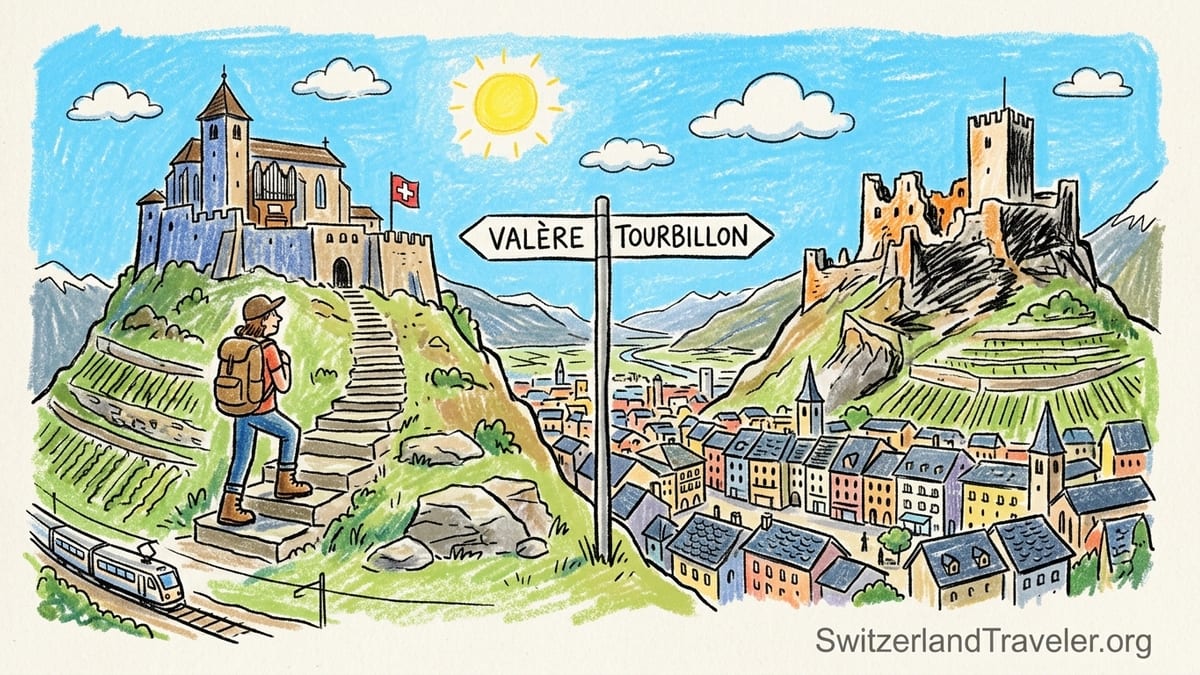
From the floor of Sion’s old town, Valère and Tourbillon look like a matched pair: two rocky hills rising straight out of the Rhône Valley, each crowned with medieval stonework that seems to float above the vineyards. It is only when you decide to climb both hills in a single day that their differences become clear. On a warm autumn visit, I did exactly that, walking up first to the basilica of Valère with its famous medieval organ, then across town and up again to the ruined episcopal stronghold of Tourbillon that burned in 1788. What follows is a practical, ground-level account of what it really feels like to tackle both hills, step by step.
Getting Oriented: Two Hills, One Compact Old Town
Seen from the train as it pulls into Sion, the scene is almost theatrical. To the left rises Valère, a fortified church complex forming an irregular crown of walls and roofs. Directly opposite, on a slightly sharper ridge, are the broken ramparts and keep of Tourbillon Castle. Between them lies a compact old town of slate roofs, narrow lanes and quiet squares. Distances here are short: from the railway station to the base of Valère via the old town is roughly 15 to 20 minutes on foot for an average walker, and the municipal tourism office confirms that the climb from the old town to each hilltop typically begins only about 10 minutes from the historical center.
The two hills face each other across a small valley, so you do not need any public transport to move between them. A realistic day plan is to start in the old town, climb Valère, come back down to roughly the same level, cross beneath the hills, then tackle Tourbillon, finishing with a gentle descent back into town for a late-afternoon drink. That is exactly the loop I walked. In total, with time spent in the basilica and wandering the ruins, I spent about four and a half hours between leaving and returning to the main square, which included generous pauses for photographs and water breaks rather than continuous hiking.
While both hills are steep, neither climb counts as a technical hike. These are stone paths and staircases, not mountain trails. However, the gradient is sharp enough that by the time you reach the upper walls of either Valère or Tourbillon, your heart rate is likely to be noticeably elevated, especially if you are carrying a daypack or visiting in summer heat. The compactness of Sion is deceptive: the vertical gain comes quickly.
I chose to visit in early autumn, with daytime temperatures in the low 20s Celsius and clear skies. In July and August, locals describe heat waves in the Rhône Valley that can push temperatures over 30 degrees, and tourism information warns that the final exposed sections of both ascents can feel significantly hotter than the town below due to the rock and south-facing slopes. If you are imagining a gentle stroll, it is worth recalibrating: this is closer to a short, stiff hill walk at each end of the day.
Climbing Valère: Shaded Lanes, Stone Steps and a Fortified Sanctuary
I started with Valère in the late morning, leaving from the old-town area near Sion’s cathedral. From here, yellow hiking signposts and small brown cultural signs marked “Valère” lead you through a sequence of increasingly narrow streets. Within five minutes, the paving cobbles give way to sloping alleys that feel more like elongated staircases than roads. It took me around 8 to 10 minutes from the cathedral square to reach the first proper set of stone steps that begins the hill climb itself.
The ascent of Valère from this side is stepped rather than a continuous ramp. The path alternates between sloping cobbled sections and flights of broad stone stairs, some of them irregular and time-worn. For a reasonably fit adult who pauses to take in the views but does not stop for long rests, the climb from the edge of the old town to the fortified gate of Valère takes about 15 to 20 minutes. Several official descriptions refer to “at least 10 minutes” of walking from the old town to the site, which matches what I saw on the trail: most people seemed to take closer to a quarter of an hour once the gradient increases and the first viewpoints tempt you to stop.
In terms of steepness, I would describe Valère as demanding but forgiving. The stairs are solid, with sturdy handrails in a couple of steeper sections. A few stretches are shaded by trees or by the rock face itself, and even around midday there were pockets of cool air on the northern side of the hill. I climbed in lightweight trail shoes with good grip and was glad not to be in smooth-soled city sneakers. Jogging-style trainers would be acceptable in dry weather, but sandals or formal shoes would make the uneven steps unnecessarily stressful.
The exposure to sun on Valère is noticeable only near the top, when the path breaks out above the tree line and runs along the outer walls of the complex. Even then, stone buildings and the church itself offer quick shade. If you carry a half-litre bottle of water from the old town, you will likely be comfortable. I had one litre in my pack and used roughly half of it before reaching the basilica doors, more out of habit than necessity in the mild weather I experienced. In peak summer, however, I would recommend at least one litre per person for the combined experience of ascents, especially if you intend to move on to Tourbillon without a long café stop.
Inside Valère: A Medieval Organ and a Living Museum of Valais
Valère is not simply a viewpoint but an inhabited historical ensemble. Once through the outer gate, you enter what feels like a small fortified village: stone houses of the former chapter, narrow alleys, retaining walls and terraces, all clustered around the basilica itself. The church combines Romanesque and Gothic elements, with foundations dating to the 12th century and later modifications that added pointed arches and larger windows. Inside, the atmosphere is hushed, with thick stone walls that mute the sounds of the valley below.
The most famous feature here is the pipe organ mounted on the west wall of the nave, high above the floor. Built in the first half of the 15th century and often cited as the world’s oldest still-playable organ, it has become a pilgrimage site for organists and music historians. Specialist organ-building firms note that the instrument’s case and several pipes date from around 1410 to 1435, and Swiss and international publications continue to describe it as the oldest functioning organ rather than a reconstructed copy. The instrument was carefully restored in the 20th century to be playable once more while preserving medieval components, and an annual organ festival brings performers who climb the narrow access to play it for public concerts.
Even if you do not time your visit for a performance, simply standing beneath the organ invites a sense of continuity that Tourbillon cannot match. The painted organ doors, with late medieval depictions of saints and biblical scenes, are on display, and interpretive panels (primarily in French and German, with some English support) explain how the instrument fits into the religious life of Sion and the broader Valais region. When I visited, a musician was practicing quietly, filling the stone interior with a thin, reedy timbre that felt more intimate than the thunderous organs of later centuries.
Alongside the basilica, Valère also houses part of the Valais History Museum. Exhibitions rotate, but visitors can expect to see artifacts that range from prehistoric finds from the Rhône Valley to medieval religious art and documents related to the bishopric. The combination of architecture, sacred art and the functioning organ makes Valère fundamentally different from Tourbillon. Where Tourbillon is about wind and ruin and views, Valère is about continuity and preservation: a living sanctuary where the ecclesiastical past is still actively curated and, in the case of the organ, audibly alive.
Crossing the Valley Floor: A Short Reset Between Hills
After descending from Valère, I allowed myself a brief reset in the old town before starting up Tourbillon. The descent uses the same stepped path and takes roughly 10 to 15 minutes back down to the edges of the historic center. Knees feel the impact more than lungs do here, particularly on the steeper lower flights of stairs. This is where good footwear proves its worth again: grippy soles and some cushioning make it easier to focus on the scenery rather than on every footfall.
At street level, the two hills feel further apart than they look from a distance, but the crossing between them is not long. From the base of Valère’s access path to the start of the climb up Tourbillon, I walked for about 10 minutes through the old town and across a small saddle below the hills. The route is loosely signposted as you follow Rue des Châteaux and neighboring lanes. There are several cafés and bakeries along this stretch, where many visitors pause for an espresso, a pastry or a light lunch before tackling the second ascent.
Using prices displayed at a couple of cafés in October 2026 as a guide, a simple espresso cost around 3 to 4 Swiss francs, while a sandwich with regional cheese or dried meat was typically in the 8 to 12 franc range. A 50 centilitre bottle of water at a convenience shop in the old town was around 2 to 3 francs. While Switzerland is not a budget destination, Sion’s old-town prices for snacks and drinks were comparable to those in other mid-sized Swiss cities. If you are planning to do both hills consecutively, this is the logical place to top up your water, add a snack and apply sunscreen before heading back into the sun.
I spent about 40 minutes between descents and rest before starting the climb to Tourbillon. That pause proved important. Although the two ascents are relatively short in isolation, doing them back to back without any real break would have left me noticeably more fatigued on the exposed sections of Tourbillon’s path. Travelers who are not accustomed to hills may want to extend this reset to a full lunch in the old town, especially in summer.
Climbing Tourbillon: Exposed Zigzags and Vineyard Views
The climb up to Tourbillon Castle feels different from the first steps. Whereas Valère begins among shaded alleys, the path to Tourbillon quickly leaves the buildings behind and strikes out across a more open, rocky slope. From the lower edge of the old town, it took me about 5 to 7 minutes to reach the real start of the hill path. From there, the climb to the castle gate was another 15 to 20 minutes at a steady pace, similar in total duration to Valère but with a different character.
The first third of the ascent is on a path of compacted earth and stone, zigzagging steadily upward. Low stone walls and scattered trees provide partial shade in the morning, but by early afternoon, most of this route is in direct sun. Higher up, the path becomes a staircase of uneven stone steps, sometimes hewn directly out of the rock. The gradient here is at least as steep as anything on Valère, but the sense of exposure is greater: on one side you often have open views down to Sion and across the Rhône Valley vineyards.
The lack of shelter on Tourbillon makes heat exposure the primary challenge, particularly from late morning to mid-afternoon in warmer months. On my autumn visit, temperatures were comfortable, yet I still noticed that the rock radiated warmth and that sweat built more quickly than during the shaded sections on Valère. I drank more water on this climb than I had on the first one, finishing my one-litre bottle just as I reached the castle gate. In summer, I would recommend carrying at least 1 to 1.5 litres per person if you plan to climb Tourbillon after already visiting Valère, and a brimmed hat becomes more than just a fashion accessory.
Underfoot, Tourbillon is slightly rougher. I did not encounter any scrambling, but the stones and steps were more irregular, and in a couple of sections loose gravel made me grateful for the tread on my trail shoes. Families with children were managing the path without difficulty, but several people paused in the shade of a wall or rock outcrop to catch their breath. A moderately fit adult who is used to walking up hills will still find this entirely manageable, but if you are unaccustomed to climbing or have knee or heart issues, it is worth being honest with yourself about pace and rest intervals.
Tourbillon’s Ruins and Rhône Panorama: Open Sky and Wind
Stepping through the gate into Tourbillon Castle is like entering an outdoor stone labyrinth. There is no intact palace here, no furnished rooms or working organ, only roofless walls and courtyards that hint at the life of the bishops who used this as a summer residence in the late Middle Ages. Historical research attributes the construction of Tourbillon to the turn of the 13th and 14th centuries under Bishop Boniface de Challant, who developed it as his principal residence. That chapter ended abruptly when a major fire in May 1788 swept through part of Sion and left the hilltop complex in ruins, after which it was never rebuilt.
The absence of interiors gives Tourbillon a very different atmosphere from Valère. Here the sky is part of the architecture. Walking along the remaining walls, you look through empty window arches at rows of grapevines and distant peaks. The chapel, though roofless, still preserves portions of frescoes, and informational panels explain the religious and political role of the bishops of Sion. But the primary experience is elemental: wind against stone, sunlight on limewashed plaster, the sound of crows circling above the keep.
For many visitors, the real reward of climbing Tourbillon is the full sweep of the Rhône Valley that opens from the upper terraces. Because the castle stands on a slightly more central and exposed promontory than Valère, the view feels wider. Looking east and west, you can see the river’s broad course, the linear geometry of the vineyards and the serrated horizon of the Valais Alps. In clear weather, it is an ideal place to understand how Sion sits within its landscape, a crossroads between high alpine valleys, ski resorts such as Crans-Montana and Nendaz, and the main Rhône corridor that connects to Lake Geneva.
When comparing the panoramas, I found that Valère offers more intimate, framed views, often through gaps between buildings or from terraces beside the basilica. Tourbillon, in contrast, delivers a 360-degree experience with very little to block your sightlines. If your primary goal is broad, cinematic scenery, Tourbillon is the stronger choice. The price of that view, of course, is full exposure to wind and weather: on the day of my visit, gusts at the top were strong enough that I was glad to have a light jacket even though it felt warm in the town below.
Comparing Effort, Footwear and Heat: Is Doing Both in One Day Tiring?
On paper, the climbs to Valère and Tourbillon seem similar in length and elevation gain. Experientially, however, they demanded different kinds of effort, and doing both in a single day added a cumulative fatigue that was noticeable by late afternoon. Including detours for photographs and short rests, my combined hillwalking time was around 70 to 80 minutes of actual ascent and descent, broken into segments by time spent at the top of each hill. That is not excessive, but the vertical gain is concentrated enough that your legs will feel it, especially if you are not already walking regularly.
For footwear, I would place both hills squarely in the “sturdy city walking or light hiking shoes” category. My low-cut trail shoes with a moderately stiff sole were ideal. Observing other visitors, those wearing running shoes or walking trainers seemed fine, but I did see a couple of people in thin-soled fashion sneakers treading gingerly on the irregular steps, particularly on the way down from Tourbillon. Hiking boots are not required unless you prefer extra ankle support or are visiting in winter conditions, but closed shoes with grippy soles are a practical minimum.
Heat exposure is the main differentiator between the two climbs. Valère offers more shade thanks to its orientation and the built environment around the path. Tourbillon is significantly more exposed, especially in the upper half of the ascent and on the castle plateau. If you are visiting on a hot day and intend to do both, a workable strategy is to tackle Tourbillon in the morning while the sun is still relatively low, break for lunch and indoor exploration at Valère during the hottest hours, then descend in the late afternoon. I did the reverse, and although conditions were mild in autumn, I could feel how much stronger the sun was on the second climb.
So did it become tiring to do both hills consecutively? The honest answer is yes, a little. By the time I walked back down from Tourbillon, my legs were pleasantly heavy, and I was ready to sit at a terrace café in the old town with a cold drink. This is not an all-day alpine trek, but it is more than a casual urban stroll. For travelers with knee issues, cardiac concerns or very limited fitness, doing only one hill may be the more enjoyable option. For reasonably active visitors, the “two-hill day” is very achievable and rewarding, as long as you plan breaks and carry enough water.
What Valère Offers That Tourbillon Does Not, and Vice Versa
Climbing both hills in one day sharpens the contrast between them. Valère is, first and foremost, a place of worship and cultural memory. It offers interiors: the cool nave of the basilica, the presence of the 15th-century organ regarded as the world’s oldest still-playable instrument, and curated museum rooms that trace the history of Valais from prehistory through the medieval bishopric. You can step inside, sit in a pew, read interpretive texts and, if you are lucky, hear music played on an instrument whose core dates back six centuries.
Tourbillon, by contrast, offers volume and sky. It has no functioning interiors, only shells and fragments of what was once an episcopal palace. What it gives in place of furnishings and liturgical objects are sweeping exterior spaces, high-level walking along walls and parapets, and uninterrupted valley views. It is easier here to imagine armed sentries and the practical logistics of defending Sion from a hilltop fortress, particularly when you stand at the highest points and trace the shape of the ancient curtain walls along the ridge.
In terms of emotional tone, Valère feels contemplative and curated. There are clear routes for visitors, informational displays, and, depending on the time of year, a program of organ concerts and religious services. Tourbillon feels freer and more elemental, a place where children can explore corners and climb a few steps within sight of their parents, where the main instructions are simply to stay behind safety rails where they exist. Both sites are part of a broader cultural ensemble that includes other Sion landmarks and museums, but each has its own personality.
This difference extends to photography. At Valère, your most characteristic images are likely to be of architectural details, the organ loft, stained glass and framed town views from terraces between buildings. At Tourbillon, it is the big picture: wide-angle shots of the Rhône Valley, the facing silhouette of Valère across the gap, and the austere geometry of ruined walls against the sky. If your interest leans toward sacred art and music history, Valère will speak more directly to you. If you are drawn to landscapes, ruins and open vistas, Tourbillon delivers more of what you want.
The Takeaway
From a practical standpoint, is it worth climbing both hills in one day, or should travelers with limited time choose one and admire the other from below? Having done the full loop on foot, my conclusion is that, for most reasonably fit visitors, the effort of climbing both Valère and Tourbillon is justified by the contrasting experiences they offer. Together, they form a complete story of Sion’s medieval identity: the spiritual and cultural world preserved at Valère, and the political and defensive world embodied in the ruined episcopal fortress of Tourbillon.
That said, there are clear priorities depending on your interests and constraints. If you care most about history, interiors and tangible artifacts, Valère should come first, and it may be enough on its own. Here you will encounter the famed medieval organ, the layered architecture of the basilica, and the collections of the Valais History Museum, along with fine but more limited views over the town. For travelers who have only an hour or two and want a single, rich cultural stop, climbing Valère, exploring the complex and then descending back into the old town is an excellent compact program.
If, on the other hand, your priority is scenery and open-air exploration, Tourbillon is the better standalone choice. Its ruins are evocative but not heavily interpreted, letting you roam among walls and courtyards while absorbing one of the best panoramas of the central Rhône Valley available without a gondola ticket. Those willing to accept a hotter, more exposed climb will be rewarded with a view that simply cannot be replicated from street level or from Valère’s terraces.
For travelers with mobility limitations, heart conditions or very young children in strollers, the most realistic option may be to appreciate Valère and Tourbillon from below, using the old-town streets and nearby open spaces to enjoy their opposing silhouettes. Seen from Sion’s squares or from the railway approaches, the twin hills are no less iconic, and their presence still shapes your sense of place in the valley. Ultimately, whether you climb one hill, both, or simply look up from the cobblestones, Sion’s paired crowns of stone ensure that the town’s medieval past is never out of sight.
FAQ
Q1. How long does it take to climb to Valère from Sion’s old town?
From the edge of the old town near the cathedral, most visitors need around 15 to 20 minutes to reach the fortified gate of Valère, including a few pauses for views.
Q2. How long does it take to climb Tourbillon Castle from the town center?
Allow about 20 to 25 minutes from the lower old-town streets to the castle gate, of which roughly 15 to 20 minutes are on the actual hill path and stone steps.
Q3. Is it realistic to climb both Valère and Tourbillon in one day?
Yes, for reasonably fit travelers it is very manageable. Expect around 70 to 80 minutes of combined ascent and descent time plus several hours exploring the basilica, museum and ruins.
Q4. Which hill offers the better Rhône Valley panorama?
Tourbillon generally provides the wider, more open panorama, with 360-degree views over the Rhône Valley, vineyards and surrounding Alps from its exposed terraces and walls.
Q5. Which is better if I am mainly interested in history and culture?
Valère is the stronger choice for history, with its Romanesque-Gothic basilica, the world-renowned medieval organ and the collections of the Valais History Museum on site.
Q6. What kind of footwear is recommended for the climbs?
Closed shoes with good grip, such as walking trainers or light hiking shoes, are recommended. Thin-soled fashion sneakers or sandals are not ideal on the uneven stone steps.
Q7. How much water should I carry for visiting both hills?
In mild weather, around one litre per person is usually sufficient for both climbs, but in summer heat 1 to 1.5 litres per person is more comfortable, especially for the exposed ascent to Tourbillon.
Q8. Is there much shade on the paths?
The approach to Valère includes more shaded sections among buildings and trees, while the path to Tourbillon is much more exposed, particularly on the upper half and at the castle itself.
Q9. Can I visit the interior of Valère’s basilica and see the medieval organ?
Yes, visitors can enter the basilica during opening hours and see the 15th-century organ mounted on the west wall. Hearing it played usually requires timing a visit with a service or concert.
Q10. Is it suitable to bring small children on the climbs?
Many families do the climbs with school-age children, but the paths are steep and stepped, so strollers are impractical. Young children should be closely supervised near drops and walls, especially at Tourbillon.