


From a distance it looks almost two-dimensional, like someone has dropped a grey rectangle across the head of the valley. It is only when you drive or ride up the last bends of Val d’Hérens and stand at its base that Grande Dixence stops being a statistic and becomes something physical. At 285 metres high and weighing around 15 million tonnes, this concrete wall in the Valais Alps is often described as a marvel of engineering. The real question for travellers is simpler: does any of that feel impressive when you are actually there, or is it only thrilling for engineers and number-lovers?
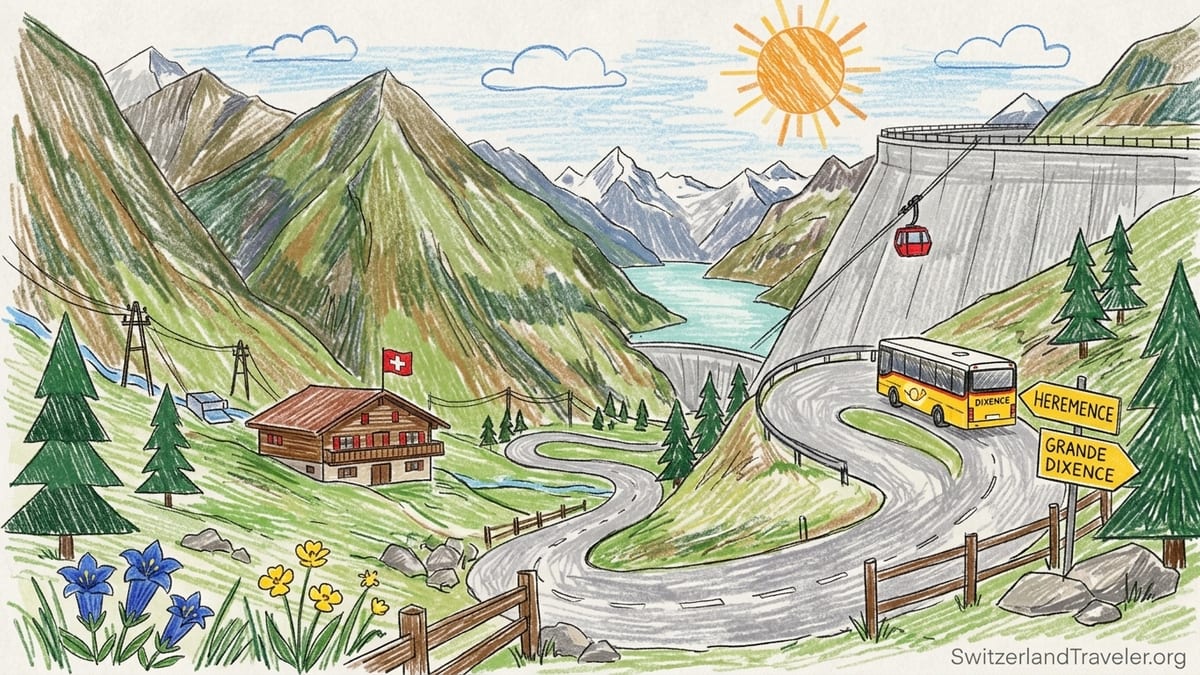
Arrival in Val d’Hérens: The Road to the Wall
The approach to Grande Dixence begins quietly on the A9 motorway, with the dam still out of sight and the vineyards around Sion doing their best to distract you. Leaving the highway at the Sion-Est exit, you follow signs for Val d’Hérens and Hérémence. Almost immediately the landscape tightens. The broad Rhône valley gives way to steeper slopes, traditional wooden barns and villages perched above the road. This is not a high-speed mountain highway. Expect a winding drive of roughly 45 minutes from Sion to the dam site, with wide but twisting tarmac and the occasional slow farm vehicle to overtake.
By car, the most striking shift comes after Euseigne, where the road passes beneath the famous earth pyramids before beginning to climb more decisively. Switchbacks pick their way up the flank of the valley, with frequent pull-outs where cyclists catch their breath and drivers can step aside to admire the deep gorge below. Signs for Grande Dixence appear on yellow boards, pairing the dam name with Hérémence and Dixence. Even before you see the dam itself, the infrastructure gives the game away: thicker power lines, small hydro installations on side streams and stark grey pipes tucked into the rock remind you that this is a valley organised around water and electricity.
Arriving by public transport softens these transitions but does not disguise them. From Sion railway station, yellow PostBus services run up Val d’Hérens towards Hérémence and on to Grande Dixence during the summer opening period, generally from early June to late October. Timetables can change each season, but you can expect several departures a day in high summer that are timed to connect with InterCity trains from Geneva, Lausanne or Brig. The ride costs roughly what you would pay for a similar length valley route elsewhere in Valais, and is fully covered by regional passes and the Swiss Travel Pass. The bus window turns into a moving cinema of gorges and hamlets, and removes the stress of the hairpin bends if you are not used to mountain driving.
In both cases, there is a sense of suspense. For much of the journey the dam is hidden by the shape of the valley. You know you are getting close when the road narrows to single direction over a small bridge, the air cools and the walls of the gorge tighten. Then the valley turns and the “wall” finally appears.
First Sight of Grande Dixence: Confronting the Vertical
The first full view of Grande Dixence is disorienting. One moment you are following the stream in a fairly typical Alpine valley. The next, the valley appears to terminate in a vertical plane of grey that seems to blot out the sky. From below, it genuinely does not read as three-dimensional. Your brain knows that there is a reservoir and 400 million cubic metres of water behind it, but your eyes register a single vast surface without edges, as though someone has taken an eraser to the glacier that once carved this notch and replaced it with concrete.
Standing at the base car park, you are around 200 metres from the toe of the dam. Here the statistics begin to translate into physical sensation. The base is approximately 200 metres thick and the crest almost 700 metres long, which means that what you are looking at is not a wall in the everyday sense but a wedge of material the size of a small mountain, poured between the cliffs. The human-scale details along the foot only heighten the effect: the visitor information pavilion, the hotel-restaurant “Le Ritz” and the PostBus all look miniaturised, as if someone has scattered model buildings in front of a backdrop.
This is one of the few dams where the visual impression from below is genuinely intimidating. Photographs tend to flatten it. In person, you notice the way the crown disappears into cloud when the weather turns, and how the valley wind pools at the base, funneled by the cliff walls. Conversation often drops to a hush here, not because of any rule, but because the presence of the structure demands it. For visitors who are sensitive to exposure or megalophobia, lingering too close to the base can feel overwhelming. Others, especially visitors with an interest in infrastructure, often find themselves silently counting the horizontal construction joints and expansion lines like growth rings on a tree.
From Base to Crest: Cable Car or Footpath
From the foot of the dam you have two basic choices for reaching the crest: ride the small cable car or walk. The cable car departs from a station beside the main car park near the hotel-restaurant. Operations usually run from early June to the end of October, with continuous service in high season and an approximate lunchtime break during the shoulder weeks. The journey takes only around four to five minutes and gains almost 200 vertical metres, placing you at the level of the hotel and the crest access tunnel. Return tickets are sold on site, and combination “Discovery” tickets bundle the ride with the interior tour of the dam at a modest discount compared with buying each element separately.
The cable car ride itself is less dramatic than you might expect. Cars are enclosed, seating a small group or family, and climb directly along the side of the dam rather than out over a void. This makes the ascent accessible to most visitors who are comfortable with gondolas elsewhere in Switzerland. Looking down through the windows, the scale of the base slowly compresses, and you begin to understand the thickness of the structure. By the time you reach the top station, the hotel and visitor buildings that looked so small from below are now level with your feet.
Walking to the top is an entirely different experience. A signed footpath climbs from near the visitor centre up a series of switchbacks to the crest. It follows the slope of the valley rather than clinging directly to the face, so you are never exposed over the sheer wall. Even so, the path is steep in places, and you should allow around 45 to 60 minutes for an unhurried ascent if you are in average hiking condition. Sturdy shoes are advisable, especially after rain when patches of the trail can be slick. On a warm July afternoon, the exertion is comparable to a short Alpine hike, with the added psychological kick that you know you are climbing alongside one of the tallest man-made walls in Europe.
The difference in perception between cable car and trail is important. The mechanical lift delivers an efficient, slightly detached understanding of the site. The footpath gives you the time to feel each metre of height you gain, to see the valley unfold behind you and to notice how the top of the wall appears to creep closer, almost reluctantly. Travellers who want a visceral sense of scale tend to come away more impressed if they walk at least one way.
On the Crown: Wind, Weather and the View of Lac des Dix
Stepping out onto the crest of Grande Dixence feels like walking along a very narrow, very exposed mountain pass that has been squared off and surfaced in concrete. In reality the top is around 15 metres wide, broad enough for service vehicles, safety railings and pedestrians to coexist. Yet the combination of height, drop and unobstructed vistas can make even that width feel slender, especially on windy days. At 2,365 metres above sea level, the air temperature on the crown is clearly cooler than in the Rhône valley below, even in mid-summer. On a sunny August midday you might enjoy short sleeves in Sion, but still reach instinctively for a fleece and windproof jacket on the crest.
The wind is not a minor detail. The dam sits at the closed end of a high valley, and air tends to accelerate as it is channeled towards the wall. On still days you can lean on the parapet and look straight down 285 metres to the base without a gust touching you. On others the wind roars over the ridge, flattening hoods and sending backpack straps snapping. None of this is unsafe, but it affects how long you want to linger and how easy it is to hold a camera steady. Families with younger children often keep a firm grip on hands near the edges, even though the railings are solid and well maintained.
The transformation in the reservoir view between base and crest is perhaps the single most compelling aspect of a visit. From below, Lac des Dix is invisible. Once on the crown, you turn your back on the Val d’Hérens and are suddenly confronted with an inland sea of milky turquoise stretching far into the mountains. On bright days the water is an opaque, glacier-fed blue, contrasting with grey rock and the darker silhouettes of the surrounding peaks. In late season, water levels can drop as storage is drawn down for power production, revealing pale bands of former shoreline and small peninsulas that would be submerged earlier in the year. These changes make repeat visits visually different even if the dam itself remains unaltered.
Looking along the crest, you also feel the horizontal dimension that can be hard to grasp from the valley floor. The 695-metre length becomes a real walk, taking several minutes from one end to the other at a normal pace. Service hatches, drainage features and the occasional instrument or plumb line housing interrupt the surface, reminders that this is a working piece of infrastructure as well as a viewpoint. On clear days the horizon is lined with peaks like the Dent Blanche and Pigne d’Arolla, giving the unsettling impression that the dam, rather than the mountain ridge, is the natural place to stand and survey the terrain.
Inside the Wall: Guided Tour Through Concrete and Cold
Visitors who want to go beyond the surface can join one of the guided tours inside the dam. These run daily during the operating season, with several departures spread between late morning and afternoon. Tickets are sold at the information pavilion at the foot of the dam and cost around 10 Swiss francs for adults, with reduced prices for children. A combined ticket that includes both the interior tour and a return cable car ride is only slightly more expensive than the tour alone, making it a good-value option if you plan to visit the crest as well.
The tour begins outside, with a short introduction to the history of the project and the role of Grande Dixence within the wider Cleuson-Dixence network. You then enter the dam itself through a door near the base and almost immediately feel the temperature drop. The interior is maintained at around six degrees Celsius, summer and winter, in order to stabilise the concrete and instrumentation. Even on a hot July day, this feels like stepping into a refrigerated warehouse. Guides strongly recommend warm clothing and solid shoes for good reason.
Once inside, the experience shifts from panoramic to introspective. The tour follows a network of galleries cut within the body of the dam, around one kilometre of walking in total over the course of about 75 minutes. The tunnels are tall enough to walk comfortably and lit by a combination of fixed lights and occasional “sound and light” installations that pick out structural elements or historic photographs. Underfoot, the floor is concrete but can be damp in places, and there are flights of stairs, including a set of around 40 high steps equipped with a handrail. The group pace is measured, but anyone with mobility issues may find the gradients and steps challenging.
What you notice most is the silence and the mass. The walls and ceiling press in, not in a claustrophobic sense, but as a diffuse but constant weight. In certain spots guides point out instruments that track minute movements of the structure or the plumb lines that measure deflection. It is here that numbers like “15 million tonnes of concrete” begin to make intuitive sense. You are no longer looking at a surface. You are walking inside what amounts to an artificial cliff, with the knowledge that on one side of you is air and on the other hundreds of millions of tonnes of water. For visitors with a strong interest in engineering or geology, this is often the highlight of the entire visit.
Does the tour justify the time if you are less technically minded? That depends. The commentary focuses on construction methods, water management and safety systems rather than on broad storytelling. There are panels and the occasional sound-and-light segment to vary the tone, but the core of the experience is informational. If you enjoy understanding how major infrastructure works, or if teenagers in your group are studying physics or geography, the interior visit adds real depth. If your priorities are primarily landscape views, casual walking and photographs, you may feel that the time would have been better spent lingering on the crest or following one of the lakeside paths.
Visitor Centre, Exhibitions and Trails: How Much More Is There?
At the foot of the dam, the information pavilion doubles as a small visitor centre, ticket office and exhibition space. Entry to the exhibitions is free, and opening hours typically mirror the dam’s main season from June to October, operating through the day. Displays cover the history of the first Dixence dam, the decision to build Grande Dixence in its present form and the integration of the site into Switzerland’s power grid. Models, archive photographs and cross-section diagrams help non-specialists visualise aspects of the structure that are not visible from outside, such as the branching tunnels that feed water into the reservoir from distant catchment areas.
The tone of the exhibits is factual and quietly proud rather than promotional. Explanations are available in several languages, and there is enough technical detail to keep specialists engaged without losing general visitors. Spending 30 to 45 minutes here before or after your tour helps contextualise what you have seen, especially if you have not taken the guided interior visit. It also offers a weather-safe option if clouds roll in and the crest becomes less appealing.
As for hiking, Grande Dixence is more than a dead end for motorists. The crest area connects directly to marked paths that skirt the edge of Lac des Dix and continue deeper into the mountains, including routes towards the Cabane de Prafleuri and the Tour du Val d’Hérens multi-day itinerary. Even short sections of these paths give a different perspective on the dam. From a few hundred metres along the lakeside, you can look back and see how the wall sits within the rock amphitheatre, with its flanks biting into the valley sides and its crest appearing lower relative to the ridges around it.
These walks vary from easy lakeside strolls to demanding Alpine hikes that require early starts, proper gear and a head for altitude. For travellers interested in combining a dam visit with a full day outdoors, planning a loop that starts or finishes at Grande Dixence can turn the site into a natural stop rather than an isolated attraction. Weather, however, is decisive. Sudden storms are not uncommon at this elevation in summer, and trails can hold snow in June. Local tourist offices in Val d’Hérens and current map apps are invaluable for checking conditions before committing to longer routes.
Does the Engineering Scale Translate into a Memorable Visit?
Many heavily promoted sights do not quite live up to their superlatives when you arrive. Grande Dixence is different. Here, the headline claims about height, mass and capacity are not marketing gloss but simple descriptions of something that feels vast in person. The main question is not whether the dam is impressive. It is. The question is what kind of impression it leaves, and for whom.
If you are naturally drawn to engineering, energy systems or large-scale human interventions in the landscape, Grande Dixence is close to ideal. The intersection of raw statistics with tangible, walkable infrastructure is rare. You can see the turbines’ outputs graphed in the visitor centre, then step outside and watch the high-voltage lines stepping down the valley. You can trace water’s journey from distant glaciers to the reservoir, into the unseen tunnels within the wall, and then down to power stations buried far below the mountains. Few sites allow that process to be observed and felt at so many points along the chain.
For visitors without a technical bias, the emotional resonance is subtler but still real. Several elements help. First is the contrast between the pastoral lower valley and the almost brutal geometry of the wall. Second is the surprise reveal of the reservoir when you first step onto the crest. Third is the physical sensation of being so high above the base, with the wind muting sound and the drop visible between your feet if you edge close to the parapet. These are experiences that do not require knowledge of megawatts or concrete volumes to appreciate.
There are, however, limits. Those expecting the romantic charm of a medieval town or the visual drama of a glacier spilling into a lake may find the aesthetic here too stark. The site is, at its core, industrial. The hotel-restaurant and visitor amenities soften the feel but do not disguise that this is primarily a working hydroelectric installation. If you are indifferent to both infrastructure and stark Alpine scenery, the visit may feel like a long ride at the end of a side valley for a single, admittedly huge, wall.
The Takeaway
So who should make the detour to Grande Dixence, and how much time should you allow? If you are staying anywhere in central Valais, from Sion to Crans-Montana or Nendaz, and have an interest in engineering, energy, or simply seeing human construction pushed to its limits, Grande Dixence is one of the most rewarding half-day excursions available. Arriving by car or PostBus, taking the cable car to the crest, walking part of the crown and spending some time at the visitor centre is comfortably achievable in about three to four hours, not counting lunch. Adding the guided interior tour extends the visit to around half a day, and is particularly recommended for travellers who appreciate technical explanation and do not mind the chilly six-degree environment inside.
For hikers, the dam can anchor a full day. Combining a morning visit to the crest and interior with an afternoon walk along Lac des Dix or onto one of the neighbouring ridges turns the destination into a gateway rather than a terminus. On clear summer days, this blend of infrastructure and landscape is hard to beat. For travellers who are more pressed for time, a shorter two-hour stop to ride the cable car, walk the crest, and take in the view of the reservoir still delivers a satisfying sense of scale, though it may feel rushed if buses are infrequent that day.
If your itinerary through Valais is already packed with high passes, glacier viewpoints and classic resort towns, you may reasonably choose to skip Grande Dixence unless the engineering aspect particularly appeals. The experience is powerful but specific. It is about confronting a wall of concrete that anchors a national energy system, and about standing where a valley has been deliberately closed and reimagined. For many travellers, that shock of scale alone justifies the journey. For others, it will remain a curious detour in a region rich with alternatives.
In practical terms, the dam rewards those who give it at least half a day, especially if you include the interior tour or a short hike. Two hours can work for a focused look from the crest if you are driving. A full hiking day makes sense only if you deliberately integrate the dam into a longer route and are keen on spending extended time around Lac des Dix. However you choose to structure it, go prepared for cooler temperatures at the crest, stronger winds than in the valley below and a very real sense that you are standing not just on a viewpoint, but on the top edge of one of the most massive man-made structures in Europe.
FAQ
Q1. How do I reach Grande Dixence Dam by public transport?
From Sion railway station, you can take a yellow PostBus service up Val d’Hérens towards Hérémence and the “Grande Dixence” stop during the summer season. Services are coordinated with mainline Swiss trains, but it is important to check current timetables, as departure frequencies and final stops can change from year to year.
Q2. When is Grande Dixence open to visitors?
The dam area, cable car and guided interior tours usually operate from early June to late October, depending on snow conditions and maintenance. Outside this period, the access road beyond a certain point is closed and the site is not set up for tourism, so visits are effectively limited to the main summer and early autumn months.
Q3. How cold is it inside the dam during the guided tour?
The interior galleries are kept at a stable temperature of around six degrees Celsius. Even on a warm summer day, this feels distinctly chilly, so visitors are advised to bring a warm layer and closed shoes, especially if they plan to spend the full 75 minutes inside on the guided tour.
Q4. Is the guided interior tour suitable for children and older visitors?
The tour is open to children from about six years of age and is generally manageable for active older visitors, but it does involve around one kilometre of walking, several flights of stairs and cool, sometimes damp conditions. People with reduced mobility or difficulty on steep steps may find it challenging and should discuss options at the visitor centre before booking.
Q5. How long should I plan for a visit to Grande Dixence?
For a brief visit focused on the views, allow at least two hours to get from the car park or bus stop to the crest, walk part of the crown and explore the immediate surroundings. To include the interior tour and spend time at the visitor centre, three to four hours is more realistic. Hikers planning lakeside or mountain trails starting from the dam should set aside a full day.
Q6. What should I wear for visiting the crest of the dam?
Even in summer, it is wise to bring a windproof layer or light jacket, long trousers and sturdy shoes or hiking boots. The crest sits at over 2,300 metres, where temperatures are several degrees cooler than the valley and wind can be strong. Sunglasses and sun protection are also important, as the combination of high altitude, water surface and pale concrete increases glare.
Q7. Is the cable car necessary, or can I walk to the top?
The cable car provides a quick and convenient link from the base car park to near the crest and is useful for families or anyone short on time. However, there is also a marked footpath that climbs to the top in roughly 45 to 60 minutes. Walking offers a more gradual and physical sense of the dam’s height, while taking the cable car saves energy for exploring the crest and nearby trails.
Q8. Are there places to eat or stay near the dam?
At the foot of the dam you will find a hotel-restaurant that serves meals, drinks and snacks, and also offers accommodation during the main season. This makes it feasible to base yourself at the site for an early morning or late afternoon visit to the crest, or to combine the dam with nearby hikes without needing to return immediately to the valley.
Q9. Is Grande Dixence worth it if I am not interested in engineering?
Even without a specific interest in engineering, many visitors find the sheer visual impact of the dam and the panorama over Lac des Dix memorable. The experience is more austere than that of a traditional Alpine resort, but the combination of massive human-made structure and high-mountain landscape can be striking. If you favour soft scenery and historic villages above all, you may prefer other excursions in Valais, but travellers who are open to a more industrial form of Alpine drama usually feel the detour is justified.
Q10. Can I combine a visit to Grande Dixence with other nearby attractions?
Yes. Many travellers pair the dam with visits to Val d’Hérens villages such as Hérémence or Evolène, known for traditional wooden houses and summer festivals. Others integrate Grande Dixence into wider Valais itineraries that include wine tasting near Sion or hikes on nearby high routes. With careful planning, the dam can be one standout element in a varied day rather than an isolated objective.