


Few rail journeys in Europe feel as naturally choreographed as the Gotthard Panorama Express from Lucerne to Lugano. In a single day you glide across Lake Lucerne by historic boat, transfer directly to a panoramic train on the old Gotthard mountain route, then roll into the palm-lined squares of Ticino. For 2026 the full boat plus train journey operates daily from 18 April to 18 October, making it an easy centrepiece of a Southern Switzerland itinerary if you understand how tickets, reservations and logistics work.
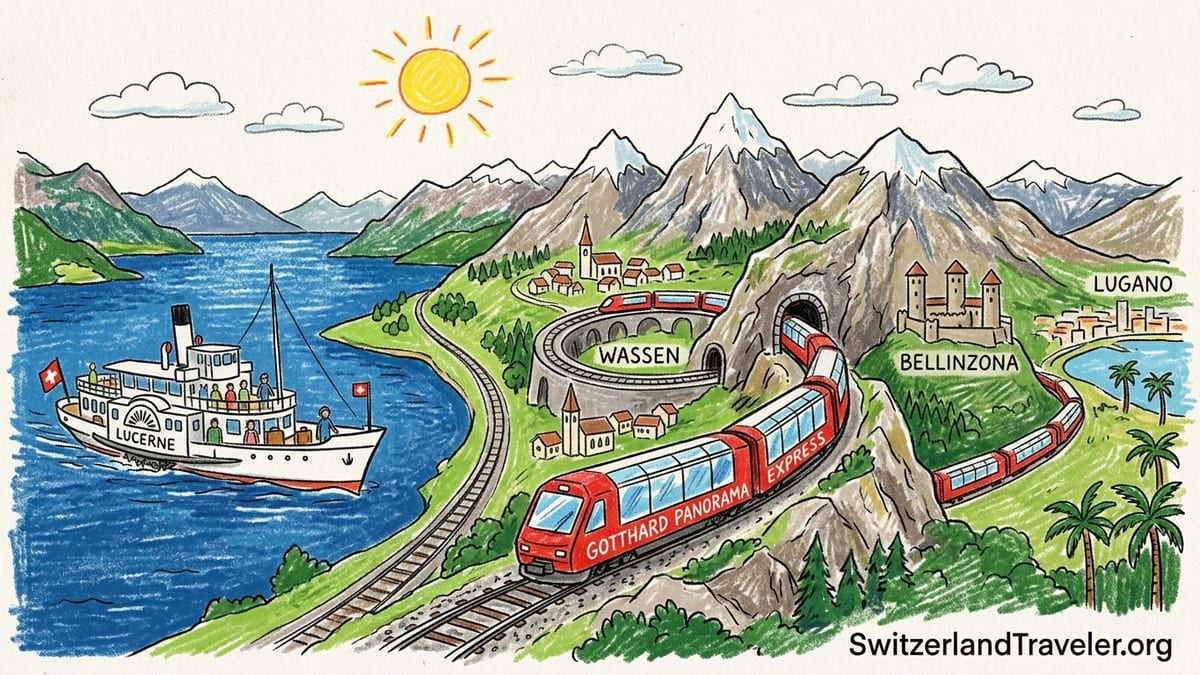
How the Gotthard Panorama Express Route Works in 2026
The classic northbound or southbound Gotthard Panorama Express itinerary links Lucerne, Flüelen, Bellinzona and Lugano in one continuous flow. You start in lakeside Lucerne, board a scheduled Lake Lucerne boat for the nearly three-hour cruise to Flüelen, then step a short distance to the adjacent railway station for the panoramic train over the historic Gotthard summit line. The train winds through the Reuss Valley, loops around iconic spiral tunnels above Wassen, crosses the old Gotthard Tunnel and continues via Airolo and Biasca to Bellinzona and finally Lugano.
For 2026, the official operating season runs from 18 April to 18 October, daily, including Mondays and public holidays. This is an upgrade from earlier years when the service often skipped Mondays. In practice that means you can treat it as a dependable backbone for spring, summer or early autumn trips, booking your Lucerne hotel and Ticino stays around any date in that window without checking weekday exceptions.
The full Lucerne to Lugano journey typically takes around five and a half hours, roughly half on the lake and half on rails. Many travellers use it as a scenic transfer: for example, travelling from Zurich or Basel to Lucerne by regular InterCity train, then continuing by boat and panoramic train to an evening arrival in Lugano. Others join or leave the panoramic section in Bellinzona, which has excellent onward connections to both northern Switzerland and Italy.
Although the name suggests a single product, you are really combining two elements: a Lake Lucerne boat segment run by the local navigation company and a special category panoramic train operated by SBB across the Gotthard mountain route. Tickets and reservations cover both, but understanding what is compulsory and what is optional will save you money and prevent surprises.
Tickets Versus Mandatory Reservations
To ride the Gotthard Panorama Express you always need two things: valid travel entitlement for the route (a ticket or rail pass) and, on top of that, a mandatory seat reservation and panorama supplement for the panoramic train section. The basic ticket is your right to travel; the reservation guarantees a specific place in the special panoramic coaches and covers the service surcharge.
Most international visitors travel with a Swiss Travel Pass, an Interrail or Eurail Global Pass, or SBB Saver Day Passes rather than buying full-fare point-to-point tickets. These passes fully cover the route from Lucerne through to Lugano in terms of base fare, but they do not include the mandatory reservation for the panoramic train. As of recent seasons, that reservation has typically cost around 16 Swiss francs per person for the Gotthard Panorama Express. Expect similar pricing in 2026, with exact amounts confirmed at the time of booking.
You can book the reservation via SBB channels by selecting the specific Gotthard Panorama Express departure and choosing “seat reservation only” if your pass already covers the fare. Alternatively, specialised booking portals and ticket desks at major Swiss stations can process the supplement. On a practical level, most travellers secure reservations weeks or months ahead for peak July and August dates, while in May, June or late September it is usually still possible to find places a few days in advance.
For the boat segment between Lucerne and Flüelen, the situation is more flexible. Your Swiss Travel Pass, most Interrail and Eurail passes valid in Switzerland, and ordinary SBB tickets generally cover standard-class travel on regular Lake Lucerne services, including the sailing used by the Gotthard Panorama Express connection. Reservations are not compulsory on the boat, though on sunny summer weekends some travellers choose to pay a small supplement for special upper-deck or lounge areas, which can be arranged on the spot if space allows.
First Class Only: What That Means in Practice
The Gotthard Panorama Express train operates with first-class panoramic coaches only. That means you cannot simply board with a second-class ticket or pass and sit anywhere. If your Swiss Travel Pass or point-to-point ticket is already first class, you only need the panorama reservation supplement to be fully set. If your pass is second class, you must buy a 2nd to 1st class upgrade for the route in addition to the panoramic supplement.
For example, imagine you hold a 3-day Swiss Travel Pass in second class and want to travel Lucerne to Lugano via the Gotthard Panorama Express on one of those days. You would purchase a first-class upgrade for Lucerne to Lugano for that date, plus the mandatory panorama reservation. If instead you travel with a Saver Day Pass booked directly in first class, that already grants you first-class entitlement for the route, so you only add the panorama supplement.
On the boat, ticket class matters mainly for where you may sit. First-class ticket holders can access upper-deck saloons and certain quieter areas; second-class travellers remain in the main deck sections. If you have upgraded to first class purely for the panoramic train, you also enjoy the first-class zones on the Lake Lucerne boat on the same ticket or pass date, which enhances the overall experience with better views and usually more space.
For visitors who do not own any pass, SBB and partner websites sell combined Gotthard Panorama Express packages that bundle first-class boat and train travel with the panorama supplement in one purchase. These can be cost-effective for a single big day trip, especially if you are not otherwise using Swiss public transport extensively.
From Piers to Spiral Tunnels: The Journey Step by Step
Your day usually begins at Lucerne’s lakefront piers a short walk from the main station. Ticket offices and clear signage point to the correct boat for Flüelen. Boarding starts roughly 10 to 15 minutes before departure, but in peak summer arrive a bit earlier if you want a prime outdoor seat on the stern or bow. Once underway, the boat threads past lakeside villages such as Weggis, Vitznau and Brunnen, with views of Mount Rigi and Mount Pilatus framing the water.
The Lucerne to Flüelen sailing typically lasts around 2 hours 45 minutes. You can move freely between indoor lounges, outside decks and the onboard restaurant, where a simple coffee and croissant might cost around 8 to 10 francs, while a full hot lunch could run 25 to 40 francs per person depending on your choices. Many travellers time their main meal for this portion of the journey, so that they can focus on scenery and commentary once on the panoramic train.
On arrival in Flüelen, the boat docks within an easy few minutes’ walk of the railway station. Signs and staff direct Gotthard Panorama Express passengers toward the correct platform. The panoramic train usually waits ready, its large-window coaches and labeled exterior making it easy to identify. Seating is assigned by reservation, so you simply locate your coach and seat number and settle in before departure.
The rail segment is where the engineering drama unfolds. Leaving Flüelen, the train climbs the Reuss Valley, passing waterfalls, ravines and the villages of Erstfeld and Göschenen. The highlight is the series of helical tunnels around Wassen, where you see the village church from three different angles at progressively higher elevations. After crossing the original Gotthard Tunnel to Airolo, the train gradually descends into Ticino, with the landscape softening into chestnut forests, terraced vineyards and eventually palm trees as you pass Biasca and Bellinzona on the way to Lugano.
Seats, Direction of Travel and Best Views
Because the Gotthard Panorama Express is a once-daily, reservation-only train, your seat is predetermined, but there are still strategies to maximise views. The scenic sections are impressive on both sides of the train, yet each side has its strengths. North of the tunnel, many travellers favour the right-hand side when heading south from Flüelen, as it offers dramatic river and valley views, while the left-hand side can be better for glimpses of the Wassen church during the spiral tunnels.
You generally cannot specify “left” or “right” at the time of booking through standard SBB channels, though staff try to distribute groups sensibly. If direction of travel matters to you, consider arriving early and politely asking the conductor on the platform if any unassigned or lightly booked sections could better match your preference. On less busy days in May or October they may allow discreet seat adjustments as long as you remain within the same coach and respect other reservations.
On the boat, seats are unassigned. For morning southbound journeys from Lucerne, the left-hand side facing the direction of travel often brings attractive views towards Rigi’s slopes and the fjord-like Urnersee section near Flüelen. Upper-deck outdoor seating is particularly photogenic when the weather is clear. If sunshine is strong, however, many travellers alternate between sitting in the shade indoors and stepping outside for key stretches such as the Rütli meadow and Tell’s Chapel area.
Within the panoramic coaches, windows run up into the roofline, so even travellers not facing directly forward enjoy sweeping views. The train staff usually offer occasional commentary, maps or small local souvenirs, adding context about the Gotthard route’s history without turning the trip into a formal guided tour. Photography is easy through clean, large panes, though reflections increase in strong midday light, so pressing your camera close to the glass helps.
Luggage, Practicalities and Travel Light Strategies
One pleasant surprise for many visitors is how straightforward luggage handling can be on this route. You can bring standard suitcases on board both the boat and the train, placing them in dedicated racks or keeping smaller bags above your seat. A medium-size wheeled suitcase plus a daypack per person is common and manageable, especially given the short, level walk between pier and station in Flüelen.
In recent seasons, SBB has offered a free or low-cost door-to-door or station-to-station luggage transfer for Gotthard Panorama Express passengers between Lucerne and Lugano on certain tickets or pass combinations. The exact conditions can vary, so before your trip check current information when reserving. In practice, travellers hand over their suitcases in the morning at Lucerne station’s luggage desk and collect them later that day at Lugano, freeing them to enjoy the boat and panoramic train with only small day bags.
Even if you keep your bags with you, it pays to pack with transfers in mind. Use a backpack or soft bag instead of multiple loose items so that boarding the boat in Lucerne and the train in Flüelen feels effortless. On busy summer sailings and trains, large hard-shell suitcases may fill the communal racks quickly, so avoiding oversized luggage reduces stress and speeds up disembarking in Bellinzona or Lugano.
As with all Swiss public transport, punctuality is high, and the connections are planned with sensible buffers. Still, aim to arrive at the Lucerne pier at least 20 to 25 minutes early, especially if you need to collect physical tickets or clarify reservations at the ticket office. In Flüelen, follow the crowd from boat to station but avoid lingering for too long at the pier; your train departure will be coordinated but not endlessly delayed for stragglers.
Integrating the Journey into a Southern Switzerland Stay
The Gotthard Panorama Express is more than a day trip; it is a natural spine for structuring a wider Swiss itinerary. A common pattern is to spend two or three nights in Lucerne, ride the boat and panoramic train to Lugano, then base yourself in Ticino for at least three nights to explore Lake Lugano, Lake Maggiore and nearby valleys before continuing to Italy or returning north by faster base-tunnel trains.
For example, a week-long plan might look like this in practice: arrive in Zurich and travel immediately to Lucerne for three nights, using a Swiss Travel Pass to ride up Mount Pilatus or Mount Rigi and take evening cruises on the lake. On day four, board the Gotthard Panorama Express to Lugano, checking into a hotel near the lakeside promenade. Spend the next three days visiting Gandria by boat, walking the Olive Grove Trail, and taking day trips to Bellinzona’s castles or to Locarno and Ascona on Lake Maggiore.
Another appealing option is to step off in Bellinzona rather than continuing to Lugano. Bellinzona’s trio of UNESCO-listed castles and compact historic centre make it an atmospheric base for two nights. From there you can reach Locarno in about 30 minutes by regional train or Lugano in roughly 20 minutes, while still having direct InterCity connections north via the Gotthard Base Tunnel to Zurich, Basel or Lucerne for your departure.
Travelers continuing into Italy can treat Lugano as a soft landing before larger hubs like Milan. After a couple of nights in Lugano, frequent EuroCity and regional trains carry you to Milan’s Centrale station in roughly an hour and a quarter, often with no change of trains. Structuring the Gotthard Panorama Express in the middle of such a trip provides a scenic, low-stress transition between German-speaking central Switzerland and Italian-speaking southern Europe.
Costs, Booking Tips and When to Travel
Exact fares for 2026 will be confirmed closer to the season, but recent years provide a useful reference point. A full-price first-class ticket for Lucerne to Lugano, including boat and train, can exceed 150 Swiss francs per adult. Adding the panorama supplement typically brings the total into the 160 to 180 franc range. By contrast, a first-class Saver Day Pass booked well in advance can cost significantly less than the sum of regular fares, and it usually covers the entire route; you only add the separate panorama reservation.
Holders of multi-day Swiss Travel Passes enjoy the most straightforward experience, as they can simply make the obligatory reservation and board. If you are mixing Swiss days with time in Italy or France, consider whether a 4-day or 8-day pass will align with your longer travel window so that the Gotthard Panorama Express day falls within pass validity. Interrail and Eurail pass holders follow a similar pattern, but should always confirm that their chosen pass type includes Switzerland and the relevant class.
In terms of seasonality, all parts of the operating window from 18 April to 18 October 2026 bring different moods. Late April and May can still carry snow on higher peaks, making the mountain scenery particularly striking, while tourist numbers are moderate. July and August bring warmer lake temperatures, busier boats and more families, but also the longest days and the lushest greenery. September and early October often deliver stable weather and golden light on Ticino’s hillsides, with fewer crowds on weekdays.
Booking strategies reflect this. For July and early August departures, aim to secure your panorama reservation and any key hotels 8 to 12 weeks ahead, especially if travelling on weekends or with a group. For late April, May, late September or October trips, a few weeks’ lead time is often enough, though last-minute travellers can still succeed by targeting midweek dates and being flexible on exact departure days.
The Takeaway
By pairing a Lake Lucerne cruise with the historic Gotthard mountain railway, the Gotthard Panorama Express condenses a surprising amount of Swiss variety into a single, well-orchestrated day. From Lucerne’s medieval skyline and mirror-calm waters to the engineering theatre of the spiral tunnels and the Mediterranean-inflected squares of Lugano, you experience a genuine transition between cultures and landscapes rather than a simple transfer.
For 2026, daily operation from 18 April to 18 October makes it easier than ever to weave this journey into a Southern Switzerland itinerary. The key is to separate the concepts of tickets and obligatory reservations, plan for first-class requirements on the panoramic train, and think through luggage and seating preferences in advance. Whether you step off in Bellinzona to explore fortress walls or continue all the way to Lugano’s palm-lined shore, the route rewards a little preparation with a day that feels both effortless and memorable.
Used as a scenic transfer between central and southern Switzerland or as the centrepiece of a dedicated Ticino stay, the Gotthard Panorama Express remains one of the most atmospheric ways to cross the Alps. With the right combination of pass, reservation and timing, it can be as practical as it is beautiful, transforming what might have been a routine journey into a highlight of your trip.
FAQ
Q1. Do I need both a ticket and a reservation for the Gotthard Panorama Express?
Yes. You always need valid travel entitlement such as a ticket or rail pass for the Lucerne to Lugano route, plus a mandatory seat reservation and panorama supplement for the Gotthard Panorama Express train itself.
Q2. Is the Gotthard Panorama Express first class only?
Yes. The panoramic coaches are first class only. If you have a second-class pass or ticket, you must purchase a 2nd to 1st class upgrade for the relevant section in addition to the panorama reservation.
Q3. Is the boat ride on Lake Lucerne included in my Swiss Travel Pass?
In most cases yes, regular scheduled sailings between Lucerne and Flüelen are covered by the Swiss Travel Pass. You may still pay for optional extras such as special lounge areas or certain catering services on board.
Q4. How long does the full Lucerne to Lugano journey take?
The combined boat plus panoramic train journey usually takes around five and a half hours, with roughly 2 hours 45 minutes on the lake and a similar duration on the train to Lugano.
Q5. Can I travel only part of the route, for example Lucerne to Bellinzona?
Yes. You can board in Lucerne and leave the panoramic train in Bellinzona, or join at Bellinzona and continue to Lugano or Lucerne. Just ensure your ticket or pass covers the chosen section and that your reservation matches your boarding point.
Q6. When does the Gotthard Panorama Express run in 2026?
In 2026 the Gotthard Panorama Express is scheduled to operate daily from 18 April to 18 October, including Mondays and public holidays in both directions between Lucerne and Lugano.
Q7. Can I bring large luggage on the boat and panoramic train?
Yes, standard suitcases are allowed and can be stored in luggage racks or near your seat. For extra convenience, check whether station-to-station luggage transfer between Lucerne and Lugano is available for your ticket type when you book.
Q8. Which side of the train has the best views?
Both sides offer excellent scenery. Southbound from Flüelen many travellers prefer the right-hand side for valley views, while the left-hand side can be better for seeing the church at Wassen during the spiral tunnels.
Q9. Do I need to reserve a seat on the Lake Lucerne boat?
No, reservations are generally not compulsory on the regular Lucerne to Flüelen boat used by the Gotthard Panorama Express connection. Seating is first come, first served, though some premium areas may carry a small supplement.
Q10. Is the Gotthard Panorama Express suitable as a travel day with children?
Yes. The mix of boat and train, frequent scenery changes and onboard movement make it engaging for children. Families should still plan snacks, sun protection for the boat and simple entertainment for quieter stretches of the train ride.