


Southern Switzerland’s Ticino region feels like a slice of northern Italy grafted onto the Alps: palm trees and arcades, stone villages clinging to green valleys, and lakes that glow cobalt at sunset. It is also one of the easiest corners of Switzerland to explore without a car, thanks to fast trains and dense PostBus networks. This modular route through Lugano, Morcote, Bellinzona, Valle Verzasca, Locarno, Ascona and Vallemaggia helps you decide when to rent a car for extra freedom and when public transport actually delivers a smoother trip.
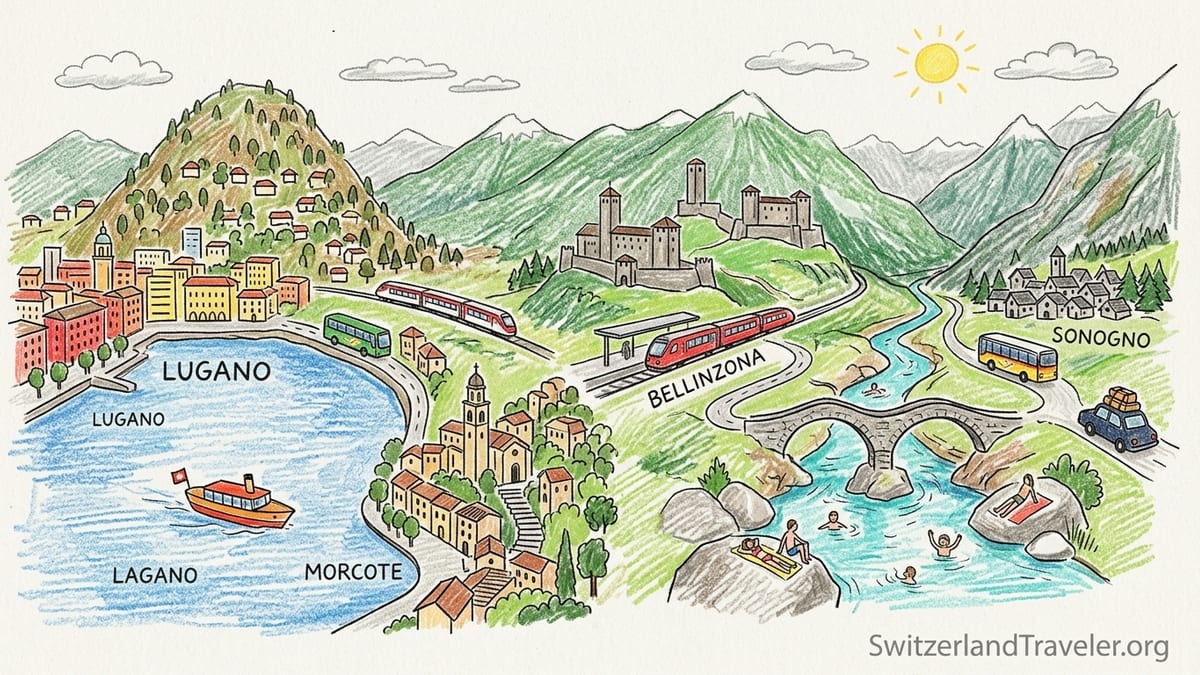
How This Modular Southern Ticino Route Works
The core route runs in a logical arc: Lugano → Morcote and the Mendrisiotto area → Bellinzona → Valle Verzasca → Locarno and Ascona → Vallemaggia, with an optional loop along Lake Maggiore. You can complete the highlights in three packed days, but most travelers will be happier stretching the journey over five to seven days, adding hiking, lake swims and winery visits as weather allows.
Because distances are short and rail links are fast, you can treat this as a base-and-spoke itinerary. For example, you might sleep three nights in Lugano, then three nights in Locarno or Ascona, using trains and PostBus for the valleys. Drivers can follow the same structure but add side roads and lesser-known hamlets, such as the high terraces above Vallemaggia or rural wine villages near Mendrisio.
Public transport timings shape the whole decision. Official timetables for 2026 show Lugano to Bellinzona taking around 15 to 25 minutes on direct S-Bahn and regional trains, running several times per hour, and Locarno to Lugano taking about 30 to 45 minutes with at least hourly service via Giubiasco and Cadenazzo. That means you rarely gain serious time by driving between the main towns, and downtown parking charges can erase any perceived savings.
Where a rental car really shines is inside the side valleys and on cross-valley days that string together small villages and viewpoints that are not on a single PostBus line. Think of linking Sonogno in upper Valle Verzasca with Fusio in upper Vallemaggia, or dropping into tiny stone hamlets like Corippo for a late dinner. On those days, a car can easily double your flexibility. On town-to-town days, it often adds nothing but the hunt for parking.
Lugano and Morcote: Lakeside Base or First Stop
Start in Lugano, a compact lakeside city that feels resort-like without losing its Swiss backbone. The train station sits on a hill above the center, connected by a funicular, so arriving by rail is painless. Trains from Zurich and Milan funnel through Lugano several times an hour, and local TILO S-Bahn lines run frequently toward Bellinzona and Mendrisio, making this an easy arrival hub whether you fly into Zurich, Milan Malpensa or Milan Linate.
If you pick up a rental car, Lugano is a practical place to do it. Major agencies cluster around the station and in the city center. Before committing, simulate your first hop in a timetable app. Around midday on a typical summer Sunday, you might see four or more trains per hour to Bellinzona, many with travel times under 20 minutes. Reproducing that by car, then parking near Bellinzona’s historic core, is rarely quicker in real time once you factor in traffic lights and garages.
From Lugano, Morcote makes an easy half or full day. You can drive the lakeshore road in about 25 minutes, threading through villages like Paradiso and Melide, or cruise down on the frequent bus line that hugs the same shore. The road is narrow in spots, and lakeside parking in Morcote is limited to a few paid lots and marked bays that fill quickly on sunny weekends. In high season, visitors who arrive by bus often walk straight off at the Morcote stop and begin climbing the stone stairways while drivers circle for a space.
If you have a car, consider using Morcote as a jumping off point to quieter corners of the Mendrisiotto region. You can continue toward Mendrisio for a winery visit in the Ticino merlot vineyards or a detour up to the small hilltop of Castel San Pietro. Public transport does reach these places, but connections can involve multiple buses and up to an hour of changes, whereas a car lets you chain two or three stops and be back in Lugano by dinner.
Bellinzona’s Castles and Why Trains Win Here
Bellinzona sits at a strategic Alpine bottleneck and is famous for its three UNESCO-listed castles. It is also the clearest example of when not to bother with a car. Direct trains rolled into Bellinzona from Lugano in as little as around 14 to 18 minutes in recent 2026 timetables, with service often every 15 minutes at busy times of day. You step off almost directly into the old town, with Castelgrande visible above.
Driving the same stretch on the A2 motorway looks quick on the map at about 30 kilometers, but congestion around exits and traffic lights can push you close to half an hour in peak periods. Once in Bellinzona, most historic center streets are pedestrianized, and nearby garages charge by the hour. A realistic door-to-door comparison for a visitor staying near Lugano’s lakefront often favors the train by the time you walk from a car park to the castle lifts.
Spend at least half a day here. With a public transport pass, you can glide up by elevator to Castelgrande, then walk the ridge toward Montebello and Sasso Corbaro, dropping back into town between visits. Travelers with a car often feel compelled to move the vehicle between attractions to chase marginal convenience, which can mean wrestling with one-way streets and limited on-street spaces. When you can embrace Bellinzona as a fully walkable stop, you appreciate its arcades, Saturday market and cafe terraces much more.
If you still want a car for later valley days, consider timing your rental so that you pick it up after you have finished exploring Bellinzona. For example, arrive in Lugano by train, explore Lugano and Bellinzona car-free for two days using regional rail, then collect a vehicle from a neighborhood agency on the afternoon you head into the valleys. This sequencing limits urban driving and parking while giving you full flexibility where public transport thins out.
Valle Verzasca: PostBus Spine vs Car Flexibility
North of Locarno and Tenero, Valle Verzasca narrows into a steep, emerald-green canyon fed by a turquoise river that looks almost unreal in photographs. Today the valley is connected by a single main road from the south, reached from Tenero or Gordola, and a PostBus service that functions as a lifeline for residents and hikers. Summer 2026 schedules show route 321, operated by a regional carrier under the PostBus umbrella, running from Locarno and Tenero up to Sonogno at the head of the valley, with multiple buses per hour at peak times and reduced but steady service in shoulder seasons.
For classic Verzasca day hikes, such as the popular stone-bridge loop around Lavertezzo or the long valley trail between Lavertezzo and Sonogno, public transport is so convenient that a car can feel like a liability. You can step off the bus at Lavertezzo, Paese, hike upstream for several hours, swim in the river, and then simply catch any returning PostBus from Sonogno without worrying about retrieving a vehicle from your starting point. Many hikers use an all-day ticket or regional pass and treat the bus like a hop-on, hop-off shuttle between villages and trailheads.
Parking tells a similar story. The Verzasca valley authorities have mapped out a series of designated parking areas along the river, with clear signage and variable hourly or day rates in summer. On peak weekends, lots near the Lavertezzo bridge and popular swimming spots often fill by late morning, and overflow traffic is pushed further down-valley. Paid parking machines, time restrictions and valley patrols make it risky to improvise roadside parking. By contrast, the bus stops are directly beside almost all of the key access points.
Where a car does improve a Verzasca trip is if you base yourself for multiple nights inside the valley, perhaps at a rural inn in Brione or an apartment above Gerra, and you want easy access to trailheads at odd hours, grocery runs in Tenero, or side trips to less frequented corners. It also helps for heavy luggage: carrying full hiking packs or family gear on tightly timed buses can be stressful. For most visitors staying on the lakes, however, combining SBB trains to Tenero or Locarno with the valley PostBus offers the most relaxed and flexible experience.
Locarno, Ascona and the Optional Lake Maggiore Loop
As you emerge from Valle Verzasca, Locarno and neighboring Ascona spread along the northern shore of Lake Maggiore. Locarno’s station is a rail hub, with hourly InterRegio trains to and from the north, and regional RE and S-Bahn connections toward Lugano via Giubiasco. Recent timetables show Locarno to Lugano typically around 30 to 45 minutes, with most journeys involving a simple change at Giubiasco or a direct regional express. For many travelers, that makes Locarno an ideal second base, balancing lakeside relaxation with onward connectivity.
Driving between Lugano and Locarno follows the A2 and then a spur toward the lake. Travel time by car is similar to or slightly longer than rail in moderate traffic, once you factor in navigating to accommodation in often narrow one-way streets. Locarno’s central parking garages are efficient but not inexpensive. If you plan to stay in a hotel right on Piazza Grande or in Ascona’s old town, you may find that your room rate includes reduced-rate parking in a nearby structure, but you will still walk luggage through cobbled alleys. Arriving by train and local bus or taxi can be less tiring.
The optional Lake Maggiore extension suits both drivers and non-drivers. Ferries fan out from Locarno and Ascona to nearby Italian towns along the lake, offering a car-free day trip that pairs well with a regional rail pass. Drivers can loop south along the Swiss shore, cross into Italy, and continue to places like Cannobio or Stresa before looping back via the Centovalli and returning to Locarno. However, cross-border traffic bottlenecks and limited parking along Italian lakeside promenades often make the ferry and train combination more appealing if your goal is a relaxed day, not maximum mileage.
As a practical example, a couple staying three nights in Ascona might leave their car parked the entire time. One day they ferry to the Brissago Islands and picnic in the botanical gardens, another they ride the cable car up to Cardada-Cimetta above Locarno using city buses and funiculars, and the third they dip into Valle Maggia by PostBus for riverside walks and grotto lunches. The car becomes relevant again only when they move on to a more remote valley inn or cross into a rural corner of Italy not served by rail.
Vallemaggia: When a Rental Car Starts to Shine
Vallemaggia, northwest of Locarno, is broader and wilder than Valle Verzasca, with multiple side branches such as Val Bavona and the high villages toward Fusio. The main road follows the Maggia River from Locarno through villages like Avegno, Gordevio and Bignasco. A PostBus network covers the main valley and many side arms, with 2026 timetables listing routes from Locarno to Bignasco and beyond, and onward connections toward Cavergno, Fusio and smaller hamlets. Services are regular in summer, but frequencies drop outside peak hours and late in the evening.
If you plan a single day trip from Locarno, public transport works well. You might ride a morning PostBus to Bignasco, stroll to the waterfalls at nearby Foroglio in Val Bavona, have lunch at a stone grotto restaurant, and then catch an afternoon bus back. Doing this by car saves some waiting time but introduces its own issues: limited parking along the narrow Bavona road, tight hairpins and the temptation to keep leapfrogging deeper into the valley instead of soaking in one or two well-chosen spots.
For travelers who want to base themselves in Vallemaggia for several nights, a car is more compelling. A family renting a farmhouse near Cevio, for instance, might want to shop for groceries in Locarno, visit the baths in nearby Brontallo, and time hikes according to children’s energy rather than bus schedules. With a vehicle, they can also blend valleys, driving over to Verzasca one day via Gordola and Tenero, or looping up a side road for an unplanned picnic spot. The trade-off is that many old stone villages have extremely limited parking, so you may need to leave the car at the entrance and walk the last section along cobbled lanes.
An underappreciated use of a car here is for early-morning or sunset photography. PostBus runs on a human-friendly schedule; it rarely gets you to a remote chapel terrace at sunrise. Photographers staying in Fusio or the upper valley can hop in a car at 5:00, photograph first light on a granite peak, then drive back for breakfast. If you are content with late-morning hikes and lazy afternoons by the river, public transport is usually enough and makes for a calmer trip.
Designing Your Own Mix of Car and Public Transport
The sweet spot for many visitors is a hybrid approach. One practical pattern is to start and end your Ticino trip car-free, using trains to move quickly between international gateways and Lugano or Locarno, and then rent a car only for the days when you are based in a valley village. For example, you might arrive by train in Lugano, spend two nights exploring Lugano, Morcote and Bellinzona without driving, then collect a car in Bellinzona or Locarno for three nights divided between Valle Verzasca and Vallemaggia.
Cost comparisons depend on your group size and pass choices. A couple using a Swiss Travel Pass or half-fare card will find that a day of regional trains plus PostBus in Ticino can be surprisingly good value, especially when you add in discounts on cable cars and boats. A compact rental car in high season, with basic insurance and fuel, can easily reach several hundred Swiss francs for a long weekend, before parking fees. On the other hand, a family of four paying point-to-point fares at full price might come out ahead with a rental car for valley days if they use it heavily.
Environmental impact and stress levels matter too. Ticino’s authorities have invested heavily in services like on-demand e-bus shuttles in Verzasca that link hamlets to the main bus spine, specifically to reduce private car pressure in fragile valleys. Using these systems, even for part of your trip, keeps classic bottlenecks around Lavertezzo and popular swimming sites from becoming gridlocked on hot weekends. Many travelers report that they sleep better after a long hike if they have not had to navigate tight stone-walled roads in twilight.
When deciding for each leg of this modular route, ask three questions: Is there at least one train or bus per hour at the times I want to travel. Is parking straightforward and reasonably priced at my destination. Do I plan to visit more than two or three spots that are not on a single bus or train line. If the first answer is yes and the next two are no, public transport will probably serve you better than a car for that segment.
The Takeaway
A southern Switzerland road trip through Lugano, Morcote, Bellinzona, Valle Verzasca, Locarno and Vallemaggia offers a rare combination: dramatic landscapes, easy logistics and the freedom to travel either by steering wheel or by timetable app. The key is to think in modules rather than a fixed loop, adding or subtracting days in valleys and lakeside towns according to your interests and the season.
Use trains for fast hops between Lugano, Bellinzona and Locarno, where official travel times are short and frequencies high. Switch to PostBus to explore Valle Verzasca and Vallemaggia at a human pace, especially if you plan linear hikes or want to swim in the rivers without worrying about your car. Introduce a rental car only where it genuinely expands your reach, such as multi-day stays in upper Vallemaggia or early-morning photo forays to remote chapels.
By aligning your transport choices with the strengths of Ticino’s network, you reduce parking stress, keep costs under control and leave more mental space for the real reasons to come here: the glint of late-afternoon light on Lake Maggiore, the cool of a Romanesque stone church on a hot day, and the taste of a simple plate of polenta in a shaded grotto, somewhere between the lakes and the high granite walls of the valleys.
FAQ
Q1. Do I need a rental car for this Southern Ticino route?
For most travelers, you do not need a car between Lugano, Bellinzona and Locarno because trains are frequent and fast. A car becomes useful mainly if you stay several nights in Valle Verzasca or Vallemaggia and want flexible access to small hamlets and early or late hikes.
Q2. How long does it take to travel from Lugano to Bellinzona and Locarno by train?
Recent 2026 timetables show Lugano to Bellinzona in roughly 15 to 25 minutes on direct regional and S-Bahn trains, and Locarno to Lugano usually around 30 to 45 minutes with at least hourly connections via Giubiasco or Cadenazzo.
Q3. Is it difficult to find parking in Valle Verzasca and Vallemaggia?
In peak summer and on sunny weekends it can be challenging, especially near popular spots like Lavertezzo or waterfalls in Vallemaggia. There are designated paid parking areas, but they often fill by late morning, and informal roadside parking is discouraged and sometimes fined.
Q4. Can I visit Valle Verzasca as a day trip without a car?
Yes. Ride a train to Locarno or Tenero and then take the valley PostBus up to villages like Lavertezzo, Brione or Sonogno. Many classic hikes are designed around bus stops, so you can walk one way and return from a different village without needing a car.
Q5. When does a car save significant time in Ticino?
A car saves time mainly on cross-valley itineraries or when linking several small villages in one day, such as combining Sonogno in Valle Verzasca with Fusio in upper Vallemaggia. On straightforward town-to-town routes, rail is often as fast or faster once you count parking.
Q6. Are trains and PostBus services reliable in this region?
Swiss rail and PostBus services in Ticino are generally very reliable and run close to schedule, even on weekends. Weather or major events can cause occasional disruptions, but for most visitors the network feels dependable and easy to navigate with timetable apps.
Q7. What about luggage if I use only public transport?
Most trains and PostBuses have space for typical suitcases and backpacks. If you plan to move frequently, consider one medium-size rolling bag per person plus a small daypack rather than oversized suitcases, which are harder to handle on busy services to Verzasca and Vallemaggia.
Q8. Is driving in Ticino stressful for first-time visitors to Switzerland?
Outside the narrowest old-village lanes, driving is straightforward, with well-marked roads and good surfaces. The main stress points are tight bends in side valleys, limited parking, and occasional congestion near lakeside towns. If you are uneasy, start car use only after you have adjusted to the region.
Q9. Can I combine this route with a visit to northern Italy?
Yes. Both Lugano and Locarno connect easily to Italy by rail and road, and Lake Maggiore ferries reinforce that link. You can add a night or two in nearby Italian lakeside towns, but be prepared for slightly more chaotic traffic and parking compared with the Swiss side.
Q10. Which season is best for this modular Southern Ticino itinerary?
Late spring and early autumn usually offer the best balance of pleasant temperatures, running water levels in the rivers, and manageable crowds. July and August bring warm lake swimming but also the busiest trails and fullest parking lots, when using trains and PostBus becomes especially attractive.