


Southern Switzerland’s Ticino region has quietly become one of Europe’s most compelling areas for point-to-point hiking. Rather than isolated day walks, travelers can now book multi-day, self-guided hotel-to-hotel routes that thread together the Verzasca, Vallemaggia, Onsernone and Centovalli valleys before finishing high above the shores of Lake Maggiore. With around 4,900 kilometres of marked paths, more than 70 Alpine huts and over 25 cableways spread across the canton, Ticino is geared for walkers who want a structured but independent holiday, complete with luggage transfers and reliable public transport connections.
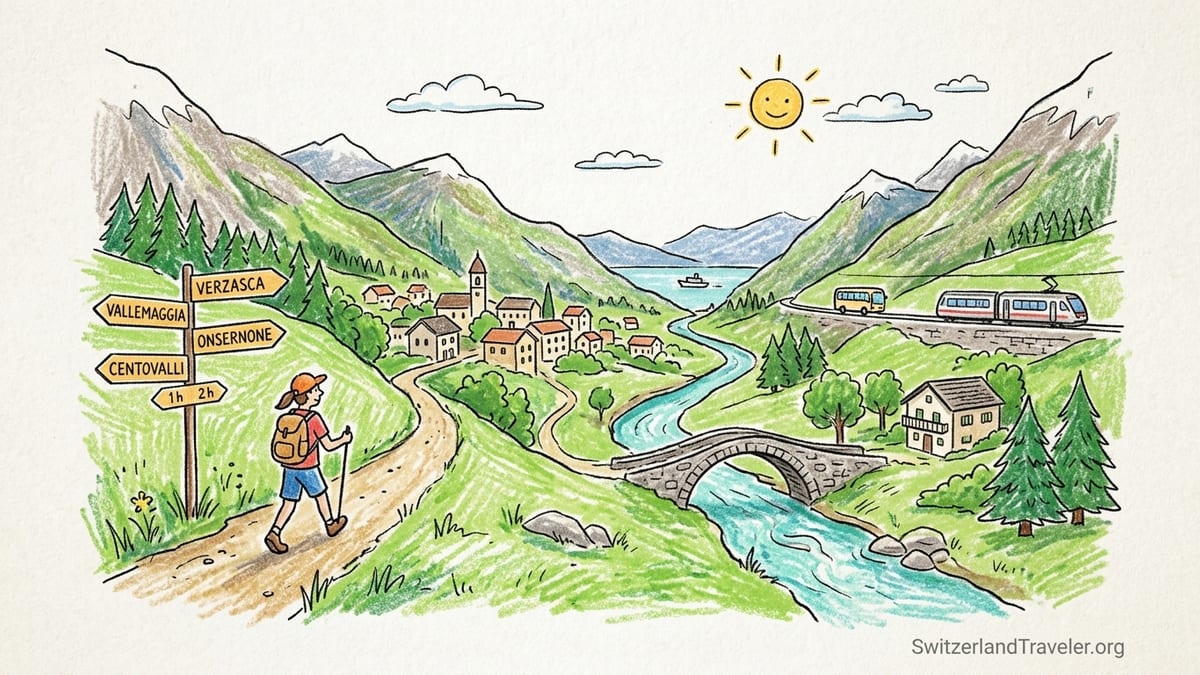
Why Ticino’s Valleys Work So Well for Hotel-to-Hotel Hiking
Ticino’s four northern valleys that feed into Lake Maggiore – Verzasca, Vallemaggia, Onsernone and Centovalli – sit close together around the Ascona–Locarno hub, but each feels distinct in terrain and character. Verzasca is known for its emerald river pools and stone villages, Vallemaggia for broad glacial valleys and traditional rustico houses, Onsernone for wild slopes and quiet hamlets, and Centovalli for deep gorges, chestnut forests and the narrow-gauge railway that links Locarno with Domodossola. Because distances between villages are relatively short and public buses run up each valley from Locarno, it is straightforward to design multi-day itineraries that connect them.
The key shift in recent years has been the emergence of bookable, packaged hiking holidays that link all four valleys into one route, typically ending with a lakeside or lake-view stay above Lake Maggiore. One current example, offered by a Swiss walking specialist, runs self-guided from Sonogno in upper Verzasca to Ronco sopra Ascona in seven or eight days, with luggage transfers and pre-booked accommodation at a starting price of about 1,255 Swiss francs per person in a double room. This confirms that the Ticino valleys are no longer a niche for map-carrying experts only, but a mainstream product competing with classic routes like the Bernese Oberland or the Engadine.
Compared with alpine regions further north, Ticino also benefits from a milder, more Mediterranean climate and a longer hiking season, often from April into October at valley level. The combination of signposted trails, integrated transport, the Ticino Ticket for free local buses and trains with an overnight stay, and an established network of huts and small hotels means that logistics for hotel-to-hotel trips are unusually smooth. For walkers used to carrying everything on their back, the option to send a bag ahead each day while they traverse centuries-old mule paths is a notable upgrade in comfort.
Verzasca Valley: Scenic Entry Point and Moderate Hiking Core
Many commercial itineraries start or spend a full day in the Verzasca Valley because it combines iconic scenery with relatively accessible paths. A typical route uses the Sentiero Verzasca footpath between Sonogno or Lavertezzo and the lower valley, following stone paths and riverside tracks above the famous turquoise river. Daily walking times of around five to six hours and modest altitude gains make this valley a good entry point for hikers with some experience but not necessarily alpine training. Accommodation is usually in small hotels or guesthouses in Sonogno, Lavertezzo, Gerra or the lakeside town of Locarno, with luggage meeting you at the end of the day.
From a comparison perspective, Verzasca tends to offer the most photogenic “first impression” per kilometre: stone bridges, polished rock pools and compact villages that feature heavily in Ticino marketing. Its paths are generally well maintained, and the valley is well served by postbuses from Locarno, which gives operators confidence when promising fixed start times and scheduled transfers. However, this popularity also means Verzasca sees more day-trippers than the other valleys, especially around the Roman bridge at Lavertezzo in summer, so commercial itineraries often time their arrival early or late in the day to miss peak bathing crowds.
On a typical self-guided package that covers all four valleys, Verzasca is used either as the starting stage or as the final descent before the walk above Lake Maggiore. In the current Sonogno-to-Ronco itinerary, for example, the first full walking day is often built around the Sentiero Verzasca before hikers continue toward Lake Maggiore. That structure allows travelers to settle into a rhythm of 5 to 6 hours of walking per day, with marked paths, regular waymarks and clear escape options to the bus route if needed.
Vallemaggia: Longer Distances and Side-Valley Ambitions
Vallemaggia, the largest valley in Italian-speaking Switzerland, generally introduces longer stage distances and more significant height differences into a commercial itinerary. The main valley floor is wider and more populated than Verzasca, but package routes frequently pull hikers up to balcony paths and side valleys for better views. For instance, the multi-day Ticino Valleys hiking holiday often brings walkers to Maggia village or another mid-valley base, then uses historic paths that climb to hamlets overlooking the river before dropping back to the valley for overnight stays in small hotels.
Compared with Verzasca, Vallemaggia offers more scope for flexible detours and tougher side trips, such as short excursions towards the Via Alta Vallemaggia high route or toward side valleys like Lavizzara and Bavona. Those options are rarely part of the standard commercial package but can be added as extra nights or day hikes for stronger walkers. This means Vallemaggia functions as a central “hub” in comparison tables: travelers who want gentler walking will stay closer to the valley floor, while those seeking more challenge can extend into higher terrain with hut stops or steeper balcony trails.
The infrastructure here is also slightly more developed. In addition to guesthouses and small hotels, Vallemaggia features traditional stone holiday houses known as rustici that can be booked as upgraded accommodation on some packages. Public buses run frequently along the valley, allowing tour operators to plan varied start and end points for each day. In a commercial comparison, Vallemaggia tends to score highly on landscape variety and accommodation character, while being rated moderate to demanding in terms of daily height gain if you opt for the more panoramic variants.
Onsernone: Wild Character, Historic Mule Paths and Lower Footfall
Onsernone is often described as wild and untamed, and this reputation shapes how it appears in commercial hiking holidays. The valley’s steep, forested slopes and stone villages perched high above the river mean that traditional routes follow old mule paths that zigzag up and down for long stretches. A section between Intragna and Loco, along the Via delle Vose mule path, is a classic example that some packages include either as a full day or as part of a connecting stage from Centovalli into Onsernone. The surface is generally good, but the cumulative ascent and descent make it more strenuous than the riverside trails of Verzasca.
Because Onsernone has limited road access and fewer accommodation providers, commercial hotel-to-hotel trips usually spend just one or two nights in the valley. Lodgings might be in a simple hotel or inn in villages like Loco or Auressio rather than in remote hamlets, to keep transfers manageable and guarantee luggage delivery. This is one area where the trade-off between wildness and comfort becomes clear: independent hikers can push deeper into the valley, but packaged trips will prioritise places that a luggage van or postal service can reliably reach.
In a difficulty comparison, Onsernone sits toward the top of the scale among the four valleys at valley-trail level, even before you consider high-alpine routes. Daily walking times of six hours with steep climbs on stone paths are typical, and there are fewer options to shorten the day using public transport compared with Verzasca or Vallemaggia. For travelers drawn by quieter paths and historical atmosphere, that extra effort is often a positive, but it should be taken seriously when choosing between route options on a self-guided booking form.
Centovalli and Lake Maggiore: Gentle Finale with Strong Transport Links
Centovalli, literally the “hundred valleys,” is the most accessible of the four in transport terms thanks to the Centovalli Railway that runs between Locarno and Domodossola. Many commercial itineraries use this valley as an entry or exit point, starting in Intragna above the Melezza River or finishing with a descent toward Lake Maggiore. A four-day traverse promoted by regional tourism, for example, begins in Intragna, follows mule path routes to Loco in Onsernone, continues via mountain trails to the Maggia valley and eventually drops toward the Verzasca valley and Lake Maggiore. That concept has fed directly into longer, bookable holidays where Centovalli provides the first or last leg.
Compared to Onsernone, the walking in Centovalli included in commercial packages tends to be moderate rather than hard, following balcony paths, chestnut woods and historic routes between villages such as Intragna and Verdasio. The presence of the railway and frequent regional buses makes it easier for organizers to guarantee connections and for hikers to shorten stages in poor weather. Accommodation is usually in small hotels or guesthouses in rail-accessible villages or in Locarno itself, particularly when the itinerary includes a final night overlooking Lake Maggiore.
The closing section above Lake Maggiore is a key selling point in price comparisons. On high-standard packages, the last night is often spent in Ronco sopra Ascona or another hillside village with lake views, positioning the trip as both a hiking holiday and a short lakeside break. That final night in a higher-category hotel partly explains why an eight-day Ticino Valleys self-guided trip with luggage transfer starts around 1,255 Swiss francs per person, compared with lower prices for simpler hut-based routes elsewhere in Switzerland. Travelers effectively pay a supplement for the combination of wild valleys and a comfortable, almost Mediterranean finale.
Self-Guided vs Traditional Hut Treks in Ticino
Ticino has a long tradition of challenging multi-day hut-to-hut routes such as the Via Alta Vallemaggia and the high routes around Verzasca and Bedretto, which largely target experienced alpinists. These itineraries rely heavily on the canton’s network of more than 70 Alpine huts, many of which are self-service or only staffed in high season, and they demand sure-footedness, good weather and a tolerance for basic dormitory accommodation. They occupy one end of the spectrum in any commercial comparison: high difficulty, high exposure, but relatively low cash cost per day once you are on the trail.
The newer hotel-to-hotel packages through Verzasca, Vallemaggia, Onsernone and Centovalli sit in the middle of the comfort and difficulty scale. They use mainly red-and-white mountain trails rather than blue-white alpine routes, and nights are spent in valley hotels or guesthouses with private rooms. Luggage transfer is included, so you hike with a daypack, and breakfast is typically part of the price, with options to add picnic lunches and half-board dinners. For many travelers, this model offers a more accessible way to tap into Ticino’s 4,900 kilometres of paths without committing to high-altitude hut stages.
In practice, the choice between a hut-oriented trek and a hotel-based circuit comes down to priorities. A self-guided hotel-to-hotel week through the four valleys might cost from around 1,255 Swiss francs per person in low season, rising with single-room supplements and higher-category hotels. A comparable length hut trek, booked privately with hut overnights and public-transport approaches, can work out cheaper per night but requires more planning, heavier packs and greater flexibility if the weather turns. Travelers unaccustomed to alpine conditions often find that paying for logistics, luggage transfers and pre-booked hotels is a worthwhile trade for a smoother overall experience.
Luggage Transfers, Public Transport and Practical Logistics
One of Ticino’s biggest competitive advantages over more remote mountain regions is its dense and integrated public transport network. Buses run from Locarno up Verzasca, Vallemaggia and Onsernone, and the regional railway covers Centovalli, linking to long-distance trains at Locarno and Bellinzona. Many hotels in these valleys participate in the Ticino Ticket scheme, which gives guests free use of local buses and trains for the duration of their stay. For packaged hiking holidays, this means companies can confidently promise seamless transfers at the start and end of each day, and hikers can rely on a bus or train connection if they need to shorten a stage.
Luggage transfer services typically operate by collecting bags each morning from the hotel reception and delivering them to the next night’s accommodation by late afternoon. On the Sonogno-to-Ronco style itineraries, this may mean bags are moved from a mountain village hotel down to Locarno and then back up another valley, but from the traveler’s perspective the process is invisible. There are usually weight limits per bag, and some routes may specify a maximum number of pieces per person, which is worth checking at booking stage. Compared to independent travel, where you carry everything and may need to book taxis for awkward transfers, the included luggage service significantly raises the level of comfort.
For those planning without a package, it is still possible to use a combination of scheduled buses, the Centovalli Railway and occasional taxis to create your own hotel-to-hotel route. However, you will need to verify seasonal bus timetables, confirm that each chosen hotel will accept luggage transfers if you book them separately, and allow for potential timetable changes in shoulder seasons. Commercial operators effectively bundle this complexity into a fixed-price product, which is one reason prices for curated four-valley holidays start above 1,200 Swiss francs even for self-guided trips.
How Difficult Are These Multi-Valley Routes Really?
From a pure hiking perspective, the standard hotel-based Ticino Valleys routes are best described as moderate to demanding, depending on the variant chosen. Daily walking times commonly range from five to seven hours, with altitude differences that can exceed 800 metres of ascent and descent on the more strenuous days, particularly in Onsernone. Paths are generally well marked and technically straightforward, with rocky but non-exposed sections and occasional steep stone steps or forested slopes. Compared with high alpine traverses in central Switzerland, you are rarely above the treeline for long, but the accumulative impact of repeated climbs and descents should not be underestimated.
Commercial providers typically recommend these trips for hikers with a good basic fitness level who are comfortable walking several hours on mountain paths carrying a daypack. The routes through Verzasca and much of Vallemaggia are suitable for confident intermediates, while the Onsernone and some Centovalli balcony paths require stronger legs and sure-footedness. There are usually options to shorten or skip tougher sections by taking a bus down to the valley floor or ending the day in a lower village. When comparing operators, it is worth checking whether they grade each day individually and if they offer alternative easier variants or extra rest days.
Seasonal factors also influence the effective difficulty. In late spring and autumn, temperatures are generally comfortable but some higher paths may still hold snow patches or be slippery with leaves and rain. In midsummer, heat in the lower valleys can be intense, turning moderate climbs into more demanding efforts, especially on south-facing slopes in Vallemaggia or Onsernone. When reading commercial descriptions that label these hikes as “moderate,” prospective travelers should look at the maximum daily ascent and distance in kilometres and consider recent walking experience rather than relying solely on the marketing term.
The Takeaway
For travelers comparing European hiking holidays, Ticino’s four-valley routes offer a compelling blend of scenic diversity, authentic villages and logistical ease. Verzasca provides the iconic emerald river landscapes and a relatively gentle introduction, Vallemaggia adds longer and more varied days with the option of side-valley ambitions, Onsernone brings wild slopes and quieter paths at the price of steeper ascents, and Centovalli plus Lake Maggiore supply a relaxed finale with strong rail and bus links. All of this is underpinned by a canton-wide network of nearly 4,900 kilometres of trails, more than 70 Alpine huts and over 25 cableways.
Commercial self-guided packages that knit these valleys together, typically over seven or eight days with hotel-to-hotel walking and luggage transfers, start around 1,255 Swiss francs per person. That pricing reflects not only accommodation but also the hidden value of route design, baggage logistics and integrated public transport planning. Compared with hut-based high routes, these trips sit at a middle ground of comfort and difficulty, opening Ticino’s valleys to a wider range of walkers who want independence on the trail and a comfortable bed each night.
For hikers choosing between destinations, the Ticino valleys stand out as a southern, softer-edged alternative to the classic Swiss alpine circuits, yet they remain fully “real” mountain landscapes with serious elevation changes and weather considerations. The presence of the Ticino Ticket, reliable valley buses and the Centovalli Railway means that even on more challenging days there are escape options, and the ability to end the trip with a view over Lake Maggiore adds a memorable final flourish. As demand for self-guided hotel-to-hotel walking holidays grows, Verzasca, Vallemaggia, Onsernone and Centovalli are likely to appear more often on comparison lists alongside the better-known alpine regions of Switzerland.
FAQ
Q1. How long is a typical self-guided Ticino Valleys hiking holiday?
Most commercial self-guided itineraries that combine Verzasca, Vallemaggia, Onsernone and Centovalli run for seven or eight days, with five to six full walking days plus arrival and departure days.
Q2. What is the usual price range for these hotel-to-hotel trips?
A current benchmark is around 1,255 Swiss francs per person in a double room for a week-long self-guided package with luggage transfer, with prices rising for higher hotel categories or single occupancy.
Q3. Do I need to carry my own luggage between hotels?
No, on most bookable packages your main luggage is transported between accommodations each day, and you walk with only a daypack containing water, clothing layers and essentials.
Q4. How difficult are the trails in Verzasca, Vallemaggia, Onsernone and Centovalli?
The standard hotel-based routes are graded moderate to demanding, with daily walking times of five to seven hours and significant but generally non-technical ascents and descents on red-and-white mountain paths.
Q5. When is the best time of year to hike these valleys?
Valley-level routes usually run from late April to October, with May, June, September and early October often offering the best balance of stable weather and comfortable temperatures.
Q6. Is public transport included, and how reliable is it?
Many hotels provide the Ticino Ticket, which gives free local buses and trains; regional buses and the Centovalli Railway are generally reliable and form an integral part of commercial itineraries.
Q7. Can less experienced hikers manage these multi-day trips?
Hikers with good basic fitness and some previous mountain walking experience usually cope well, especially if they choose itineraries with the option to shorten or skip the steeper Onsernone stages.
Q8. Are children or older travelers suited to these routes?
Active older hikers often enjoy these trips, but for families with younger children it is important to select shorter stages, avoid the toughest balcony paths and ensure everyone is comfortable with narrow mountain trails.
Q9. What kind of accommodation is typically used?
Packages usually combine small family-run hotels and guesthouses in the valleys, sometimes with a final night in a higher-category hotel overlooking Lake Maggiore rather than in remote Alpine huts.
Q10. How far in advance should I book a Ticino Valleys hiking holiday?
Booking several months ahead is advisable, especially for peak periods from late June to early September, as small valley hotels and luggage transfer services can fill quickly.