


Eastern Switzerland does not shout for your attention in the way Zermatt or the Jungfrau region does. It grows on you slowly, carriage by carriage on a narrow-gauge train, cobblestone by cobblestone in St. Gallen’s old town, and switchback by switchback on Alpstein trails above Appenzell. On my last trip I based myself between St. Gallen and Appenzell, rode the little red trains, hiked around Ebenalp and Seealpsee, and spent long, quiet hours inside the abbey district instead of just ticking off its UNESCO label. This is what that trip was really like, with the small details that matter when you are planning your own.
Riding the Little Red Trains Into Appenzell
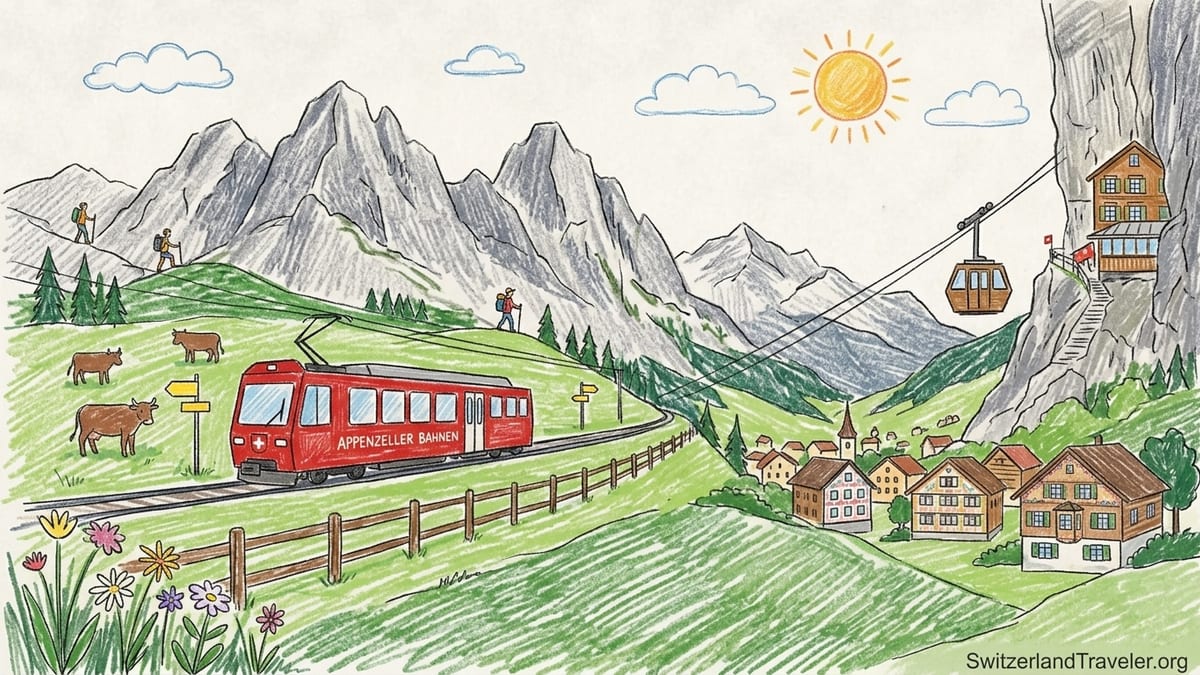
I arrived in Appenzell the way most people do, on one of the compact red trains of Appenzeller Bahnen that shuttle out of St. Gallen Hauptbahnhof. From the main station concourse it took me only a couple of minutes to find the S21 platform, where the train for Appenzell and Trogen pulls in every half hour or so during the day. The carriages felt more like an elongated tram than an intercity train, with large windows and low floors, because this line runs partly through city streets before climbing into the hills. As we slipped out of St. Gallen the graffiti and warehouses dropped away and the landscape opened into a patchwork of small farms.
Within fifteen minutes the suburbs had given way to pastures as green as the clichés suggest, divided by low wooden fences and dotted with brown and black-and-white cows. Every few kilometres we stopped at tiny stations marked by a yellow sign, a bench, and sometimes no more than a single house. On one stretch the tracks curved along a hillside and I could look down onto the roofs of Appenzell farmhouses, each with a narrow vegetable plot and an apple tree out front. The entire journey from St. Gallen to Appenzell took around 40 minutes, enough time to feel that I had left a city but not so long that it turned into a slog.
Because this is part of the St. Gallen S-Bahn network, the train felt integrated into daily life rather than like a tourist shuttle. School kids with rucksacks got off in Teufen, a man with a shopping trolley climbed aboard near Gais, and only a handful of people in hiking boots rode all the way through to Appenzell. I used a regular Swiss Travel Pass on my trip, which covered this line, but day visitors I spoke with bought an OSTWIND day ticket that allowed them to circle between St. Gallen, Appenzell and the nearby valleys without thinking about individual fares. No reservations, no seat assignments, just turn up and ride.
Arriving in Appenzell station felt almost theatrical. The train eased into a small, clean platform backed by painted wooden buildings, and as soon as I stepped out, the air smelled of cut grass and something faintly milky from a nearby dairy. It is about a five-minute walk from the station into the compact village core, but with a suitcase and cobblestones it took me a little longer. This was the first moment I felt the difference from more famous Swiss resorts. There were no big hotel signs or branded coffee chains outside the station, only a couple of local bakeries and a small Coop supermarket where hikers picked up sandwiches before disappearing toward the mountains.
First Impressions of Appenzell: Painted Facades and Quiet Evenings
Appenzell’s village center is smaller than its Instagram presence suggests, which is part of its charm. The main square, Landsgemeindeplatz, is essentially a broad open space framed by low-rise wooden houses painted in sherbet colors, with detailed decorative panels showing flowers, saints, or symbols of Appenzell history. I had seen photos of these facades in brochures, but standing in the square I noticed details that pictures flatten: the way the sunlight catches the glass in the oriel windows, the worn steps leading up to narrow shop doors, the sound of a fountain masking the distant cowbells.
I checked into a small guesthouse a couple of minutes’ walk from the square, a place with creaking hallways and flower boxes overflowing with geraniums. My room looked toward the hills and had a simple pine bed with a thick duvet. There was no spa, no designer toiletries, just a handwritten note with breakfast times and a basket of local biscuits. The owner told me most of his summer bookings now come from people who have seen the Alpstein on social media and want something quieter than Interlaken or Lucerne. He also mentioned that weekends can feel busy around midday when excursion groups roll through, but early mornings and evenings still belong mostly to locals.
My first evening in the village I walked slow loops through the traffic-calmed streets. Shops selling Appenzeller cheese, embroidered belts and traditional costumes closed by 6 or 7 pm, and by 8 pm conversations in Swiss German spilling out of two or three stubby bars were the main soundtrack. I had dinner at a restaurant just off the main square, starting with a clear beef broth and then a plate of Älplermagronen, the alpine macaroni made with pasta, potatoes, cream, and onions, served with a side of stewed apples. It was not light food, but after a day of travel it felt like the right kind of heaviness, especially washed down with a glass of crisp white from eastern Switzerland.
Appenzell at night is not lively in the sense of nightlife, and that suited me. After dinner I sat on a bench near the parish church of St. Mauritius, listening to the bells mark the hour while clouds gathered around the dark silhouette of the Alpstein ridge. I was glad I had chosen to sleep here rather than treat it as a quick stop between trains. The rhythm of the place only really showed itself once the day-trippers had vanished and locals took back the main square, walking dogs, chatting outside the bakery, or cycling past with crates of empty beer bottles.
Into the Alpstein: My Hike Around Ebenalp, Aescher and Seealpsee
The heart of this trip was a day in the Alpstein, the limestone massif that rears up behind Appenzell and provides so many of the photographs that draw people here. I set out early from Appenzell on the S23 train toward Wasserauen, the end of the line and starting point for the Ebenalp cable car. The ride took less than twenty minutes, following a valley floor that tightened as wooded slopes rose on either side. The train emptied almost completely at Wasserauen, where an entire platform of hikers crossed the parking lot to the cable car station.
I bought a return ticket for the Luftseilbahn Wasserauen–Ebenalp, which hauled us in a few steep minutes from green pasture to stony plateau. As the gondola climbed, the world dropped away into a patchwork of fields, farm tracks and the bright rectangle of a swimming pool. At the upper station the air felt several degrees cooler, and a signboard showed the path toward Wildkirchli and the Berggasthaus Aescher. I should stress that although this section is widely described as easy, it is still a mountain path with steep drops in places. Families with children were tackling it in trainers, but I was glad of my hiking boots, especially when the path threaded through damp caves where rock underfoot turned slick.
From Ebenalp the route dipped gently through a small chapel clinging to the cliff, then traversed under overhangs toward the famous Aescher guesthouse wedged into the rock face. I had seen that view a hundred times in photographs, but rounding the final corner and watching the building materialize directly in front of me was still a jolt. The terrace was busy, though not impossibly crowded, and I found a table at the edge with a clear view down to Seealpsee’s emerald water far below. While many visitors stop here only for a quick photo and a drink, I lingered over coffee and a slice of apple tart, watching tiny hikers move along the lakeshore like ants.
Rather than dropping directly down the steep and sometimes accident-prone trail toward Seealpsee, I decided to complete a loop that stayed higher for a while before descending on a more gradual path. It still took concentration. Sections of the route involved narrow ledges with chains bolted into the rock for security, and in a couple of places I waited to let uphill hikers pass before squeezing through. The reward was a series of views that showed why Alpstein feels distinct from the rest of the Alps: cliffs folding in on themselves like waves, grassy ridges twisting toward Säntis, and traditional huts perched improbably on shelves of meadow. Cows grazed near the path with their bells echoing up the walls, and once, near a hut selling drinks, a farmer’s dog ambled over for a scratch behind the ears.
The final descent to Seealpsee was the most punishing on my knees, a long ribbon of zigzags through forest, with tree roots and small stones that demanded attention. When I finally stepped onto the lakeshore, the afternoon had turned warm and people were picnicking on the grass or paddling in the unbelievably clear water. I walked partway around the lake to find a quieter spot, then lay back on the grass watching paragliders circle above Ebenalp’s cliffs. It took about an hour to follow the valley floor back to Wasserauen station, past farms selling cheese and cooled drinks from self-service fridges with honesty boxes. By the time I boarded the train, my legs were shot and my boots dusty, but I felt like I had earned every view.
Eating and Sleeping in Appenzell: More Than a Day Trip
By the time I reached Appenzell again that evening, it was obvious to me that the village works best as more than a simple day trip. The combination of a full Alpstein hike and meaningful time in the village really needs at least one night, preferably two, especially if you want a weather buffer. On my first day clouds clung to the peaks until almost midday, and if I had only scheduled a few afternoon hours, views from Ebenalp might have been entirely hidden. Staying overnight meant I could be flexible, checking the forecast each morning and swapping plans if necessary.
Food in and around Appenzell reflects both its alpine setting and its strong local identity. Beyond the Älplermagronen I had that first night, I tried Rösti served under a blanket of melted Appenzeller cheese, and a plate of Siedwurst with potato salad at a simple restaurant tucked behind the parish church. The portions were generous and priced in the same bracket as other rural parts of Switzerland, not the premium you pay in resorts that live almost entirely on foreign tourism. For a lighter break in the middle of the day, I gravitated toward the bakeries near Landsgemeindeplatz, where a coffee and a fresh Gipfeli cost noticeably less than what I had paid in Zurich earlier on the same trip.
My guesthouse stay also gave me a small window into local life. Breakfast was served in a shared room with long tables, and many of my fellow guests were Swiss walkers who came every year to tackle new routes in the Alpstein. One retired couple told me they time their visits for late September, when the larches begin to turn and the crowds thin out, and they always book the same room that faces the church spire. The owner had opinions on almost every hiking question and did not hesitate to tell guests when a planned route sounded over-ambitious for the current conditions. It felt less like a polished hotel stay and more like being folded briefly into a community that happens to welcome visitors.
If your schedule is tight, it is technically possible to visit Appenzell and do a short Alpstein walk as a day trip from St. Gallen or even Zurich. Trains and cable cars line up well enough that you can be back in your city hotel by evening. Having now done it slowly, though, I would not recommend that approach unless you truly have no alternative. The magic of Appenzell lies as much in its quiet mornings, when the first light catches the painted facades, and its unhurried evenings, when the last train has gone and only the village remains, as it does in the headline views from mountain ridges.
St. Gallen: More Than a Gateway to the Mountains
Many travelers first encounter St. Gallen as a name on a rail departures board, a necessary change of trains on the way to Lake Constance or the higher Alps. I chose to spend real time here, treating it as a base before and after Appenzell, and the city gradually revealed a character that is understated but rich. The old town begins just a few minutes’ walk from the main station. Once you cross the main road, the streets narrow, traffic recedes, and you find yourself among rows of townhouses punctuated by ornate oriel windows, each painted or carved with different motifs.
Although Switzerland Tourism often highlights St. Gallen in connection with its cathedral, abbey library and old town, what surprised me most was how lived-in those areas feel. On a weekday morning workers in suits hurried through the same alleys that tourists were dawdling in, and school groups snaked past chocolate shops and cafes. The city’s textile heritage reveals itself in small ways, from discreet signage on former embroidery factories to boutiques selling local fabrics. This history gives St. Gallen an identity beyond being just another picturesque Swiss town. It feels like a place where things have been made and traded for centuries, and where the abbey district anchors a wider story rather than floating above it.
I stayed in a modest hotel a few minutes from the station, in a plain room decorated with black-and-white photos of the old town. It was a practical base: quiet at night, with a hearty breakfast that set me up for hours of walking. Prices were broadly similar to what I paid in Appenzell, which made St. Gallen feel like good value compared with Swiss cities like Zurich or Geneva. In the evenings I could step out and be in the middle of the old town within ten minutes, choosing between cosy wine bars, casual pizza places and more formal Swiss restaurants, depending on how much energy I had left after hiking.
What anchored my time in St. Gallen, though, was simply wandering. I spent an afternoon following my nose through the back streets, noticing how the atmosphere shifted from the more touristy alleys near the abbey to quieter residential corners where laundry hung from windows and children played in small courtyards. When I needed a break, I slipped into a café that looked out onto a cobbled square and watched the ebb and flow of students and office workers. There is a sense here that tourism is part of the city’s life but not its only purpose.
Inside the Abbey District and Library: A Real Visit
The abbey district of St. Gallen is one of those places often reduced to its UNESCO World Heritage tag in brochures, but walking into it from the old town felt nothing like a checklist item. The first thing you notice is the generous open space of the courtyard, edged by the twin-towered cathedral and the long, pale facade of the abbey buildings. The lawn, bright even on an overcast day, gives the complex breathing room in the dense city fabric. I timed my visit for late morning, when the light slanted across the square and a handful of local workers sat on the grass eating sandwiches.
Entering the cathedral itself, the bustle outside fell away in a rush of cool, perfumed air. The interior is baroque but surprisingly airy, with white stucco surfaces and painted ceilings that seem to float rather than press down. I sat for a while in a side pew, listening to the faint creak of wooden kneelers and the murmur of a few visitors moving down the nave. It felt like a working church rather than purely a monument. Candles flickered in side chapels, and a caretaker in overalls moved quietly about his tasks, nodding a greeting as he passed.
The real heart of the experience, though, was the Abbey Library. Before entering the main hall, I was asked to put soft covers over my shoes to protect the historic parquet floor. This small ritual changed my relationship to the space. Inside, the sound of footsteps turned into the whisper of felt on wood, and the usual tourist shuffle became something closer to a glide. The library itself is not large, but it feels complete. Shelves of dark, polished wood curve gently toward the ceiling, which is painted with delicate scenes that reward slow looking rather than a quick upward glance. Glass cases in the center of the room display illuminated manuscripts and early printed books, but what struck me most was the smell: a mix of old paper, beeswax and wood that felt both fragile and enduring.
Photography was forbidden, and there were no flashing screens or audio-visual installations inside the main hall. An attendant reminded a couple of visitors to lower their voices when they drifted above a quiet murmur. I spent nearly an hour walking in slow circuits, reading the explanatory panels and then simply standing still to let my eyes adjust to the details. It was one of the few tourist sites where time seemed to expand rather than contract. When I stepped back outside, the courtyard felt almost noisy in comparison, even though only a small group of schoolchildren had gathered near the entrance.
Next door, the small museum extended the story with exhibits on the abbey’s history and the development of the library’s collection. Here, interactive elements and audio guides gave context to the manuscripts and highlighted how the abbey had functioned as an intellectual center for centuries. It grounded the beauty of the library in work and study rather than presenting it only as a decorative showpiece. Leaving the district later that afternoon, I understood why people speak about St. Gallen’s abbey in reverent tones, but my memory of it is less about its UNESCO label and more about the texture of felt under my feet and the quiet concentration in that painted hall.
Balancing St. Gallen, Appenzell and the Wider Region
From a practical point of view, combining St. Gallen and Appenzell in one trip felt natural. Trains connect the two in under an hour, yet the atmosphere in each place is distinct enough that moving between them feels like a real shift of gear. St. Gallen offered me urban comforts and cultural depth, while Appenzell and the Alpstein gave me the open air, big skies and aching legs I wanted from a mountain break. I arranged my itinerary with two nights in St. Gallen at the beginning, two nights in Appenzell, then a final night back in St. Gallen before moving on toward Lake Constance.
This pattern worked well for several reasons. First, it allowed me to adjust to Swiss time and weather in a city with multiple indoor distractions. On a drizzly day I ducked into museums, lingered over coffee, and visited the abbey library without feeling I was missing out on prime hiking conditions. Second, it meant my longest hike in the Alpstein came in the middle of the trip, when my body had shaken off the stiffness of the flight. Third, returning to St. Gallen after Appenzell gave me a gentle landing from the mountains rather than dropping straight into a busy transit day.
Proximity to Lake Constance also factored into my planning. From St. Gallen, local trains run to Rorschach on the Swiss shore in roughly twenty minutes, opening up options for lakeside walks and boat excursions. I used one of my afternoons to ride out to the lake, stroll along the waterfront and watch ferries cross toward Germany and Austria. It made tangible the idea often mentioned by Switzerland Tourism that St. Gallen sits at a crossroads between mountains and water. You can walk in the abbey library in the morning, lunch in the old town, and still have time for a stroll by Lake Constance before dinner.
Looking back, I would not shorten either side of the equation. Appenzell deserved its overnight stays, both for practical hiking reasons and for the chance to see the village breathe beyond its tourist hours. St. Gallen, for its part, rewarded unhurried exploration. Were I advising a friend with a week in eastern Switzerland, I would suggest at least two nights in each, plus an extra night to flex toward better weather. Anything less risks turning train rides and check-ins into the main activity rather than the mountains and abbey that brought you here in the first place.
The Takeaway
This trip through eastern Switzerland left me with a sense of coherence that some more famous itineraries lack. The little red trains, the painted facades of Appenzell, the stone paths of the Alpstein, and the polished floors of St. Gallen’s abbey library all felt like parts of a single story rather than disconnected sights. Staying overnight in both Appenzell and St. Gallen, rather than skimming across them in day trips, allowed the story to unfold at its own pace. There was space for weather to change, for plans to adapt, and for small, unscripted moments like honesty-box cheese stops and conversations with guesthouse owners.
If you are drawn to Switzerland for its mountains but hesitate at the crowds of the big-name resorts, or if you love historic cities but prefer them with a working pulse rather than as open-air museums, this corner of the country makes a compelling alternative. It is a place of modest scales and strong character, where trains are short, towns are compact, and hikes can feel wild without being remote. Most of all, it is somewhere that rewards attention. The more closely you look, whether at the grain of wooden library shelves or the folds of limestone ridges, the richer it becomes.
FAQ
Q1. Can I visit Appenzell as a day trip from St. Gallen?
Yes, you can reach Appenzell from St. Gallen by S-Bahn in under an hour and return the same day, but staying at least one night gives you more flexibility for weather and allows you to experience the village when it is quieter in the mornings and evenings.
Q2. How difficult is the hike from Ebenalp to Aescher and Seealpsee?
The path from Ebenalp to Aescher is short and moderately easy but still a real mountain trail with some exposure and damp rock in the caves, while the descent from the higher plateau to Seealpsee is steep and demanding on knees and requires good footwear and attention.
Q3. Do I need special mountain gear for hiking in the Alpstein?
For the classic routes around Ebenalp, Aescher and Seealpsee in good summer conditions, sturdy hiking shoes, layered clothing, water and sun protection are usually sufficient, but more ambitious ridge or blue-white marked routes require proper alpine gear and experience.
Q4. Is the Abbey Library in St. Gallen worth the entry fee?
Yes, the Abbey Library is a highlight of eastern Switzerland, and the entry fee covers access to the baroque hall and exhibits; the experience of walking in felt shoe covers among centuries-old manuscripts and carved shelves feels unique rather than like a generic museum visit.
Q5. Can I photograph inside the Abbey Library?
Inside the main library hall photography is not allowed, and staff enforce a quiet, contemplative atmosphere, so you should plan to simply look and absorb rather than capture images.
Q6. Is St. Gallen a good base for visiting both the mountains and Lake Constance?
Yes, St. Gallen sits between the Alpstein region and Lake Constance, with frequent trains toward Appenzell and short rides to lakeside towns such as Rorschach, so you can combine mountain hikes, cultural visits and waterside walks without changing bases constantly.
Q7. How expensive are meals in Appenzell and St. Gallen compared with larger Swiss cities?
In both Appenzell and St. Gallen, I found restaurant and café prices slightly lower than in Zurich or Geneva, with hearty local dishes like Älplermagronen or Rösti costing less than in big-name mountain resorts that cater heavily to international tourism.
Q8. Do I need to reserve the trains between St. Gallen and Appenzell?
No, the S-Bahn services between St. Gallen and Appenzell operate like commuter trains without seat reservations, so you can simply check the timetable, show up at the platform and board with your valid ticket or travel pass.
Q9. Is English widely spoken in Appenzell and St. Gallen?
Staff in hotels, restaurants and main attractions in both Appenzell and St. Gallen generally speak enough English to help with check-in, ordering food and buying tickets, although locals often converse among themselves in Swiss German, especially in smaller shops and village settings.
Q10. How many days should I plan for St. Gallen and Appenzell together?
For a balanced trip that includes time in the abbey district, relaxed old-town wandering, at least one full Alpstein hike and unhurried evenings in Appenzell, planning four to five nights split between the two places works well, with an extra night if you want a buffer for poor weather in the mountains.