


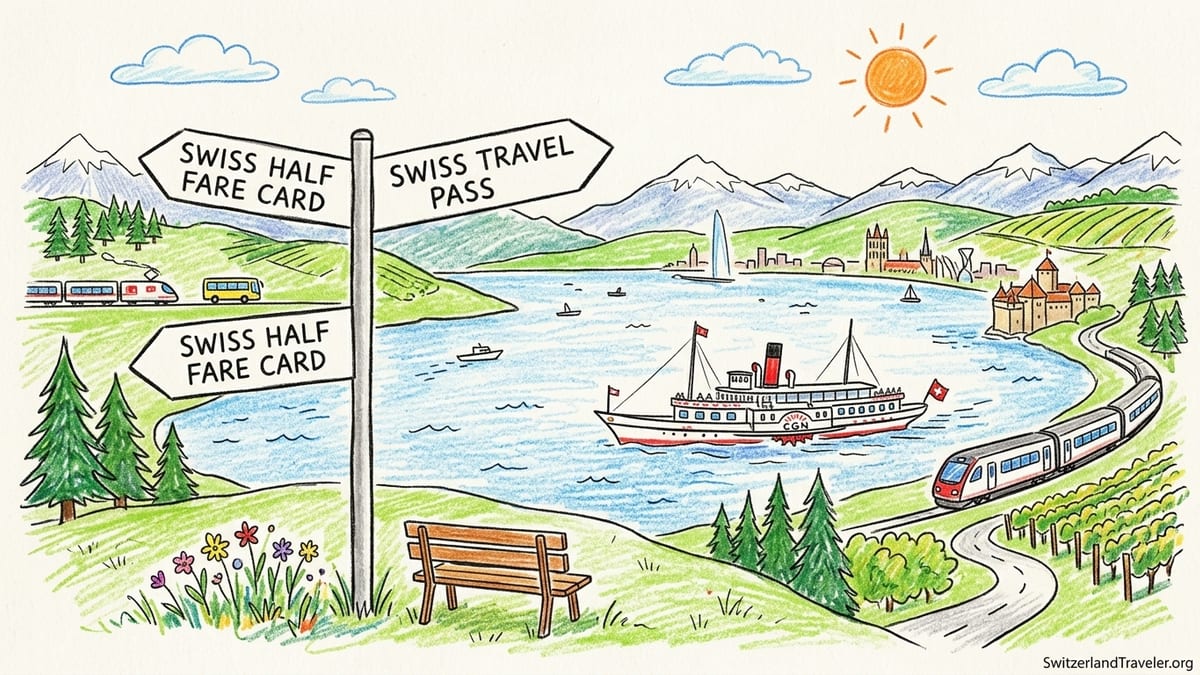
The Swiss Travel Pass is heavily marketed as the simple answer to riding Switzerland’s trains, boats and buses, but in 2026 it is also a serious investment. If you are focusing on Western Switzerland around Lake Geneva, you need more than glossy promises of “unlimited travel” to know if it is worth buying. This guide walks through real 2026 prices and sample itineraries for Geneva, Lausanne, Montreux, Lake Geneva boats, plus side trips to Fribourg, Gruyères and Neuchâtel, and shows when the Swiss Travel Pass wins or loses against point to point tickets and the Swiss Half Fare Card.
Key 2026 Prices You Need To Know Before You Do The Math
Any purchase decision starts with understanding what things actually cost in 2026. For visitors based around Geneva, Lausanne and Montreux, the most relevant national passes are the Swiss Travel Pass and the Swiss Half Fare Card. The official 2026 price for a standard adult 2nd class Swiss Travel Pass is around CHF 309 for 4 consecutive days and CHF 399 for 6 consecutive days, bought through SBB or official resellers. The tourist Swiss Half Fare Card, which gives 50 percent off almost all trains, buses, boats and many cable cars nationwide for one month, costs about CHF 150 per adult for 30 days of validity.
Point to point fares on the Lake Geneva corridor vary slightly by time of day and whether you can snag limited super saver tickets, but full flexible 2nd class one way fares give a solid planning baseline. In 2026 a typical one way from Geneva to Lausanne is around CHF 23 at full fare, Lausanne to Montreux about CHF 11, and Lausanne to Geneva Airport about CHF 25. Regional journeys such as Lausanne to Fribourg are usually in the CHF 25 range, Fribourg to Gruyères about CHF 12, and Lausanne to Neuchâtel roughly CHF 35 at full fare for a standard intercity route with one change in Yverdon.
Boats on Lake Geneva, operated by CGN, are where costs can rise quickly but are also where the Swiss Travel Pass shines. A simple short hop like Montreux to Vevey may be around CHF 15 at 2nd class adult standard fare, while a longer cruise from Lausanne Ouchy to Chillon Castle or even to Geneva climbs into the CHF 40 to CHF 60 bracket depending on distance and promotions. CGN day passes for unlimited boat travel on the lake typically sit somewhere around CHF 60 to CHF 70 in 2nd class. With these numbers in mind, it becomes much clearer how your travel style interacts with the upfront cost of a rail pass.
What The Swiss Travel Pass Actually Includes Around Lake Geneva
For travelers concentrating on Western Switzerland, it helps to strip the Swiss Travel Pass down to what really matters in this region. On the Lake Geneva arc between Geneva, Nyon, Lausanne, Montreux and beyond, the pass covers virtually all SBB mainline trains, regional trains and most local public transport. This means you can ride freely between cities, hop between lakeside towns, and use many city buses and trams in Geneva and Lausanne without ever buying an additional ticket as long as the pass is valid that day.
Crucially for a Lake Geneva trip, the Swiss Travel Pass includes free travel on regular scheduled CGN boats in 2nd class on Lake Geneva. You can treat the boats as floating buses for point to point hops such as Lausanne Ouchy to Evian, Vevey or Montreux, or spend a full day making a grand loop on the water without any extra ticket cost. If you are the kind of traveler who wants to do multiple boat journeys in one or two days, the value adds up quickly.
The pass also includes free admission to many museums, including several in Geneva and Lausanne. For instance, entry to major institutions like the Olympic Museum in Lausanne or the Red Cross and Red Crescent Museum in Geneva is covered. Each museum ticket on its own is usually in the CHF 15 to CHF 20 range, so if you tend to visit a museum most days, the pass recoups part of its price in cultural savings alone. However, those savings will not justify the pass if your train travel is otherwise light.
What the Swiss Travel Pass does not do in this region is deeply discount premium mountain railways and cable cars above cities like Montreux in a way that would radically change a Lake Geneva focused budget. Some mountain lifts provide 50 percent off with the pass, but serious mountain days are more common in the Bernese Oberland and Valais. Around Lake Geneva, the boats and city public transport are the main extras that shift the equation relative to simply buying tickets with or without a Half Fare Card.
Sample 4 Day Lake Geneva Itinerary: When The Pass Is Borderline
Consider a compact 4 day trip that many visitors follow. Day 1: Arrive in Geneva, train to Lausanne and short explore. Day 2: Lausanne to Montreux return, plus a boat ride to Chillon Castle and perhaps a hop to Vevey. Day 3: Lausanne to Gruyères via Fribourg and back in the afternoon or evening. Day 4: Lausanne to Geneva or Geneva Airport with a quick Geneva city tram ride before departure. This stays mostly within the region and squeezes in one countryside day.
Pricing this trip with full fare point to point tickets in 2nd class gives a rough picture. Geneva to Lausanne one way at about CHF 23, Lausanne to Montreux return about CHF 22, Lausanne to Gruyères and back via Fribourg roughly CHF 70 to CHF 75 in total, and Lausanne to Geneva Airport at around CHF 25. Boat rides could easily total around CHF 40 to CHF 60 if you do a substantial mid lake segment like Montreux to Lausanne Ouchy and one or two shorter hops. Add a couple of city tram or metro rides in Geneva and Lausanne, say CHF 8 to CHF 10 overall, and the four day total without any pass lands in the ballpark of CHF 190 to CHF 215 if you are measured about boat use, or CHF 230 to CHF 250 if you indulge more on the water.
Now compare that with a 4 day Swiss Travel Pass at CHF 309. If you follow this exact pattern, ride a reasonable amount of boats and visit perhaps two museums, the Swiss Travel Pass will be more expensive in pure cash terms, probably by CHF 50 to CHF 100. The pass starts to get closer to break even only if you add more rail distance, for example a day trip from Lausanne to Bern and back instead of just Gruyères, or if you spend a full long day on boats instead of a single mid lake cruise. In that expanded scenario, point to point tickets might rise to CHF 260 or more, at which point the Swiss Travel Pass premium buys you spontaneity rather than savings.
Introduce the Swiss Half Fare Card into this same 4 day itinerary and the calculation shifts. With the Half Fare Card, those same point to point tickets are roughly halved: Geneva to Lausanne about CHF 12, Lausanne to Montreux return about CHF 11, Lausanne to Gruyères via Fribourg and back closer to CHF 35, and Lausanne to Geneva Airport around CHF 13. Boat rides drop similarly, so instead of CHF 40 to CHF 60 you might pay CHF 20 to CHF 30 for a comparable set of cruises. Add local transport at half price and your four day transport spend with the Half Fare Card comes to roughly CHF 90 to CHF 120 in tickets plus the CHF 150 card itself, giving a realistic total near CHF 240 to CHF 270. That still often undercuts the CHF 309 Swiss Travel Pass, while remaining cheaper than paying everything full fare.
Stretching To 6 Days: Side Trips To Neuchâtel And Extra Boat Time
Many travelers expand a Lake Geneva stay to about a week. Imagine a 6 day plan built around Geneva, Lausanne and Montreux with two major side trips. Day 1: Geneva city plus train to Lausanne in the evening. Day 2: Lausanne and Lavaux vineyards, with multiple short train hops between Lutry, Cully, Epesses and Vevey, plus at least one boat segment. Day 3: Full day Lausanne to Neuchâtel and back with a lakeside walk. Day 4: Montreux and Chillon Castle day, mixing trains and boats. Day 5: Day trip to Gruyères via Fribourg. Day 6: Lausanne to Geneva or Geneva Airport with one final Geneva tram ride.
On full fare 2nd class tickets, long intercity segments add up quickly. Geneva to Lausanne around CHF 23, Lausanne to Neuchâtel return roughly CHF 70, Lausanne to Fribourg and Gruyères return about CHF 70 to CHF 75, and Lausanne to Geneva Airport approximately CHF 25. Add Lausanne to Montreux and back at about CHF 22, and several short regional hops along the Lavaux coast that might total CHF 20 to CHF 30 if bought individually. You can easily reach CHF 230 to CHF 260 in train fares alone before adding boats or city transport.
Boats and local transit for this 6 day journey could comfortably push the total to CHF 320 or more. A full day of intensive CGN boat use, if paid without any pass, can approach CHF 60 to CHF 70. Two or three shorter boat segments on other days might represent an additional CHF 30 to CHF 40. City buses and trams in Geneva, Lausanne and Montreux, while individually cheap, accumulate over several days. That makes a full fare total of something like CHF 350 to CHF 380 for transport if you travel actively most days and enjoy Lake Geneva by boat on at least one long day.
Compare that to a 6 day Swiss Travel Pass at CHF 399. In this scenario the Swiss Travel Pass often comes close to breaking even or wins slightly, especially if you live on the boats during your dedicated lake day, or add one more long rail journey such as a quick morning hop to Bern or a late afternoon trip along the Jura to Biel. Because every rail journey and CGN boat is fully included, you are not punished for extra spontaneity. The more you decide on the day to take another train or boat ride, the better the value becomes relative to buying tickets as you go.
Now insert the Swiss Half Fare Card. Halving those earlier estimates quickly reshapes the budget. Major train segments drop to perhaps CHF 115 to CHF 130 in total with half price, boat costs come into the CHF 45 to CHF 55 range for all days together if you replicate the same pattern of usage, and local transport settles into the CHF 15 to CHF 20 bracket at half price. That means you might spend roughly CHF 180 to CHF 210 on tickets on top of the CHF 150 Half Fare Card, creating a total cost of around CHF 330 to CHF 360. In an average 6 day Lake Geneva itinerary with a couple of long regional trips, the Half Fare Card often beats both the 6 day Swiss Travel Pass and paying full fare, unless you deliberately maximize boat and museum use every single day.
Adding Fribourg, Gruyères And Neuchâtel: Where The Half Fare Card Shines
The moment you add Fribourg, Gruyères and Neuchâtel to a Lake Geneva plan, you create exactly the kind of medium distance rail days that favor the Swiss Half Fare Card on cost. From Lausanne, a return journey to Fribourg plus the branch line to Gruyères already sits near CHF 70 to CHF 75 at full fare. That is just one day. Lausanne to Neuchâtel return may hover near CHF 70 at full fare as well, depending on timings and route. A traveler who does both trips within a single week has spent roughly CHF 140 to CHF 150 on these two days alone, without counting Geneva and Montreux segments.
With a Swiss Half Fare Card, each of those medium distance days can drop to closer to CHF 35 to CHF 40 in train tickets, which means both round trips together might cost only CHF 70 to CHF 80 in addition to the CHF 150 Half Fare Card fee. Layer on your Geneva to Lausanne and Lausanne to Montreux journeys at half price, plus half price on local transport and boats, and the effective discount over full fare typically surpasses the cost of the Half Fare Card by day four or five of active exploration.
The Swiss Travel Pass covers those same journeys in full rather than at half price, which means if you squeeze all of this travel into a 4 or 6 day block and travel hard every day, you can reach or surpass the pass cost. However, for many travelers the itinerary is not absolutely packed with train rides on each consecutive day. You might have a slower day in Lausanne in between major excursions, or spend a day in Geneva mostly on foot. Those quieter days dilute the value of a consecutive day pass but do not affect the month long Half Fare Card. That is where the flexibility of the Half Fare Card often produces better financial outcomes.
In practice, a visitor who plans at least three or four medium distance day trips from the Lake Geneva base cities within a month, such as Gruyères, Neuchâtel, Bern or even Zermatt, will usually recover the CHF 150 Half Fare Card cost and then enjoy genuine savings on every further train, bus and boat. A minimalist traveler who only shuttles between Geneva, Lausanne and Montreux once each way, and perhaps does Gruyères as a single extra excursion, may come closer to break even or even slightly lose on the Half Fare Card, particularly if staying just three or four days total in Switzerland.
When The Swiss Travel Pass Still Makes Sense Around Lake Geneva
Despite the strong numbers for the Swiss Half Fare Card, there are still cases where the Swiss Travel Pass is the better choice even for a fairly compact Lake Geneva itinerary. One scenario is the classic “no brainpower, no friction” trip where you anticipate dense sightseeing and do not want to think about tickets. If you expect to ride trains and boats multiple times a day, and frequently change plans at the last minute, the psychological value of showing your pass and walking on can outweigh small pure cost differences.
Another scenario is boat heavy travel. Suppose you plan to spend one full day moving almost entirely by CGN boats, plus several extra boat segments on other days between Geneva, Nyon, Yvoire, Lausanne, Vevey and Montreux. If your shipboard travel, priced individually, would approach CHF 120 or more over the course of your pass validity, and your trains add a similar amount, the Swiss Travel Pass at CHF 309 for 4 days or CHF 399 for 6 days can undercut both full fare tickets and a Half Fare Card plus tickets. This is especially true if your museum visits are frequent; three or four museums during pass validity might otherwise cost CHF 60 to CHF 80 on their own.
The pass also suits travelers who cluster big rail days together. For example, you might land in Geneva and immediately travel to Neuchâtel, then to Lausanne, then to Gruyères and back to Montreux over four consecutive days, followed by a break from big train journeys. Packaging this into a 4 day Swiss Travel Pass can be efficient, and you might then pay separately for any lighter days before or after. Conversely, if your big rail days are spread out across ten or eleven days in Switzerland, the Half Fare Card almost always wins.
Finally, convenience matters. A Swiss Travel Pass is a single QR code loaded once and presented at random inspections, on boats and at museum entries. For some people, particularly those traveling with children or older relatives, not having to validate which travelers have which cards in the SBB app every time they purchase a ticket is a real advantage. It does not show up on a spreadsheet, but it makes the travel experience smoother, especially in busy hubs like Geneva Cornavin and Lausanne during rush hours.
Decision Guide: How To Choose For Your Western Switzerland Route
For a Lake Geneva focused itinerary that includes Geneva, Lausanne, Montreux, Lake Geneva boats plus side trips to Fribourg or Gruyères and Neuchâtel, you can think of the choice in three simple steps. First, estimate how many long or medium distance train days you will have in Switzerland overall during a month, not only during four or six consecutive days. If the number is fewer than about three substantial days, passes are less likely to pay off and straightforward point to point tickets may be best, possibly supplemented by an occasional Saver Day Pass if you spot an attractive deal in the SBB app.
Second, if you count around three to six substantial travel days dispersed across more than a week, or you plan several medium distance excursions from a Lake Geneva base, the Swiss Half Fare Card usually becomes the financially strongest candidate. In this situation, the Swiss Travel Pass often costs more than the Half Fare Card plus half price tickets, unless your boat and museum usage is very high and concentrated. You also gain flexibility: your heavy rail days do not need to be consecutive, and a surprise detour to Bern, Vevey or even Interlaken can stay affordable because every ticket is automatically half price.
Third, if you foresee four to six extremely active consecutive days with multiple long rail trips and frequent CGN boat rides, and you prefer a simple all inclusive solution, the Swiss Travel Pass can be worth its price. For example, a 6 day spree that strings together Geneva, Lausanne, Neuchâtel, Fribourg, Gruyères, Montreux and a full day on Lake Geneva boats, plus two or three museum visits, is exactly the kind of usage pattern where the CHF 399 6 day pass either breaks even or pulls ahead. The more you hop on and off transport without worrying about cost, the more the pass earns its keep.
Whichever option you lean toward, treat the official 2026 prices as your starting point, then run a rough calculation using conservative estimates. If your realistic numbers are within CHF 20 or CHF 30 of each other, choose based on convenience and your tolerance for minor overspending in exchange for flexibility. If one option is clearly cheaper by CHF 50 or more, the decision is usually just as clear in practice.
The Takeaway
For a Western Switzerland itinerary built around Geneva, Lausanne, Montreux and Lake Geneva, with day trips to Fribourg or Gruyères and Neuchâtel, the Swiss Travel Pass is not automatically the best or worst deal in 2026. At CHF 309 for 4 days and CHF 399 for 6 days in 2nd class, it can be a smart buy if you pack consecutive days with long train rides, generous CGN boat use and several museum visits, or if the simplicity of an all in one pass is a top priority.
Yet for many travelers, especially those spreading their journeys over more than a week or mixing heavy and light travel days, the CHF 150 Swiss Half Fare Card plus half price tickets tends to deliver greater value. It usually undercuts both the Swiss Travel Pass and full fare point to point tickets on a Lake Geneva route that includes side trips to Fribourg, Gruyères and Neuchâtel, while preserving the freedom to change plans without worrying about which days are “pass days.”
Point to point tickets alone are worth considering for short stays of two or three days with limited regional travel and minimal boat use, particularly if you are comfortable checking for occasional Saver Day Pass offers. However, by the time you are planning three or more medium distance excursions in Western Switzerland, some form of pass almost always pays off.
The best strategy is to sketch your likely days, check current 2026 fares in the SBB app for key segments, estimate your likely boat usage, then compare those totals against the fixed prices of the Swiss Travel Pass and the Swiss Half Fare Card. A few minutes of arithmetic before you buy can easily save you the equivalent of a fine dinner along the shores of Lake Geneva, without sacrificing the views from the train windows and boat decks that make this region so rewarding to explore.
FAQ
Q1. Is the Swiss Travel Pass worth it if I only visit Geneva, Lausanne and Montreux?
It can be, but usually only if you ride trains and boats heavily for several consecutive days. For a short, simple trip with one or two train journeys and limited boat use, point to point tickets or a Swiss Half Fare Card plus discounted tickets often cost less than a 4 day Swiss Travel Pass.
Q2. How does the Swiss Half Fare Card work for a Lake Geneva itinerary?
The Swiss Half Fare Card is valid for one month and gives you about 50 percent off almost all trains, buses and boats. Around Lake Geneva this means half price on journeys like Geneva to Lausanne, Lausanne to Montreux, Lausanne to Neuchâtel, plus reduced fares on CGN boats and local trams, which can add up quickly if you plan several regional day trips.
Q3. Do I need a pass to use Lake Geneva boats between Lausanne, Vevey and Montreux?
No. You can always buy individual tickets or a day pass for CGN boats. A Swiss Travel Pass lets you ride regular scheduled boats in 2nd class without extra payment, while a Swiss Half Fare Card gives you reduced fares. If you only plan one or two short cruises, paying per trip can be cheaper than buying a rail pass just for the boats.
Q4. For a 6 day trip with side excursions to Gruyères and Neuchâtel, which option usually saves more?
In many 6 day Western Switzerland itineraries with a couple of medium distance day trips, the Swiss Half Fare Card plus half price tickets works out cheaper than a 6 day Swiss Travel Pass, unless you use boats and museums very heavily. The Swiss Travel Pass becomes more competitive if you stack big train and boat days back to back and travel intensively every day.
Q5. Can I combine a 4 day Swiss Travel Pass with point to point tickets on other days?
Yes. A common strategy is to use a 4 day Swiss Travel Pass for the busiest block of your itinerary, covering the heaviest train and boat days, then buy separate tickets at full or half price on lighter days before or after. This hybrid approach can keep total costs down while preserving a few days of all inclusive convenience.
Q6. How do museum discounts affect the decision in Western Switzerland?
The Swiss Travel Pass gives free entry to many museums, including major attractions in Geneva and Lausanne. If you visit several museums during your pass days, you effectively recover part of the pass price. With point to point tickets or a Half Fare Card, you pay normal museum admission, so heavy museum goers may find the Swiss Travel Pass more appealing.
Q7. What about Saver Day Passes on the SBB app instead of a rail pass?
Saver Day Passes can sometimes undercut both the Swiss Travel Pass and regular tickets if you buy early for fixed dates. However, they require you to commit in advance, availability is limited, and they do not include museum entry. They can be an excellent tool for one or two very long travel days within a wider itinerary built around the Swiss Half Fare Card.
Q8. Is 1st class worth paying extra for on Lake Geneva trains and boats?
On the busy Lake Geneva train corridor, 1st class offers a bit more space and a quieter environment but the journey time and scenery are identical. On CGN boats, 1st class often means access to upper decks or quieter lounges. For most value focused travelers comparing pass types, 2nd class is sufficient and keeps the cost of both passes and individual tickets lower.
Q9. Should couples or small groups make a different choice than solo travelers?
The math per person is the same, but couples and small groups might value simplicity more when moving together. A Swiss Travel Pass for each traveler can reduce the risk of one person buying the wrong ticket or forgetting to switch fare settings in the app. If everyone in the group travels at the same pace, a shared decision either for the Swiss Travel Pass or for the Half Fare Card usually works best.
Q10. When is it clearly not worth buying any pass for Western Switzerland?
If you are spending only two or three days in the Lake Geneva area, mostly staying within one city with perhaps a single return trip to another lakeside town and one short boat ride, the upfront cost of either the Swiss Travel Pass or the Swiss Half Fare Card is unlikely to pay off. In that case, buying simple point to point tickets for trains, boats and local transport is usually the most economical approach.