


Lavaux’s terraced vineyards between Lausanne and Vevey are one of Switzerland’s most rewarding wine regions to visit: steep stone-walled slopes falling into Lake Geneva, tiny wine villages, and crisp glasses of Chasselas in hand. Yet once you start planning, the options quickly multiply, from guided walking tours and cellar tastings to little vineyard trains such as Lavaux Express and Lavaux Panoramic, not to mention just exploring on your own. This guide compares the main ways to experience Lavaux today, with concrete examples of routes, prices and inclusions, to help you decide which kind of tour is worth paying for and where to start your day: Lausanne or Vevey.
Understanding Lavaux, Chasselas and the Wine Landscape
Lavaux is the ribbon of vineyards stretching for roughly 15 kilometres along the north shore of Lake Geneva between Lausanne and Vevey. Stone terraces climb up from the lakeside villages of Lutry, Cully, Rivaz and Saint-Saphorin to viewpoints above Chexbres and Chardonne, with the Alps rising on the French side of the water. The whole area is protected as a UNESCO World Heritage cultural landscape, which is why infrastructure is subtle and walking paths thread directly between the vines. For visitors, that means you often stand just metres from the grapes while trains and boats glide along the lake below.
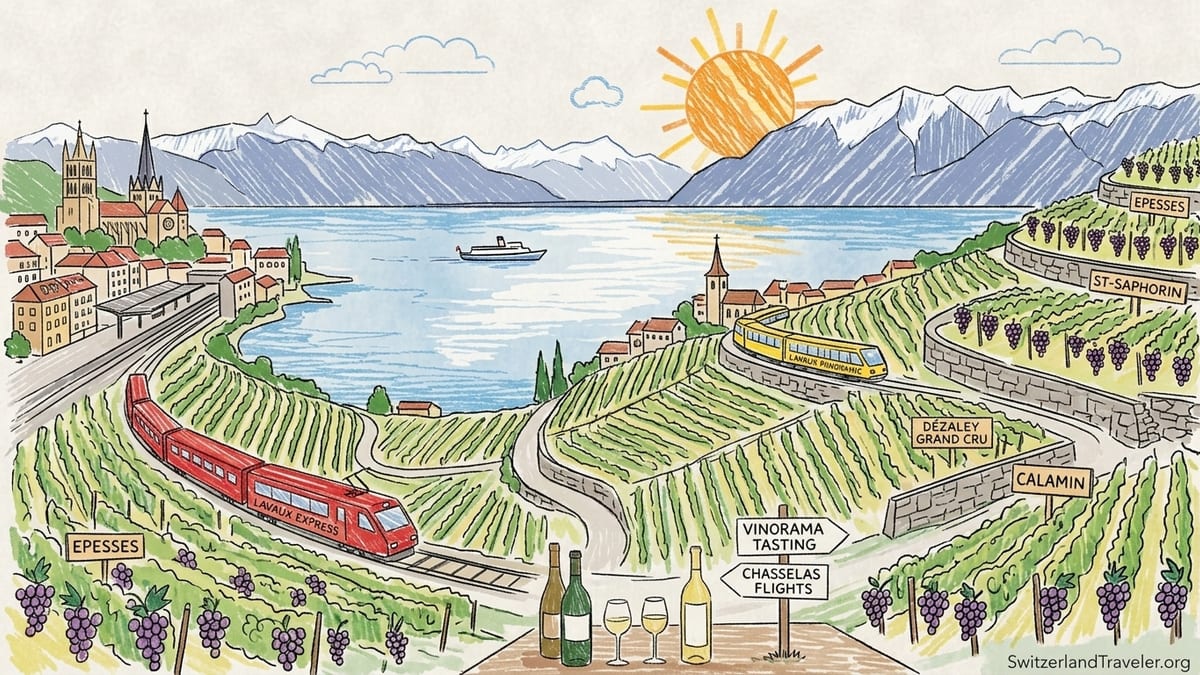
The dominant grape here is Chasselas, a light, pale white whose character shifts noticeably depending on slope, soil and exposure. You will see it labelled under local appellations such as Epesses, St-Saphorin, Dézaley or Calamin rather than “Chasselas” alone. In practice, that means a Lavaux tasting might feature three Chasselas wines that look similar in the glass but taste distinctly different: one delicate and floral, another more mineral and saline, a third with a richer texture from riper fruit or longer ageing on lees.
Chasselas is also the star of many structured tastings. At Lavaux Vinorama in Rivaz, for example, the entry “Chasselas” package currently offers three white Chasselas wines with bread and snacks from 17 Swiss francs per person, while more extensive flights add reds or Grand Cru bottles at higher prices. The centre presents around 300 regional wines, so it is one of the few places where you can sample across multiple villages and producers without making a string of individual appointments.
Beyond Chasselas, producers also bottle reds such as Pinot Noir and specialty varieties like Plant Robert, along with a scattering of aromatic whites and sweet wines. Most group tours and cellar visits will include at least one red in the line-up, but if you are specifically interested in Grand Cru Chasselas or unusual grapes, it is worth checking the tasting descriptions before you book.
Departing from Lausanne vs Vevey: Which Base Works Best?
Most visitors approach Lavaux from either Lausanne on the western side or Vevey and Montreux in the east. Both are well connected by regular Swiss Federal Railways services, and both offer straightforward access into the terraces, but the feel of your day can be quite different depending on your starting point.
From Lausanne, the classic approach is to take the short regional train east to Lutry, Cully or Grandvaux and then walk or ride the Lavaux Express vineyard train. Lutry has a pretty historic centre and small harbour, while Cully is particularly convenient because it sits at the heart of the vineyards with flat lakeside promenades and steep paths rising directly into the terraces. For example, you might travel Lausanne to Cully in under 15 minutes, stroll the waterfront, then join a Lavaux Express loop up through Riex and Epesses before dropping back for a lakeside dinner.
Vevey is a stronger starting point if you are attracted by the Lavaux Panoramic train and the eastern villages of Rivaz, Saint-Saphorin and Chardonne. The Lavaux Panoramic runs various themed routes, some departing directly from Vevey’s boat dock and others from stations such as Chexbres. A typical seasonal “heritage train” tour, for instance, departs Vevey mid-morning, climbs through the terraces with commentary and includes an apéro in the vineyards. Vevey also works well if you plan to combine Lavaux with Montreux or Chillon Castle on the same day.
In practical terms, Lausanne is slightly better if you are using Swiss Travel Pass day trips to bounce between city museums and the vines, while Vevey feels more like a dedicated vineyard base. Travel times between Lausanne and Vevey by train are only about 20 minutes, so you can also stay in one city and still choose tours that technically “depart” from the other.
Guided Walking Tours and Private Wine Experiences
Guided walking tours are the most informative and immersive way to experience Lavaux, especially if you are curious about geology, winemaking and the cultural history behind the terraces. Tourism offices in Lausanne, Vevey and Montreux promote seasonal guided walks where certified guides lead small groups between villages, often along sections of the Grand Traversée de Lavaux trail, with one or more tastings along the way. Prices vary, but half-day group tours with two or three wines commonly start around the higher double digits in Swiss francs, depending on duration and inclusions.
One typical format departing from the Lausanne side is a 2 to 3 hour afternoon walk from Cully or Grandvaux, with a guide explaining the dry-stone walls, irrigation systems and appellations, followed by a commented tasting either at a village cellar or in a simple vineyard hut. Departures from Vevey often emphasise the eastern appellations, for example a loop from Chexbres overlooking the “Balcony of Lavaux” above Saint-Saphorin, again with a tasting stop built in. On both sides, walking distances are usually moderate but the paths can be steep, with many stone staircases between terraces, so good footwear is essential.
Private or semi-private tours tend to be more flexible and can combine transport, walking and cellar visits into a full-day programme. Some local agencies, for instance, will pick you up in Lausanne or Vevey, drive to a village such as Epesses or Rivaz, lead a short walk, then arrange two or three pre-booked tastings at family wineries not normally open to drop-in visitors. Prices for these bespoke experiences can climb into the low hundreds of francs per person, particularly once generous pours, cheese boards or lunch are included.
Whether such a full guided tour is “worth it” depends on your priorities. If you value context, want to meet winemakers and feel unsure about navigating French-language websites to make appointments, a guide can save hours of planning. If you mainly want scenery and a glass or two of Chasselas, you may get similar enjoyment from mixing a vineyard train ride with a single pre-booked tasting at Vinorama or an open village cellar.
Cellar Tastings and Lavaux Vinorama: What You Actually Get
Lavaux’s cellars range from tiny vaulted spaces under village houses to modern tasting rooms with lake views. Outside major events such as the Canton of Vaud’s “Open Cellars” weekends, many producers host visitors only by prior appointment, and it is common for individual tastings to be charged or to expect a purchase in return. For travellers with limited time, centralised venues like Lavaux Vinorama in Rivaz simplify things considerably.
Lavaux Vinorama is a dedicated discovery centre built into the cliff just above Rivaz’s lakeshore. It showcases roughly 300 wines from across the entire Lavaux region, from multiple producers and appellations, and offers structured flights at transparent prices. Currently, the basic Chasselas tasting of three whites with bread and snacks starts at about 17 francs, while packages that add red wines, aromatic whites or a broader “expert” selection cost more. There is also a short documentary film about a year in the life of a Lavaux winegrower screened in several languages, which can be combined with tasting packages.
Vinorama’s advantage is breadth. In one sitting, you might taste a crisp young Dézaley, a more rounded Epesses and a delicate St-Saphorin, poured side by side and explained by staff who are used to international visitors. If you find a favourite, bottles are available to buy at the bar or shop, which is convenient if your schedule does not allow detours into individual estate cellars. Opening hours vary by season, but it typically runs from late morning through early evening several days a week, making it easy to fit around train and boat schedules.
By contrast, the Lavaux Express “Caveau Train” from Lutry shows how a cellar visit can be combined with transport. This evening service runs on selected days from spring to September, leaving Lutry’s pier at around 18:30 and climbing into the vineyards before stopping at a partner cellar for about 45 minutes of tasting. Adult tickets are around the high twenties in francs and include three wines plus a souvenir glass. For travellers staying in Lausanne, it is a neat way to access an authentic village cellar without worrying about driving back after a couple of glasses.
Lavaux Express and Lavaux Panoramic Trains: Scenic vs Immersive
The two best known vineyard trains in Lavaux are the Lavaux Express and the Lavaux Panoramic. Both are rubber-tyred tourist trains that look like mini locomotives pulling open or covered carriages, designed for slow scenic circuits through the vineyards. They are not part of the national rail system, so Swiss Travel Passes do not typically cover them, but base fares are relatively modest for the experience.
Lavaux Express operates primarily from Lutry and Cully, offering one-hour loops through villages such as Aran, Grandvaux, Riex, Epesses and Dézaley. A standard daytime ride without cellar visit starts at about 16 francs for adults, with discounts for teenagers and children. The focus is the landscape rather than wine: you sit comfortably while the little train winds up narrow vineyard roads that private cars are often discouraged from using, with lake and mountain views at every bend. Commentary is minimal or recorded, and any wine is usually extra unless you join a specific themed departure like the evening Caveau Train.
Lavaux Panoramic, by contrast, concentrates on the eastern half of Lavaux around Vevey, Corseaux, Chexbres, Rivaz and Saint-Saphorin. It offers several themed tours, from short scenic loops to special “heritage” or “Brisolée” trains that include guided visits and food. Current public experiences start from around the mid-twenties in francs for simple tours, with more elaborate options such as a combined vineyard ride and meal costing more. Some departures include a glass of wine or full apéro, while others are purely scenic, so it is important to read the specific tour description when you book.
Both trains are easy to reach by regular rail. For Lavaux Express, travellers typically ride a mainline train from Lausanne to Lutry or Cully and walk a few minutes to the pier or station square where the tourist train departs. For Lavaux Panoramic, the main hubs are Vevey’s boat dock and Chexbres station. The biggest difference is the level of commentary and inclusion: Lavaux Express is simple and flexible, ideal if you want to hop off after the ride for a self-guided walk, while Lavaux Panoramic aims for richer storytelling on certain routes, sometimes with a guide on board and a drink or tasting included.
Self-Guided Vineyard Walks: Freedom, Costs and Walking Difficulty
Self-guided walking is the most economical and flexible way to experience Lavaux and is perfectly feasible thanks to clear signage, frequent mainline trains, and villages every kilometre or two. A common route is to take the train to Cully, then follow the marked vineyard paths through Riex and Epesses towards Rivaz or Saint-Saphorin, dropping back down to a lakeside station when you are ready. Walking between Cully and Rivaz via the terraces can take about 1.5 to 2 hours at a relaxed pace, without counting stops for photos or tastings.
The main challenge is steepness rather than distance. Short sections can be strenuous, with stone staircases and ramps linking terraces that climb several hundred metres above the lake. Paths are often paved or gravel but can be uneven. In hot weather the sun reflects off the stone walls and can make midday walking tough, especially for families. A sensible approach is to walk one direction gently downhill, for example starting in Grandvaux or Chexbres and dropping to Cully or Rivaz, then using the regular trains to get back uphill or back to Lausanne or Vevey.
Costs on a self-guided day can be kept low. Train fares between villages are modest, and there is no admission fee to walk the paths. You pay only for tastings, snacks and transit to and from the region. A simple example: Lausanne to Cully and back by train, plus a Chasselas tasting at Vinorama in Rivaz and perhaps a glass of wine at a lakeside café, might keep your total below the price of a structured full-day tour, while still delivering the iconic vineyard views.
The trade-off is that you need to take responsibility for timing, route-finding and cellar access. Many small producers list visiting hours only on their own noticeboards or regional tourism sites, and outside special open-door events you may find doors closed if you arrive without a reservation. This is where combining a self-guided walk with a fixed-point venue such as Vinorama or a train tour that guarantees at least one tasting can provide a good balance.
Is a Full Lavaux Wine Tour Worth Paying For?
Whether to invest in a full guided tour or piece together your own day depends on your budget, mobility and how deeply you want to engage with the wines themselves. A structured group tour that includes transport from Lausanne or Vevey, a guided walk, two tastings and possibly snacks will typically cost several times more than a simple self-guided visit plus one or two tastings. However, for many first-time visitors, the added context and saved logistics are genuinely valuable.
If you are short on time, travelling without mobile data, or nervous about French-language signage, a tour takes the stress out of catching trains and finding trailheads. Guides can also answer specific questions about Chasselas styles, explain why a Dézaley Grand Cru commands higher prices than a basic Epesses, and introduce you directly to winemakers. On a rainy or very hot day, having a minivan on standby between stops can make the experience much more comfortable than walking exposed paths.
On the other hand, if your priority is simply to see the terraces, take photographs and enjoy one focused tasting, the combination of a vineyard train and Vinorama or an open cellar may suit you perfectly. For example, you might ride Lavaux Express from Cully in the late morning, walk downhill into the village after the loop, then take the mainline train a couple of stops to Rivaz for an afternoon Chasselas flight at 17 francs. Including train tickets, this can still come in under the cost of many guided options, while giving you a sense of independence and time to linger where you like.
In practice, many visitors find a hybrid approach works best: one structured experience such as a Lavaux Panoramic heritage train or an organised walking tour, plus some unhurried self-guided time in the vines. If you have two or three days in Lausanne or Vevey, reserving one afternoon for a paid tour and another for casual rambling allows you to enjoy both depth and freedom.
Practical Tips: Train Access, Timing and Booking Strategies
Lavaux benefits from excellent public transport. The main railway line linking Lausanne, Vevey and Montreux has stops all along the foot of the terraces, including Pully, Lutry, Cully, Epesses, Rivaz, Saint-Saphorin and Vevey. Higher up, Chexbres-Village station sits above the vines and connects to Vevey via a short branch line, making it a popular starting point for downhill walks. Trains on these routes usually run at least twice an hour during the day, and travel times between villages are often under 10 minutes.
For vineyard trains, it is important to check seasonal schedules. Lavaux Express typically runs from spring to late autumn, with specific days and hours for each loop and for the evening Caveau Train. Lavaux Panoramic also operates mainly in the warmer months, with different themed departures scattered across the season, some tied to one-off events in September or October. Seats on special departures that include meals or heritage commentary can sell out, so advance booking is strongly recommended.
Cellar and tasting bookings also deserve some planning. Lavaux Vinorama accepts both walk-ins and reservations, but groups or those wanting a particular package at a specific time should reserve ahead, especially on summer weekends. Small independent wineries generally expect appointments, which can be arranged by email or phone; local tourism offices can sometimes help coordinate if you prefer not to contact producers directly. If you are visiting during open cellar events, you may be able to buy a tasting pass that grants you samples at multiple producers in one day, but these events are busy and will largely replace routine private visits.
Allow generous margins between train connections, tastings and walks. It is easy to underestimate how often you will stop for photographs or how slow certain staircases feel on a hot afternoon. As a rule of thumb, planning only one structured activity with a fixed start time per half day, such as a specific vineyard train or guided walk, leaves you freer to improvise the rest of your itinerary depending on weather and mood.
The Takeaway
Lavaux offers a spectrum of wine experiences, from simple self-guided walks framed by lake and mountain views to curated tours that unlock hidden cellars and pour carefully chosen flights of Chasselas. Lausanne and Vevey both make excellent bases: Lausanne gives easy access to Lutry, Cully and the Lavaux Express, while Vevey connects naturally with Lavaux Panoramic and the dramatic eastern terraces above Rivaz and Saint-Saphorin. Chasselas itself is subtle, so tasting it side by side in structured flights, whether at Lavaux Vinorama or during a guided tour, helps reveal why locals treasure it as much as they do.
In deciding whether to pay for a full tour, weigh how much you value explanation, guaranteed tastings and logistical comfort against the freedom and lower cost of exploring on your own. A vineyard train ride starting around the mid-teens to mid-twenties in francs, plus a focused tasting from about 17 francs, can already deliver a memorable half-day in the terraces. Add good shoes, a charged camera and respect for the vines, and Lavaux will reward you whether you arrive by heritage train, guided group or a simple local commuter service hugging the lake.
FAQ
Q1. Is it better to start a Lavaux wine day from Lausanne or Vevey?
Both work well. Lausanne gives quicker access to Lutry and Cully plus the Lavaux Express, while Vevey is closer to Lavaux Panoramic and eastern villages like Rivaz and Saint-Saphorin. Because trains between Lausanne and Vevey take around 20 minutes, you can also stay in one city and still use tours that formally depart from the other.
Q2. How difficult are the vineyard walks in Lavaux?
Distances are moderate but paths are often steep, with many stone steps between terraces. Expect short, sometimes strenuous climbs rather than long flat walks. Starting from higher stations like Chexbres or Grandvaux and walking downhill to lakeside villages such as Cully or Rivaz reduces the effort, but good footwear and sun protection are important.
Q3. Do Lavaux Express and Lavaux Panoramic tickets include wine tastings?
Not always. Standard daytime Lavaux Express loops focus on scenery and do not include wine by default, though special departures like the evening Caveau Train bundle in three wines and a souvenir glass. Lavaux Panoramic offers themed tours, some of which include a glass of wine or apéro, while basic scenic rides may not. Always check the exact tour description when booking.
Q4. What does a Lavaux Vinorama tasting typically include?
Lavaux Vinorama in Rivaz offers structured flights of regional wines. Entry-level options start around 17 francs for three Chasselas wines with bread and snacks, while more elaborate packages add reds or Grand Cru selections at higher prices. The venue showcases around 300 Lavaux wines, making it easy to compare different appellations in one sitting without multiple cellar appointments.
Q5. Is a guided Lavaux wine tour worth paying for?
It can be, especially if you want deeper understanding, guaranteed cellar access and minimal logistics. Guided tours often combine transport, a vineyard walk and one or more tastings, which is helpful if you are short on time or not comfortable arranging visits in French. If you mainly want landscape views and a single tasting, a self-guided day with a vineyard train and Vinorama or an open cellar may offer better value.
Q6. Can I visit small Lavaux wineries without a reservation?
Some village cellars open for walk-in tastings at posted hours, but many producers receive visitors only by appointment outside major events. It is safest to contact wineries in advance by email or phone, or to rely on centralised tasting venues and organised tours if you prefer not to plan individual visits. During open cellar festivals you can usually drop in freely, but these are specific weekends rather than daily occurrences.
Q7. How do I reach Lavaux’s vineyards by public transport?
Regular Swiss Federal Railways trains run between Lausanne, Vevey and Montreux, stopping at stations such as Pully, Lutry, Cully, Epesses, Rivaz and Saint-Saphorin. From these, signposted paths lead directly into the terraces. Chexbres-Village station, reached by a branch line from Vevey, sits high above the vines and is a popular starting point for downhill walks. Vineyard trains like Lavaux Express and Lavaux Panoramic depart from places such as Lutry, Cully, Vevey and Chexbres.
Q8. What should I wear and bring for a Lavaux wine day?
Wear sturdy walking shoes with good grip, as paths can be steep and uneven. In warm weather, lightweight clothing, a hat, sunglasses and sunscreen are essential because the terraces are exposed and stone walls reflect heat. Bring water, especially if you plan longer walks between tastings, and a light jacket for changing conditions near the lake. A small backpack for purchased bottles can also be useful.
Q9. Are Lavaux wine experiences suitable for children or non-drinkers?
Yes. Children and non-drinkers often enjoy the scenery, trains and lakeside villages even without tasting wine. Vineyard trains welcome families, with reduced child fares and the option to skip alcohol. On guided tours, non-drinkers can usually request grape juice or soft drinks in place of wine, though it is polite to mention this when booking so hosts can adapt the experience.
Q10. How far in advance should I book Lavaux tours and tastings?
For peak summer weekends and special vineyard train departures that include meals or heritage commentary, booking several weeks ahead is sensible. Lavaux Vinorama and many group walking tours can often be reserved a few days in advance, but popular time slots may fill quickly in high season. If you are organising private cellar visits or a bespoke guided day, contact providers at least a couple of weeks before your trip to secure preferred dates and times.