


Few wine regions in Europe pack as much variety, scenery and easy transport into such a small area as French-speaking Switzerland. From the UNESCO-listed terraces of Lavaux above Lake Geneva to the sun-soaked slopes of Valais around Sion, you can taste elegant Chasselas, powerful Valais reds and crisp alpine whites often within a couple of hours of each other. Better still, you can do it largely by train, boat and on foot, without a designated driver. This guide compares the main wine areas of Romandie and explains how to build wine days that balance tasting, walking and culture.
Lavaux: UNESCO terraces and the heartland of Chasselas
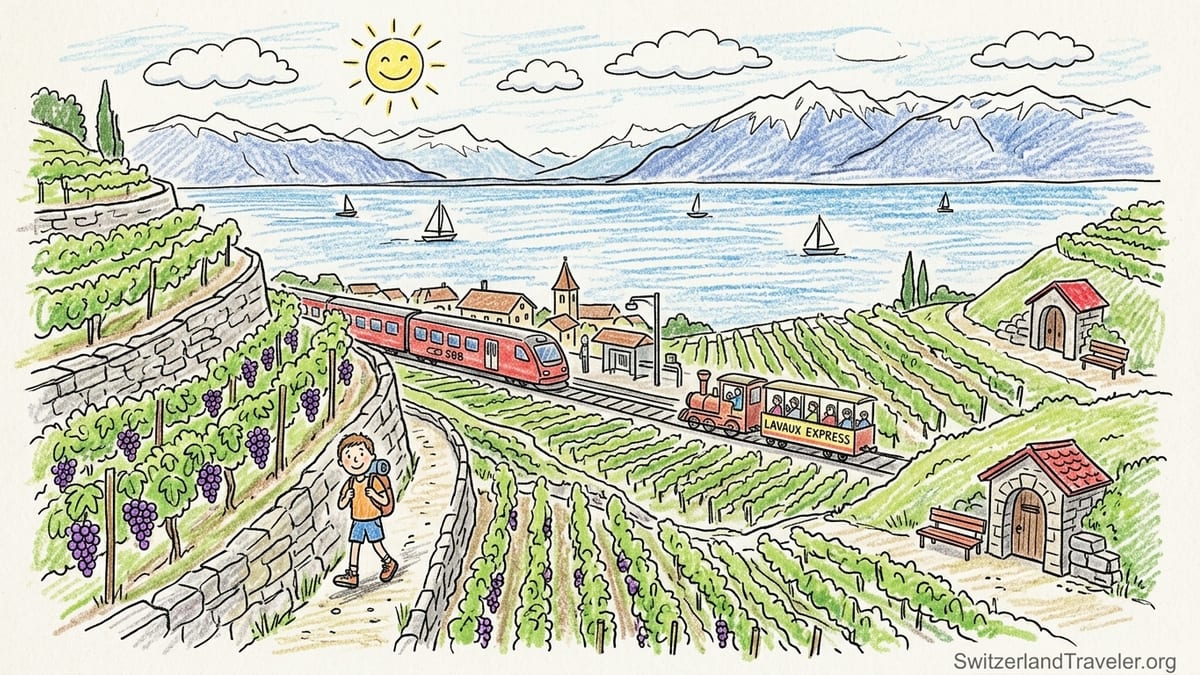
Lavaux is the name that appears on postcards and bucket lists, and for good reason. Between Lausanne and Montreux, more than 800 hectares of steep terraces drop towards Lake Geneva in sweeping arcs, with stone walls, narrow paths and tiny cellar doors tucked between the vines. Since 2007 these vineyard terraces have formed a UNESCO World Heritage site, recognized as a cultural landscape shaped over nearly a thousand years. The signature grape here is Chasselas, producing pale, dry whites that are subtle rather than showy, often with notes of white flowers, stone fruit and a delicate mineral finish.
For visitors, Lavaux is unusually easy to explore without a car. Regional trains run at least hourly, usually more often, between Lausanne and Vevey or Montreux, with stops at stations such as Lutry, Cully, Epesses and Chexbres-Village. A common day-trip pattern is to ride up to Chexbres-Village, walk for 60 to 90 minutes down through the terraces to Cully or Rivaz, then return along the lake by train or boat. The paths are clearly marked and involve frequent views over the water to the French Alps, but also steps and uneven ground, so light hiking shoes are better than city sneakers.
Guided experiences are well established in Lavaux if you prefer someone else to handle logistics and introductions. Small tourist trains such as the Lavaux Express from Cully or the Lavaux Panoramic from Lutry offer one to two hour loops through the terraces, sometimes including stops at viewpoints and short tastings en route. Some operators run themed outings, such as heritage trains visiting the Chasselas Conservatory near Rivaz followed by an aperitif of local wines and charcuterie. Expect to pay roughly what you would for a short lake cruise in Switzerland, with tastings and snacks adding a supplement on top.
Independent tastings are very feasible if you are willing to plan. Many producers operate small cellar rooms, or caveaux, in villages like Epesses, Dézaley, Riex and St-Saphorin. Some are open only one or two afternoons per week or by reservation, others keep more regular hours in summer. A practical approach is to choose a base village like Cully, check its tourist office listing of open cellars for your date, and design a loop that links two or three within walking distance. Because pours are typically generous in Switzerland, it pays to share tasting flights if you are visiting several cellars and to drink tap water regularly as you walk.
La Côte: lakeside villages and relaxed cellar visits
West of Lausanne, the La Côte appellation stretches from roughly Morges past Rolle to Nyon, along gentle slopes between Lake Geneva and the Jura. It lacks Lavaux’s vertiginous drama but compensates with a softer, more rural feel, dotted with castles, orchards and farmhouses. Chasselas is again important here, but you will also encounter more Pinot Noir, Gamaret and Garanoir, plus occasional plantings of aromatic whites like Pinot Gris or Viognier. Many estates are family-run, and cellar visits feel more like dropping in on a working farm than a polished tourist experience.
La Côte is well suited to travelers who enjoy mixing wine with lakeside strolls and small-town browsing. Trains run frequently between Lausanne and Geneva, stopping at Morges, Rolle and Nyon, from where local buses or 20 to 40 minute walks bring you to villages such as Féchy, Mont-sur-Rolle or Tartegnin. In Mont-sur-Rolle, for example, you might walk uphill from the station for half an hour through vines to reach a family estate overlooking the lake, where a tasting of three or four wines could cost about the same as a glass of wine in a city bar. Some domaines offer cellar tours explaining pressing and barrel aging before you taste.
Organized wine tourism products in La Côte have grown in recent years, often coordinated by regional tourism bodies. Experiences range from simple “wine and cheese at the farm” evenings to more inventive options like wine-themed escape games among the barrels in Tartegnin or curated cellar discovery visits at estates above Mont-sur-Rolle, where a grower leads you through the cellar then pours several cuvées paired with local charcuterie. Seasonal open-cellar weekends see dozens of producers in Nyon district throwing open their doors; a modestly priced tasting pass typically gives you a tasting glass and access to multiple cellars linked by shuttle buses or signposted walking routes.
Compared with Lavaux, La Côte feels less crowded and slightly less formal. Cellars may close at midday or keep irregular hours outside summer, so calling ahead or emailing is often necessary, especially if you want to visit on a weekday morning or in winter. On the plus side, winemakers often have more time to talk. You might find yourself sampling a vertical of Chasselas from different parcels overlooking the lake, or comparing a light, fruit-forward Pinot Noir aged in stainless steel with a more structured cuvée that has spent a year in oak.
Geneva vineyards: Mandement villages on the city’s doorstep
Many visitors see Geneva as a cosmopolitan city of banks and international organizations, but within 20 minutes by train you can be walking between vines. The main vineyard area for Geneva wines lies in the Mandement region around villages such as Satigny, Russin, Dardagny and Peissy, northwest of the city. Satigny alone has several hundred hectares of vines, making it one of the largest wine-growing communes in Switzerland, and the landscape mixes rolling vineyards with small woods and farm tracks that are ideal for half-day walks.
Reaching these vineyards without a car is straightforward. From Geneva’s main station, regular suburban trains run to Satigny in under 15 minutes. From there, signposted footpaths lead uphill in 10 to 20 minutes to viewpoints over the “Geneva bowl”, with lines of vines stretching towards the French border and the Saleve mountain in the distance. Local buses also connect to Dardagny and Russin. Many estates cluster around village cores, so you can spend an afternoon walking a loose circuit between two or three cellars, returning to the station on foot or by bus.
Geneva’s vineyards showcase a broad palette of grapes. Chasselas is present, but you will also taste Chardonnays with subtle oak, crisp Sauvignon Blanc, and reds based on Gamay, Pinot Noir and blends including Gamaret and Garanoir. A number of estates have modern, architect-designed cellars that double as event spaces, while others remain more traditional. During the canton’s annual Caves Ouvertes, usually held in late spring, a low-cost tasting pass typically covers transport on the regional network and a souvenir glass, allowing you to ride shuttle buses from cellar to cellar all day without driving.
Guided tours around Geneva’s vineyards tend to be more bespoke than in Lavaux. Some local companies offer half-day e-bike tours through Satigny and the surrounding slopes, stopping at one or two estates for tastings and snacks, while private guides can combine a morning in the old town with an afternoon among the vines. If you prefer independence, it is still wise to reserve tastings directly, particularly outside event days. Many Geneva producers operate on a “shop plus tasting” model, where you buy a bottle or two to enjoy back in the city after sampling small pours at the counter.
Valais around Sion: heroic vineyards and immersive wine experiences
Head east along the Rhône by train and the character of French-speaking Switzerland’s wine country changes. Around Sion, capital of Valais, vineyards cling to incredibly steep, south-facing slopes, criss-crossed by stone walls and historic irrigation channels known as bisses. Here Chasselas appears but does not dominate. Instead you will encounter Valais specialty grapes like Petite Arvine, with its grapefruit and saline notes, Amigne with its honeyed character, and reds such as Cornalin and Humagne Rouge that produce deep, spicy wines.
Sion has invested heavily in structured wine tourism that weaves together heritage, food and tasting. The Sion & Wine Tour is a flagship example: a half-day guided walk through the old town, usually offered from two participants upwards, that includes tastings of five local wines, a Valais platter of cured meats and cheese, and access to three historic sites that are normally closed to the public, such as the Sorcerers’ Tower or Roman baths. Prices are broadly in line with other Swiss guided walking tours once you factor in the food and wine included. For travelers short on time, this single product offers a compact introduction to both the city’s history and its wines without needing to seek out individual cellars.
Beyond the city itself, purpose-built wine centers offer deeper immersion in the landscape. A short bus or train ride from Sion brings you to the Celliers de Sion complex, a modern visitor center shared by two major local producers and backed by dramatic terraced vineyards. From here, guided “gatehouse tours” lead you on foot up into the vines, stopping at traditional stone shelters where you taste multiple wines accompanied by Valais raclette, platters of dried meat or fondue. Walking times vary from a gentle one-hour loop to more strenuous three-hour routes climbing the terraces, but all return to the base where you can browse the wine shop or watch short films on Valais viticulture.
Independent travelers can also explore the slopes around Sion and nearby villages such as Sierre, Salquenen or Chamoson on waymarked vineyard trails. Many wineries accept visitors by appointment, especially for small groups. Because producers here often work with rarer grape varieties and old vines planted on steep parcels, tastings can feel like mini masterclasses in alpine wine. Expect to pay a bit more per bottle than in some Vaud regions, particularly for limited-production cuvées of Petite Arvine or Cornalin, but entry-level blends and Fendant, the local name for Chasselas, remain accessible.
Chasselas versus Valais varieties: what you will be tasting
Understanding the key grape varieties helps make sense of how these regions differ in the glass. In Lavaux and La Côte, Chasselas is the undisputed star. Often labeled simply as “Chasselas” or under local designations like Dézaley, Epesses or Féchy, it is usually vinified dry, with moderate alcohol, soft acidity and delicate aromatics. Rather than bold fruit, expect subtle notes of pear, white flowers and fresh bread crust, with a slight spritz in some young wines. Chasselas is traditionally served as an aperitif or with lake fish, fondue and raclette.
In Geneva, Chasselas appears alongside more international grapes, acting almost like a bridge between Vaud and Valais styles. A tasting flight might start with a Chasselas, move to a barrel-aged Chardonnay and then to reds made from Gamay or Pinot Noir. The result is a broader stylistic spread but slightly less focus on a single, emblematic grape. Visitors who already know Burgundy or Beaujolais often find it easier to relate Geneva wines to those benchmarks, while Chasselas remains a discovery.
Valais around Sion tells a different story. Here Chasselas is often labeled Fendant and is typically lighter and crisper than some Vaud examples, suited to pairing with dried meats and mountain cheese. Many visitors, however, come specifically to taste indigenous or long-established varieties. Petite Arvine stands out for its vivid acidity and often saline edge, especially when grown on high terraces. Amigne can range from off-dry to sweet, with honey, citrus and sometimes beeswax notes. Among reds, Cornalin tends to be deeply colored and spicy, while Humagne Rouge can offer rustic tannins and dark fruit. Tasting these side by side with a classic Chasselas flight from Lavaux brings the contrast between regions into sharp focus.
Practically, this means planning your days according to your interests. If you want to dive deep into the nuances of Chasselas across different slopes and villages, focus your time on Lavaux and La Côte, where producers often offer multiple bottlings from specific parcels. If your priority is discovering grapes you rarely see outside Switzerland, build at least one full day around Sion, combining a structured tour with independent tastings. Either way, remember that Swiss wine servings are generous and alcohol levels can be significant, especially for sun-soaked Valais reds, so pace yourself with food and water.
Guided tours versus independent tastings
Choosing between guided and independent experiences shapes not only how you taste but how much you can relax. Guided tours, whether in Lavaux, Geneva or Valais, typically package together transport, commentary and a set number of wines, sometimes with food. In Sion, for instance, the Sion & Wine Tour combines a guided city walk with five tastings and a Valais cold-cut platter, plus entry to historical sites. In Lavaux, tourist trains such as Lavaux Express or Lavaux Panoramic often include at least one glass of local wine at a scenic stop, with commentary about the UNESCO landscape.
The obvious advantage of guided options is that you do not have to worry about navigation or who will stay sober enough to drive; they are inherently designed around public transport or walking. They also tend to include background on history, geology and grape varieties that can be hard to piece together alone, especially if you do not speak French or German. For first-time visitors or those with only a day or two in the region, a guided product can provide a solid foundation, after which you might feel more confident arranging your own cellar visits.
Independent tastings, by contrast, offer maximum flexibility and often more direct contact with growers. In La Côte, you might email an estate above Rolle to arrange a late afternoon visit, then time your train so you can walk up through the vines in golden hour, tasting for an hour before descending to the lakeside for dinner. In Geneva’s Mandement villages, you could pick two cellars in Satigny reachable on foot and craft your own walking loop between them. Costs can be lower per tasting than on organized tours, especially if you buy a bottle or two to take away.
The trade-off is that independent visits require more planning and, in some cases, language skills. Websites may not always be updated in English, and smaller producers can be fully occupied during harvest or bottling. It is wise to keep a printed or downloaded list of cellars with phone numbers, and to remain flexible if someone needs to shift your appointment by an hour. For many travelers, a hybrid approach works best: book one or two structured tours that cover transport and background, then sprinkle in a handful of independent cellar appointments where logistics are simple.
Moving between vineyards without a car
One of the greatest strengths of French-speaking Switzerland as a wine destination is its public transport. Trains, buses and boats are coordinated on a single timetable, and most vineyards described here sit within a few kilometers of a station or bus stop. In Lavaux, the backbone is the railway running along the lake, with local stopping trains serving Lutry, Cully, Epesses (sometimes via nearby Puidoux-Chexbres), Rivaz, St-Saphorin and Vevey. From these stops, signed footpaths climb directly into the terraces. On summer weekends, lake boats operated by local companies call at villages such as Cully and Rivaz, letting you combine a short cruise with a vineyard walk.
In La Côte, the main Lausanne–Geneva rail line serves Morges, Rolle and Nyon, while local buses push uphill into vine-covered villages. For example, from Rolle station you can take a bus partway up towards Tartegnin or walk roughly 30 minutes through fields and vineyards. Similarly, from Nyon buses reach Féchy and other wine villages, with services typically running at least once an hour during the day. If you purchase a regional day pass or hold a Swiss Travel Pass, you can usually hop on these trains and buses without buying individual tickets each time.
Geneva’s suburban rail network makes its vineyards among the most accessible in Europe. Regular trains from the main station call at Satigny in under 20 minutes, and from there most estates can be reached on foot within half an hour along country lanes. Buses layered on top of this serve Russin, Dardagny and nearby hamlets. During major wine events such as the canton-wide open-cellar day, extra shuttle buses typically operate between villages and estates so that visitors can taste freely without worrying about driving.
Valais vineyards around Sion may look more rugged, but they are still well linked by public transport. Intercity or regional trains bring you into Sion station, and from there local buses fan out along both sides of the Rhône and up into the side valleys. Many vineyard walks, including those starting from Celliers de Sion, begin within a 10 to 20 minute bus ride from the station, followed by an uphill walk on signposted paths. Because services may be less frequent in the evening, it is important to check your last bus or train in advance and plan tastings earlier in the day rather than late at night.
Walking through the vines and avoiding a designated driver
If your goal is to avoid a car entirely, the combination of walking and public transport is your friend. In Lavaux, iconic itineraries like Chexbres-Village to Cully or Grandvaux to Lutry follow well-maintained paths with plenty of opportunities to stop at benches or viewpoint terraces. Elevation changes can be significant, especially when you descend from the top of the terraces to lake level, so build in time for breaks and bring a small daypack with water, sun protection and a light jacket. Since many cellar doors lie right on or just off these paths, you can structure your day around one morning walk, lunch at a village café and one or two afternoon tastings.
In La Côte and Geneva, slopes are gentler and distances between villages slightly longer, so think in terms of two to three hour countryside walks linking stations. A feasible plan might be to take a morning train from Lausanne to Morges, walk along the lake and into the vineyards above the town for a cellar visit, then continue on foot or by bus to another village before circling back to the rail line. Around Satigny, loops through the Mandement often combine field paths, small woods and long views over the vineyards, with plenty of spots to pause for a picnic. In both cases, choosing one main tasting stop mid-walk, then perhaps one lighter stop at the end, keeps the day enjoyable without overdoing the alcohol.
In Valais, vineyard walks tend to be shorter in distance but tougher in elevation. Some itineraries from Celliers de Sion involve climbing steep paths and steps between terraces, which can be demanding in hot weather. Guided experiences there solve some of the logistical challenges by integrating rest stops at stone gatehouses where you sit, taste a few wines and sample local dishes before continuing. If you are walking independently, be realistic about your fitness and account for how wine tasting might make you feel on the descent. As in other regions, the safest strategy is to plan wine stops after the steepest sections of your hike rather than right at the start.
Public transport also plays a crucial role in avoiding the need for a designated driver at the end of the day. Because trains in Vaud and Valais often run at least hourly until late evening on main routes, you can usually schedule a final tasting that finishes an hour or two before your last train and enjoy a leisurely dinner in a village or town afterwards. If you are staying in cities like Lausanne, Geneva or Sion, many hotels provide local transport cards that include buses and some regional trains, which further simplifies car-free movement between vineyards and accommodation.
The Takeaway
French-speaking Switzerland offers a rare combination of world-class wine landscapes, compact distances and excellent public transport. Lavaux remains the flagship, with its UNESCO-listed terraces, dense network of cellar doors and ready-made tourist trains and walking routes centered on Chasselas. La Côte and Geneva’s Mandement region offer quieter, more rural experiences where you can combine lakeside towns and soft hills with relaxed tastings at family estates. Around Sion in Valais, dramatic “heroic” vineyards and a strong focus on indigenous grapes translate into structured wine experiences that blend history, hiking and generous food.
Planning your trip around trains, boats and well-marked footpaths makes it easy to taste broadly without a car or designated driver. Guided products such as Lavaux’s panoramic trains or Sion’s wine tours provide an accessible entry point and help you understand the context behind the wines, while independent cellar visits allow you to dig deeper into particular villages, styles or grapes. Whether you spend a single day walking between terraces above Lake Geneva or a week hopping from Lavaux to La Côte, Geneva and Sion, the region rewards slow travel, curiosity and a willingness to explore both the famous and the quietly local.
FAQ
Q1. Do I need a car to visit the main wine regions in French-speaking Switzerland?
You do not need a car. Lavaux, La Côte, Geneva’s vineyards and Valais around Sion are all accessible by train and bus, with many cellar doors a short walk from stations. Tourist trains in Lavaux and guided tours in Sion further reduce the need for private transport.
Q2. When is the best time of year to plan wine tours in these regions?
Late spring to early autumn is ideal, roughly May to October, when vineyard paths are dry, cellar doors keep longer hours and lake boats operate regular services. Harvest time in September can be especially beautiful, though some small producers may be busy and require advance reservations.
Q3. How much should I budget for a day of wine touring without a car?
Allow for regional train and bus tickets or a day pass, a guided tour or a couple of tastings, and food. A realistic range might be the cost of a Swiss regional day ticket plus one paid tour or two independent tastings, depending on how many wines are included and whether you buy bottles to take home.
Q4. Can I visit cellars in Lavaux or La Côte without a reservation?
Some cellar doors operate fixed opening hours, especially on weekends in high season, but many smaller estates prefer or require reservations. It is wise to check regional tourism listings for “open cellars” on your chosen day and to contact any specific producers you hope to visit in advance.
Q5. What should I wear for walking through the vineyards?
Wear comfortable closed shoes with a decent grip, such as light hiking shoes or sturdy sneakers, and dress in layers suited to the season. In summer, sun protection is essential, as many paths are exposed, and a small backpack for water, a light jacket and any wine purchases is practical.
Q6. Are tastings in Valais very different from those in Lavaux?
Yes. In Valais, especially around Sion, tasting flights often highlight local varieties like Petite Arvine, Amigne, Cornalin and Humagne Rouge alongside Fendant, the local name for Chasselas. In Lavaux, tastings focus more heavily on different expressions of Chasselas from specific villages or slopes.
Q7. Are guided wine tours suitable for travelers who do not speak French or German?
Many guided tours in Lavaux and Sion offer departures in English or multilingual commentary, particularly in high season. When booking, check the tour description or ask the provider which languages are available on your chosen date.
Q8. Can I ship Swiss wines home from these regions?
Some larger producers and visitor centers can arrange international shipping to certain countries, while smaller estates may not. International shipping from Switzerland can be costly, so many travelers choose to buy a few bottles to take in their luggage, respecting airline weight limits and customs rules at home.
Q9. How physically demanding are the vineyard walks?
Difficulty varies by region. Lavaux and Valais involve steeper paths and steps, which can be challenging for those with limited mobility. La Côte and Geneva’s vineyards tend to be gentler, with more rolling terrain. Checking route length and elevation in advance helps you match walks to your fitness level.
Q10. Is it necessary to tip during tastings or on guided tours?
Tipping is not mandatory in Switzerland, as service is included in prices, but rounding up the bill or leaving a small extra amount for excellent service is appreciated. For guided tours, offering a modest cash tip to a guide who has gone above and beyond is a courteous gesture rather than an obligation.