


Eastern Switzerland is where the gentle pre-Alps roll down to Lake Constance and the Rhine, dotted with baroque abbeys, painted medieval towns and farms that still make cheese the traditional way. For first-time visitors, this compact region can feel like a puzzle of smaller areas and transport lines. This guide explains the overall geography, how to move around by train, car, boat and on foot, and what to expect in the key subregions before you choose a base.
Understanding Eastern Switzerland’s Geography
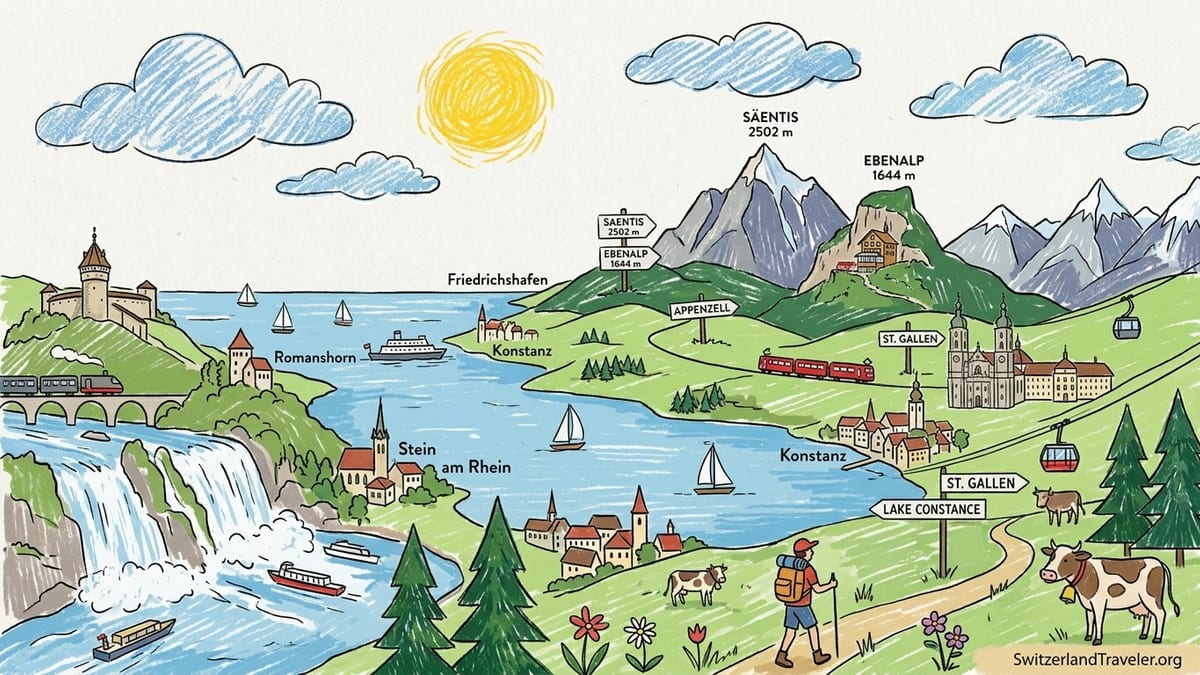
Eastern Switzerland, as promoted by Switzerland Tourism, stretches from the German border at Schaffhausen and the Rhine Falls along Lake Constance across to St. Gallen, Appenzell and the Alpstein mountains, then south toward Toggenburg and the small canton of Glarus. It is more rolling green hills than sharp high Alps, although the Alpstein and Glarus Alps provide plenty of rugged scenery. On a clear day you can stand on Säntis or Ebenalp and see the glint of Lake Constance to the north and major Alpine chains to the south.
For trip planning, imagine three north–south bands. On the northern edge sit Schaffhausen, the Rhine Falls, Stein am Rhein and the Swiss shore of Lake Constance in Thurgau. In the middle, St. Gallen anchors a belt of small towns and farmland leading into Appenzellerland and the Toggenburg valley. Further south, the mountains rise more steeply around the Sernftal and Linth valleys of Glarus. Distances are short: a direct train from Zurich to St. Gallen usually takes about an hour, and Schaffhausen is roughly 45 minutes from Zurich by rail, which makes Eastern Switzerland ideal for hub-and-spoke itineraries.
Because the region is knitted together by dense public transport, you rarely need to commit to one base. You might spend three nights in St. Gallen without a car and still make easy day trips to Appenzell, the Rhine Falls and Lake Constance. Alternatively, drivers can link the same sights in a relaxed loop, for example Zurich to Schaffhausen, Stein am Rhein, along the southern shore of Lake Constance to Romanshorn, then inland to St. Gallen and Appenzell before returning via Glarus. Understanding this layout will help you choose whether to stay by the river, the lake, a city or in the countryside.
Schaffhausen, Rhine Falls and Stein am Rhein
The Schaffhausen area forms the western gateway to Eastern Switzerland and is dominated by the Rhine. Schaffhausen itself is a small riverside city with oriel-windowed townhouses and the circular Munot fortress above the roofs. Just a few minutes away by local train or bus, the Rhine Falls thunder over a broad rock step. Marketed as Europe’s most powerful waterfall, the falls are easily reached on foot from Neuhausen Rheinfall station, with well-developed viewpoints and optional boat rides that nose close to the spray.
Most first-time visitors combine Schaffhausen and the Rhine Falls with the medieval town of Stein am Rhein. Trains or boats wind downriver to Stein, where half-timbered houses and vividly painted facades line a compact old town square. A common day-trip pattern is to depart Zurich mid-morning by train to Schaffhausen, visit the falls around midday, then continue to Stein am Rhein for a late-afternoon stroll and dinner before returning to Zurich in the evening. This works smoothly by public transport because regional trains along the Rhine typically run at least once an hour.
Travelers with more time can slow down in Schaffhausen’s wine country. Gentle slopes north of town, close to the German border, are covered in vineyards, and small tasting rooms welcome visitors by prior arrangement. In summer, local outfitters rent canoes and stand-up paddle boards for quiet sections of the Rhine upstream from the falls, which contrasts with the busy viewpoints at Neuhausen. Accommodation here ranges from simple guesthouses in Stein am Rhein’s side streets to business-style hotels in Schaffhausen that often discount prices on summer weekends when business travel dips.
Thurgau, Lake Constance and Shoreline Cruises
East of Schaffhausen the Rhine widens into the western arm of Lake Constance, shared with Germany and Austria. On the Swiss shore, the canton of Thurgau offers low-key lakeside towns such as Kreuzlingen, Romanshorn, Altnau and Uttwil. Trains run close to the lake, so it is easy to step off at a small station, walk a few minutes to the water and find a grassy swimming area or lido. In warm weather locals bring picnics, while casual restaurants serve simple fish dishes and salads at outdoor tables right by the shore.
Passenger boats and ferries knit Lake Constance together. For example, the ferry between Romanshorn in Switzerland and Friedrichshafen in Germany operates roughly hourly throughout the year, carrying both foot passengers and vehicles. In the main season, additional excursion boats run along the Swiss shore between ports such as Romanshorn and Kreuzlingen, with some continuing across to German resort towns or to the flower island of Mainau. It is straightforward to combine train and boat on a single day ticket, using the train out and a late-afternoon cruise back as the sun drops behind the hills.
The lake area is well suited to travelers who want gentle activity rather than high-altitude drama. Flat cycle paths link lakeside villages, orchards bloom in spring, and many farms open seasonal stands selling apples, berries and local cider. Accommodation is often in small family-run hotels or B&Bs rather than big resorts. A practical pattern for first-timers is to base in a town like Romanshorn or Kreuzlingen for two nights, take a half-day cruise, then continue by train inland to St. Gallen for urban sightseeing and onward connections.
St. Gallen and Its Urban Gateway Role
St. Gallen is the most important city in Eastern Switzerland and a natural transport hub. Intercity trains from Zurich usually reach St. Gallen in about an hour, many continuing toward Lake Constance or deeper into Eastern Switzerland. The compact old town spreads uphill from the station, dominated by the twin towers of the baroque cathedral and the Abbey District, a UNESCO World Heritage site. Inside the abbey library, wood-paneled galleries and painted ceilings provide one of the country’s most atmospheric historic interiors.
As a base, St. Gallen offers several advantages. Public transport fans can use it as a spoke for day trips to Appenzell via the scenic narrow-gauge railway, to Rorschach on Lake Constance for a lakeside walk, or even back to the Rhine Falls. Hotels range from modern business properties near the station to characterful boutique hotels inside old burgher houses. Prices vary by season, but travelers often find that a centrally located four-star hotel in St. Gallen costs less than similar accommodation in Zurich, especially on weekends.
The city has a long textile and embroidery tradition, still visible in museum collections and in the façades of former merchants’ houses. Cafés and restaurants have a lived-in, local feel, catering as much to students and office workers as to tourists. For a first-time visitor, a full day is enough to see the Abbey District, wander the car-free alleys and enjoy an evening meal before heading onward. If you plan several excursions into Appenzellerland and along Lake Constance, two or three nights here create an efficient and comfortable base.
Appenzellerland, Säntis, Ebenalp and Rural Traditions
South of St. Gallen the landscape rises gradually into Appenzellerland, one of Switzerland’s most traditional rural regions. The small town of Appenzell, with its brightly painted houses and intricate eave decorations, serves as the cultural heart. Surrounding hills support dairy farms that produce Appenzeller cheese, and visitors can tour show dairies to watch curds being stirred in copper vats and taste finished wheels. Festivals and local processions often feature farmers in traditional costume, and in autumn the ceremonial descent of cattle from high pastures remains a highlight.
Above the rolling hills, the Alpstein massif rises abruptly, culminating at Säntis, which reaches more than 2,500 meters in elevation. Several cable cars, including to Säntis and Ebenalp, give straightforward access to viewpoints and ridge paths. On Ebenalp, many travelers walk the short, dramatic path to the cliff-hugging Berggasthaus Aescher, a rustic mountain inn that has become famous through travel magazines and social media. Hiking options range from easy one- to two-hour circuits between cable car stations to demanding full-day traverses that connect multiple peaks and alpine lakes.
Public transport makes reaching these mountains surprisingly simple. A typical itinerary might see you ride the Appenzeller Bahnen from St. Gallen to Wasserauen in around an hour, ascend to Ebenalp by cable car, walk to Aescher for lunch, then wander back via scenic paths to the valley and return to St. Gallen for the evening. Appenzellerland’s network of narrow-gauge trains, postbuses and on-demand shuttles allows flexible one-way hikes, so you can descend in a different valley and still reach a train station without difficulty.
Accommodation in Appenzellerland ranges from village hotels in Appenzell itself to basic but atmospheric mountain inns reachable only on foot or by cable car. Staying a night in a Berggasthaus can be especially rewarding in summer, when the evening light empties the trails and cowbells echo across the slopes. For first-time visitors who want to taste traditional rural Switzerland without venturing into very high or glaciated terrain, two or three nights around Appenzell, combined with a day in St. Gallen, make a well-balanced introduction.
Toggenburg and the Quiet Valleys
Southwest of St. Gallen, the Toggenburg valley follows the upper Thur River between the Churfirsten peaks and lower hills towards Wil. This area receives fewer international visitors than Appenzell but offers similar pastoral scenery, with scattered farmhouses, small villages and green slopes rising to rocky ridges. In winter local ski areas attract families, while summer brings hikers and mountain bikers who prefer quieter trails and village guesthouses over major alpine resorts.
Access is straightforward by regional train along the valley floor, with stations such as Wattwil, Nesslau and Wildhaus serving as starting points for hikes or bus connections to higher hamlets. From some points in Toggenburg, you can look across toward the Alpstein and Säntis, so it is entirely possible to combine a Säntis cable car ride one day with a gentler valley walk the next without changing hotels. Public transport timetables are generally built around hourly patterns, which makes spontaneous planning easy: if you miss one train, another will often follow in about an hour.
Accommodation in Toggenburg skews towards modest three-star hotels, bed-and-breakfasts and rented apartments, with prices often a little lower than in Appenzell or directly on Lake Constance. Traditional restaurants serve hearty dishes such as cheese-based specialties and local sausages. For travelers considering self-drive itineraries, the main valley road allows unhurried progress, with regular viewpoints and picnic spots. Toggenburg can work as a base if you want a single, peaceful location within range of both St. Gallen and the eastern Alps.
Glarus, Mountain Valleys and Alpine Character
The canton of Glarus lies further south and has a more distinctly alpine feel than the rolling hills around Lake Constance. Steep walls frame the Linth and Sernftal valleys, and small towns such as Glarus, Ennenda and Elm cling to narrow valley floors. Geology enthusiasts are drawn to the nearby Glarus thrust fault, part of a UNESCO World Heritage site, but even casual visitors notice the dramatic layers of rock visible on high cliffs. Compared with Appenzell, Glarus feels more rugged and less polished, with a working industrial history and fewer international visitors.
From Zurich, fast trains travel along the main route toward Chur, with regional branches into Glarus and Linthal. Journey times from Zurich to the town of Glarus are usually around an hour and a quarter, so it remains a viable day trip from big-city bases. Once in the valleys, postbuses and small cable cars lead to high meadows and lakes such as Klöntalersee, where sheer walls plunge into greenish water. Hiking routes vary from family-friendly lakeside strolls to demanding alpine ascents that should only be attempted with appropriate experience and equipment.
Accommodation options in Glarus are more limited than around Lake Constance or Appenzell, which is part of the charm for those seeking quiet nights and starry skies. Small hotels, simple inns and mountain huts dominate, and advance booking is advisable in high summer and during autumn foliage season. For first-time travelers who want one or two days that feel distinctly alpine but do not have time to reach Graubünden or the Bernese Oberland, Glarus can provide that sharper mountain atmosphere within manageable travel times.
Trains, Driving, Hiking and Choosing a Base
Eastern Switzerland is one of the easiest parts of the country to explore without a car. Intercity trains link Zurich, Winterthur, St. Gallen and Lake Constance, while regional lines fan out to Schaffhausen, Stein am Rhein, Appenzell, Toggenburg and Glarus. In practice, a first-time visitor can ride from Zurich to the Rhine Falls in under an hour, then continue by train and boat to Stein am Rhein and Lake Constance, and finally arrive in St. Gallen the same evening on a single sequence of connections. Many visitors use nationwide travel passes to simplify these combinations, especially during several consecutive days of touring.
Driving can be useful for families or travelers wanting to stay in farmhouses or small villages away from train lines. Roads are generally well maintained, parking is clearly signed in towns such as Schaffhausen and St. Gallen, and lakeside roads in Thurgau allow leisurely itineraries from one swimming spot or café to the next. However, city centers and major sights like the Rhine Falls charge for parking, and in peak summer some mountain roads and village centers can feel congested at midday. Mixing modes works well: you might drive to a cable car base station, park, then rely on lifts and public transport for the remainder of the day.
Hikers will find that Eastern Switzerland offers every level of effort. Around Lake Constance and in the rolling hills of Thurgau, paths follow rivers and orchards with minimal elevation gain, perfect for families or relaxed walkers. In Appenzellerland and Toggenburg, signposted trails climb from villages to panoramic meadows and back, with many routes serviced by cable cars or chairlifts that shorten the ascent or descent. In Glarus and the higher parts of the Alpstein, steep and sometimes exposed mountain paths demand sturdy footwear, a head for heights and attention to weather forecasts, particularly in shoulder seasons when lingering snow can block passes.
When choosing a base, first-timers should think in terms of atmosphere. St. Gallen suits those who want an urban center with easy rail links and cultural sights. Appenzell or a nearby village appeals to travelers seeking traditional architecture and quick access to cable cars and farm tracks. A lakeside town in Thurgau is ideal if you plan to swim, cycle and take boat rides, while Schaffhausen works as a one- or two-night stop focused on the Rhine. Glarus and Toggenburg best fit repeat visitors or those who prize quiet, rural surroundings over a wide range of restaurants. Because travel times are short, you can comfortably combine two contrasting bases within a week-long trip.
FAQ
Q1. Is Eastern Switzerland a good region for a first trip to the country?
Yes. Distances are short, public transport is frequent and the main sights, from the Rhine Falls to Appenzell and Lake Constance, are easy to combine without rushing.
Q2. Where should I base myself if I do not plan to rent a car?
St. Gallen is an excellent base without a car, with frequent trains to Zurich, Lake Constance, Appenzell and even Schaffhausen, plus a historic old town to explore in the evenings.
Q3. How much time do I need for the Rhine Falls and Stein am Rhein?
A full day from Zurich or St. Gallen is enough to see the falls, take a short boat ride if desired, and stroll the medieval streets of Stein am Rhein before returning.
Q4. Are lake cruises on Lake Constance included in Swiss rail passes?
Many national or regional rail passes offer either free or discounted travel on certain Lake Constance boat routes, but coverage varies, so it is wise to check the current conditions when planning.
Q5. Is hiking in Appenzell suitable for beginners?
Yes. While the Alpstein massif has serious alpine routes, there are many beginner-friendly trails near cable car stations such as Ebenalp, Kronberg and Hoher Kasten, with clear signposting.
Q6. What is the best season to visit Eastern Switzerland?
Late spring through early autumn is ideal for most travelers, with green hillsides, operating lake boats and cable cars, and generally stable hiking conditions at moderate elevations.
Q7. Do I need to book accommodation far in advance?
In July, August and during major local events, booking several weeks ahead is sensible, especially for popular spots around Appenzell, St. Gallen’s old town and lakeside towns on Lake Constance.
Q8. Is it worth renting a car for this region?
A car can be convenient for reaching remote valleys and farm stays, but it is not essential. Most first-time visitors manage comfortably with trains, buses, boats and cable cars.
Q9. Can I visit Glarus as a day trip from Zurich or St. Gallen?
Yes. Trains from Zurich reach Glarus in roughly an hour and a quarter, and with careful planning you can include a short hike or a visit to a nearby lake before returning.
Q10. Are traditional Swiss customs still visible in Eastern Switzerland?
Very much so. In Appenzellerland and rural Thurgau you may encounter seasonal cattle processions, local music, and small cheese dairies that still work much as they did decades ago.