


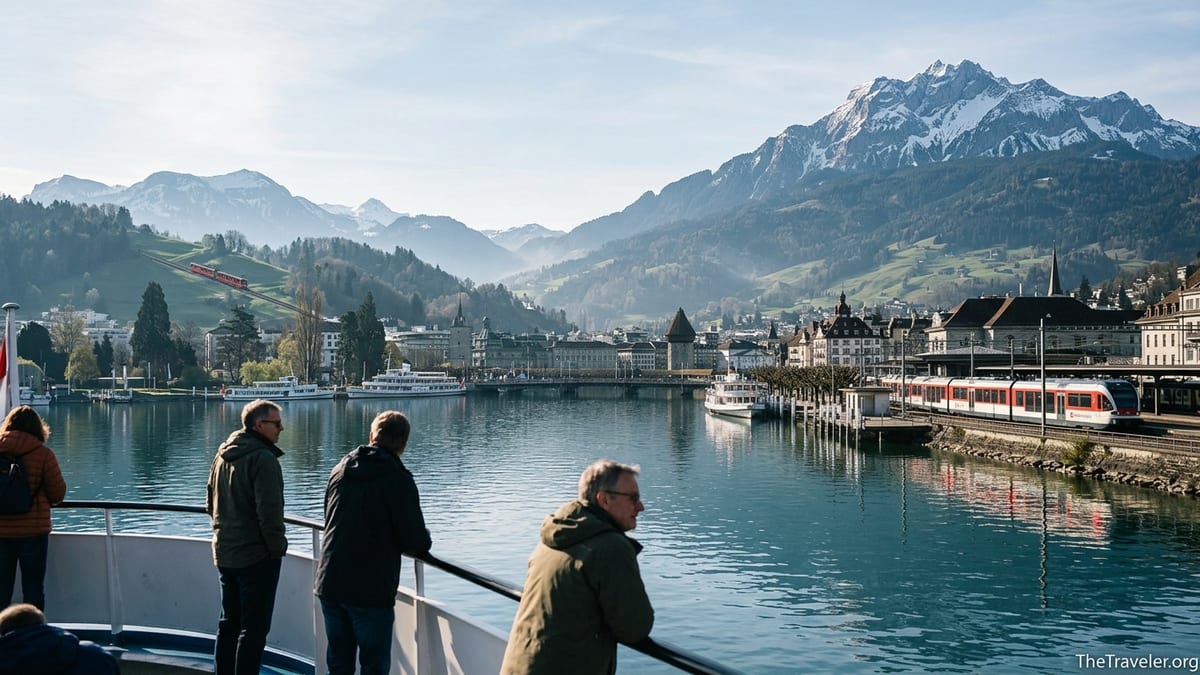
Snow-dusted peaks, glassy lakes and tidy medieval towns are the signature of Central Switzerland. Less obvious, until you arrive, is how astonishingly easy it is to explore all of it without ever getting behind the wheel of a car. With dense train, boat, bus, cable car and mountain railway networks radiating from Lucerne, you can reach high alpine viewpoints, tiny lakeside chapels and silent traffic-free villages using nothing more than a public transport pass and a timetable app.
Why Central Switzerland Is Perfect Without a Car
Central Switzerland may look remote on a map, but it is one of Europe’s most public-transport-friendly mountain regions. Lucerne is less than an hour by direct train from Zurich Airport, and from Lucerne’s compact station and lakeside piers you can fan out by train, boat and bus to Engelberg, Mount Rigi, Pilatus, Stoos and dozens of small lakeside settlements. Many of the mountain destinations, such as Rigi and Stoos, are in fact car free, so trains and cableways are not just convenient but the only practical way in.
For most visitors the easiest approach is to use integrated tickets and passes rather than buying each ride separately. The national Swiss Travel Pass covers regular trains, buses and boats throughout the region and grants free or discounted rides on mountain railways and cable cars. In Central Switzerland specifically, the Tell-Pass and Rigi or Pilatus combination tickets can dramatically simplify planning and give predictable costs for a full day or several days of intensive sightseeing without a car.
In day-to-day terms, travelling without a car here means thinking in connections and timetables rather than parking spaces. A typical summer day could start on the Luzern–Engelberg Express, continue on the Titlis Xpress gondola to 3,000 metres, return to Lucerne by mid afternoon, then continue by boat across Lake Lucerne for dinner in Weggis before a final evening train back to your hotel. Everything runs to predictable schedules, and stations, piers and valley terminals are clearly signposted, making transfers straightforward even for first-time visitors.
Language barriers are minimal. Timetables, ticket machines and announcements are reliably bilingual or trilingual, staff are used to helping visitors, and almost every route can be planned using one national journey planner app. The result is that not only is a car unnecessary, in peak season it can actually be slower and more stressful than simply stepping on board the next train or boat.
Key Transport Passes and How to Choose
Before diving into specific routes, it is worth understanding the passes that can make car free travel in Central Switzerland substantially easier. The Swiss Travel Pass, sold in durations such as three, four or eight consecutive days, covers almost all regular trains, boats and postbuses nationwide and includes free entry to many museums. In the Lucerne region it also offers free or 50 percent discounted travel on several mountain routes, which can noticeably reduce the cost of big-ticket days such as Pilatus or Rigi.
The regional Tell-Pass focuses specifically on Central Switzerland and is available for a set number of days in summer and winter versions. It offers unlimited travel on most boats across Lake Lucerne, the Luzern–Engelberg Express, numerous cable cars and mountain railways including Pilatus and Rigi in the higher season. For example, a three-day summer Tell-Pass typically makes sense if you plan to combine Pilatus, Rigi and Engelberg–Titlis within a short stay, because you avoid buying separate mountain tickets that can individually cost the equivalent of a substantial day tour.
For visitors basing themselves mainly in Lucerne who want one or two mountain days, targeted combination tickets can be more economical. The Golden Round Trip ticket on Pilatus, for instance, bundles the boat from Lucerne to Alpnachstad, the cogwheel railway to Pilatus Kulm, the aerial cableway and gondola down to Kriens, plus the connecting city bus back to Lucerne in a single price. Likewise, Rigi Railways offer day passes that allow unlimited rides on their cogwheel trains from Vitznau and Arth-Goldau and the cable cars from Weggis and Kräbel, which can be excellent value if you intend to mix summit visits with lakeside stops.
If you are arriving with children or plan to stay for a week or more, consider how family and half-fare reductions fit into your plans. Many Swiss residents use the Half Fare Travelcard, which halves most transport prices; tourists can buy a temporary version called the Swiss Half Fare Card. Children under a certain age accompanied by a parent with a suitable pass often travel free or at a steep reduction. Checking these details before you buy can noticeably reduce the overall cost of exploring the region without a car.
Lucerne: The Ideal Public Transport Base
Lucerne works as the natural hub for a car free trip in Central Switzerland. Its main railway station is directly beside the old town and across the road from the piers for Lake Lucerne boats. Within a few minutes’ walk you can reach hotels, the Chapel Bridge, the KKL concert hall and the departure point for city buses heading to local cable car terminals at Kriens and to neighbouring lakeside communities. This means you can step off a morning intercity train from Zurich and, with only a short walk, be boarding a boat or mountain railway minutes later.
For accommodation, travellers relying on public transport generally do best staying in or very close to the old town, the station or the lakefront. Mid range examples include modern hotels immediately opposite the station, which are especially convenient if you plan early starts for Engelberg or return late from lake cruises. Smaller boutique properties inside the medieval walls appeal to those who want character while remaining within a ten-minute walk of almost every boat or bus you are likely to use.
On arrival, one of the most useful habits is to pick up or download the current boat and mountain railway timetables. A simple practical example is planning a Pilatus day: you might choose the 9:38 morning boat from Lucerne to Alpnachstad, timed to meet a late morning cogwheel departure, then schedule a descent so that you can catch an afternoon bus back from Kriens to Lucerne in time for dinner on the riverfront. Having these connections in mind lets you relax and enjoy the views without constantly checking your watch.
Lucerne is also where you will most easily find information desks for the main mountain operators. The tourism office near the station can advise on weather conditions at altitude, which is important before committing to an expensive day trip. It is common for visitors to adjust plans one day at a time, for example swapping an Engelberg–Titlis glacier excursion for a Rigi hike if cloud cover is forecast, all done by simply choosing a different train from the same central station.
Classic Mountain Excursions by Rail and Cable
Among all the mountain options reachable without a car, four stand out for most visitors: Pilatus, Rigi, Titlis above Engelberg, and the car free plateau of Stoos. Each combines a scenic train journey from Lucerne with one or more mountain railways or cable cars, making them perfect showcases for travelling in Central Switzerland entirely on public transport.
Pilatus is Lucerne’s signature local mountain, rising more than 2,000 metres above sea level. The Golden Round Trip that many visitors choose typically starts at Lucerne boat pier, where you board a lake steamer or motor vessel to Alpnachstad. From there the world’s steepest cogwheel railway climbs to Pilatus Kulm in around 30 minutes, with gradients of up to 48 percent. After time on the summit walkways and viewing terraces, you descend towards Kriens using a large aerial cableway followed by smaller gondolas, then return by city bus directly to Lucerne station.
Mount Rigi, sometimes called the Queen of the Mountains, is reached by historic cogwheel trains and lakeside cable cars. One popular car free itinerary begins with a boat journey from Lucerne to Vitznau, where the Rigi cogwheel railway starts directly beside the pier. In about half an hour the train climbs through meadows and small hamlets to Rigi Kulm for sweeping views over Lake Lucerne and the surrounding peaks. Many visitors then descend as far as Rigi Kaltbad and switch to the cable car to Weggis, walking a few minutes downhill to the lake for a boat connection back to Lucerne.
Engelberg and Titlis provide an accessible high alpine experience that feels surprisingly close to the city. The direct Luzern–Engelberg Express operated by Zentralbahn covers the journey from Lucerne to Engelberg in about 43 minutes, with wide windows and views of lakes and river valleys along the way. In Engelberg you stroll or take a short bus ride to the Titlis valley station, then ride a series of cableways, including the Titlis Xpress and the rotating Titlis Rotair, which together take roughly half an hour to reach around 3,000 metres. Here you find glacier caves, snow activities in most seasons and panoramic platforms looking deep into the Alps.
Stoos, by contrast, is about escaping traffic entirely rather than climbing to the highest altitude. You reach it first by train from Lucerne to Schwyz, then a short bus ride to the valley station of the Stoosbahn. This record breaking funicular, which can cover the climb in just a few minutes, transports you into a village where cars are not allowed. Once on the plateau you can continue by chairlift or cable car to viewpoints over Lake Lucerne, follow easy walking paths between farmhouses and chapels, or simply enjoy the quiet on a restaurant terrace before reversing the journey back to Lucerne.
Lakes, Boats and Scenic Rail: Stringing Routes Together
The lakes are as integral to Central Switzerland’s transport network as the rails and cables. Lake Lucerne in particular functions like a watery main road, with scheduled boats connecting Lucerne to Weggis, Vitznau, Brunnen and Alpnachstad. For a car free traveller this means you can often approach a mountain one way by boat and return a different way by train, creating natural round trips. One common example is to cruise from Lucerne to Vitznau in the morning, ascend Rigi by cogwheel train, then use the cable car to Weggis and an afternoon boat back across the lake.
Scenic rail journeys extend these possibilities. The Luzern–Engelberg Express can be combined with other routes to form multi-day, car free itineraries. A practical pattern for a short stay might involve a day devoted to Pilatus via the Golden Round Trip, another day to Rigi with extensive walking between intermediate stops, and a third day to Engelberg–Titlis, all returning each evening to the same Lucerne hotel. Travellers with more time could continue beyond Engelberg by train and bus into quieter valleys, always without needing to rent a car.
Scheduling becomes particularly important if you want to experience the oldest or most characterful boats that often run at specific times, such as mid morning or during the dinner hours. On a sunny summer day you might plan to meet a classic paddle steamer departure from Lucerne so that you enjoy open decks and traditional wood interiors on the crossing to Vitznau, then pair this with a mid morning cogwheel ascent to Rigi Kulm. Later, you could choose a modern diesel vessel for the return leg so you have indoor seating and a restaurant service during an evening cruise.
Another advantage of the boat and rail combination is flexibility in poor weather. If clouds close over the summits, you can still have rewarding days out by concentrating on valley level experiences. Cruising to Brunnen for lakeside walks, visiting the transport museum in Lucerne, or riding the Engelberg train simply for the scenery and a village lunch are all realistic alternatives that keep your trip car free while avoiding expensive mountain tickets on days of limited visibility.
Where to Stay: Best Bases for Public Transport
Although Lucerne is the strongest single base, you can fine tune your accommodation to match the sort of car free holiday you want. Travellers focused on varied day trips and city atmosphere usually stay in Lucerne itself and treat the mountains as excursions. For this style, hotels within a five to ten minute walk of the station and piers are ideal, from simple guesthouses just behind the old town alleys to larger, more contemporary properties on the lakeside promenade.
If your priority is alpine scenery and you are happy with slightly longer journeys into town, Engelberg is an excellent second base. Staying here puts you within walking distance of the Titlis cableways and other local lifts, while the direct train to Lucerne lets you still enjoy occasional city or lake days without a car. Many Engelberg hotels are used to guests arriving by rail and will provide directions from the station that involve nothing more complex than crossing a few streets or taking a short local bus ride.
Lakeside villages such as Weggis and Vitznau offer a different, slower pace. Both are directly connected to Lucerne by scheduled boats, and between them they provide access to Rigi via cable car and cogwheel railway. Choosing a lakefront hotel here means you can walk to the pier in a few minutes for morning departures, spend days hiking on Rigi or cruising the lake, then return to quiet waterfront promenades in the evening. These villages also work well if you want to combine relaxation with the occasional high mountain experience, since you can still add day trips to Pilatus or even Engelberg using connecting buses and trains.
For a more unusual car free base, consider staying on the Stoos plateau itself. Accommodation ranges from traditional inns to modern hotels, all served by the same funicular that brings day trippers from the valley. Because Stoos is traffic free, you walk everywhere, and evenings are notably peaceful once the day visitors have left. This arrangement demands a little more attention to the funicular timetable, especially in the shoulder seasons when late services may be reduced, but the reward is a direct experience of alpine village life without through roads or passing lorries.
Practical Tips, Tickets and Seasonal Considerations
Operating seasons and weather are the two main practical factors to keep in mind when exploring Central Switzerland without a car. Some mountain railways, such as the cogwheel trains to Rigi, operate all year with only short maintenance closures, while others are strongly seasonal. The cogwheel railway from Alpnachstad to Pilatus, for example, usually runs from mid May to mid November, with aerial cableways and gondolas having their own maintenance windows in spring or autumn. Checking planned closures on operator sites as you plan your trip will help you avoid disappointment and adjust routes if a particular cable car is temporarily offline.
Buying tickets is straightforward but can be approached in different ways depending on how structured you want your days to be. Many visitors pre-purchase key items such as a Swiss Travel Pass or Tell-Pass before arrival, then buy specific mountain add-ons like the Pilatus Golden Round Trip or Rigi day pass the day before or even on the morning of travel. At busier times of year you may need or prefer to reserve a seat on certain services, particularly the Pilatus cogwheel railway where timed reservations can help ensure smooth connections with boats across the lake.
In terms of budgeting, it is helpful to think in terms of full-day spending rather than individual rides. A Pilatus or Titlis excursion from Lucerne can easily become the most expensive single day of a trip once you include mountain transport and meals, but combining such flagship days with gentler, lower cost days can balance the overall picture. For instance, you might follow an Engelberg–Titlis glacier day with a quieter outing consisting only of a lake cruise and village strolls, using the same pass to keep incremental costs low.
Finally, remember that weather and visibility at altitude can differ sharply from conditions in Lucerne. A common real world example is waking to low cloud over the lake, only to find that the webcams from Rigi or Pilatus show brilliant sunshine above a sea of mist. Many hotels and tourist offices display these feeds in reception, and it is worth checking them at breakfast before committing to a particular direction. Travelling without a car makes changing plans easy: you simply board a different train or boat from the same central hub, with no parking reservations or long drives to undo.
FAQ
Q1. Can I visit Pilatus, Rigi and Titlis from Lucerne without renting a car?
Yes. Pilatus, Rigi and Titlis are all designed to be reached by train, boat, bus and cable car. From Lucerne you can take boats and cogwheel railways to Pilatus and Rigi, and the Luzern–Engelberg Express plus cableways to Titlis, returning to the same hotel each night.
Q2. Which transport pass is best if I am staying three days in Lucerne?
The best pass depends on how many mountain excursions you plan. If you want to do two or more big days such as Pilatus and Rigi, a regional pass like the Tell-Pass or a short Swiss Travel Pass often gives good value, while single-ride tickets may be enough if you choose only one major mountain trip.
Q3. Do I need to reserve seats on mountain trains and cable cars?
On most routes you can simply turn up with a valid ticket, but popular services such as the Pilatus cogwheel railway in high season increasingly offer or recommend seat reservations. Regular boats, local trains and many cable cars in the region generally do not require reservations.
Q4. Is it realistic to stay in Engelberg or a lakeside village without a car?
Yes. Engelberg has a direct train to Lucerne, and lakeside villages like Weggis and Vitznau are linked by scheduled boats and buses. Hotels in these places are used to guests arriving by public transport and typically give simple walking or bus directions from the nearest stop.
Q5. What happens if the weather is bad on the day I planned a mountain trip?
If cloud or rain makes summit visits unattractive, you can easily switch to lower altitude activities. Many travellers replace a planned mountain excursion with a lake cruise, village visit or museum day and postpone the high mountain until a clearer day, adjusting simply by choosing a different departure from Lucerne.
Q6. How much time should I allow for a full Pilatus Golden Round Trip from Lucerne?
Allow at least half a day and preferably a full day. Once you include the boat across the lake, the cogwheel ascent, time on the summit, the cableways down and the bus back to Lucerne, many visitors find that six to eight hours passes comfortably without feeling rushed.
Q7. Are the cable cars and mountain trains suitable for travellers with limited mobility?
Many of the main routes, including the Luzern–Engelberg Express, several lake boats, the Titlis cableways and key mountain railways, are equipped to assist travellers with limited mobility. It is still advisable to check specific accessibility details with each operator and to allow extra time for transfers between modes.
Q8. Can I bring luggage on boats and mountain railways if I am changing hotels?
Small and medium luggage is commonly carried on trains, boats and many cable cars, but space can be limited at peak times. If you are moving base from Lucerne to somewhere like Engelberg or a lakeside village, consider travelling earlier in the day and keeping bags as compact as possible.
Q9. Is it cheaper to book day trips with a tour company instead of using public transport myself?
Organised tours can be convenient but are not always cheaper, especially if you already hold a rail pass. Many travellers find that planning their own routes on regular public transport, using passes and combination tickets, gives more flexibility and can reduce costs while offering the same views and experiences.
Q10. When is the best season to explore Central Switzerland without a car?
Late spring to early autumn offers the widest choice of open mountain railways and cable cars, with summer bringing long daylight hours for hiking and lake cruises. Winter has a different appeal, with snow sports and quieter lakes, but you should check seasonal timetables carefully if relying entirely on public transport.