


Central Switzerland is where the country’s story began. Around Lake Lucerne, in compact cities like Lucerne and Zug and in alpine valleys such as Engelberg and Uri, you get much of what travelers picture when they imagine Switzerland: steepled Old Towns, deep blue lakes, peaks dusted with snow even in summer, and trains and boats that run with minute-by-minute precision. This guide focuses on the core cantons of Lucerne, Uri, Schwyz, Nidwalden, Obwalden and Zug and is written for first-time visitors who want clear, practical advice, realistic costs and concrete examples to build an achievable itinerary.
Understanding Central Switzerland’s Regions
Central Switzerland is a compact region at the geographical and historical heart of the country, officially made up of six cantons: Lucerne, Uri, Schwyz, Obwalden, Nidwalden and Zug. The area wraps around Lake Lucerne, whose German name translates to “Lake of the Four Forest Cantons,” a reminder that these shores were the cradle of the Swiss Confederation. For a first-time trip, you do not need to see every valley, but it helps to understand how each piece fits together geographically so you can plan efficient base towns and day trips.
Lucerne city, on the lake’s western end, is the natural hub. It combines an atmospheric Old Town and waterfront with fast rail links to Zurich Airport, Bern and Interlaken. From Lucerne station you can reach Engelberg in about 45 minutes by direct train, or take boats and trains that fan out to mountains such as Pilatus, Rigi and Stanserhorn. Many visitors choose to stay here three or four nights and use Lucerne as their primary base, especially on a first visit.
To the south and east of the lake lie the more rural cantons. Uri stretches along the Reuss valley toward the Gotthard Pass, with small towns like Altdorf and Flüelen and strong William Tell associations. Schwyz, on the north-eastern side of the lake, is home to the Stoos and Fronalpstock viewpoints and to Brunnen, where lakeside promenades face steep cliffs across the water. Obwalden and Nidwalden occupy the mountains just south of Lucerne, including Engelberg, the Stanserhorn and the Bürgenstock plateau. Zug, a small and prosperous canton to the north, offers a handsome lakeside old town and fast commuter-style rail into Lucerne, making it a possible but usually secondary base for tourists.
Most first-time travelers will find it easiest to concentrate on Lucerne, Engelberg and a handful of lake and mountain excursions, rather than trying to “collect” all six cantons. In one week you might combine three nights in Lucerne with two or three nights in Engelberg, or stay in Lucerne for the whole time and visit the other cantons as day trips by train, boat or cable car.
Lucerne and Lake Lucerne: Classic First Base
Lucerne is often the first stop in Central Switzerland for good reason. The compact Old Town, with its painted facades and wooden Chapel Bridge, sits right next to the main station. From most central hotels, such as the mid-range Waldstätterhof near the station or Hotel des Balances in the Old Town, you can walk to the waterfront in under five minutes. A coffee on the lakeside promenade typically costs around 5 to 6 Swiss francs for an espresso and 6 to 7 francs for a cappuccino, which gives a realistic sense of Swiss café prices.
Lake Lucerne itself is deeply indented, with narrow arms reaching toward Flüelen, Brunnen and Küssnacht. Regular passenger boats operate as part of the public transport network, not just as sightseeing cruises. For example, a standard second-class point-to-point boat ticket between Lucerne and Vitznau typically costs the equivalent of a regional train ride of similar distance, often around 20 to 30 francs for an adult one-way fare if you buy it at the pier. Holders of national or regional passes frequently ride at no or low additional cost, which is one reason these passes are popular around the lake.
For first-timers, a classic day is to combine a lake cruise with a mountain railway. One well-known option is the “Golden Round Trip” to Mount Pilatus, which usually links a boat from Lucerne to Alpnachstad, a cogwheel train up to Pilatus Kulm and aerial cableways down to Kriens before a short bus ride back into town. As of 2025, the official price for this round trip starts at just under 60 francs per adult in low season for the basic combination in second class, with higher prices in peak months and for additional services. Mountain weather is changeable, so it is wise not to prebook on a day with solid rain forecast; on bright days, though, this loop provides an efficient introduction to lake, train and mountain in one.
Another classic is Mount Rigi, reached by boat or train to Vitznau or Arth-Goldau and then by cogwheel railway to the plateau and summit paths. Because Rigi is included on several regional passes, many travelers treat it as a flexible half-day outing: if you wake to clear skies, you can be on a boat from Lucerne within half an hour, ride up for the views and then stroll back down to a mid-station with alpine meadows and farm restaurants before returning by mid-afternoon.
Engelberg, Titlis and High-Alpine Experiences
Engelberg, in Obwalden, is the main high-alpine resort in Central Switzerland and easy to reach as a day trip or base. Direct trains from Lucerne take around 45 minutes and deposit you a short walk from the village center. Engelberg is especially known for Mount Titlis, whose summit cable car station sits over 3,000 meters above sea level, offering glacier views and near-guaranteed snow for much of the year. The Titlis Xpress gondola and revolving cable car typically cost the equivalent of a serious day excursion, with full-price adult return tickets often well over 90 francs; various passes and hotel guest cards can reduce this.
For a first-time visitor who wants a true “high Alps” experience without technical hiking, a typical day might start with the 8:30 a.m. gondola, a walk on the glacier paths and viewing platforms, and a simple lunch of rösti or pasta at one of the summit restaurants, where main dishes typically run from 22 to 30 francs. In the afternoon you can detour at the Trübsee mid-station, where lakeside walking paths are mostly gravel and suitable for casual shoes in good weather. Rental pedal boats or rowboats on the lake often cost the equivalent of 20 to 30 francs for half an hour, which is about the same price as a quick-service meal back down in the village.
Engelberg itself is worth more than a quick transit to the cable car. The village has a large Benedictine monastery whose grounds you can visit, and easy walking trails along the valley floor that are often clear of snow even when higher routes are still wintery in April and early May. A mid-range hotel in Engelberg in summer, such as Hotel Central or a three-star chalet-style property, might start around 160 to 220 francs per night for a double room including breakfast if you book several months ahead, with higher prices in peak ski weeks around February.
Activity-wise, Engelberg offers relatively gentle hiking by Swiss standards, but altitude and weather still matter. In early summer you can expect packed dirt and gravel paths with some muddy sections and occasional snow patches above 2,000 meters, while in shoulder seasons such as late October some high trails and lifts close for maintenance. It is important to check the Titlis and Brunni lift websites the evening before your day trip and build a Plan B in case fog or high winds shut the upper sections.
Exploring Uri, Schwyz, Nidwalden, Obwalden and Zug
While many travelers base themselves in Lucerne or Engelberg, the surrounding cantons reward even short forays. Uri, aligned along the Reuss valley, has a slightly wilder feel and strong links to the founding myths of Switzerland. From Lucerne you can take a boat or train to Flüelen at the southern tip of Lake Lucerne and then walk the lakeside promenade, where sheer cliffs rise almost directly from the water. Nearby Altdorf has a central square with a William Tell monument, and an hour or two here can be combined with a lake cruise back toward Brunnen and Lucerne.
Schwyz, to the northeast, offers some of the region’s finest lake panoramas without the heavy crowds of the most famous peaks. From Brunnen, the views along Lake Lucerne toward the Gotthard peaks are among the most photographed in Central Switzerland, and there is a lakeside path suitable for an afternoon stroll. Above the small resort of Stoos you find the Fronalpstock viewpoint, reached via what is advertised as one of the world’s steepest funiculars from the valley floor. A return trip on the funicular and chairlifts typically costs in the range of several dozen francs at full price, again with reductions for various passes.
In Nidwalden and Obwalden, compact valley towns and dramatic peaks sit only a short ride from Lucerne. Stans, about 15 minutes by train, is the gateway to Stanserhorn, whose cable car features open-air upper decks in summer. The Stanserhorn lift usually operates from around mid-April to mid-November, with exact dates varying each year, and tickets are often bundled with restaurant or evening offers. Obwalden includes not only Engelberg but also quieter spots such as Sarnen, a lakeside town with a small historic center and swimming spots at the lake in summer where local families gather, especially on warm weekends.
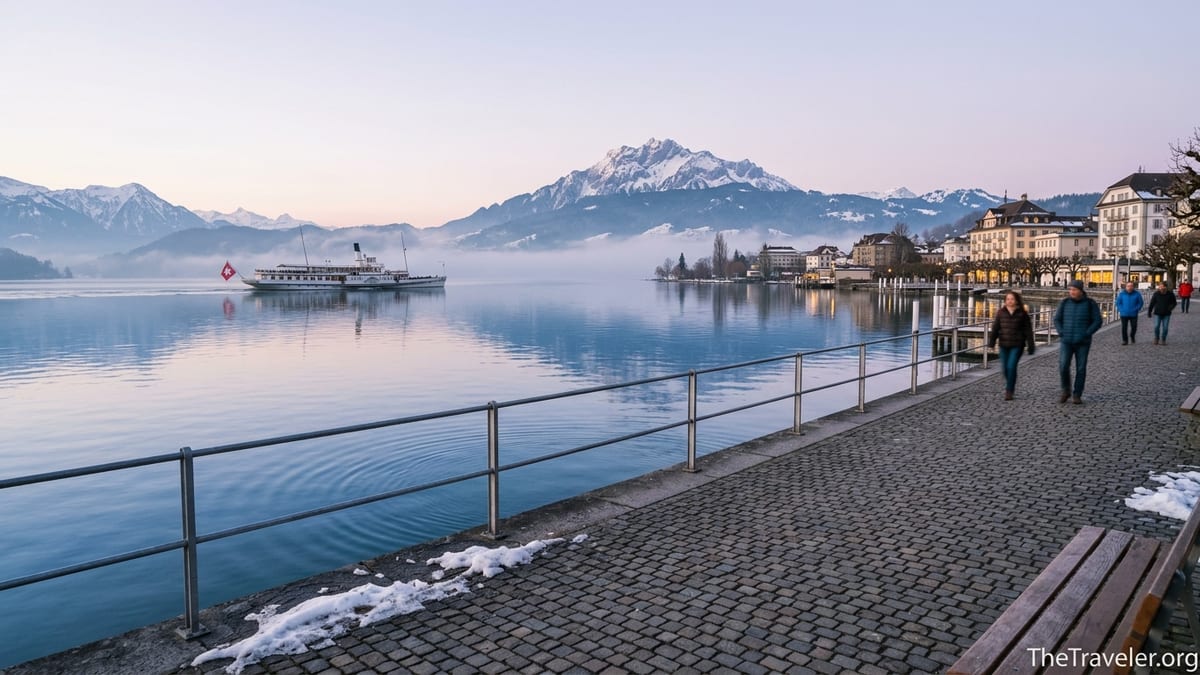
Zug, though often thought of more as a business center, can work as a pleasant half-day visit. Its lakeside Old Town is small but atmospheric, and locals often gather at the lakeshore to watch the sunset, which is particularly striking when low clouds turn pink over the water. Food prices here are similar to Lucerne, but accommodation can be more expensive on weekday nights due to business travel. For tourists, Zug is most practical as a quick outing from Lucerne, only around 20 minutes away by frequent train, rather than as a primary base on a short holiday.
Getting Around: Trains, Boats and Regional Passes
One of Central Switzerland’s main advantages is the density and reliability of public transport. Trains between Lucerne and Zurich Airport run at least twice per hour during the day and usually take about 70 to 90 minutes with a simple change in Zurich’s main station if you do not catch the occasional direct service. Within the region, half-hourly or hourly trains link Lucerne to Engelberg, Zug, Stans and Sarnen. Boats around Lake Lucerne operate more frequently in summer, with a reduced but still practical schedule in winter, so it is worth checking current timetables a few days before your visit.
For first-timers, the confusing part is often the choice of passes. At the national level, the Swiss Travel Pass offers unlimited travel on most trains, buses and boats for consecutive days and includes many museum entries. As of the 2025 price lists, a 3-day Swiss Travel Pass in second class typically costs just under 250 francs for adults, while an 8-day pass is usually a bit under 420 francs. Prices can be adjusted periodically, so use these numbers only as an order-of-magnitude guide when comparing against your own point-to-point tickets. The pass also gives substantial discounts on many mountain railways, though rarely full coverage on the most expensive peaks.
For travel focused on Central Switzerland, regional passes may offer better value. The Tell-Pass, for instance, is promoted as the unlimited regional pass for Central Switzerland and typically covers trains, buses, boats and several major mountain lifts around Lucerne, including Pilatus, Rigi and Titlis, on a 2 to 10 day basis. Typical prices for a 3-day Tell-Pass in second class are positioned below the equivalent Swiss Travel Pass and can be especially attractive if you plan to ride multiple cable cars in a short window. Another regional product, the Lucerne Travel Pass, offers multi-day coverage on local trains, buses and some mountains in the broader Lucerne area. Locals living in the cantons of Lucerne, Obwalden and Nidwalden often use a zone-based system called Passepartout for their daily commuting; while not mainly marketed to tourists, understanding that many city buses and regional trains are integrated can reassure first-time visitors that transfers are straightforward and usually included in the same ticket.
Short-stay travelers who are not ready to commit to a pass can also look at Saver Day Passes or simple point-to-point tickets via the national rail operator’s website or app. A Saver Day Pass bought well ahead of time can sometimes cost significantly less than the equivalent total of separate tickets for a day of long-distance travel, but prices rise dynamically as the date approaches. For someone spending three nights in Lucerne with one long arrival day and two days of local excursions, a practical strategy is often to buy a Saver Day Pass only for the arrival or departure day that includes the airport transfer, then pay individually or use a regional pass for local journeys.
Accommodation and Typical Trip Budgets
Accommodation in Central Switzerland reflects the country’s generally high prices, but with careful planning first-time visitors can keep costs predictable. In Lucerne, simple but well-located two-star hotels or traditional guesthouses often start around 140 to 170 francs per night for a double room in low season, rising to 220 francs or more in July, August and during local festivals. Three- and four-star hotels facing the lake or river, such as properties along the Nationalquai or in the Old Town squares, commonly price standard doubles between 260 and 400 francs per night in peak periods. Engelberg’s pricing is broadly similar in summer, with some ski-focused hotels offering better deals in the hiking season outside major events.
Self-catering apartments and holiday flats, widely listed on booking platforms and through local tourism offices, can offer better value for families or small groups. A two-bedroom apartment in or near Lucerne might cost in the range of 220 to 350 francs per night depending on size, location and season. In smaller towns such as Sarnen or Stans you might find simpler apartments from roughly 180 francs per night outside peak school-holiday weeks. These accommodations usually provide kitchen facilities, which can significantly reduce food costs if you are willing to prepare at least breakfast and some dinners yourself.
In terms of daily budgets, a realistic mid-range estimate for a couple staying in Lucerne could look like this: 250 to 300 francs per night for a central hotel room, around 80 to 120 francs per day for food if you mix picnic lunches, bakery breakfasts and one sit-down dinner, and 40 to 80 francs per day on average for local transport when spread across a multiday pass. Add one or two major mountain excursions at 70 to 120 francs per person each, depending on whether you have discounts. Over five days, such a trip might total roughly 2,000 to 2,800 francs for two people, not counting flights, although exact figures will depend heavily on your lodging choice.
Travelers on tighter budgets often choose one or two “big ticket” experiences and keep other days simpler. For example, a backpacker staying in a hostel dorm in Lucerne might pay 50 to 70 francs per night, cook in the shared kitchen, and focus on free Old Town walks and lower-cost viewpoints such as local hills or lake swimming areas. They might then allocate 120 to 150 francs total for a single flagship excursion, such as Titlis or Pilatus, and otherwise rely on regular trains and hikes from valley stations.
First-Time Itinerary Planning and Best Seasons
For a first visit focused solely on Central Switzerland, a 4 to 7 night stay is usually ideal. With four nights, you can base entirely in Lucerne and plan two or three day trips: one to Pilatus or Rigi, another to Engelberg and Titlis, and a third flexible day for the Old Town, nearby museums and a short lake cruise. With six or seven nights, you might spend three nights in Lucerne, two in Engelberg and one or two in a quieter lakeside village such as Brunnen or Weggis to experience smaller-scale Swiss life.
Season matters more here than in many urban destinations. From late June through early September, high hiking trails are generally open, lifts run on their summer schedules and lake boats operate at full frequency. This is also when crowds and prices peak. May and October are shoulder months with fewer visitors and somewhat lower hotel rates, but some mountain railways may be closed for maintenance and higher paths can still be snowy or muddy. In winter, December to March, Central Switzerland turns into a ski region, especially around Engelberg and Stoos, and lakeside towns take on a quieter, sometimes misty atmosphere that appeals to travelers who prefer calm promenades and indoor museums.
When planning, it is useful to treat mountain days as flexible rather than fixed. A common strategy is to book accommodation and long-distance trains well in advance, but leave the choice of which peak to visit to a day or two before, once you can see the weather forecast. If you wake up in Lucerne to low clouds but a forecast suggesting afternoon clearing, you might switch a planned Titlis outing with a museum day and hold the summit excursion for a clearer window. Travel passes for the region usually do not lock you into a specific mountain on a specific day, which gives you this flexibility.
For those combining Central Switzerland with other parts of the country, keep travel times in mind. Lucerne to Interlaken typically takes around two hours by train, Lucerne to Bern about an hour, and Lucerne to Lugano in Ticino around 2.5 to 3 hours depending on the route through the Gotthard Base Tunnel. On a 10 to 12 day Switzerland itinerary, spending the first three nights in Lucerne before heading to the Bernese Oberland or further south is a common and practical pattern.
FAQ
Q1: How many days should a first-time visitor spend in Central Switzerland?
Most first-time visitors do well with 4 to 7 nights. This allows time for Lucerne, at least one major mountain such as Pilatus, Rigi or Titlis, and a few quieter lake or village excursions without rushing.
Q2: Is Lucerne or Engelberg a better base for seeing the region?
Lucerne works best as a first base thanks to easier airport access, more hotel options and direct links to boats and multiple mountains. Engelberg is ideal as a second base if you want more time in the high Alps and plan to ski or hike around Titlis.
Q3: Are regional passes like the Tell-Pass better value than the Swiss Travel Pass?
For trips focused mainly on Central Switzerland, a regional pass can be better value because it often includes unlimited travel on local trains, boats and several mountains in a smaller area. If you plan to cross the whole country by train, the Swiss Travel Pass may be more convenient despite a higher upfront cost.
Q4: What is a realistic daily budget in Central Switzerland?
For a mid-range traveler staying in a central hotel, a realistic daily budget for one person is roughly 180 to 260 francs including accommodation, food, local transport and a share of occasional mountain excursions, but not international flights.
Q5: Do I need to rent a car to explore Central Switzerland?
No. Trains, buses and boats reach nearly all the main sights around Lucerne, Lake Lucerne and Engelberg, and mountain cable cars usually start directly at a bus or train stop. A car can be convenient in some rural valleys but is not necessary for first-time visitors and can be inconvenient in city centers with high parking costs.
Q6: When is the best time of year to visit for lake cruises and easy hiking?
Late June through early October is usually best for combining lake cruises with straightforward hiking. Boats run frequently, most lifts operate on their summer schedule, and low and mid-altitude trails are typically snow free, though weather can still shift quickly.
Q7: Can I visit both Pilatus and Titlis in one day?
It is technically possible, but not recommended for most travelers. Each mountain comfortably fills a good part of a day once you factor in transport from Lucerne or Engelberg, time at the summit and weather changes. Trying to do both in one day tends to feel rushed and offers less flexibility if clouds roll in.
Q8: Are food and drink much more expensive on the mountains?
Yes, prices at summit restaurants and self-service cafeterias are usually higher than in valley towns. A simple main course can cost around 25 to 30 francs, and drinks may be several francs more than in Lucerne. Many visitors bring a picnic and buy only a drink or dessert at the top.
Q9: Is Central Switzerland suitable for children and older travelers?
Yes. Boats, cogwheel trains and cable cars are generally accessible and popular with families and older travelers. Many short walks near lake promenades or mid-stations are level and well paved, and local tourism offices can point you to stroller-friendly or low-gradient trails.
Q10: Do I need to book mountain excursions and boats in advance?
For most regular boats and mountain lifts in Central Switzerland, you can simply buy tickets on the day, especially outside peak summer weekends. It is still wise to check schedules and any maintenance closures a few days in advance and to arrive early on clear Saturdays in July and August when queues can build.