

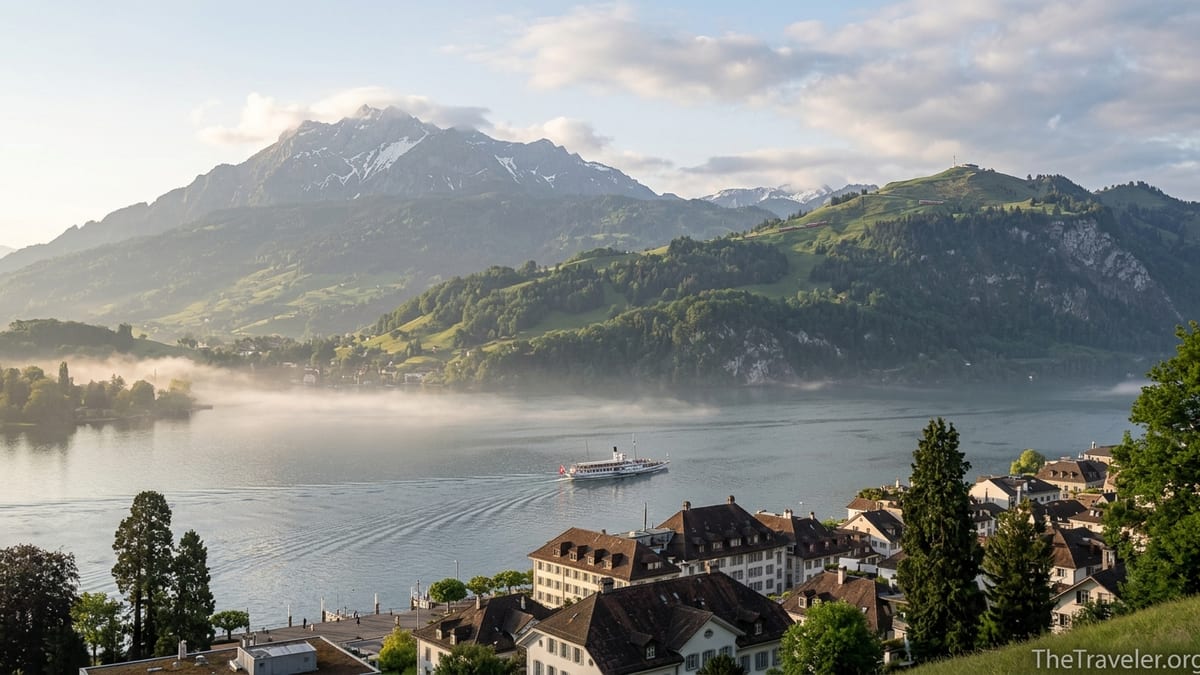
Lucerne is one of the best bases in Switzerland for easy mountain excursions. Within 90 minutes you can be standing on a rocky summit, cruising across Lake Lucerne, or gliding above green meadows on a silent cable car. With so many options, though, it can be hard to choose where to spend your time and money. This guide compares the major day trips from Lucerne as of the 2026 season and helps you match Pilatus, Rigi, Engelberg–Titlis, Stoos, Stanserhorn, Weggis, Vitznau and other nearby excursions to your budget, interests and the weather on the day.
How to Choose the Right Lucerne Day Trip
When every direction from Lucerne leads to a postcard view, choosing a mountain can feel overwhelming. A practical way to decide is to weigh five key factors: total travel time from Lucerne, typical ticket prices, scenery and atmosphere, how family friendly the outing is, and how sensitive it is to weather and visibility. These are the variables that will shape your day far more than whether one summit is 1,800 or 3,000 meters high.
Start with travel time. A classic round trip to Mount Pilatus or Mount Rigi usually takes a full day but still leaves a couple of hours to explore Lucerne in the evening. Engelberg–Titlis, by contrast, requires a roughly 45 to 50 minute train ride each way from Lucerne before you even board the gondola, which pushes the overall excursion closer to 7 to 9 hours once you factor in queues and time on the summit. Stoos and Stanserhorn fall somewhere in between and work very well as half‑day or flexible‑day options.
Price is the next big filter. Rack‑and‑cableway return tickets for the main peaks typically sit in the range of about 60 to just over 100 Swiss francs per adult in 2026, depending on route and discounts such as the Half Fare Card or regional passes. A family of four can quickly be looking at 250 francs or more for one big day out. That is why many visitors consider a regional transport pass that includes mountain railways, especially if they want to combine multiple excursions over two or more days.
Finally, be honest about your priorities. Do you want snow, even in summer, and are you happy to pay for it? Do you prefer grassy hiking paths and picnic spots over steel walkways and glacier caves? Are you traveling with young children or grandparents who may tire easily? Once you are clear on those questions, it becomes far easier to match yourself with Pilatus, Rigi, Titlis, Stoos or a lake‑based variation via Weggis or Vitznau.
Mount Pilatus: Big Views and Classic Round Trips
Mount Pilatus is Lucerne’s signature peak and the most famous day trip from the city. The classic Golden Round Trip combines a lake steamer to Alpnachstad, one of the world’s steepest cogwheel railways to the summit at just over 2,100 meters, and a descent by gondola and cable car to Kriens before a short bus ride back into Lucerne. In practice, most travelers who follow this route leave Lucerne between 8:30 and 10:00 in the morning and are back at the station or old town by late afternoon.
In 2026, pricing for Pilatus continues to place it among the more expensive Lucerne excursions. A full Golden Round Trip adult ticket without discounts typically sits in the low 100s in Swiss francs. Travelers with Switzerland’s Half Fare Card or relevant regional passes receive reductions on the cogwheel and cableway portions, but the lake boat portion is usually charged separately unless a pass includes it. For a concrete example, a couple without any discounts should budget roughly 220 to 260 francs together by the time they have purchased the round trip, added a coffee at the summit terrace and perhaps a light lunch.
Where Pilatus excels is drama and variety in a single day. The cogwheel climb from Alpnachstad is a highlight in its own right, with windows filling gradually with forests, rock walls and waterfalls before you break above the tree line. At the top, there are short, well‑signposted paths to several viewpoints, indoor restaurants, and hotel terraces where you can linger over a drink with sweeping views across Lake Lucerne and, on clear days, the Alps as far as the Bernese Oberland. Families appreciate the small dragon‑themed adventure playgrounds at the Krienseregg mid‑station, which can turn the descent into an easy walk‑and‑play afternoon for children.
Pilatus is very weather dependent. On a cloudy or rainy day low cloud often wraps the summit and limits views to a few meters, which makes the high ticket price hard to justify. It is also one of the busiest mountains in high summer and on sunny weekends, so travelers who dislike queues and crowds may prefer to go early in the day in shoulder season or choose a quieter alternative such as Stanserhorn or Stoos when the weather is only moderately good.
Mount Rigi, Weggis and Vitznau: Flexible, Scenic and Often Better Value
Mount Rigi, often called the Queen of the Mountains, is arguably the best value all‑round day trip from Lucerne, especially for travelers using a Swiss Travel Pass or a regional Tell‑Pass. Rigi’s cogwheel railways and cable car can be combined in multiple ways: by boat to Vitznau and train to the summit, by train to Arth‑Goldau and up from the other side, or by boat to Weggis and cable car to Rigi Kaltbad before a short rail hop to the top. All of these routes can be done comfortably in a day, with total travel times similar to Pilatus but more flexibility to shorten or extend the outing.
Return tickets from lakeside villages such as Vitznau or Weggis to Rigi Kaltbad and Rigi Kulm typically fall below Pilatus in price in 2026, especially when using half‑fare or local visitor card discounts. Travelers staying overnight in Weggis or Vitznau often receive around 20 percent reductions on mountain railway tickets via the regional guest card, which brings a classic cogwheel return for an adult closer to the mid‑double‑digit franc range rather than the 80‑plus level. Rigi also runs its own combined offers, such as tickets that pair the journey with admission to the popular mineral baths at Rigi Kaltbad, allowing you to turn a sightseeing day into a spa day for a predictable package price.
In terms of scenery, Rigi is less about high alpine glaciers and more about panoramic lake and lowland views. On the way up from Vitznau the focus is firmly on Lake Lucerne and the neighboring peaks. From Rigi Kaltbad upwards the perspective gradually shifts towards the Swiss Plateau, Lake Zug and, on clear days, even the Black Forest in Germany. This makes Rigi particularly beautiful at sunrise or sunset, and many visitors choose a later morning departure from Lucerne, have lunch at or near the summit, then descend via a different side or linger at Rigi Kaltbad for spa time before heading back.
Rigi is very family friendly and comparatively forgiving in bad weather. Even if high cloud limits long‑distance views, the lower trails and meadows around Kaltbad and First often remain pleasant for short walks or playground time. There are easy gravel paths suitable for strollers, and the altitude is moderate enough that most people adjust well, including older travelers. On foggy autumn days Rigi sometimes sits above a carpet of cloud, giving a classic Swiss sea‑of‑fog view that can feel magical despite poor conditions down in Lucerne.
Engelberg–Titlis: High Alpine Snow and Glacier Thrills
For travelers wanting guaranteed snow, even in summer, Engelberg–Titlis is the standout choice from Lucerne. You first take a direct train from Lucerne to the village of Engelberg, usually around 45 to 50 minutes. From there it is a short walk or shuttle ride to the Titlis valley station, where the Titlis Xpress gondola ascends in two stages to Stand, followed by the Titlis Rotair, a revolving cable car, to the summit station at just over 3,000 meters. The full ascent from Engelberg to the summit typically takes around 30 minutes once you are actually in the cabins, but you should allow for waiting times at busy hours.
The price reflects the altitude and infrastructure. In 2026, a return adult ticket from Engelberg to the Titlis summit is broadly in the 70 to just over 100 franc range depending on season, online offers and discount cards. Because you must also pay for the train from Lucerne to Engelberg unless a pass covers it, a realistic budget for one adult starting in Lucerne is often around 110 to 140 francs by the time both segments are paid. Families should plan carefully here: two adults and two teenagers can easily cross the 400 franc mark once you add lunch at the summit self‑service restaurant and perhaps a coffee or snack in Engelberg.
What you get in return is a full high‑alpine experience. Even in July and August the upper slopes around Titlis are snowy, the glacier cave and cliff walk are open in typical conditions, and there are dedicated snow play areas where children and adults can slide on hired sleds or simply jump into soft snowbanks. In shoulder seasons and winter, Titlis doubles as a ski area with extensive lifts and pistes, which means that non‑skiers will share facilities with skiers but can still enjoy the old monastery village of Engelberg, lakeside walking paths around Trübsee at the mid‑station, and views of jagged peaks all around.
Titlis is more weather sensitive than its lower neighbors. If thick cloud or a storm is forecast, you may spend a large amount of money only to see grey fog at the top. On marginal days, a smart strategy is to watch live summit webcams in the morning and buy your ticket at Engelberg once you are sure the views are acceptable. Because the main cableways do not typically sell out and prices are fixed for a given season, there is usually no financial penalty for buying one or two days in advance or even same‑day, as long as you are not joining a large tour group.
Stoos and Stanserhorn: Quieter Alternatives with Big Rewards
Stoos and Stanserhorn are excellent options if you prefer gentler atmospheres and fewer crowds than the headline peaks but still want impressive scenery. Both can be reached from Lucerne in well under an hour by a combination of train and bus, followed by a mountain railway. This makes them particularly appealing if you want a half‑day outing or prefer to keep your schedule flexible around changeable weather.
Stoos is a small, car‑free village perched on a high plateau above Lake Lucerne. You reach it via the steep Stoos funicular from the valley station near Schwyz. From Stoos itself, a chairlift continues up to Klingenstock, famous for the Stoos ridge hike between Klingenstock and Fronalpstock, which gives sweeping views down to Lake Lucerne and across to Rigi and Pilatus. Ticket prices for Stoos in 2026 are generally lower than for Pilatus or Titlis, especially if you buy a combined day ticket for the funicular and chairlifts or benefit from regional guest card discounts that often shave around 20 percent off the list price.
Stanserhorn combines an old‑style funicular from the edge of the town of Stans with a modern open‑top cable car that allows passengers to ride on the roof deck. From the summit you see an impressive spread of lakes and peaks, but at a more modest altitude than Titlis, which makes it comfortable even for those who worry about thin air. Many travelers from Lucerne simply hop on a short train to Stans, walk a few minutes to the lower station, and spend a relaxed afternoon at the mountain restaurant terrace before returning in time for an early evening stroll along Lucerne’s waterfront.
Both Stoos and Stanserhorn are solid choices for families. Walking paths near the top are varied enough for confident hikers but include plenty of shorter, well‑marked routes suitable for children and older adults. There are playgrounds and informal picnic areas rather than large commercial complexes. Weather still matters, but because these destinations sit lower than Titlis they are less prone to full whiteouts and can remain enjoyable even when high alpine peaks have disappeared into cloud.
Travel Time, Weather and Passes: Practical Decision Guide
Once you understand what each mountain offers, the decision often comes down to the day’s weather and what tickets you already hold. If you wake up to a perfectly clear morning and you want a big, varied day with a famous name, Pilatus or Rigi are safe first picks from central Lucerne. Pilatus gives you more drama in the ascent and a slightly higher summit, Rigi gives more flexibility and often better value, especially if your Swiss Travel Pass covers the trains and boats and you only need to pay for mountain sections.
On a day with mixed or uncertain weather, Stoos, Stanserhorn or a partial Rigi trip from Weggis or Vitznau can be smarter. For example, if cloud is hanging around 2,000 to 2,500 meters, you might take the boat to Weggis, ride the cable car to Rigi Kaltbad and walk an easy loop through meadows and forest, returning when you like. You still enjoy a lake cruise and mountain air even if the highest viewpoints are not at their best. Similarly, a trip to Engelberg without necessarily riding all the way up to Titlis can be rewarding if you prefer to keep spending moderate and avoid committing to a summit lost in cloud.
Passes make a significant difference. A regional Tell‑Pass for Central Switzerland, for instance, commonly includes full access to several mountains around Lucerne, including Pilatus, Rigi and Stoos, over a set number of days. Travelers who know they will do two or more big excursions plus lake boats in that period often find the pass pays for itself quickly. By contrast, if you are in Lucerne for just one full day with no transport pass, a lower‑priced destination such as Rigi, Stanserhorn or Stoos will generally provide a better cost‑to‑experience ratio than paying separately for Titlis.
Families should also think about energy levels and logistics. A Golden Round Trip to Pilatus or a full Titlis excursion can be tiring for small children, with multiple modes of transport and potential waiting times. In those cases, splitting the experience can work well: perhaps a half‑day on Rigi combined with time at the lakeside promenades of Weggis or Vitznau, or a morning on Stanserhorn followed by an afternoon on Lucerne’s old town squares and lakeside parks.
Real‑World Itinerary Examples
To see how these choices play out in practice, consider a couple with one full day and a moderate budget in Lucerne. If they choose Pilatus, they might take a morning boat at around 9:00, ride the cogwheel railway to the summit, walk the short Esel and Oberhaupt paths, have lunch at the self‑service restaurant and descend via Kriens by mid‑afternoon, spending a total of roughly 8 hours door to door and around 220 to 260 francs for transport and basic meals. The day will feel full and varied but leave limited time for anything else.
If the same couple chooses Rigi, they might leave Lucerne a bit later, say at 10:00, cruise by boat to Vitznau, ride the cogwheel train to Rigi Kulm, walk half an hour along a gentle ridge path, then descend mid‑afternoon to Rigi Kaltbad for a soak at the mineral spa. After an early evening cable car ride down to Weggis and a lakeside dinner, they return to Lucerne by boat or bus. The experience emphasises relaxation and lake views rather than a dramatic ascent, and their transport and spa costs will typically come in lower than a comparable Pilatus and lunch combination.
For a family with teenagers visiting in summer, Engelberg–Titlis might be the priority. They could take an early train from Lucerne, reach Engelberg before 10:00, ride the Titlis Xpress and Rotair to the summit, do the cliff walk and glacier cave, then spend part of the afternoon at the Trübsee mid‑station where there are short walking paths and simple activities such as rowing boats or small ziplines in season. The total travel time is similar to Pilatus, but the altitude is far higher, and the day feels more like a classic alpine glacier outing you might associate with destinations like Jungfraujoch, just focused around a different peak.
Finally, consider travelers arriving in Lucerne late in the morning on a day with changeable weather. Instead of committing to an expensive high‑alpine ticket, they might ride the short train to Stans, ascend Stanserhorn for a few hours of lunch and views, and still be back in Lucerne in time for an evening walk across Chapel Bridge. Their overall spending stays moderate, and if the weather turns poor in the afternoon, they have not invested as much as they would have for Titlis or a full Pilatus round trip.
The Takeaway
Lucerne’s location at the junction of lake and mountains means you are rarely more than an hour away from a memorable day trip. The key is to match your expectations and budget with the strengths of each excursion. Pilatus and Titlis deliver the biggest drama and most vertical meters but at a higher price and with greater dependence on good weather and patience for crowds.
Rigi, reached via Weggis or Vitznau, offers a relaxed blend of lake cruises, historic cogwheel trains and moderate hikes that work in almost any season and for almost any age group. Stoos and Stanserhorn provide quieter paths and wide views with shorter travel times and gentler price tags, ideal when you want a flexible half‑day or wish to avoid the busiest routes. The surrounding villages on the lake, from Weggis to Vitznau, are day trips in their own right if you simply want to stroll, swim in summer or linger on a terrace without heading all the way up a mountain.
If you have two or more days in Central Switzerland and expect to combine several of these, looking into a regional pass that includes mountain transport can unlock more freedom and better value. Whatever you choose, planning around the latest weather forecast and live webcams on the morning of your excursion will do more to shape your experience than any fixed ranking on paper. In good conditions, there is no wrong choice around Lucerne, only different flavors of a very Swiss day out.
FAQ
Q1. Which Lucerne day trip is best if I only have one full day?
Pilatus or Rigi are the most balanced choices for a single full day, with Pilatus offering a more dramatic ascent and Rigi providing more flexibility and often better value.
Q2. Is Titlis worth the extra cost compared with Pilatus or Rigi?
Titlis is worth it if you specifically want snow, glacier activities and high‑alpine scenery even in summer and are comfortable with a higher budget and longer travel time.
Q3. How far in advance should I buy tickets for Pilatus, Rigi or Titlis?
For most individual travelers, buying tickets one or two days ahead or even on the same day is fine, as prices are fixed for the season and regular services rarely sell out.
Q4. Which excursion is best for families with young children?
Rigi, Stanserhorn and Stoos are very family friendly thanks to gentler paths, playgrounds and shorter travel times, while Pilatus and Titlis suit older children and teenagers.
Q5. What if the weather forecast is cloudy or changeable?
On uncertain days it is usually better to choose lower‑altitude options like Rigi, Stanserhorn or Stoos or focus on lake cruises, saving Pilatus and Titlis for clear conditions.
Q6. Are these trips accessible in winter?
Yes, but operations vary by season. Pilatus and Rigi run in winter with reduced schedules, while Titlis is a year‑round ski and excursion mountain. Always check current timetables.
Q7. Do I need a Swiss Travel Pass or Tell‑Pass to make these excursions worthwhile?
No, but passes can significantly reduce costs if you plan several mountain trips and lake boats within a few days. For a single outing, buying point‑to‑point tickets can be simpler.
Q8. Can I visit more than one mountain in a single day?
It is technically possible to combine, for example, a short Rigi visit with another outing, but most travelers find one major mountain excursion per day is enough to feel enjoyable rather than rushed.
Q9. Which destination has the easiest walking for less mobile travelers?
Rigi Kulm, Pilatus and the Stanserhorn summit all offer short, relatively flat paths and viewing terraces close to the stations, making them suitable for many less mobile visitors.
Q10. How should I dress for these Lucerne mountain trips?
Wear layers, sturdy shoes and carry a windproof jacket, even in summer. Higher peaks like Pilatus and especially Titlis can be much colder and windier than Lucerne on the same day.