


French-speaking Switzerland, known locally as Suisse romande or simply Romandie, is where Swiss order meets a relaxed, quietly French-influenced way of life. Stretching from cosmopolitan Geneva along Lake Geneva’s shores through the vineyards of Vaud, the medieval towns of Fribourg and Neuchâtel, the pastoral Jura hills and down the Rhône valley in Valais, it offers a compact but surprisingly varied introduction to the country. This guide orients first-time visitors and helps you understand how Romandie fits into Switzerland as a whole, before you dive into more detailed planning for each region.
Understanding Romandie within Switzerland
Romandie is the French-speaking part of Switzerland, officially recognised by the Swiss federal authorities as the western language region of the country. French is the sole official language in the cantons of Geneva, Vaud, Neuchâtel and Jura and a co-official language in parts of Fribourg, Valais and Bern, where French-speaking districts sit alongside German-speaking areas. On federal language maps you will see this western wedge of the country clearly marked as francophone, with the linguistic border running through cantons such as Fribourg, Valais and Bern.
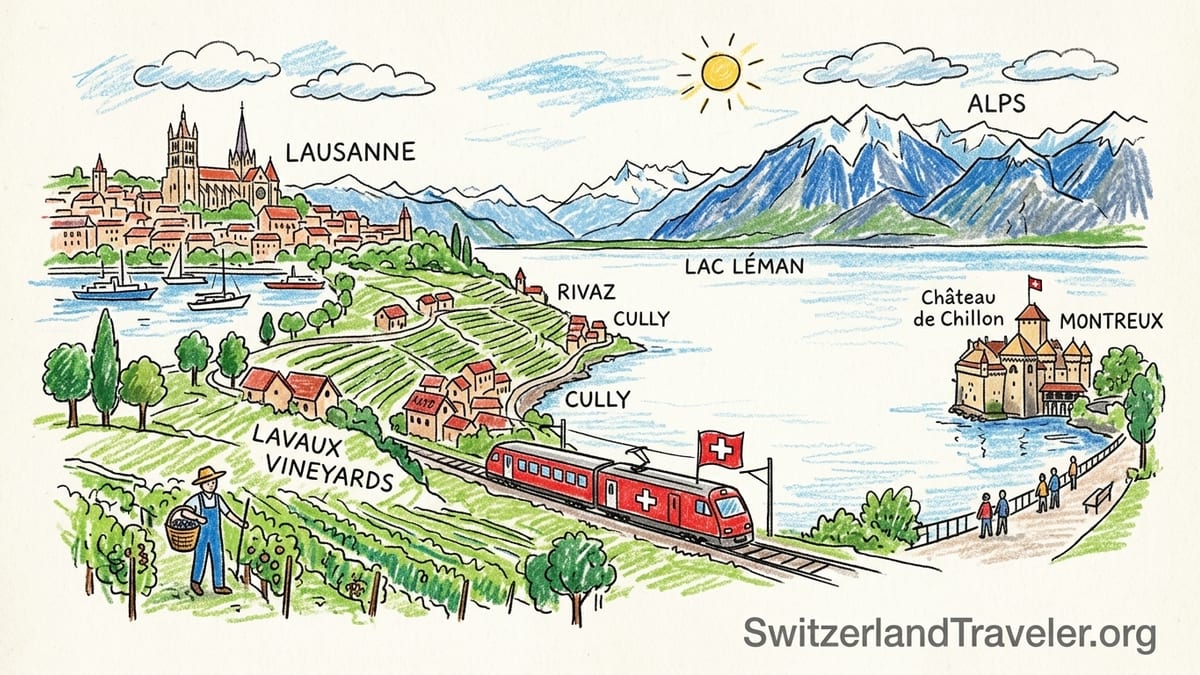
For a first visit, it helps to picture Romandie as a broad arc from south to north. You begin on Lake Geneva in Geneva, follow the shore northeast through Lausanne and the UNESCO-listed Lavaux vineyards to Montreux, then turn inland to the hilltop village of Gruyères and the medieval city of Fribourg. From there, the landscape opens toward Neuchâtel and the soft ridges of the Jura. Finally, you swing back south along the Rhône to Sion and the Lower Valais, gateway to high alpine resorts like Crans-Montana and the valley leading to Zermatt.
Although the region is unmistakably Swiss in its punctual trains, clean streets and dense public transport network, the cultural feel differs from German-speaking Switzerland. You are more likely to hear French on terraces and in shops, and local daily life leans toward café culture and long lunches rather than early dinners and beer gardens. In border areas such as Geneva or the Jura, influences from nearby France are obvious in everything from bread styles in bakeries to weekend market produce.
Crucially for visitors, English is widely spoken in major destinations such as Geneva, Lausanne, Montreux and Sion, especially in hotels and restaurants. Still, even a few basic French phrases like “bonjour,” “s’il vous plaît” and “merci” go a long way, particularly in smaller wine villages in Lavaux or in rural Jura communities where staff may not default to English.
Geneva: International Gateway to Romandie
For many travelers, Geneva is the entry point to French-speaking Switzerland. Geneva Airport sits only a few minutes by train from the city center, and frequent direct trains connect Geneva to Lausanne in around 40 minutes and to Montreux in just over an hour. The city itself offers a gentle landing: a small, walkable old town, a lakeside promenade on Lake Geneva (Lac Léman in French) and an unmistakably international atmosphere due to the many global organizations headquartered here.
On the ground, everyday details quickly show Geneva’s position at the intersection of Swiss and French culture. Cafés serve strong espresso and croissants in the morning, then switch seamlessly to plat du jour lunches and after-work glasses of local white wine. A basic espresso in a central café typically costs around 4 to 4.50 Swiss francs, while a cappuccino or flat white in a speciality coffee bar can run 5.50 to 6.50 francs. Prices are high by international standards, but the quality of ingredients and service is correspondingly elevated.
Lake Geneva shapes both the city’s skyline and its leisure time. Locals swim from small lakeside beaches, especially in July and August, and commuter boats shuttle passengers between harbours on the Swiss and French shores. First-time visitors often combine a morning exploring Geneva’s old town with an afternoon boat cruise or a lakeside walk from the Jardin Anglais out toward quieter residential neighbourhoods, getting a feel for the city’s slower rhythm compared with Zurich or Basel.
Geneva’s rail connections make it an ideal launchpad for exploring Romandie. Direct intercity trains run at least twice an hour eastward along the lake toward Lausanne, Lavaux and Montreux, and regional services branch off inland to destinations such as Nyon, Morges and the Jura foothills. For visitors using a Swiss Travel Pass, these trains and many lake boats are covered, allowing easy day trips to almost every destination covered in this guide without the need for a car.
Lausanne and Lavaux: Lake City and UNESCO Vineyards
Forty minutes by train from Geneva, Lausanne offers a more overtly French-feeling urban experience while still being unmistakably Swiss. The steep old town climbs from the main station up to the Gothic cathedral, with small boutiques, bakeries and brasseries packed into narrow streets. Down at Ouchy, Lausanne’s lakefront neighbourhood, promenades lined with plane trees and hotels stretch along the water, with clear views of the Alps on the opposite shore.
Just east of Lausanne lie the Lavaux vineyard terraces, one of the most distinctive landscapes in Switzerland. These terraced vineyards cover roughly 800 hectares on south-facing slopes between Lausanne and Vevey, and are recognised as a UNESCO World Heritage cultural landscape. The steep hillsides are planted mainly with Chasselas grapes, used to produce dry, mineral white wines served in carafes at local restaurants and wine cellars in villages like Cully, Epesses and Saint-Saphorin.
Trains running between Lausanne and Vevey or Montreux stop at small stations such as Lutry, Cully and Rivaz, putting you within a few minutes’ walk of vineyard paths. A classic first-timer day is to take a morning train from Geneva or Lausanne to Cully, walk an easy lakeside and vineyard route toward Saint-Saphorin over 90 minutes to two hours, stopping at a village café for a glass of local wine, then continue by train to Montreux in the afternoon. In summer, small tourist trains, known locally as vineyard trains, also loop through parts of Lavaux, offering panoramic views over the lake and Alps.
The cultural feel in Lausanne and Lavaux is distinctly Romand. Locals linger over coffee and pastries in the morning, workdays start a little later than in some German-speaking cities, and evening apéritif on a terrace is almost a ritual. Yet trains still run precisely on time and stations are spotless. Compared with Italian-speaking Ticino, the pace here is more measured and less Mediterranean, while compared with Zurich the city feels smaller, more neighbourly and less dominated by finance.
Montreux, Gruyères and Fribourg: Riviera and Medieval Heartland
Continuing along the lake, Montreux sits on the so-called Swiss Riviera, with a mild microclimate that supports palm trees and exotic plants along its famous lakeside promenade. The town is best known for its July jazz festival and as a base for visiting the lakeside Château de Chillon, one of Switzerland’s most photographed castles. Even outside festival season, the waterfront is lively with cafés, ice-cream stands and hotel terraces, and most visitors spend at least a night here to enjoy the evening light on the lake.
From Montreux, trains climb into the hills toward Gruyères, a postcard-perfect medieval village in the canton of Fribourg. The trip, often involving a change at Montbovon or Bulle, takes roughly 90 minutes from Montreux or about two hours from Geneva. In Gruyères, cobbled streets lead up to a castle and surrounding walls, and restaurants specialise in fondue made with local Gruyère cheese and robust mountain dishes such as raclette and rösti. This is an easy place to experience classic Swiss comfort food in an authentically French-speaking setting.
Nearby Fribourg city provides a deeper look at the linguistic border in action. The lower old town, with its bridges and medieval houses, is predominantly French-speaking, while some northern districts of the canton have historically been German-speaking, although French has been gaining ground. Street signs, newspapers and local government communications appear primarily in French in the city, but you will still occasionally hear Swiss German spoken in shops or on buses, especially from commuters and students.
The atmosphere in Fribourg is different again from both Lausanne and Bern, the nearby German-speaking federal capital. Cafés serve croissants and pain au chocolat instead of the Bretzeln and sausages more common in German-speaking railway stations, and the rhythm of conversation on terraces is unmistakably French. At the same time, public life follows Swiss norms: punctual municipal buses, high levels of civic participation and a strong focus on public education and culture.
Neuchâtel, the Jura and Three-Lakes Country
North of Fribourg and Lausanne, the landscape softens into a series of lakes and low limestone ridges. Neuchâtel sits on the lake of the same name and is an elegant small city with sandstone buildings, a lakeside promenade and a compact old town crowned by a château and collegiate church. Trains from Lausanne and Geneva reach Neuchâtel via the mainline toward Biel/Bienne, often with a change in Yverdon-les-Bains, making it an easy addition to a Romandie itinerary.
Further northwest rise the Jura mountains, a chain of forested ridges and pastures that forms the natural border between Switzerland and France. Towns such as La Chaux-de-Fonds and Le Locle in the canton of Neuchâtel, or Delémont in the canton of Jura, have a more workaday, watch-industry feel than the lakeside resorts, but they reward visitors with quiet streets, strong local culinary traditions and far fewer crowds. In summer, the Jura is crisscrossed by hiking and cycling trails, and in winter its gentle hills host cross-country ski tracks and family-friendly downhill slopes.
The so-called Three-Lakes region, roughly between Neuchâtel, Murten/Morat and Biel/Bienne, is an excellent case study in Switzerland’s multilingual reality. Some lakeside towns are French-speaking, such as Neuchâtel itself, while others like Biel/Bienne are officially bilingual, with both French and German used side by side. Ordering a coffee or buying a train ticket, you may hear staff switch fluidly between the two languages depending on the customer in front of them.
Compared with the dramatic alpine scenery of Valais or the built-up lakeshore between Geneva and Lausanne, the Jura and Three-Lakes area feels rural and understated. Vineyards around Lake Neuchâtel and Lake Biel produce whites and light reds served in local wine caves, often at prices slightly lower than in the more high-profile Lavaux. Accommodation ranges from small city hotels in Neuchâtel to rural guesthouses and farm stays in the Jura, making this an appealing region for travellers who want a quieter, more local side of Romandie on a first or second trip.
Sion and Lower Valais: Gateway to the High Alps
From the arc of Lake Geneva, the Rhône valley runs southeast into the canton of Valais. The lower part of the valley, from around Martigny through Sion to Sierre, is largely French-speaking, while the upper stretches closer to Brig and the side valleys around Zermatt and Saas-Fee are predominantly German-speaking. Trains from Geneva and Lausanne follow this valley, with intercity services reaching Sion from Geneva in roughly 2 hours 15 minutes and from Lausanne in about 1 hour 15 minutes.
Sion, the cantonal capital, is an excellent base for exploring Lower Valais. The town itself has two hilltop castles, Valère and Tourbillon, rising above the old centre, with narrow streets lined by bakeries, wine bars and small boutiques. Vineyards climb the valley sides, producing a mix of whites such as Fendant (a local name for Chasselas) and reds including Pinot Noir and indigenous varieties like Cornalin. Many wineries offer tastings by appointment, and some operate walk-in cellar doors where you can sample a flight of wines for around 10 to 20 francs.
From Sion, regional trains and buses climb into side valleys leading to resorts such as Crans-Montana, Nendaz, Veysonnaz and Anzère. These destinations combine traditional wooden chalets with modern hotels and apartments, and in winter they plug into some of the largest interconnected ski domains in Switzerland. In summer, they switch to hiking, mountain biking and family activities built around panoramic views over the Rhône valley and the high peaks lining the horizon.
Lower Valais illustrates linguistic Switzerland in miniature. Railway station announcements and road signage are bilingual French and German, but the everyday language in villages from Martigny to Sion is French. Travel farther up-valley toward Visp or into Zermatt and you cross into German-speaking Switzerland, where menus flip from “fondue moitié-moitié” to “Käsefondue” without any change in the dish itself. For first-time visitors, this provides a clear, tangible sense of the country’s parallel cultures coexisting within a single small territory.
Language, Food and Everyday Culture in Romandie
Language is the most obvious difference between Romandie and the rest of Switzerland, but the variety of French spoken here is subtly distinct from that in France. Swiss French preserves some older expressions and uses number forms such as septante (70) and nonante (90) in many regions instead of the soixante-dix and quatre-vingt-dix used in standard French in France. For visitors, understanding these variants is helpful when reading prices in markets or listening to train announcements for departure times.
Food in Romandie reflects both alpine Swiss traditions and neighbouring French influences. Classic dishes include cheese fondue, often prepared in a moitié-moitié mix of Gruyère and Vacherin Fribourgeois, raclette scraped from a half-wheel of melting cheese onto potatoes and pickles, and hearty plates of rösti, a crisp potato cake served with toppings like cheese, bacon or fried eggs. Around Lake Geneva and Neuchâtel you will also find lake fish on menus, while Valais is known for air-dried meats, rye bread and platters of local charcuterie.
Vineyards are a recurring theme in French-speaking Switzerland, particularly in Vaud and Valais. In Lavaux, small wine cellars known as caves often open on weekends or summer evenings to serve glasses of Chasselas and simple plates of cured meats and local cheeses, sometimes for less than the cost of a cocktail in Geneva or Zurich. In Valais, visitors can join guided tastings to explore less-known varieties such as Petite Arvine and Humagne Rouge, giving a concrete sense of how local climate and terrain shape the region’s wines.
Everyday culture in Romandie feels, to many visitors, slightly more relaxed and outward-looking than in some German-speaking regions. Café terraces are busy late into the evening in Lausanne and Geneva, and long Sunday lunches with family are common. At the same time, trains, trams and boats remain the backbone of daily life, and respect for public space is high. Compared with Italian-speaking Ticino, service interactions here are often a little more formal and reserved, but less so than in some German-speaking cities, giving first-time travelers a gentle introduction to Swiss norms.
Getting Around, Accommodation and Travel Logistics
Public transport is the most efficient way to travel between the main hubs of French-speaking Switzerland. Intercity and interregional trains link Geneva, Lausanne, Montreux, Fribourg, Neuchâtel, Sion and many smaller towns at least once an hour, often more frequently on the core Lake Geneva corridor. Regional trains and postal buses extend the network into Lavaux’s hillside villages, Jura towns and alpine valleys in Valais, usually timed to connect with mainline arrivals and departures.
For a first trip focused on Romandie, many visitors find that a Swiss Travel Pass or regional pass covering trains, buses and boats delivers both value and simplicity. Typical itineraries might involve flying into Geneva, spending a night or two in the city, then moving on to Lausanne or Montreux, using these bases for day trips to Lavaux, Gruyères and Fribourg, before heading to Neuchâtel or Sion. Because distances are short, it is quite realistic to visit multiple regions in one week without feeling hurried, as long as you cluster sights geographically along the Geneva to Valais arc.
Accommodation ranges from grand lakefront hotels in Geneva, Lausanne and Montreux to mid-range city hotels, family-run inns in smaller towns and self-catering apartments in vineyards or mountain villages. In high season, especially during the Montreux Jazz Festival or school holidays in February and July–August, prices and occupancy rise sharply, so booking a few months ahead is advisable. In shoulder seasons such as May–June and September–October, you can often find comfortable double rooms in three-star city hotels in Lausanne or Neuchâtel for prices that, while still high compared with many countries, are noticeably lower than Geneva’s peak rates.
Driving is possible and roads are well maintained, but parking in city centers can be costly and restricted, and many scenic villages and mountain areas are easier to reach by public transport. In Lavaux, for example, village parking is limited and steep, narrow lanes can be stressful for unfamiliar drivers, whereas local trains between Lausanne and Montreux stop close to most wine trails. In Valais, some high resorts and side valleys are car-free or partly restricted, with visitors leaving vehicles in valley car parks and continuing by cable car or train.
In terms of practicalities, payment cards are widely accepted, and contactless payments are standard in cafés, supermarkets and train stations. Tipping is modest and service is included by law, but rounding up a restaurant bill or leaving a few francs for good service is appreciated. Many municipalities, including Lausanne and Geneva, provide free local transport cards to hotel guests for the duration of their stay, making it easy to use buses, trams and local trains without buying separate tickets.
The Takeaway
French-speaking Switzerland offers a concentrated introduction to the country’s landscapes and cultures while remaining easy to navigate for first-time visitors. Within a few hours by train you can move from Geneva’s diplomatic waterfront to the terraced vineyards of Lavaux, the palm-lined promenade of Montreux, the medieval charm of Gruyères and Fribourg, the quiet elegance of Neuchâtel and the sunny Rhône valley around Sion. Throughout, you will experience a blend of Swiss organisation and French-inflected daily life that feels distinct from both German- and Italian-speaking regions.
Using Geneva to Sion as your main travel axis, with side trips into Lavaux, the Gruyères–Fribourg area, Neuchâtel and the Jura, allows you to sample the key flavours of Romandie without constant packing and unpacking. Once you have a feel for the region’s geography and culture, you can dive into more detailed guides for specific cantons or cities, whether you are drawn most to vineyards, lakes, mountains or medieval towns. However you structure your trip, understanding Romandie as a coherent region within Switzerland will help you make sense of the train timetables, language borders and culinary variations you encounter along the way.
FAQ
Q1. Is French enough to travel around Romandie, or do I need German too?
French is the main language in Geneva, Vaud, Neuchâtel and Jura and widely used in French-speaking parts of Fribourg, Valais and Bern. In major tourist towns, English is also common. Basic French phrases are helpful everywhere, but you do not need German to travel comfortably in the core Romandie areas.
Q2. How many days should a first-time visitor spend in French-speaking Switzerland?
A well-paced first trip typically runs 5 to 8 days. That allows 1 to 2 nights in Geneva, 2 to 3 nights in Lausanne or Montreux with time for Lavaux and Gruyères, plus 2 to 3 nights divided between Neuchâtel, the Jura or Sion and Lower Valais.
Q3. What is the best season to visit Romandie?
Late spring from May to June and early autumn from September to early October are ideal, with mild temperatures, vineyards in full leaf and generally fewer crowds. July and August are popular for lake swimming and festivals, while winter suits visitors heading for Valais ski resorts.
Q4. Are Swiss trains in Romandie as reliable as in German-speaking Switzerland?
Yes. The national rail network serves French-speaking Switzerland with the same high standards of punctuality and frequency. Intercity trains link Geneva, Lausanne, Fribourg, Neuchâtel and Sion regularly, and regional trains and buses feed into smaller towns and valleys.
Q5. How expensive is food in French-speaking Switzerland compared with neighboring France?
Prices are generally higher than in nearby French regions. A coffee in Geneva or Lausanne can easily cost 4 to 6 francs, and simple main courses at mid-range restaurants often start around 25 to 35 francs. Budget-conscious travelers can save by using supermarket buffets and bakeries for some meals.
Q6. Do I need a car to explore Lavaux, Gruyères and Valais vineyards?
Public transport is usually the better option. Trains along Lake Geneva stop at Lavaux villages, regional lines reach Gruyères and buses and trains fan out from Sion into Valais side valleys. A car can be useful for very rural stays, but parking and narrow roads can make driving less relaxing in vineyard areas.
Q7. How does the cultural feel of Romandie differ from German-speaking Switzerland?
Romandie combines Swiss structure with French-influenced everyday life. Café terraces are central to social life, meal times are slightly later, and spoken French dominates streets and shops. In German-speaking regions, you are more likely to encounter Swiss German dialects, beer gardens and somewhat more direct communication styles.
Q8. Is accommodation cheaper in Neuchâtel and the Jura than on Lake Geneva?
Often yes. While prices vary by season, smaller cities and rural Jura towns typically offer lower nightly rates than Geneva, Lausanne or Montreux. Travelers on moderate budgets frequently choose a mix, staying a few nights on Lake Geneva and a few in less expensive inland areas.
Q9. Can I easily combine Romandie with Italian-speaking Ticino on one trip?
It is feasible but adds travel time. Fast trains link Lausanne and Geneva with the Gotthard base tunnel route toward Lugano and Bellinzona, usually with a change in Zurich or Arth-Goldau. For a one-week trip, many visitors focus on Romandie alone and save Ticino for a future itinerary.
Q10. Are local wines in Romandie good value for visitors?
Yes, especially when enjoyed close to where they are produced. In Lavaux and Valais, a glass of local Chasselas or a simple tasting flight at a cellar or wine bar often costs less than imported wines in big-city restaurants and offers a direct connection to the surrounding landscape.