


French-speaking Switzerland compresses an extraordinary amount of scenery into a compact corner of the Alps. From palm-lined lakeside promenades in Montreux and Vevey to high alpine pastures above Château-d’Oex and the jagged peaks over Rochers-de-Naye, some of the country’s most impressive landscapes are threaded together not by highways, but by slow, scenic trains. For travelers based in Lausanne, Montreux or Vevey, these lines are more than postcard views on rails: they are practical, flexible ways to explore the region without a car. This guide compares the flagship GoldenPass services with the cogwheel line to Rochers-de-Naye, the vineyard-hugging Train des Vignes, and a handful of useful regional routes, focusing on what matters in practice: scenery, time, reservations, and which journeys are genuinely worth paying extra for.
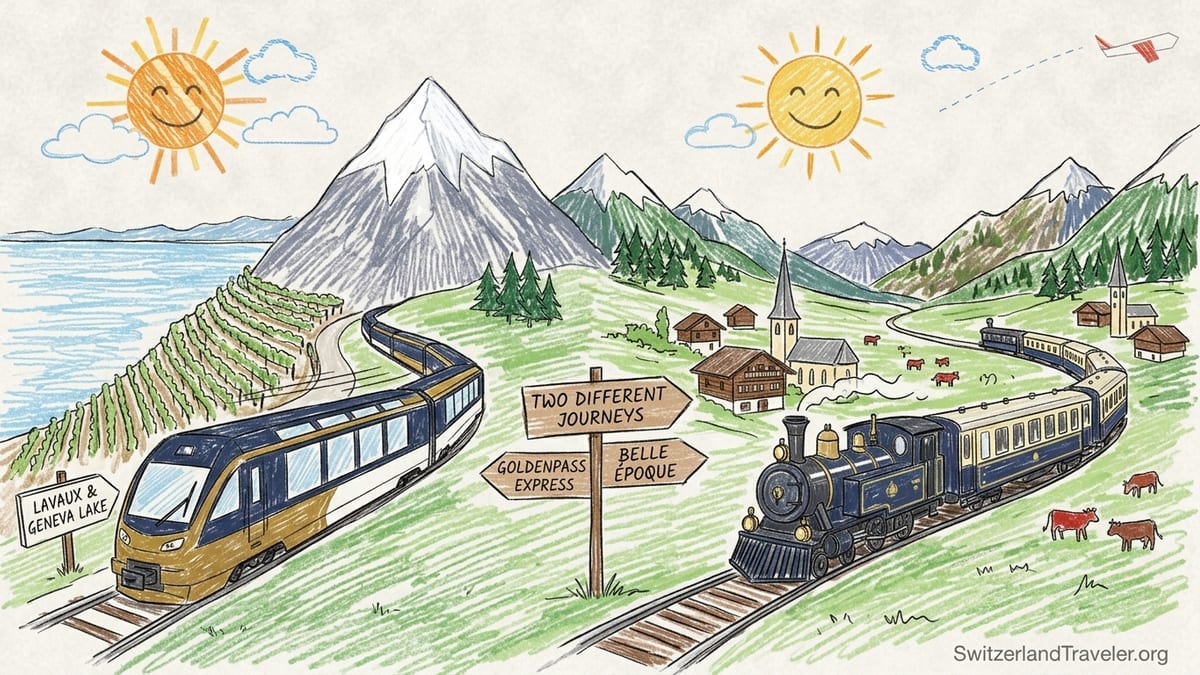
GoldenPass Express vs Belle Époque: Two Very Different GoldenPass Experiences
GoldenPass is less a single train and more a family of services. The modern GoldenPass Express links Montreux on Lake Geneva with Interlaken in the Bernese Oberland, running via Château-d’Oex, Gstaad and Zweisimmen. On the same Montreux to Zweisimmen stretch, classic GoldenPass Belle Époque and panoramic trains operate as a regional service. In practical terms, that means you can choose between a through panoramic train all the way to Interlaken, or a shorter scenic hop into the Alps from the French-speaking shore of Lake Geneva.
The GoldenPass Express is designed for long-distance travelers who want to sit down in Montreux and step off hours later in Interlaken without changing trains. Carriages have large panoramic windows in both first and second class, with a premium Prestige Class section at one end. Reservations are optional in standard classes but strongly recommended at busy times like July, August and autumn weekends, and they are compulsory if you want Prestige Class. The base ticket price is similar to other intercity trains for the same route; the extra cost comes from seat reservations and Prestige supplements, which for many travelers add up to the price of a good restaurant meal.
GoldenPass Belle Époque, by contrast, runs only between Montreux and Zweisimmen and feels like stepping into a period film. The Belle Époque coaches have wood paneling, vintage-style upholstery and softer lighting, but still offer large windows. Journey time is similar to regular regional trains, roughly two hours end to end, and the line is part of the regular timetable, with several departures a day. Because Belle Époque shares the same base fare as normal trains, the only surcharge you need to think about is a modest seat reservation fee if you want to guarantee a window seat in high season.
From a scenery perspective, both Express and Belle Époque cover the same core stretch between Montreux and Zweisimmen: steep vineyards climbing above Lake Geneva, the narrow gorge near Montbovon, the wide valley and church spire of Château-d’Oex, and the open pastures around Gstaad. The Express continues beyond Zweisimmen into the Simmental and around Lake Thun toward Interlaken, adding a long, gentle valley and distant views of higher Bernese peaks. For most visitors focused on French-speaking Switzerland, however, the essential landscapes are concentrated between Montreux and Gstaad, which you can experience perfectly well on Belle Époque or the standard panoramic trains without paying the higher supplements of Prestige Class.
Scenery Compared: Lakes, Vines, Peaks and Pastures
Travelers often ask which of these trains is the most scenic. The honest answer is that each highlights a slightly different version of what makes French-speaking Switzerland special. If you imagine the region as a layered amphitheater rising from lake to vineyards to foothills and finally to high peaks, each line occupies its own tier.
The Train des Vignes between Vevey and Puidoux runs right through the middle of the Lavaux terraced vineyards, a UNESCO World Heritage landscape. Within minutes of leaving Vevey, the train climbs steeply above Lake Geneva, hugging the hillside. On a clear afternoon in June or September, you look straight across the neat vineyard walls toward the Savoy Alps on the far shore. The journey is short, around 20 minutes each way, but almost every minute offers a classic Lavaux postcard view. It is arguably the single best train for photographing vineyard landscapes and the lake in the same frame.
GoldenPass, whether Express or Belle Époque, offers more varied scenery over a longer distance. Departing Montreux, the line climbs in tight curves above the town, giving you a final look back over the lake before diving into forested slopes. Around Montbovon and Château-d’Oex, the countryside opens into a broad valley with chalets, church spires and dairy farms. Near Gstaad and Saanenmöser the line feels more alpine, with grazing cows in summer and ski slopes in winter. The overall effect is not as dramatically vertical as the Lavaux vineyards or the Rochers-de-Naye summit, but as a continuous slow reveal of different landscapes it is hard to beat.
The cogwheel line from Montreux to Rochers-de-Naye adds the high-altitude layer. This train starts at lake level and climbs more than 1,600 meters to a summit plateau above 2,000 meters. For about 50 minutes each way you watch the lake recede until it looks like a map laid flat below you. On clear days the summit offers wide, sweeping views along Lake Geneva and into the Valais and French Alps. It is the most dramatic change in altitude and perspective of all the lines covered here, though low cloud can quickly erase those views, so timing matters more than on the lower routes.
Journey Time, Frequency and How Easily They Fit an Itinerary
When you build an itinerary around these trains, the key trade-off is time. GoldenPass Express from Montreux to Interlaken takes roughly three hours. If you add the return trip you are committing most of a day to that single journey, especially if you stop in Gstaad or Château-d’Oex for lunch. This is ideal if you are moving bases, for example relocating from Geneva or Montreux to the Jungfrau region and want your transfer day to double as a scenic experience. For a simple out-and-back day trip from Lausanne or Geneva, however, the full Express can feel long.
GoldenPass Belle Époque and other panoramic trains between Montreux and Zweisimmen are easier to slot into a half-day or flexible day trip. From Montreux to Gstaad is about one hour 45 minutes. Many travelers take a morning train up, have lunch and a short walk in Gstaad’s traffic-free center, then return on a different departure in the afternoon. Because these are effectively regional trains with a scenic twist, they run several times a day, giving you options to shorten or lengthen your time in the mountains without penalty.
The Train des Vignes is the most time-efficient of all. Vevey to Puidoux takes about 20 minutes, with at least hourly services. A realistic plan from Lausanne might be: 15 minutes to Vevey on a regular intercity, 20 minutes up to Puidoux through the vineyards, then a late-morning hike back down via Chexbres-Village with a glass of Chasselas at a wine cellar, and back on the train to Lausanne in time for evening plans. This line fits naturally as a half-day add-on to almost any stay along Lake Geneva, which is why it is so consistently recommended by local tourist offices.
Rochers-de-Naye requires a bit more commitment. The cogwheel train from Montreux to the summit takes around 50 minutes each way and runs several times a day year-round, more frequently in summer. To make the most of the ticket price and the summit facilities, you will want to spend at least an hour or two at the top to walk the paths, visit the viewing terraces or, in winter, explore the snow. Allowing for connections from Lausanne or Vevey, a Rochers-de-Naye excursion typically occupies at least half a day and easily stretches into a relaxed full day.
Classes, Reservations and What You Really Need to Pay For
On paper, the class and reservation options across these lines can be confusing. In practice, the question for most travelers is simple: when is it worth paying extra, and when is a standard ticket enough? On the GoldenPass Express, second and first class both have large panoramic windows. The real step up is Prestige Class, a small section where seats are raised slightly higher for a better view and can be turned to face the direction of travel. Prestige requires a paid supplement on top of your normal ticket or rail pass and always requires a reservation. If you are traveling in peak season and know you value comfort and quiet, this can feel special, but it is very much a splurge rather than a necessity.
For many visitors, a reserved window seat in standard first or second class on GoldenPass Express or Belle Époque offers 90 percent of the view for far less extra cost. Seat reservations, where available, are relatively modest compared with the base fare, and on shoulder-season weekdays you can often find decent unreserved seats. However, July, August and sunny weekends in late September can see these trains busy with tour groups. If you are traveling with children or carrying luggage, reserving at least one leg of the journey is a small price to pay for peace of mind.
By contrast, the Train des Vignes and the cogwheel train to Rochers-de-Naye operate largely as regular regional services. On the vineyard line, there is usually standard second-class seating only, no supplements, and no reservations needed. The views are just as good from any seat, and in practice many passengers stand by the doors to take photographs as the train curves along the hillside. Rochers-de-Naye trains do not require reservations either; you simply buy a ticket or use your rail pass, then board. On very busy summer weekends you may have to wait for the next departure to secure a seat by the window, but you will not be turned away for lack of a booking.
From a value perspective, the pattern is clear. If you are a rail enthusiast or marking a special trip, paying for Prestige Class on the GoldenPass Express makes sense, particularly when you are combining the transfer from Montreux to the Bernese Oberland with a honeymoon or anniversary. For most others, the money is better spent on a nice meal in Gstaad, a wine tasting in Lavaux, or a night in a lakeside hotel, while traveling comfortably in standard panoramic coaches.
How These Trains Fit a Lausanne or Montreux-Based Trip
Lausanne Tourism and local partners promote these railways not only as attractions, but as practical spokes radiating from a central base. If you are staying in Lausanne, Vevey or Montreux for three or four nights, you can realistically experience two or three of these routes without rushing. A common three-day pattern might be: GoldenPass to Gstaad on day one, a vineyard-focused day using the Train des Vignes on day two, and Rochers-de-Naye on day three if the weather cooperates.
For example, from a hotel near Lausanne station, you can be on a morning GoldenPass departure out of Montreux in under 40 minutes, including the connection along the lake. Spend a leisurely day riding up to Gstaad, strolling through the village, then back down in the late afternoon. The next day, you could make a much shorter hop to Vevey, ride the Train des Vignes up to Puidoux, then walk a section of the vineyard trails downhill through Chexbres-Village and into one of the small wine-growing hamlets like Rivaz or St-Saphorin, returning by local train along the lakeshore.
Rochers-de-Naye fits well as a flexible weather-dependent option. Because services run year-round and do not require reservations, you can simply check the summit webcam or forecast in the morning and decide if visibility looks promising. On a clear October day, you might decide at breakfast in Lausanne to head for the 10:17 cogwheel departure from Montreux, spend two or three hours at the summit, then be back at lake level in time for a late lunch on the Montreux promenade. If clouds hang low over the peaks, you can swap plans and focus instead on vineyard walks or a boat trip.
For travelers connecting French-speaking Switzerland with the Jungfrau region, the GoldenPass Express is most useful as a one-way transfer. For instance, you may spend two nights in Montreux after flying into Geneva, then board a mid-morning Express train directly to Interlaken West and continue by local train to Lauterbrunnen or Grindelwald. In that scenario, paying a reservation fee or even a Prestige upgrade can feel more justified, because the cost replaces what you might otherwise spend on a less scenic intercity journey plus an additional excursion.
Other Regional Panoramic Routes Worth Considering
Beyond the headline trains, several ordinary-looking regional services around Lake Geneva and the Vaud Alps offer quietly excellent views. Local trains between Lausanne, Vevey and Montreux run close to the shore, with frequent glimpses across the water and up into the vineyards. While they lack the panoramic windows of GoldenPass stock, they are fast, flexible and fully covered by most rail passes. Many travelers discover that the short hops between lakeside towns at sunset provide some of their favorite unplanned views of the trip.
Further inland, regional trains from Vevey up to the small resort of Les Pléiades and from Aigle toward Leysin or Les Diablerets also provide rewarding scenery for comparatively little effort. These lines climb from the lake into forest and pasture, revealing Lake Geneva below through occasional clearings much as GoldenPass does above Montreux, but with shorter journey times and lower fares. They rarely require any form of reservation, and in shoulder seasons you may find yourself sharing a carriage with only a handful of local commuters or hikers.
Connections between these regional lines and the headline routes are generally straightforward. For example, you might ride the Train des Vignes up through the vineyards, walk for an hour along a waymarked trail, then connect at Puidoux to a train toward Fribourg or Bern. Alternatively, after returning from Rochers-de-Naye to Montreux, you can continue straight onto a GoldenPass Belle Époque departure further into the Prealps. The Swiss timetable is usually synchronized enough that you spend more time looking out the window than waiting on platforms.
Because these quieter lines are not branded as premium experiences, they are often less crowded and more relaxed. This makes them especially appealing to independent travelers who prefer spontaneous stops and do not enjoy the feeling of traveling in a group. Combined with the flagship panoramic services, they allow you to tailor your use of trains to the rhythm of your trip: structured and scenic on one day, improvised and local the next.
Which Scenic Trains Are Most Worth Paying Extra For?
Seen from the perspective of value rather than pure rail enthusiasm, a hierarchy emerges. At the top sits Rochers-de-Naye, where there is no first-class option or reservation system to worry about, but the ticket price buys you a rare combination of effortless altitude gain and broad alpine panoramas. If the weather is clear on the day you plan to go, this is the one excursion where many travelers feel the cost is unquestionably justified, especially if you are unlikely to visit other high viewpoints in the Swiss Alps.
Next comes the GoldenPass segment between Montreux and Gstaad or Zweisimmen. Here, the base ticket or rail pass coverage gets you most of the benefit. Spending a little more to secure a window seat on a Belle Époque or modern panoramic coach is worthwhile in peak season, but jumping to Prestige Class only makes sense if you are particularly keen on comfort, photography or celebrating a special occasion. If your budget is limited, prioritize timing your journey for good light, such as mid-morning or mid-afternoon, rather than spending heavily on upgrades.
The Train des Vignes, by contrast, requires no extra payment beyond a normal regional ticket and delivers some of the most iconic Lavaux landscapes in the country. In strict value terms, this makes it one of the best deals in Swiss rail travel. You can combine it with low-cost or free activities such as walking between vineyard villages or picnicking on a terrace bench overlooking the lake. For travelers trying to experience the region on a tighter budget, this line often proves more rewarding than a more expensive long-distance panoramic trip.
Finally, the full GoldenPass Express to Interlaken is best thought of as a premium scenic corridor for those already planning to travel between Lake Geneva and the Bernese Oberland. Paying extra for reservations or Prestige makes the most sense if it replaces the need for a separate long-distance train plus an additional tourist excursion. If you are not committed to staying in Interlaken or the surrounding villages, you may extract more enjoyment by focusing instead on shorter loops from Lausanne, Vevey or Montreux that combine vineyards, lake views and mid-mountain landscapes without long one-way commitments.
The Takeaway
French-speaking Switzerland offers a dense network of scenic trains that serve both as transport and experience. For travelers using Lausanne, Vevey or Montreux as a base, these routes make it easy to step from an urban café onto a panoramic carriage and, within an hour or two, find yourself among alpine pastures or high above the lake. Choosing wisely among GoldenPass Express, Belle Époque, Rochers-de-Naye, the Train des Vignes and other regional lines is mostly a matter of matching journey time, cost and scenic priorities to the rhythm of your trip.
If your time is short and the weather plays along, prioritize the Train des Vignes for Lavaux’s terraced vineyards and Rochers-de-Naye for big alpine views. Add a GoldenPass run to Gstaad if you want a fuller sense of how the landscape changes from palm trees to chalets within a morning’s ride. Treat the full GoldenPass Express to Interlaken as a strategic choice for when you are already moving between regions and want that transfer day to double as a highlight in itself.
Above all, remember that in this corner of Switzerland even ordinary-looking regional trains often deliver extraordinary views. Whether you are in a Belle Époque salon car, a modern panoramic coach or a simple two-car regional unit climbing through the vines, the essential experience is the same: watching the light shift over Lake Geneva, the vineyards, and the mountains as the train curves quietly along the hillside.
FAQ
Q1. Do I need seat reservations for the GoldenPass Express and Belle Époque trains?
Reservations are compulsory only for Prestige Class on the GoldenPass Express and optional but advisable in standard classes during summer and holiday peaks. On GoldenPass Belle Époque, reservations are recommended in high season if you want a guaranteed window seat, but you can still ride with a normal ticket if seats are available.
Q2. Are the Train des Vignes and Rochers-de-Naye cogwheel trains covered by Swiss Travel Passes?
Swiss Travel Passes generally cover the Train des Vignes as it operates as a regular regional service. The Rochers-de-Naye line is often either fully covered or offered at a substantial discount, depending on the pass type and current conditions, so it is worth checking the latest coverage details when you buy your pass.
Q3. Which scenic train should I choose if I only have half a day from Lausanne?
If you have just half a day, the Train des Vignes is the easiest choice, combining a short journey time with outstanding vineyard and lake views. Alternatively, a shorter GoldenPass run from Montreux to Château-d’Oex or Gstaad and back is feasible if you start early, but it will feel more rushed than the vineyard route.
Q4. Is Prestige Class on the GoldenPass Express worth the extra cost?
Prestige Class offers slightly higher, more comfortable seats and a quieter, more exclusive atmosphere, which some travelers find ideal for a special occasion or for high-season travel. For most visitors, however, the views and experience in standard panoramic first or second class are more than sufficient, making Prestige a nice-to-have rather than a must.
Q5. What is the best season to ride these scenic trains?
Late spring, summer and early autumn offer the most reliable combination of clear views, open hiking trails and vibrant colors in the vineyards and pastures. Winter rides can also be beautiful, especially on Rochers-de-Naye or the higher sections of GoldenPass, but shorter daylight hours and the risk of cloud or fog make timing more important.
Q6. Can I combine a scenic train ride with a vineyard walk in Lavaux?
Yes, the Train des Vignes is ideal for this. Many travelers ride up from Vevey to Puidoux, then walk downhill through Chexbres-Village and the vineyard terraces to villages like Rivaz or St-Saphorin, before returning by train along the lakeshore. This combination delivers both the classic train views and time among the vines.
Q7. How child-friendly are these scenic train journeys?
Most of these lines are very child-friendly, with relatively short segments and frequent chances to get off and explore. On GoldenPass, children enjoy the changing landscapes and the novelty of the Belle Époque carriages; Rochers-de-Naye adds the excitement of a cogwheel climb and summit viewpoints, though parents should be prepared for cooler temperatures and strong sun at altitude.
Q8. What should I budget for a typical scenic train day from Lausanne?
Costs vary depending on whether you use a rail pass, but a traveler without a pass might expect to spend the equivalent of a modest day tour on a round-trip GoldenPass excursion to Gstaad and somewhat less on a Train des Vignes and vineyard-walk day. Rail passes can quickly improve value if you plan multiple scenic journeys within a few days.
Q9. How far in advance should I book GoldenPass reservations in peak season?
For travel in July, August and during popular holiday periods, aim to book GoldenPass Express or Belle Époque reservations at least a couple of weeks ahead, especially if you need several seats together or want Prestige Class. Outside peak dates, a few days’ notice is usually enough, and in low season you can often ride without reservations.
Q10. If the weather is poor, which scenic train offers the least risk of disappointment?
On cloudy or hazy days, the lower-level Train des Vignes usually suffers less than high-altitude routes, because views across the lake and vineyards remain attractive even without sharp mountain outlines. GoldenPass between Montreux and Gstaad can also be rewarding in mixed weather, as the closer valley scenery and villages are less dependent on perfect visibility than the summit panorama at Rochers-de-Naye.