


Switzerland’s parks are increasingly packaging their wildest landscapes into multi-night hiking holidays, complete with reserved beds, luggage transfer and clear stage-by-stage itineraries. For travelers who want more than a single summit day, parks such as Parc Ela, the Swiss National Park with Val Müstair, Entlebuch and the Jura parks offer very different but equally compelling ways to spend a week or more on foot. The key is choosing the setting and trip style that matches how you like to hike, sleep and move.
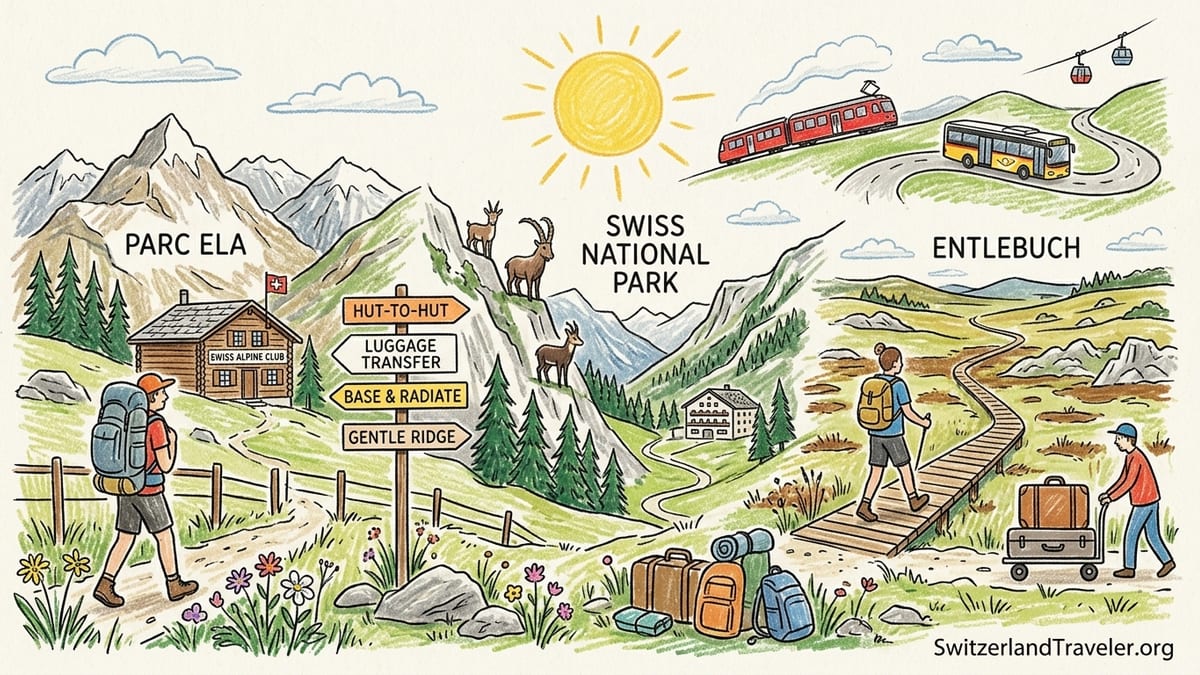
How Swiss parks frame multi-night hiking holidays
Across Switzerland, protected areas have shifted from promoting individual day hikes to curating complete walking holidays. On the national Swiss parks platform you now find multi-day packages that combine handpicked stages, pre-booked accommodation and, on many routes, optional luggage transport between overnights. Prices vary, but as a benchmark, a four to five night self-guided package with half board and luggage transfer typically starts around 800 to 1,100 Swiss francs per person in a double room, depending on season and comfort level. What you trade in spontaneity you gain in reassurance that every bed is booked and your bag will be waiting at the next inn.
Within this framework, the parks highlighted here have developed distinctive offers. Parc Ela leans into longer hut-to-hut trekking in a classic Alpine setting. The Swiss National Park and the adjacent Val Müstair build trips around strict conservation rules and a blend of wild core zone and lived-in valley. Entlebuch, a UNESCO biosphere, sells the idea of crossing a chain of moorlands and karst slopes with luggage transfer included. The Jura parks, stitched together by the Jura Crest Trail and park-to-park itineraries, position themselves as Switzerland’s gentler, quieter long-distance option, ideal for extended ridge walks and one-base holidays with expansive views of the Alps.
When you compare them as multi-night hiking destinations rather than individual trails, three questions matter most. Do you prefer a linear journey or a base-and-radiate setup? How much infrastructure, from mountain huts to PostBus stops, do you want to rely on? And are you happy with basic dormitories, or do you value private rooms and creature comforts? Parc Ela and the Jura parks are best-equipped for classic long-distance journeys, while Entlebuch and Val Müstair add more structured packages with built-in luggage transfer and wellness-focused hotels.
Public transport makes these itineraries feasible without a car. In practice, this means catching a morning train from Zurich or Geneva, a connecting regional train into the valley, then a PostBus up to the starting village. For example, hikers beginning a Parc Ela trek often arrive via Chur and Tiefencastel before boarding local buses to Savognin or Bivio, while those starting a Jura Crest section may step off a suburban train just outside Zurich and join the ridge on foot within an hour.
Parc Ela: long-distance Alpine trekking in 17 stages
Parc Ela, in Graubünden between the Albula and Julier passes, is home to one of the country’s most ambitious park-based treks: a long-distance circuit of roughly 17 stages around the park’s wild core. Instead of a single branded "through-hike" like the Via Alpina, Parc Ela’s route knits together existing trails and mountain huts into a continuous journey: over high passes above Bivio, through stone-vaulted villages such as Stierva and across balcony paths with views to the Piz Ela massif. Many hikers do not walk all 17 stages in one go; instead they link four to eight consecutive days, such as a loop from Savognin via Ela Hut and the high plateau of Alp Flix before descending through traditional Walser settlements.
As a multi-night destination, Parc Ela is strongest for hut-to-hut trekking. The route relies on a network of simple mountain inns and Swiss Alpine Club huts like Chamanna d’Ela, where you sleep in dormitories and share hearty dinners of barley soup and rösti with other walkers. Expect to pay in the region of 70 to 110 Swiss francs per person for half board in a hut or simple guesthouse. Because road access is limited on some stages, luggage transfer is patchy; on many sections you must carry full kit for several days. This makes Parc Ela a good choice for hikers with some experience of Alpine trekking who enjoy the rhythm of early starts, pass crossings and evenings in remote huts.
For those who want more comfort, there are ways to adapt the Parc Ela experience. Some regional hotels in villages such as Savognin, Bivio and Filisur collaborate with the park and tour operators to offer multi-night packages: for instance, a six-day hiking holiday that uses two or three comfortable hotels as bases and shuttles you to different trailheads each morning. In that case you might spend two nights in Savognin exploring balcony trails and one-day sections of the long-distance route, then transfer by PostBus to Bivio for high pass day hikes, returning each night to a hot shower and proper bed. Luggage transfer is straightforward on such itineraries because your main bag stays in the valley hotels while you carry only a daypack.
Seasonality also matters more in Parc Ela than in the lower parks. The main trekking season usually runs from late June to late September, with snow lingering on higher passes well into June in heavy winters. Trail conditions can still be Alpine in character in early July, so trekkers planning hut-to-hut routes should be prepared for patches of old snow and occasional re-routing. Later in the season, from late August into mid-September, you often find quieter huts, larch forests turning golden and a more stable weather pattern that suits a week-long crossing.
Swiss National Park and Val Müstair: wild core, soft edges
The Swiss National Park in the Engadine is the country’s only strict nature reserve of its kind. Hiking is confined to waymarked paths, visitors must stay on trail, and overnighting inside the park is not allowed except at the long-established mountain hotel Il Fuorn on the Ofen Pass road. As a result, the National Park alone is not a classic multi-night trekking destination in the hut-to-hut sense. Instead, it becomes a wild core around which multi-night itineraries use the neighboring Val Müstair and Lower Engadine villages as overnight bases, often bundled under the umbrella of the UNESCO Biosphere Engiadina Val Müstair.
One of the most structured examples is the Three Parks Trail, a four-day journey that links the Swiss National Park, the Biosfera Val Müstair and Italy’s Stelvio National Park. Hikers typically start in Zernez, join the park’s trail network for a day above Il Fuorn, then cross into Val Müstair and Italy before looping back toward the Engadine. Overnight stops are in hotels and guesthouses in accessible locations rather than remote huts, which keeps comfort levels high. Package versions organised through regional tourism offices or specialist operators include half board, trail descriptions, and sometimes luggage transfer, allowing walkers to carry a light daypack while their main luggage moves by road between inns.
Val Müstair on its own is also developing comfort-oriented hiking holidays. A typical four-day "gourmet hiking" offer might base guests in two family-run hotels, for example in the village of Valchava and in S-charl over the pass, and combine moderate day hikes with regional cuisine and wellness facilities such as saunas. Prices for such comfort treks, including several nights’ half board, shuttle transfers and luggage transport, are often in the order of 900 to 1,300 Swiss francs per person, reflecting both the remote location and the included services. These trips work well for travelers who want meaningful time on trail but are less interested in spartan hut life.
For independent hikers looking to build a week around the park, a common pattern is to spend three or four nights in Zernez, Scuol or a village in Val Müstair and explore a new section each day. You might, for instance, take the morning PostBus from Zernez to S-charl for a high-level loop and marmot watching, then ride back to your hotel in the evening. The next day you could travel up to the Ofen Pass, walk along the park boundary and descend into Val Müstair for a night in a village inn. This one-base or two-base model suits hikers who prefer marked trails and wildlife encounters over the commitment of a point-to-point trek.
Entlebuch: moorland crossings with luggage transfer
West of Lucerne, the Entlebuch UNESCO Biosphere Reserve has carved out a niche as Switzerland’s moorland hiking destination. Rather than a single flagship through-hike, it offers several curated itineraries that cross raised bogs, karst landscapes and rolling pasture from village to village. A standout example is the five-day "Moorlandschaftspfad" offer, a long-distance walk through the country’s largest contiguous moorland region. The official package, marketed through Swiss parks channels, includes multiple overnight stays, breakfast and dinner, and luggage transport from one accommodation to the next, so hikers carry only a daypack on the trail.
On the ground, the Moorlandschaftspfad experience feels different from a high Alpine trek. Elevation changes are moderate, paths meander through boardwalks above bogs and gentle hills rather than steep rock faces, and many overnights are in small inns or guesthouses in villages such as Sörenberg and Schüpfheim rather than isolated huts. A typical package might cost in the realm of 800 to 1,000 Swiss francs per person for five walking days, depending on room standard. This structure makes Entlebuch particularly attractive to walkers who want to experience a multi-night journey without the strain of big daily ascents or the need to carry heavy gear.
Entlebuch also works well as a one-base walking destination with easy day hikes. Because Schüpfheim and other villages sit on the rail line between Lucerne and Bern, visitors can book an apartment or hotel for four or five nights, use a local guest card for discounts on cable cars such as the Sörenberg lifts, and combine short moorland walks with excursions to Mount Pilatus or Lake Lucerne. Families sometimes choose a base here because accommodation can be more affordable than in Lucerne itself, yet trains into the city still take around 30 to 40 minutes, allowing a hybrid of nature and classic sightseeing days.
For more experienced hikers, tour operators and the biosphere reserve also promote two or three day loops that link moorland stages with more demanding ridge walks, such as routes that involve the Brienzer Rothorn area. These trips often use small mountain hotels near upper cable car stations and combine hiking with other activities like e-biking. However, even on tougher variants, the overall character of Entlebuch remains softer than the high Alps, making it a good early-season or shoulder-season option when snow still lingers higher up.
The Jura parks and the Jura Crest Trail: Switzerland’s gentle long-distance option
The Jura parks span a series of regional nature parks along Switzerland’s northwestern arc, including Chasseral, Jura vaudois and Aargau Jura Park. Binding them together is the historic Jura Crest Trail, the country’s oldest long-distance hiking route, which runs in roughly 16 stages from the Zurich region to Lake Geneva. Average stages involve six to seven hours of walking on rolling ridges with wide views of the distant Alps, through karst pastures, beech forests and farm hamlets that feel a world away from the dramatic Bernese Oberland.
For multi-night hiking holidays, the Jura Crest Trail is the backbone. Independent trekkers can follow the national signposted route and build their own hut-to-hut style itinerary, staying in a mix of simple mountain inns, farm stays and small hotels. Because the terrain stays between about 800 and 1,600 meters, snow melts earlier than in the high Alps and the main season stretches from late April into October in many sections. Accommodation standards vary, but walkers can usually choose between basic dormitories from around 60 to 80 Swiss francs per person with half board and more comfortable private rooms from roughly 120 to 160 francs for two people including breakfast.
Organised offers have grown quickly here. Switzerland Tourism and various tour operators now sell three to six day segments of the Jura Crest Trail as self-guided holidays, for instance from Regensberg to Solothurn, or from Solothurn to Couvet. These packages include hotel bookings, a detailed roadbook and often luggage transfer between overnight stops, so you walk each day with only a daypack while your suitcase travels by taxi or shuttle. A representative price for a five-day package with luggage service might be around 900 to 1,200 Swiss francs per person in a mid-range hotel, which compares favorably with similar Alpine routes.
Beyond the central Crest Trail, the Jura parks collaborate on multi-park itineraries under banners like "Nature Park Trail" and "Lakes & Forests" routes, some of which are promoted through the Swiss parks platform. These connect parks such as Jura vaudois, Gruyère Pays-d’Enhaut and others, often offering a combination of hiking days and public-transport segments between valleys. In practice, this means that a hiker might spend two nights crossing the ridges above Vallée de Joux in the Jura vaudois park, then ride a regional train to a neighboring park for the next segment. Much like the Lakes & Forests route across the western Jura, these itineraries are ideal for travelers who appreciate variety over one continuous, demanding traverse.
Comparing trip styles: hut-to-hut, luggage-transfer and one-base stays
Looking purely at their suitability for hut-to-hut trekking, Parc Ela stands out as the most traditionally Alpine, followed by selected traverses in the Jura parks. Parc Ela’s 17-stage circuit offers the closest thing to a classic Alpine long-distance trek entirely within a park, with multiple consecutive nights in mountain huts and inns, substantial daily elevation gain and the satisfying sense of walking an entire arc of landscape. In the Jura, a full ridge traverse from the vicinity of Zurich to Nyon delivers continuity too, but over gentler terrain and with overnights almost always in road-accessible accommodation rather than remote huts.
For luggage-transfer holidays, Entlebuch and the Jura parks take the lead. The Moorlandschaftspfad in Entlebuch is explicitly marketed as a five-day walking trip with included luggage transport, appealing to hikers who want the security of a structured product and lighter packs. Along the Jura Crest Trail and associated park-to-park routes, many operators bundle luggage transfers with hotel stays, meaning you can plan an eight to ten day journey that never requires carrying more than a day’s food, water and extra layer. In Parc Ela, luggage transfer is generally limited to valley-based multi-night stays, not the high hut stages, while around the Swiss National Park and Val Müstair, luggage services are usually tied to hotel-based comfort treks rather than a continuous hut-to-hut line.
One-base walking holidays, where you stay three to six nights in a single village and explore different day hikes, are particularly strong around the Swiss National Park, in Entlebuch and in parts of the Jura. Zernez or Scuol make excellent bases for combining National Park day routes with spa evenings, while villages like Schüpfheim in Entlebuch or small towns along the Jura front such as Solothurn allow easy access to a web of trails plus cultural attractions in nearby cities. Parc Ela can support this model too, especially from Savognin or Bivio, but the landscape often beckons you to link stages into a journey rather than simply dip in and out.
For easier day hikes and mixed-ability groups, Entlebuch and the Jura parks are the most forgiving. Many Entlebuch moorland loops take three to four hours on gentle gradients, with escape options via PostBus if legs tire, while lower stages of the Jura Crest Trail can be shortened using cable cars or public transport from passes down to valley towns. Around the Swiss National Park, trails are clearly graded but often steeper, and elevation gain can be significant for families with younger children. Parc Ela’s terrain is the most demanding overall; even some "moderate" routes involve substantial climbing and rougher surfaces that may not suit occasional walkers.
Planning and practicalities for multi-night park hikes
Booking strategy varies between these destinations but a few principles apply. In Parc Ela and on popular Jura Crest sections, booking huts and small inns several months in advance for peak dates in July and August is wise, especially for weekends. Park-linked packages can be reserved through official platforms or directly with regional tourism offices; these often include a printed or digital roadbook, GPX tracks and emergency contact numbers. Independent hikers can use national trail mapping tools and local tourist offices to piece together their own multi-stage journeys, but should still reserve accommodation in advance, as small family-run inns frequently close midweek or during shoulder seasons.
Cost control is similar across all four areas. Choosing dormitories or simple guesthouses with half board keeps daily budgets lower, since buying restaurant dinners à la carte in Switzerland adds up quickly. Some trekkers limit expenses by alternating between package segments that include meals and nights where they self-cater in village apartments. Railway and regional passes can also reduce transfer costs; for example, visitors staying multiple nights in Entlebuch or Val Müstair sometimes receive guest cards that offer discounted or free local transport and cable cars, adding value to a base-based holiday.
Gear needs depend on your chosen park and style. Hut-to-hut trekkers in Parc Ela will want sturdy boots suitable for rocky, potentially snow-patched paths, a light hut sleeping bag, and layers that can handle sudden temperature drops above 2,000 meters. In the Jura and Entlebuch, lower elevations mean lighter footwear such as trail shoes can suffice for most, although spring and autumn mud on forest tracks may still justify waterproof models. In all regions, sun protection, a quality rain jacket and a small first-aid kit are standard. For luggage-transfer holidays, a soft duffel that can be easily moved by shuttle services works better than a rigid suitcase.
Finally, regulations and etiquette differ slightly. The Swiss National Park is the strictest: no leaving the marked trails, no dogs, and no overnighting inside the core zone beyond allowed facilities. In the Jura parks and Entlebuch, dogs are often permitted on leash, but sensitive zones such as moorlands may have seasonal restrictions. Wild camping is heavily restricted or effectively prohibited in many Swiss lowland parks, so multi-night hikers should plan to sleep in official accommodation unless a park explicitly designates bivouac areas. Respecting these frameworks keeps the landscapes that make these multi-day walks special intact for the next generation.
The Takeaway
Choosing the best Swiss park for a hiking holiday is less about ranking landscapes and more about matching destination to walking style. Parc Ela rewards trekkers who dream in multi-stage circuits, are happy with mountain huts and do not mind carrying their world on their back for several days. The Swiss National Park and Val Müstair wrap intense core-zone nature protection inside comfortable bases and curated four- or five-day packages that balance trail time with regional culture and cuisine.
Entlebuch offers a different rhythm again: a moorland-crossing journey with luggage transfer that suits newcomers to multi-day hiking, plus the possibility of combining gentle stages with excursions to Lucerne’s lakes and mountains. Meanwhile, the Jura parks string together Switzerland’s soft western ridges and regional nature parks on the Jura Crest Trail and related routes, offering long-distance potential and flexible shorter stays with big horizons but modest elevation.
For hut-to-hut purists, Parc Ela and a full Jura Crest traverse stand out. For luggage-transfer walkers, Entlebuch and the Jura packages shine. Travelers who prefer one-base comfort with serious nature at the doorstep might gravitate to Val Müstair, Zernez or Entlebuch’s villages. With clear self-knowledge about how you like to hike, sleep and move, each of these Swiss parks can anchor a memorable, multi-night journey on foot.
FAQ
Q1. Which of these parks is best for a first multi-day hiking holiday?
For most first-timers, Entlebuch or a luggage-transfer segment of the Jura Crest Trail works best. Daily distances are manageable, gradients are moderate, and you can stay in comfortable guesthouses rather than mountain huts, which makes the logistics and physical challenge easier to handle.
Q2. Where can I do the most traditional hut-to-hut trek?
Parc Ela offers the most traditional hut-to-hut feel among these parks, especially if you follow several stages of its 17-stage long-distance circuit. You will spend multiple nights in mountain huts or simple inns, cross high passes and be away from roads for full days at a time, similar in spirit to better-known Alpine traverses but with fewer crowds.
Q3. Are luggage-transfer services widely available?
Luggage-transfer services are common on organised packages in Entlebuch and along the Jura Crest Trail, and on some hotel-based hiking offers around Val Müstair and the Swiss National Park. In Parc Ela, luggage transfer is more limited to valley-based itineraries, so hikers doing high hut stages should plan to carry their full gear.
Q4. Which area is best for one-base walking with easy day hikes?
Entlebuch and the surroundings of the Swiss National Park are particularly good for one-base holidays. Villages like Schüpfheim or Sörenberg in Entlebuch and Zernez or Scuol near the National Park offer multiple day-hike options, access to public transport, and other attractions such as lakes, spas or nearby city visits, all while returning to the same bed each night.
Q5. How long is the hiking season in these parks?
In Parc Ela, high Alpine sections are usually best from late June to late September, depending on snow. The Jura parks often offer a longer season, from around late April to October, thanks to lower elevations. Entlebuch’s moorland routes typically run from late spring into autumn, while day hikes around the Swiss National Park and Val Müstair are generally reliable from June to October.
Q6. Are these trips suitable for families with children?
Many itineraries in Entlebuch and the Jura parks are suitable for families, especially shorter stages and moorland or forest loops that can be cut short using public transport. Around the Swiss National Park, families often enjoy wildlife-focused day hikes from a fixed base. Parc Ela’s hut-to-hut sections are more demanding and better suited to older children with some hiking experience.
Q7. Do I need to book everything through an official package?
No, you can hike independently in all of these parks, booking huts, hotels and guesthouses yourself. However, official or operator packages simplify logistics by bundling accommodation, some meals, and often luggage transfers. These products are particularly helpful for visitors unfamiliar with the region or language, or for those short on planning time.
Q8. How expensive are multi-night hiking holidays in Swiss parks?
Costs vary, but a realistic range for a four to six night hiking holiday with mid-range accommodation and some meals included is roughly 800 to 1,300 Swiss francs per person. Hut-based trips with dormitory accommodation and half board can be cheaper per night, while hotel-based comfort treks with luggage transfer and wellness facilities tend to be at the higher end of that range.
Q9. What level of fitness is required?
For hut-to-hut trekking in Parc Ela, you should be comfortable walking six to eight hours a day with significant elevation gain while carrying a pack. Entlebuch and the Jura parks generally demand a moderate level of fitness, with four to six hour days on rolling terrain. Around the Swiss National Park and Val Müstair, fitness requirements depend on the chosen routes, but many day hikes involve sustained climbs.
Q10. Can I combine more than one park in a single trip?
Yes, it is quite feasible to combine parks in one holiday. For example, you could spend three nights walking stages of the Jura Crest Trail through Jura vaudois, then travel by train to Entlebuch for a moorland package, or pair a hut-to-hut segment in Parc Ela with a more relaxed, hotel-based hiking stay in Val Müstair. Good rail and PostBus connections make such combinations practical within a two-week itinerary.