


Switzerland’s protected landscapes offer some of Europe’s most reliable wildlife encounters, from ibex clinging to high ridges to red deer in dark forests and marmots whistling across alpine meadows. Yet for many visitors, the key decision is not just where to go, but whether to go alone or book a guide. This commercial guide compares the country’s standout parks for wildlife watching and shows where paying for expert-led excursions, telescopes and ranger knowledge can turn a pleasant hike into a genuine nature experience.
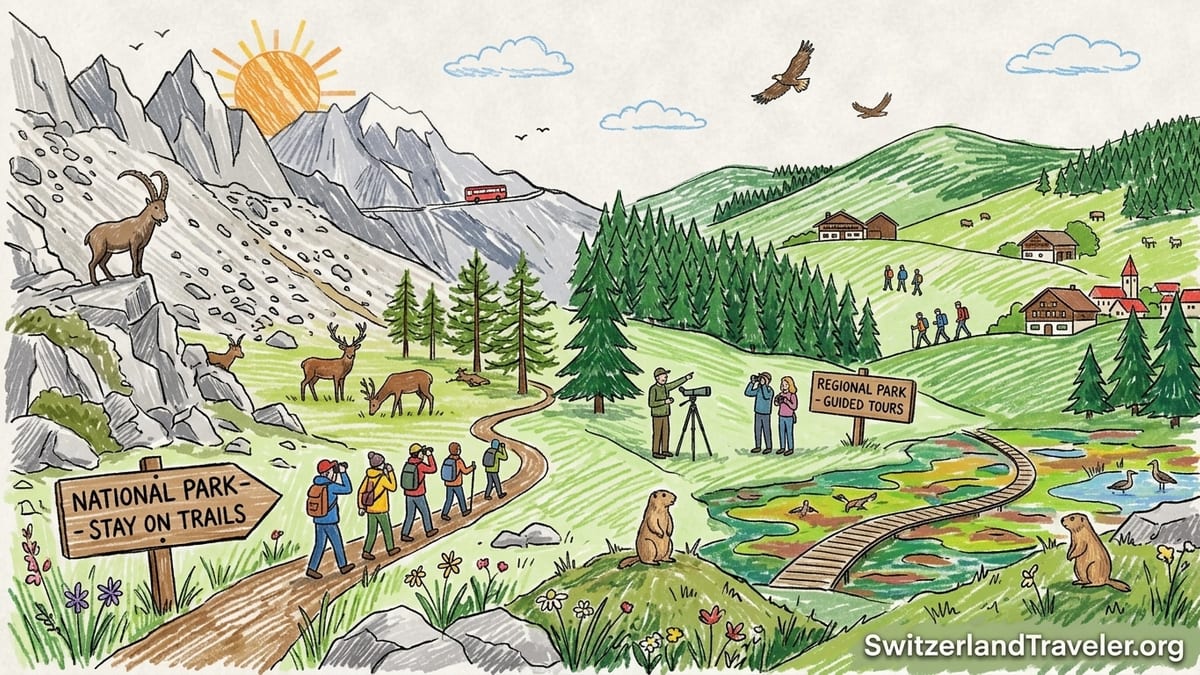
How Swiss Parks Work for Wildlife Watching
Switzerland has one national park and a network of regional nature and biosphere parks that together cover a substantial slice of the country. The Swiss National Park in the Engadin is the strictest reserve, where visitors must stay on marked trails and nature is left largely to its own processes. Regional parks such as Parc Ela in Graubünden or the UNESCO Biosphere Entlebuch in central Switzerland combine conservation with traditional farming and tourism, making them more flexible for guided activities and village-based stays.
For wildlife watchers, this structure matters. In the Swiss National Park you are not allowed to leave the paths, light fires or use drones, and rangers can fine visitors who disturb animals. Independent visitors can still see ibex, red deer and marmots, but they are limited to what is visible from the trail. In regional parks the rules are generally less strict, so guides can vary routes, linger in good viewing areas and sometimes use hides or quiet corners just outside the busiest hiking corridors.
Guided excursions have become a core part of many parks’ offers. The Swiss National Park promotes guided walks where naturalist guides carry powerful telescopes and help visitors find distant animals in the scree or forest clearings. Parc Ela and several regional parks advertise bookable wildlife or nature events each season, from dawn deer outings to night-time bat walks. The decision to pay for these experiences is ultimately commercial, but in practice it often determines whether you return with a story and a good photograph or simply the memory of a nice landscape.
Language and season also shape the experience. In many parks, the most detailed commentary is offered in German, with selected walks in English or French in high season. Wildlife viewing is strongly seasonal: red deer are easiest to see in the autumn rut, ibex around snow-free high ridges in late spring to early autumn, and marmots from roughly May to October depending on altitude. A guide who works locally year-round will know which valley is snow-free first and which hillside the animals are using in a given week.
Swiss National Park: Ibex, Red Deer and Marmots With a Telescope
The Swiss National Park, reached from villages such as Zernez and Scuol in the Engadin, is the premier destination for seeing wild alpine mammals. Red deer, alpine ibex, chamois and marmots are all present, and with patience many visitors spot several of these in a single day. Hikes like the valley of Val Trupchun are especially known for red deer during the autumn rut, when the animals’ calls echo across the slopes at dawn and dusk.
Independent visitors who arrive early and move quietly have a realistic chance of seeing wildlife on their own. In summer, marmots are often visible beside the path, standing sentry or sprinting between burrows. With a basic pair of 8x or 10x binoculars you might spot small herds of chamois or ibex feeding on steep grass above the trail and occasionally golden eagles circling overhead. A typical self-guided day involves buying a printed trail map in Zernez, catching the postbus to a trailhead such as Il Fuorn and returning in mid-afternoon, with wildlife sightings depending heavily on your field skills and luck.
Where paying for a guide adds clear value here is in the distance and direction of your viewing. Official park-guided excursions, such as the classic Val Trupchun or Margunet tours, are explicitly marketed around animal observation with expert guides and powerful telescopes. On these outings the guide will repeatedly scan slopes that many visitors would casually walk past, then set up a spotting scope so the group can see, for example, ibex kids playing on crags hundreds of metres away or a bearded vulture gliding over a ridge. Participants typically rotate through the eyepiece so everyone gets a sharp, close-up view.
The commercial trade-off is between cost and certainty. A guided day in the Swiss National Park usually adds a modest surcharge to your trip compared with hiking alone, but it substantially increases your chances of seeing more than silhouettes. For first-time visitors with limited days, especially families with children or photographers without their own large lens, this can transform the outing. Guides also provide context: how long the ibex have been back in the region, how the deer population is monitored and why certain meadows are left ungrazed, all of which deepen the experience beyond simply ticking species off a list.
Parc Ela: Quiet Valleys and Bookable Wildlife Excursions
Parc Ela lies between the Albula and Julier passes in Graubünden and is Switzerland’s largest regional nature park. Its landscape of larch forests, high pastures and limestone peaks supports similar wildlife to the national park, including ibex, red deer and marmots, but with fewer visitors and more lived-in villages. The park works with local nature guides and mountain leaders to offer a programme of bookable wildlife and landscape events that change by season.
Examples of these activities include dawn or dusk red deer walks in autumn, when a guide leads small groups from a village such as Savognin or Bivio to viewing points overlooking quiet side valleys. Participants learn to distinguish deer calls, read tracks on the ground and use binoculars effectively at first light. In early summer, guides might run family-friendly marmot outings where children are shown fresh burrow entrances and learn why marmots disappear underground for months each winter.
Independent wildlife watching is entirely possible in Parc Ela, especially if you are comfortable planning your own routes on Swiss topographic maps and are willing to hike before or after the main daytime crowds. It is feasible, for example, to plan a loop above Savognin or Tiefencastel and quietly scan upper pastures for ibex bands or roe deer. However, unlike the Swiss National Park there are fewer information boards or obvious wildlife “hotspots” signposted for casual visitors. Much of the local knowledge about where animals are using the landscape in a given year sits with the park office and its network of guides.
Booking one of Parc Ela’s wildlife events effectively buys you into that knowledge. Prices vary, but many half-day excursions are structured to be accessible, sometimes including public transport or a simple picnic. For travellers this creates a middle ground between a generic hike and an expensive private guiding arrangement. If your time in Graubünden is short, paying for one of these scheduled experiences can be a practical way to ensure at least one day has a strong wildlife focus, especially if you do not speak German or Romansh and would like explanations in English.
Entlebuch Biosphere: Birds, Bogs and Wetlands From Boardwalks
South-west of Lucerne, the UNESCO Biosphere Entlebuch protects a mosaic of raised bogs, moorland, karst landscapes and traditional alpine pastures. The wildlife here is less about large mammals and more about specialist birds, amphibians and plants that depend on wetland and moor habitats. Birdwatchers visit for species such as whinchats, wagtails and various warblers, while the bogs host rare carnivorous plants and dragonflies in summer.
Much of the Entlebuch’s wildlife is subtle or easily overlooked if you are not used to reading wetland landscapes. The biosphere authority publishes seasonal brochures that highlight guided offers for visitors, including bird and bog walks that follow boardwalk trails through protected moors. On these tours, local guides point out breeding territories, explain how peat forms and help participants distinguish calls that might otherwise blur into background noise. Binoculars are still useful, but the emphasis is more on patient listening and short-range observation than on scanning distant slopes.
Independent visitors can certainly walk the same boardwalk loops and moor paths. Information panels in German and sometimes English explain the history of peat cutting, water management and the biosphere’s UNESCO status. If you already have experience with European birds, you may be content to visit alone with your own field guide or app and spend an early morning on a quiet trail. In peak summer, when day-trippers arrive from Lucerne and Bern, it can still feel like a busy family destination, so timing your visit for weekdays or early hours remains wise.
Where a guide makes a disproportionate difference in the Entlebuch is for travellers who are new to European wetland ecology. Without guidance, a visitor might walk across a raised bog and notice only “nice scenery.” With a guide, that same walk becomes an introduction to why raised bogs are rare in Central Europe, which birds rely on them and how local farmers manage surrounding land. For visitors considering the biosphere as a day trip from Lucerne, paying for at least one half-day guided tour can be a good value investment in understanding what they are seeing, rather than treating it as simply another pretty hiking area.
Regional Nature Parks: Specialist Nature Activities Beyond the Big Names
Beyond the headline destinations, Switzerland’s regional nature parks have developed a wide variety of specialist nature offers that go well beyond spotting ibex from a trail. In the Binntal Landscape Park in Valais, for example, park guides run themed hikes on topics such as mountain geology, mineral hunting, alpine flora and animal tracking. These guides are trained in both natural history and local culture and can tailor excursions to families, school groups or serious hikers, making the experience more akin to a field course than a simple stroll.
In western Switzerland, the Gruyère Pays d’Enhaut Regional Nature Park promotes guided discoveries in reserves such as the Grande Cariçaie along Lake Neuchâtel. Here biologist guides lead small groups on foot or by canoe through reed beds and lagoons, pointing out herons, grebes and reed warblers while explaining how the reserve is managed. Such wetland excursions typically have limited capacity and are only accessible with a guide, so paying the fee is effectively the only way to reach some of the most sensitive habitats.
Closer to major cities, parks such as the Zürich Wilderness Park and the Gantrisch Nature Park combine easy access with structured nature education. The Sihlwald forest in the Zürich Wilderness Park, for instance, serves as a near-natural forest reserve where rangers and educators offer guided walks on forest dynamics, deadwood ecology and nocturnal animals. In the Gantrisch Nature Park near Bern and Thun, visitors can book guided night hikes, dark-sky events and themed walks on alpine flora. Some of these activities are explicitly family-oriented, while others target photography enthusiasts or hikers looking for a deeper nature immersion.
In these regional parks, language choice and group size can be decisive for international visitors. Many tours run primarily in German or French, with occasional English-language dates announced in seasonal programmes. Small-group formats allow for questions and hands-on use of equipment such as bat detectors, moth lamps or simple field microscopes. For a visitor who might otherwise simply ride a cable car, take a few photos and descend, booking a specialist tour can be the difference between “we went up a mountain” and “we listened to bats hunting over a forest pond and saw how the night sky is protected.”
Independent vs Guided: When Paying Extra Really Helps
Across Swiss parks, the same core questions recur for travellers: can I see wildlife on my own, and when does it make sense to spend extra on a guide? In general, independent visitors with patience, an early start and a pair of binoculars can expect to see common species such as marmots and chamois on many alpine hikes between late spring and early autumn. In areas like the Swiss National Park or above pass roads surrounding Parc Ela, even first-time visitors often encounter marmots close to the trail and may glimpse ibex or red deer at a distance.
Guided excursions add value in three main ways. First, they significantly increase your chances of seeing shy or distant animals well, thanks to the guide’s local knowledge and use of spotting scopes. Second, they provide interpretation: stories about conservation, local culture and behaviour that you are unlikely to get from signboards alone. Third, they reduce planning stress. When a park or regional tourism office offers a clearly described “wildlife evening” or “red deer rut walk,” you know transport, timing and route have been optimised for that purpose rather than guessed from a map.
In purely financial terms, a half-day group wildlife excursion in a regional park often costs roughly the same as a restaurant meal in a Swiss mountain town. For many travellers, choosing a guided outing instead of a second night of dining out proves a better long-term memory. In the Swiss National Park, the price of a guided day may sit on top of existing transport and accommodation costs, but this is often the best way for a family or first-time wildlife photographer to come home with a clear view of ibex horns or a red deer stag rather than tiny shapes on a hillside.
There are situations where independent viewing is perfectly adequate. Confident hikers visiting in peak marmot season, birders with their own telescopes and travellers fluent in local languages may prefer to explore on their own and seek occasional advice from visitor centres or rangers. But for visitors with limited time, little mountain experience or a strong desire to see a particular species, booking at least one guided nature experience in the region they are visiting is a commercially sensible decision rather than an indulgence.
Planning Tips by Season, Language and Equipment
Seasonality is fundamental when planning a wildlife-focused trip to Swiss parks. For ibex and general alpine mammals, late May through early October is usually the best window, once snow retreats from higher slopes but before the first serious autumn storms. Marmots emerge as soon as snow melts around their burrows and remain active through summer until they begin to retreat underground in early autumn. Red deer are easiest to observe during the rut, commonly around late September and early October, especially in places like Val Trupchun in the Swiss National Park and forest edges in Parc Ela.
Bird and wetland experiences in places such as the Entlebuch Biosphere or the Grande Cariçaie are more spread across spring and summer. Migrant birds arrive in spring, while dragonflies, amphibians and flowering bog plants peak from roughly June to August. Many regional parks publish seasonal brochures or online calendars that list guided activities by month, making it easier to match your travel dates with appropriate excursions. Booking ahead is often advisable, particularly for small-group outings that are limited to a dozen participants or fewer.
Language can be a practical constraint for non-European visitors. Guided walks in major destinations like the Swiss National Park or the Entlebuch Biosphere sometimes offer fixed English-language dates in high summer, while in places like Parc Ela or smaller regional parks, most tours are conducted in German or a local language. It is worth contacting park visitor centres or tourism offices before your trip to ask about language options; often guides can accommodate English if there is enough interest or if you are willing to book a private or semi-private tour.
Finally, consider your equipment. For independent visitors, a basic pair of binoculars dramatically improves your chances of meaningful wildlife sightings in any Swiss park. A small daypack with warm layers and rain protection is essential, given changeable alpine weather, even in summer. Guided excursions often provide specialised equipment such as high-quality telescopes, bat detectors or field microscopes, so you do not need to bring your own. If you are debating whether to pack a large telephoto lens, remember that many guided tours prioritise observation over photography, although guides can usually suggest vantage points where photography is most rewarding.
The Takeaway
Switzerland’s protected areas offer rich wildlife possibilities, from ibex in the Swiss National Park to deer and marmots in Parc Ela, wetland birds in the Entlebuch and a wealth of specialist nature experiences in regional parks. Travelling independently with a good map and binoculars can certainly yield memorable encounters, especially in summer and early autumn when animals are most active and accessible. However, the country’s parks have increasingly invested in guided nature activities that turn casual sightings into structured, informative experiences.
For travellers weighing where to allocate their budget, a useful rule is to plan at least one guided wildlife or nature excursion in whichever region you visit, then spend the rest of your time exploring independently. In the Swiss National Park, this might mean joining a telescope-equipped animal observation walk. In Parc Ela, it could be a bookable dawn deer outing. In the Entlebuch, a bog and bird tour might reveal details you would otherwise miss, while regional parks from Binntal to Gantrisch and around Lake Neuchâtel offer everything from geology walks to wetland canoe trips.
Ultimately, the choice is less about guides versus independence and more about combining the two. Let a local expert show you how to read the landscape, then apply that understanding on your own hikes. In Switzerland’s national and regional parks, that combination offers the best chance of returning home with both remarkable memories and a deeper appreciation of the country’s wild side.
FAQ
Q1. Do I need a guide to see ibex, red deer and marmots in the Swiss National Park?
Independent visitors can see these animals on popular routes like Val Trupchun, especially in late spring to early autumn, but guided walks with telescopes make sightings more reliable and allow much closer views without disturbing the animals.
Q2. Is Parc Ela suitable for first-time visitors who do not speak German?
Yes, Parc Ela is accessible, though many tours are advertised in German. The park office or local tourism boards can often recommend English-friendly guides or small-group wildlife events that are suitable for international visitors.
Q3. When is the best time of year to visit for the red deer rut?
The red deer rut in alpine areas typically peaks from late September into early October. Guided dawn or dusk walks in the Swiss National Park and Parc Ela are often scheduled in this period to maximise chances of hearing and seeing stags.
Q4. Are guided wildlife excursions in Swiss parks expensive?
Group excursions are usually priced in line with other Swiss activities, often comparable to a mid-range restaurant meal. For many travellers, one well-chosen guided outing offers better long-term value than another evening of dining out.
Q5. Can children join guided nature tours in these parks?
Many parks offer family-friendly options, such as shorter marmot walks, wetland discovery trails or forest adventures. Age recommendations vary by tour, so check details when booking to ensure the outing suits your children’s stamina and interests.
Q6. What equipment should I bring if I book a guided wildlife tour?
Comfortable hiking shoes, layered clothing, rain protection and a small backpack are essential. Basic binoculars are helpful but not mandatory, as many guides provide high-quality telescopes or other specialist equipment for group use.
Q7. Are there good wildlife experiences accessible from cities like Zurich, Bern or Lucerne?
Yes, regional parks such as the Zürich Wilderness Park, Gantrisch Nature Park and the Entlebuch Biosphere can be reached within a few hours by public transport and offer structured nature activities and guided excursions suitable for day trips.
Q8. How far in advance should I book guided excursions?
In high season from June to September and during the autumn rut, it is wise to book at least several days to a few weeks in advance, especially for small-group wildlife or wetland tours with limited capacity.
Q9. Can I rely on English during guided tours and in visitor centres?
Visitor centres in major destinations usually have staff who speak English and offer written information in multiple languages. Guided tours in English are more limited but often available in summer or on request, particularly in well-visited parks.
Q10. Is it possible to combine multiple parks in one trip focused on wildlife?
Yes, many travellers link the Swiss National Park or Parc Ela with a regional park or the Entlebuch Biosphere over one to two weeks, using Switzerland’s rail and bus network to move between valleys while experiencing different habitats and guided activities.