


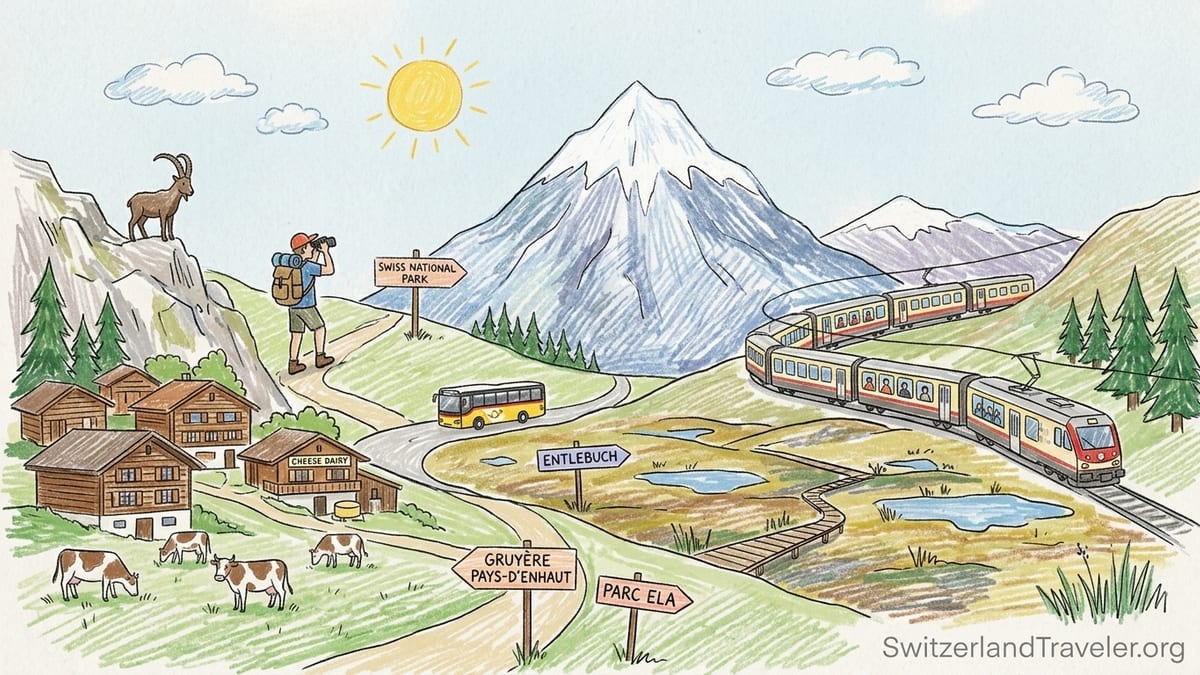
Switzerland’s parks of national importance are not interchangeable green blobs on a map. Each of them combines protected landscapes with living traditions, small-scale agriculture and everyday village life. For travelers willing to go a little beyond the classic Matterhorn-and-Jungfraujoch loop, they offer exactly what many visitors now crave: quieter trails, more local encounters and a stronger sense of place. This guide focuses on seven standout parks, each with its own personality and ideal season, and suggests how many days you should plan to make the most of them.
Why Swiss Parks Belong On Your Itinerary
Unlike the national park systems in some larger countries, most Swiss parks are not wilderness sealed off from human life. With one big exception, the Swiss National Park in the Engadine, these protected areas are mosaics of working farms, compact villages, cultural landmarks and carefully managed wild spaces. You can hike to a limestone ridge in the morning, watch cheese being made in a high Alpine hut at midday, then sleep in a mid-range family-run hotel or simple guesthouse that evening.
Practically, this means you rarely need a car. The vast majority of these parks are linked by regular trains, PostBus routes and sometimes seasonal “nature shuttles.” For example, reaching the UNESCO Biosphere Entlebuch from Lucerne can be as easy as hopping on an hourly regional train from the city’s main station and stepping off in Schüpfheim or Entlebuch village around 35 to 45 minutes later, with onward buses to trailheads. In the Gantrisch Nature Park near Bern, new on-demand services like MyBuxi and park-branded buses connect visitors to ridge walks and forest boardwalks without needing to drive.
Switzerland Tourism describes these parks as distinct landscapes that pair nature with traditions and regional culture. In practice, that means each park is better for some travelers than others. The Swiss National Park suits hikers who want strict wilderness rules and higher chances of ibex sightings. Gruyère Pays-d’Enhaut appeals to food-motivated travelers who want to see where their fondue and meringues actually come from. Parc Ela rewards those happy to base themselves in a Graubünden village and spend days crossing high passes used since Roman times.
This article focuses on seven of the most interesting parks for visitors: Swiss National Park, Entlebuch, Parc Ela, Val Müstair, Jura Vaudois, Gruyère Pays-d’Enhaut and Gantrisch. For each, you will find a traveler profile, best season, suggested length of stay and real-world examples to help you imagine how a visit fits into a wider Swiss itinerary.
Swiss National Park: Switzerland’s Wilderness Flagship
The Swiss National Park in the Lower Engadine valley is the country’s only official national park and by far its strictest protected area. Centered around the village of Zernez, often called the gateway to the park, it covers a high mountain landscape where nature is deliberately left to its own devices. Hiking off marked trails, wild camping, lighting fires and even leaving official paths at night are prohibited, which can surprise visitors used to more relaxed Alpine areas. In return, you get one of the best chances in Switzerland to see red deer, chamois, ibex and marmots in a landscape almost free of modern infrastructure.
For independent travelers, the park’s 100 kilometers or so of marked hiking paths are the main draw. A typical day might start with an early bus from Zernez to the Val Trupchun trailhead, followed by a 4 to 5 hour hike into a side valley where red deer graze on distant slopes and golden eagles sometimes circle overhead. In high season, it is not unusual to see photographers carrying long lenses on sturdy tripods, hoping to capture wildlife from the legal distance. At the end of the day, hikers often return to mid-range hotels and guesthouses in Zernez or nearby Scuol, where dinner menus might feature Engadine barley soup and capuns, a local chard-wrapped dumpling dish.
The National Park Centre in Zernez, recently modernized and easily reached on foot from the train station, is more than a visitor center. Its permanent exhibition “Wilderness in the centre” explains the park’s philosophy and rules with interactive models and films, and there is an information wall covering the parks of the wider Graubünden region. Families often start their visit here before committing to longer hikes. Admission is typically in the range of a mid-priced museum ticket in Switzerland, and lockers make it easy to drop luggage if you are in transit between trains.
Traveler profile, season and length of stay: The Swiss National Park is ideal for hikers, wildlife watchers and photographers who appreciate clear rules and do not mind that there are no mountain bike trails, no ski lifts and no restaurants inside the protected zone. It works well for serious day hikes or for multi-day trekkers continuing into the neighboring Val Müstair. The best season for most travelers is late June to late September, when snow has melted from most trails and wildlife is visible on open slopes. Aim for at least two full days on the ground: one day for a major hike such as Val Trupchun, and another for an easier valley or forest walk combined with a visit to the National Park Centre.
Entlebuch: Moorlands, Karst and Easy Access From Lucerne
The UNESCO Biosphere Entlebuch lies between Lucerne and Bern and protects one of Switzerland’s richest concentrations of moorlands alongside striking karst formations. It feels surprisingly wild given its central location and easy rail access. The area is a patchwork of raised bogs, chalky limestone hills and small farming villages where brown-and-white cows graze close to bus stops and school playgrounds. For travelers who want a strong sense of nature but must keep travel times short, Entlebuch offers a compelling alternative to more distant Alpine destinations.
One of the flagship experiences is the Moorland Landscape Trail, an approximately 80 kilometer long-distance route divided into five one-day stages. It stays on existing mountain paths and small roads and crosses some of the biosphere’s most impressive bog landscapes. The high moor near Sörenberg is listed as a wetland of international importance, and access is tightly controlled; you walk along marked routes skirting the bog rather than trampling into it. Many visitors, especially families, opt for a single day stage instead of the full trail, combining it with a meal at a mountain inn serving simple dishes like Älplermagronen (Alpine macaroni with cheese, potatoes and onions).
Entlebuch’s karst landscapes are equally distinctive. Around the Schrattenfluh, a limestone ridge above Sörenberg, the ground is riddled with grooves and sinkholes. Guided excursions, sometimes offered in summer through local tourism offices, introduce visitors to caves and surface formations while emphasizing how fragile these systems are. Because Entlebuch is a UNESCO biosphere, it also foregrounds local produce: farm shops along the valley road sell raw-milk cheeses, dried meats and honey, and some guesthouses market themselves as “biosphere partners” committed to sourcing ingredients locally.
Traveler profile, season and length of stay: Entlebuch is best for travelers based in Lucerne or Bern who want nature-rich day trips or a short, lower-altitude hiking break. It suits families, moderate hikers and anyone with an interest in wetland ecology and farm life. The main hiking season runs from around June to October on higher routes such as the Moorland Trail, though valley walks and village visits are possible from spring to late autumn. Budget at least one full day if you are dipping in from Lucerne; two days lets you combine a moorland hike with a karst-focused walk and time to linger in villages like Schüpfheim or Sörenberg.
Parc Ela: Big-Sky Mountain Passes and Quiet Villages
Parc Ela, in the canton of Graubünden, is Switzerland’s largest nature park and a paradise for travelers who love big, open landscapes. The park surrounds three historically important passes: Albula, Julier and Septimer. Ancient trade routes traversed these corridors, and today’s hikers follow in their footsteps along trails that cross high meadows, traverse scree slopes and pass through villages where Romansh, German and Italian influences meet. The park takes its name from Piz Ela, a distinctive peak of layered rock at the center of the protected area.
Unlike the Swiss National Park, Parc Ela includes settled areas and working infrastructure. Alpine trains climb over the Albula line, buses grind up to the Julier Pass at over 2200 meters above sea level, and you will often hear cowbells as you walk. Yet the sense of space and relative quiet is striking. A multi-day circuit trail circles the park from village to village, linking places like Tiefencastel, Radons, Bivio, Bergün and Lenzerheide via mountain huts and small inns. Some routes overnight at Club Alpino or Swiss Alpine Club huts such as the Ela Hut or Kesch Hut, where dinner is served at communal tables and dormitory bunks are the norm.
Parc Ela is also rich in cultural side trips. At the bottom of the Albula valley, the rail museum near Bergün explains how engineers carved spiral tunnels and viaducts into the landscape, while baroque churches and old patrician houses recall the days when pack animals carried salt and wine over the passes. In practice, a traveler might spend a morning hiking from Preda to Bergün along the Albula line, pausing to photograph stone viaducts, and the afternoon swimming in a local lake or sampling regional specialties such as capuns or homemade nut cake in a village café.
Traveler profile, season and length of stay: Parc Ela is ideal for strong hikers, long-distance walkers and landscape photographers who want an Alpine feeling without the heavy lift infrastructure of bigger resorts. It fits well into a longer Graubünden itinerary that might also include the Engadine or Davos. The prime season runs from late June to the end of September, when higher passes are generally snow free and mountain huts fully operational. Plan three to five days if you want to complete a meaningful section of the park circuit or link several high passes; a shorter two-day visit can still be rewarding if you base yourself in a village like Savognin, Bivio or Bergün and do day hikes.
Val Müstair: Where Culture and Nature Intertwine
Val Müstair, at Switzerland’s eastern edge near the Italian border, is both a regional nature park and part of a larger UNESCO biosphere that also includes the Swiss National Park. This valley combines a strong conservation ethic with centuries-old cultural heritage. Terraced fields, traditional wooden houses and small-scale agriculture sit alongside protected forests and meadows that support an impressive variety of species. For visitors, the result is a place where walking through the landscape feels like stepping into a living open-air museum rather than an isolated reserve.
One of the valley’s cultural anchors is a medieval monastery complex in Müstair village, which is recognized for its nearly complete set of early medieval frescoes. A typical day for a culture-focused traveler might involve touring the monastery in the morning, then following one of the marked nature trails to a nearby hamlet where small guesthouses serve seasonal dishes using local produce. Honey, herbal teas and organic grains from the valley are often labeled with biosphere branding, so you can literally eat your way through local conservation projects.
For hikers, Val Müstair offers a wide range of paths that link up with the routes of the Swiss National Park across the pass. The Senda Val Müstair, for example, is a day hike of roughly 10 kilometers that traverses meadows and forests with broad valley views, especially lovely during the Bergfrühling, the mountain spring period when wildflowers bloom. In summer, it is relatively easy to combine a stay in Val Müstair with day hikes into the national park on the other side of the pass, using PostBus connections and planning ahead for travel times of one to two hours between valley bases.
Traveler profile, season and length of stay: Val Müstair is a good match for travelers who value a slower, more contemplative rhythm: walkers who want to combine gentle to moderate hikes with visits to churches, small museums and farms. It also works well for families looking for a quieter alternative to more famous resorts, especially if they enjoy educational trails and simple guesthouses rather than luxury hotels. The valley has something to offer in all seasons, but for hiking and cultural visits, late May to October is broadly the most convenient window. Two to three full days allow time to visit the monastery, explore several themed trails and enjoy at least one longer hike linking towards the national park or nearby passes.
Jura Vaudois: Forests, Crests and the Vallée de Joux
On the opposite side of the country from the big Alpine resorts, the Jura Vaudois Nature Park stretches from the Dôle peak above Lake Geneva through forested ridges and open pastures to the Vallée de Joux. It is a gentler mountain world of rounded crests and dry stone walls, shaped by cattle and watchmakers rather than glaciers. The park encompasses villages between the foot of the Jura range and the high valley, as well as three well-known road passes: La Givrine, Marchairuz and Mollendruz. For travelers based in Geneva or Lausanne, it offers fast access to cooler air and quiet trails.
The Vallée de Joux, at the park’s heart, is a long, high valley with a lake lined by small villages and discreet watch factories. In summer, families picnic along the lakeshore or rent paddle boards, while hikers and trail runners head up to crest paths that follow the French border, with broad views over Lac Léman and the distant Alps. In winter, the same open pastures become a cross-country ski network, with modestly priced day passes sold at local sports shops and cafés. Small hotels and guesthouses typically offer hearty menus focused on regional cheeses and charcuterie.
A typical day trip from Lausanne might involve a morning train to the foot of the Jura, a PostBus ride up to the Marchairuz pass, then a 3 to 4 hour walk along the skyline before descending to a village where you can catch an afternoon connection back to the city. The forests here are managed but extensive, with patches of near-silence only an hour or so away from major urban centers. Interpretive panels along some trails explain how local farmers manage “pré-bois” pastures where scattered conifers stand among grazing land, a characteristic feature of the Jura landscape.
Traveler profile, season and length of stay: Jura Vaudois is ideal for visitors to Geneva and Lausanne who want to see a different Switzerland than the high Alps, and for hikers who prefer rolling terrain to steep climbs. It suits long weekend trips, low-key family holidays and even spontaneous day hikes when the weather is good. The best times to visit for walking are late April to October, with snow lingering on higher crests into spring and returning by late autumn. One full day is enough for a representative hike, but two to three days based in the Vallée de Joux or a Jura village allow you to explore both crests and lake, and perhaps tour a small watch museum or chocolate factory in nearby towns.
Gruyère Pays-d’Enhaut: Cheese, Chalets and Storybook Villages
The Gruyère Pays-d’Enhaut Nature Park spans parts of the pre-Alpine regions of the cantons of Fribourg and Vaud, and is arguably the most instantly charming of Switzerland’s parks. This is the homeland of Gruyère cheese and traditional Alpine dairy culture, where timber chalets are decorated with carved balconies and summer pastures still host “désalpe” festivities when cows descend from the mountains. The park links places such as the medieval hilltop town of Gruyères, the Pays-d’Enhaut villages of Château-d’Oex and Rougemont, and side valleys where cheese is produced in simple mountain huts.
For many travelers, food is the main attraction. You can watch cheesemakers in action at visitor-friendly dairies near Gruyères or in smaller mountain cooperatives, then sample fondue, raclette or meringues with double cream in village restaurants. A typical day might involve arriving by train at Gruyères station, walking up to the old town to tour the castle and modern art museum, then continuing on a signed path to a nearby alp where cheese is made over open fires during summer. Prices for fondue in touristy restaurants can be on the higher side by Swiss standards, but menus in less famous villages or weekday lunch specials often offer better value.
Hiking in the park ranges from gentle riverbank strolls to steeper routes up grassy peaks. Families often choose panoramic paths that link villages in the Pays-d’Enhaut, where frequent train and bus connections make it easy to shorten or extend walks as energy levels dictate. In winter, the same slopes host modest ski areas and snowshoe routes, and some farms offer overnight stays in rooms above the cowshed or in simple agrotourism guesthouses, usually booked directly or via regional tourism offices.
Traveler profile, season and length of stay: Gruyère Pays-d’Enhaut is perfect for travelers who want a strong dose of “classic” Swiss village atmosphere and are interested in culinary traditions. It works well as a base for families, older travelers and first-time visitors who prefer gentle to moderate walking and a wide choice of cafés and restaurants. The park is attractive year-round, but for green pastures, open alps and cheese-making demonstrations, late May to early October is the sweet spot. Plan two to three days if you want to mix village sightseeing, at least one full hiking day and unhurried meals; day trips from cities such as Fribourg, Montreux or Lausanne are also very feasible.
Gantrisch: Accessible Hiking Near Bern
The Gantrisch Nature Park lies surprisingly close to the Swiss capital, spreading between Bern and Fribourg over a chain of peaks, forests, moorlands and the blackwater river valleys of the Sense and Schwarzwasser. For visitors staying in Bern, it is one of the easiest ways to experience wilder landscapes without committing to long train rides into the high Alps. The park includes the Gantrisch mountain itself, a prominent peak with a via ferrata route, as well as family-friendly boardwalks like the Gäggersteg, which crosses a forest recovering from storm damage and offers open views towards the Alps.
Public transport access has improved in recent years. Standard PostBus routes connect Bern with key points like the Gurnigel pass, a popular starting point for ridge walks. In addition, regional partners have introduced branded “nature park buses” on certain lines and flexible on-demand shuttles such as MyBuxi, which visitors can book via app to reach trailheads without needing to interpret complex bus timetables. A realistic example: a traveler can leave Bern just after breakfast on a weekend, ride a bus up to Gurnigel Berghaus, complete a 4 to 5 hour loop along the Gantrisch ridge and be back in Bern in time for dinner.
Gantrisch offers a spectrum of activities, from moderately demanding ridge hikes and the via ferrata on Gantrisch peak to gentle walks along rivers and through forests. Local initiatives encourage low-impact visits, and small restaurants and farm cafés near trailheads serve simple, regionally sourced dishes like cheese plates, rösti and seasonal fruit tarts. Compared with the better-known Bernese Oberland around Interlaken and Grindelwald, the Gantrisch park feels more local and less polished, which many visitors appreciate once they have ticked off the big-name viewpoints.
Traveler profile, season and length of stay: Gantrisch is ideal for active travelers staying in Bern or Fribourg who want full days of hiking with minimal travel time, as well as for Swiss rail pass holders looking to make the most of their network ticket with short, scenic outings. The main hiking season runs from roughly May to October, with snow persisting on higher routes into spring and early-season weather sometimes changeable. One or two days are sufficient for most visitors: one day for a ridge hike or via ferrata, and, if you stay longer, another for gentler valley walks, river gorges or family-friendly boardwalks.
The Takeaway
Switzerland’s parks of national importance are not a single product repeated across different regions. The Swiss National Park delivers strict wilderness and serious wildlife watching. Entlebuch offers moorlands and karst a short train ride from Lucerne. Parc Ela opens up vast Alpine passes and quiet villages in Graubünden. Val Müstair blends nature with deep cultural roots. Jura Vaudois brings forests and crests within easy reach of Lake Geneva cities. Gruyère Pays-d’Enhaut wraps pre-Alpine landscapes in cheese and chalet culture. Gantrisch gives Bern-based travelers a gateway to real mountains in a single day.
For a first or second trip to Switzerland, combining one or two of these parks with a more classic hub such as Lucerne, Interlaken or Zurich can dramatically change the feel of your journey. You might spend a morning on a popular lake cruise, then find yourself almost alone on a moorland trail the next day, watching clouds drift over quiet pastures. With careful use of trains, buses and regional passes, these parks are accessible without a car and can be explored on modest daily budgets by Swiss standards, especially if you self-cater some meals and choose simple guesthouses.
Ultimately, the “best” Swiss park is the one that matches your travel style and season. If you value wildlife and do not mind rules, head for the Engadine and the Swiss National Park. If you are drawn to food and photogenic villages, try Gruyère Pays-d’Enhaut. If you crave big landscapes and long trails, Parc Ela may be your place. Whatever you choose, plan at least a full day on the ground, pack for changeable mountain weather and allow yourself enough unstructured time to sit on a bench, listen to cowbells and watch the light change on the hillsides.
FAQ
Q1. Do I need a car to visit these Swiss parks?
Most travelers do not need a car. All seven parks described here are reachable by a combination of trains, PostBus routes and, in some cases, on-demand shuttles. A Swiss Travel Pass or regional day tickets can make travel more economical, especially if you plan several park visits in the same trip.
Q2. How many days should I allocate to the Swiss National Park specifically?
Two full days are a good minimum for the Swiss National Park. One day lets you tackle a major hike such as Val Trupchun, while the second can combine an easier walk with a visit to the National Park Centre in Zernez. Serious hikers and wildlife photographers often stay three or more days to increase their chances of good conditions and animal encounters.
Q3. Is Entlebuch suitable for families with younger children?
Yes. Entlebuch is well suited to families thanks to its moderate terrain, clear signage and short access from Lucerne and Bern. You can choose shorter sections of the Moorland Landscape Trail, visit accessible viewpoints near Sörenberg and combine walks with stops at farm cafés or small playgrounds in village centers.
Q4. What is the best time of year to visit Parc Ela for hiking?
The main hiking season in Parc Ela runs from late June to late September, when most high passes are free of snow and mountain huts are open. Early summer brings wildflowers and lingering snowfields, while late summer and early autumn offer stable weather and clearer views. Outside this window, some higher routes can be unsafe or closed.
Q5. Can I combine Val Müstair and the Swiss National Park in one trip?
Yes. Val Müstair and the Swiss National Park are neighboring areas within a larger UNESCO biosphere, and bus connections over nearby passes make it possible to combine them. Many travelers base themselves in one valley for a few nights, then move to the other, using a mix of PostBus and regional trains to transfer between them.
Q6. Are the Jura Vaudois trails easier than those in the Alps?
Generally, yes. The Jura Vaudois offers rolling crests and forest paths with gentler gradients than many Alpine trails, making it suitable for moderate hikers and families. However, distances can still be long, and weather can change quickly, so proper footwear, layers and basic navigation skills remain important.
Q7. Is Gruyère Pays-d’Enhaut worth visiting if I am not a big hiker?
Very much so. Gruyère Pays-d’Enhaut combines accessible village walks, cultural visits and food experiences. You can spend your time touring the castle in Gruyères, visiting cheese dairies, riding scenic trains and taking short walks between villages without committing to strenuous hikes.
Q8. How close is Gantrisch to Bern, and can it be visited as a half-day trip?
Gantrisch is close enough to Bern to be visited in a long half-day, though a full day is more satisfying. Buses from Bern to trailheads around Gurnigel typically take around an hour. With a morning departure and afternoon return, you can comfortably complete a moderate hike, enjoy a meal at a mountain inn and be back in the city for the evening.
Q9. Are there entry fees to these parks?
There are generally no gate-style entry fees to these Swiss parks. Costs arise from transport, accommodation, guided tours, museum visits and, in some cases, parking if you drive. The Swiss National Park charges admission only for the visitor center, not for hiking access itself. Budget-conscious travelers can keep costs down by using public transport passes and choosing simple lodgings.
Q10. How should I prepare for weather in these parks?
Mountain and pre-Alpine weather is changeable, even in summer. Pack lightweight layers, a waterproof jacket, sun protection, and sturdy walking shoes or boots. Check local forecasts the evening before your hike and again in the morning, and be ready to shorten or alter your plans if thunderstorms or sudden cold fronts are predicted.