


Switzerland’s parks of national importance cover about 15 percent of the country and range from strict wilderness to lived-in cultural landscapes. For a first-time visitor, the labels and categories can be confusing, but understanding how the Swiss National Park, regional nature parks and nature discovery parks differ is the key to planning a realistic itinerary that fits your time, fitness and interests.
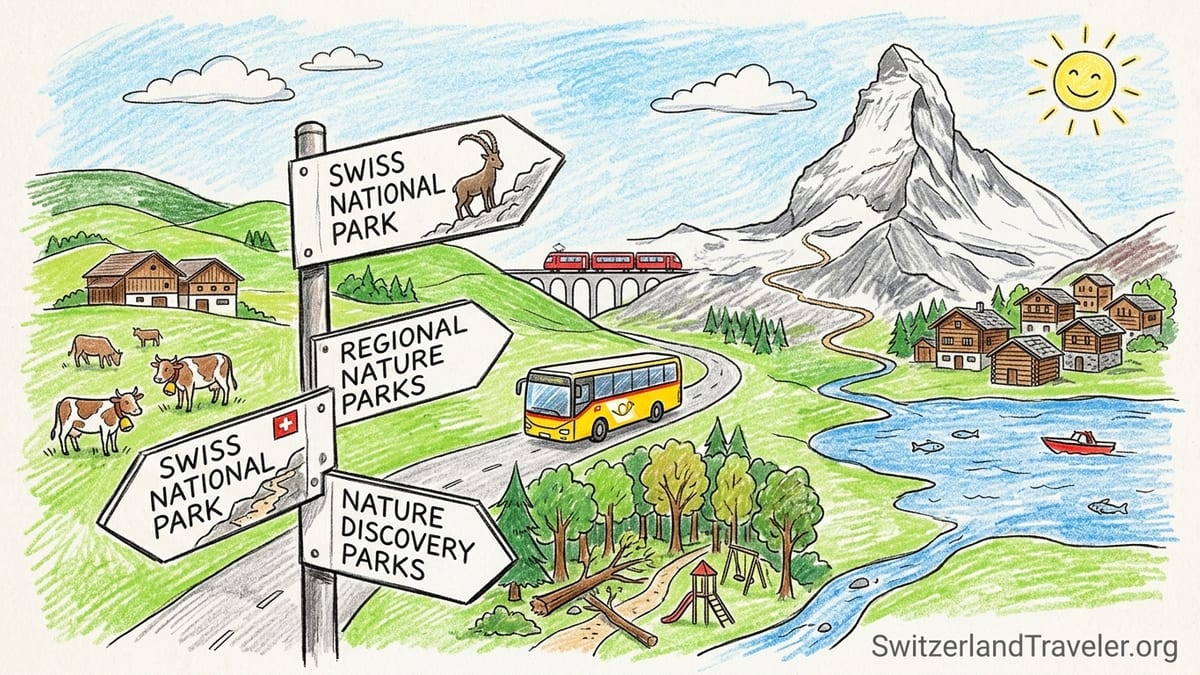
How the Swiss park system works
Switzerland officially recognises 20 “parks of national importance,” grouped into three categories under federal law: one Swiss National Park, 17 regional nature parks and two nature discovery parks. All three categories aim to protect landscapes and biodiversity while supporting local communities, but they differ in how strictly they are managed and how people can use them in everyday life.
The Swiss National Park in the canton of Graubünden is the country’s oldest and most strictly protected area. It follows a near-wilderness philosophy: nature is left largely to itself, and visitors follow a dense but clearly defined network of waymarked trails. Off-trail walking, picking flowers, making fires and bringing dogs (even on a leash) are prohibited, and visitors are expected to treat the park more like an open-air laboratory than a leisure resort.
Regional nature parks, such as Parc Ela in Graubünden or Gruyère Pays-d’Enhaut in western Switzerland, are different. They are lived-in regions where people farm, make cheese, run guesthouses and operate small businesses. Protection and tourism are balanced: you can drive through villages, stay in hotels or farmstays, visit cheese dairies and still find wild valleys with ibex, chamois and golden eagles. These parks are typically large, sometimes spanning multiple cantons, and they are ideal for visitors who want a mix of hiking, scenery and culture.
Nature discovery parks occupy a middle ground between the strict national park model and everyday landscapes. Wildnispark Zürich Sihlwald near Zurich is the best-known example. The core forest area has been left to develop naturally for decades, with fallen trees and old-growth beech woods, but it is ringed by accessible paths, picnic areas and an animal park. These sites are designed for environmental education and easy access by public transport, especially for families and school groups.
Understanding the 20 parks and how they are distributed
On a map, the 20 parks of national importance form a loose ring around the Alps and Jura, with a few outliers close to major cities. The Swiss National Park anchors the eastern Alps near Zernez. Around it, several regional nature parks like Parc Ela, Biosfera Val Müstair and Parco Val Calanca form a cluster of protected landscapes in Graubünden, making this one of the densest park regions in the country.
In the west, a chain of regional nature parks runs through the Jura and pre-Alps. Parc Jura vaudois and Parc régional Chasseral protect the Jura ridges above Lake Geneva and the Swiss Plateau, while Gruyère Pays-d’Enhaut and the UNESCO Biosphere Entlebuch straddle the Prealps between Lake Geneva and central Switzerland. Further south in Valais, Pfyn-Finges spans the dry inner Rhone valley with its vast pine forest and vineyards.
Closer to the German border, you will find parks such as Jurapark Aargau, Regionaler Naturpark Schaffhausen and Park Thal. These areas preserve rolling hills, river valleys and traditional villages with half-timbered farmhouses, and they are among the easiest parks to reach from Basel, Zurich and Bern. Schaffhausen even extends across the border into Germany, reflecting how natural landscapes ignore political lines.
The two nature discovery parks are deliberately located near large urban centres to make wild nature feel close at hand. Wildnispark Zürich Sihlwald lies just south of Zurich along the Sihl valley, and the second nature discovery park, currently located in western Switzerland, is similarly designed for easy access with marked core zones where nature is left largely undisturbed and visitor zones with educational trails and facilities.
Regions and realistic park combinations
Because distances in Switzerland are short and public transport is dense, you can combine several parks in one trip, but it helps to think in regions rather than individual sites. In the Eastern Alps, the logical cluster is around the Swiss National Park. Using Zernez as a base, you can explore the national park itself, then travel over the Ofen Pass into Biosfera Val Müstair, a regional nature park that combines traditional Romansh villages, terraced fields and forested slopes. With an additional day or two, Parc Ela, centred around the Albula and Julier passes, offers more expansive mountain hiking and small, stone-built villages.
In Valais, a realistic combination is Pfyn-Finges and nearby destinations like the Aletsch region. Based in Sierre, Sion or Leuk, you can hike through the Pfynwald, one of the largest continuous Scots pine forests in Switzerland, then take day trips by train and cable car to viewpoints above the Aletsch Glacier. Although the glacier area itself is not a regional nature park, it fits naturally into a park-focused itinerary thanks to its strict protection and network of signed trails.
For visitors based in western Switzerland, the Jura chain offers another set of park combinations. From Lausanne or Geneva, you can reach Parc Jura vaudois in around one hour by train and bus, spending a day walking along pasture ridges dotted with dry-stone walls and solitary maple trees. On another day, you could travel north to Parc régional Chasseral with its panoramic crest above the lakes of Neuchâtel and Biel, or to Parc du Doubs on the French border, known for its secluded river gorge and watchmaking towns.
In the Mittelland and around Zurich, shorter park excursions fit well into city-based trips. From Zurich or Basel, visitors can combine Jurapark Aargau and Park Thal over two or three days, walking between orchards, vineyards and wooded hills while staying in small-town hotels. The Regionaler Naturpark Schaffhausen, with the Rhine Falls as a natural highlight, is within easy reach of Zurich by S-Bahn and regional trains, making it an attractive day or overnight trip for first-time visitors.
Geography, landscapes and what to expect on the ground
Switzerland’s national and regional parks reflect the country’s major landscape types. In the high Alps, such as the Swiss National Park, Parc Ela or Beverin Nature Park, you will find deep U-shaped valleys, glaciers or former glacier basins, and rugged peaks that can stay snow-covered into early summer. Trails here often involve significant elevation gain, and above the tree line you will be exposed to weather, so even in July temperatures can drop quickly in the afternoon.
The inner Alpine valleys, especially in Graubünden and Valais, have a noticeably drier, more continental climate than the northern foothills. In Pfyn-Finges, for example, the Rhone valley receives relatively low rainfall, which allows for extensive Scots pine forests and sunbaked vineyards on south-facing slopes. Hikers can move from shady riverside paths to open, stony hillsides in a single day, so packing layers, sun protection and enough water is essential in late spring and summer.
The Jura parks such as Jura vaudois, Chasseral and Parc du Doubs are lower in altitude but still feel wild. Their characteristic features are limestone plateaus, sinkholes and ridges with sweeping views over the Swiss Plateau and the Alps beyond. Forests of beech and spruce alternate with open pastures, where dairy cows graze and bell sounds carry across the hillsides. In wet periods, some trails can become muddy or temporarily closed due to forestry or pasture management, and signposted detours are common.
Closer to the Swiss Plateau and major cities, parks like Jurapark Aargau, Regionaler Naturpark Schaffhausen and Wildnispark Zürich combine river landscapes, mixed deciduous forests and gently rolling farmland. In Sihlwald, for instance, visitors encounter an old beech forest left largely untouched for decades, where fallen trunks and deadwood are intentionally left in place to support insects, fungi and birds. Paths in these lowland parks are often wider, with compacted gravel suitable for strollers and casual walkers, but core zones can still feel surprisingly remote once you leave the main access points.
Hiking, public transport and practical access
All Swiss parks integrate with the national yellow signposted hiking trail network. Trail difficulty is graded from easy valley walks to alpine routes that cross scree and require sure-footedness and good weather. In the Swiss National Park, for example, popular day hikes from Ofenpass or Zernez follow marked mountain paths with clear signage, time estimates and colored difficulty indicators. Because leaving the path is forbidden, you can plan safely around these waymarked routes, but you still need solid hiking shoes and a basic level of fitness.
Public transport is one of the great advantages of visiting Swiss parks. Most have railway stations or PostBus stops at key trailheads and visitor centres. To reach the Swiss National Park, visitors typically travel by train to Zernez, then continue by yellow PostBus to stops such as Il Fuorn or Val Trupchun. For Jura parks, regional trains and buses connect plateau towns like Le Sentier or Saint-Ursanne with nearby ridges. In Wildnispark Zürich Sihlwald, the S4 suburban train from Zurich drops you directly at Sihlwald station next to the visitor centre, making it an easy half-day trip even for jet-lagged travellers.
For first-time visitors planning to move between several parks, a Swiss Travel Pass or a regional pass can be cost-effective, especially if you plan multiple long-distance train journeys and local buses. A typical one-way train ride from Zurich to Zernez might cost the equivalent of several dozen Swiss francs without a pass, while regional bus journeys within parks are usually a fraction of that. Always check timetables in advance, as some high mountain bus routes or alpine passes only operate from roughly late June to early October, depending on snow conditions.
In terms of seasonal access, lowland and Jura parks can be enjoyed almost year-round. Winter brings snowshoe trails and cross-country ski circuits to places like Gantrisch and Jura vaudois, often starting from small mountain inns reachable by bus. High Alpine parks have a shorter main hiking season, typically from late June to October. Early summer can still mean snow patches above 2,000 metres, while September often offers stable weather and quieter trails after the peak holiday season.
Wildlife, family activities and educational experiences
Swiss parks are among the best places in the country to see wildlife that is otherwise elusive in more developed areas. In the Swiss National Park, it is common to spot groups of red deer grazing on alpine meadows at dawn and dusk, while marmots whistle and dive into burrows near the paths. With patience and binoculars, visitors may glimpse ibex on rocky slopes or chamois on steep grass faces. Spotting predators such as lynx or wolves is rare, but their presence is part of the broader ecological story explained at visitor centres.
Regional nature parks add another layer to the experience by combining wildlife with traditional land use. In Beverin Nature Park, for instance, ranger-led excursions focus on ibex colonies above the gorge of the Hinterrhein. In Gruyère Pays-d’Enhaut, families can watch cheese being made in alpine huts before walking short themed trails through pastures filled with wildflowers in early summer. Many parks signpost “family trails” or “discovery paths” with simple information panels and interactive elements, such as wooden animal tracks or listening posts.
Nature discovery parks are particularly designed with families and school groups in mind. Wildnispark Zürich combines a near-wild forest in Sihlwald with the Langenberg wildlife park, where native animals like bears, lynx and wolves live in large enclosures. Children can follow short loops with viewing platforms, playgrounds and picnic spots within a short walk of the entrance. Because the park lies within the Zurich transport network, families can reach it with a standard city ticket, making an impromptu visit easy even for those staying only a few days.
Across the park network, visitor centres provide exhibitions, short films and hands-on displays in multiple languages, usually including English. In Zernez, the Swiss National Park visitor centre explains how the area has been left to natural processes for over a century, with time-lapse images showing forests reclaiming old pastures. In the UNESCO Biosphere Entlebuch, the visitor centre highlights raised bogs and karst formations, while offering guided excursions like moorland walks or lantern-lit winter outings. These facilities are invaluable for orienting first-time visitors and understanding the rules and seasonal conditions before heading onto the trails.
Accommodation, food and staying inside or near the parks
Accommodation inside Swiss parks ranges from simple mountain huts and farmstays to comfortable village hotels and guesthouses. In the Swiss National Park, there are no hotels inside the core protected area, but you can stay in nearby villages such as Zernez, Scuol or S-charl, or overnight at mountain huts like Chamanna Cluozza, which offers basic dormitory beds and communal meals. Bookings are often essential in peak season, and facilities are focused on hikers rather than luxury seekers.
Regional nature parks offer a broader mix of stays, which is part of their appeal for first-time visitors. In Parc Ela, for example, visitors can sleep in historic stone houses in Bergün or Filisur, in farm guest rooms on the surrounding slopes, or in small hotels near the Albula railway line. In Gruyère Pays-d’Enhaut, you can combine a stay in the medieval town of Gruyères with nights in chalet-style guesthouses higher in the valleys, making day hikes possible without long transfers. Some parks encourage certified “park partner” accommodations that commit to local sourcing and energy efficiency.
Camping options vary. Some parks have official campsites at valley level, often near riverbanks or village edges, with hot showers and small shops. Wild camping is heavily regulated or prohibited in many areas, especially above the tree line, within core zones or near sensitive wetlands. In the Swiss National Park it is not allowed at all. Travellers who wish to sleep closer to nature can look for designated “Trekkingplatz” style sites outside core zones or stay in serviced mountain huts on multi-day hikes.
Food is a highlight across all parks, because regional products are a core part of the concept. In Jura parks, that might mean hard mountain cheeses, cured meats and rustic tarts. In Valais, you can taste local wines, dried meat and raclette made from milk produced on nearby pastures. In Graubünden, barley soup, dried beef and nut-filled pastries often feature on hut menus. Many visitor centres and easy-access viewpoints have a simple restaurant or café offering hot dishes at typical Swiss mountain prices, while self-catering remains the more budget-friendly option for longer stays.
Rules, etiquette and staying safe
All Swiss parks operate under a common set of principles, but specific rules vary by category and zone. In the Swiss National Park, the rules are notably strict: visitors must stay on marked trails, may not pick plants, disturb animals, light fires or fly drones, and dogs are not allowed within the park boundaries. These rules are clearly displayed at every trailhead and in printed brochures, and rangers patrol the area, both to provide information and to enforce regulations when necessary.
In regional nature parks, rules are more flexible but still important. Dogs are usually allowed on a leash, though they may be banned or restricted during the spring and early summer wildlife breeding season or in areas with grazing livestock. Open fires are typically permitted only at designated fireplaces, which are often marked on local hiking maps. Because these parks include farms and private properties, closing gates, respecting crop fields and avoiding noise in remote hamlets are all part of basic etiquette.
Nature discovery parks like Wildnispark Zürich combine strict core zones, where you may be asked to remain on certain paths and avoid entering sensitive areas, with more relaxed recreation zones near car parks and visitor centres. Signage explains where barbecues are allowed, which routes are suitable for strollers and where off-trail access is forbidden. Visitors are expected to carry out all rubbish, keep noise low and respect wildlife viewing distances, even in areas that feel less remote than the high Alps.
Across all parks, weather and terrain demand a cautious approach. Sudden storms can build quickly on summer afternoons, especially in the Alps. Trails that look easy on a map may involve steep, uneven sections or lingering snowfields early in the season. Checking a local weather forecast on the morning of your hike, carrying a paper map or offline app, and packing layers, water and snacks are sensible precautions even for short walks. In winter, only signposted snowshoe and winter hiking routes should be used without specialist equipment or experience.
The Takeaway
For a first-time visitor, Swiss parks of national importance offer a structured way to discover some of the country’s most remarkable landscapes without needing a car or advanced mountaineering skills. Understanding the basic differences between the Swiss National Park, regional nature parks and nature discovery parks will help you match your expectations to reality, whether you are dreaming of strict wilderness, cultural landscapes or accessible family outings.
If you have a week, you might pair the Swiss National Park with a neighbouring regional nature park, using trains and PostBus routes to move between valleys. With only a few days, a base in Zurich, Geneva, Lausanne or Bern still gives access to at least one regional park or nature discovery park by public transport, making it possible to add a genuine nature experience to a city-focused trip. Whatever combination you choose, careful attention to local rules, trail signage and seasonal conditions will reward you with safe, memorable encounters with Swiss wildlife, landscapes and rural culture.
FAQ
Q1. What is the main difference between the Swiss National Park and regional nature parks? The Swiss National Park is a strictly protected wilderness area where nature is largely left to itself, with tight rules on access and behaviour. Regional nature parks are lived-in landscapes that combine conservation with agriculture, tourism and everyday village life, allowing more flexible activities and a wider range of accommodation and services.
Q2. Which Swiss park should I visit if I only have one extra day in Zurich? Wildnispark Zürich Sihlwald is the most practical choice. You can reach it directly by suburban train from Zurich, walk on well-marked forest trails, visit the wildlife park and be back in the city by evening without needing a car or overnight stay.
Q3. Are dogs allowed in Swiss parks? Dogs are completely forbidden in the Swiss National Park, even on a leash. In most regional nature parks and nature discovery parks, dogs are permitted on a leash, although some zones or seasons may have extra restrictions, especially in wildlife breeding areas or where livestock graze.
Q4. Do I need a car to explore the parks? No. Most parks are designed to be reached by public transport, using a combination of trains and PostBus services. A car can shorten some approaches, but first-time visitors can comfortably explore many trails, viewpoints and visitor centres using regular public transport alone.
Q5. When is the best season to hike in Swiss parks? Lowland and Jura parks can be enjoyed from spring through late autumn, with winter options for snowshoeing and cross-country skiing. High Alpine parks such as the Swiss National Park and Parc Ela have their main hiking season from roughly late June to October, depending on snow conditions.
Q6. Can I camp inside the parks? Wild camping is generally prohibited or heavily restricted, especially in core zones and sensitive habitats. Some parks have official campsites at valley level, and certain regions offer simple trekking camp spots or serviced mountain huts where overnight stays are allowed with reservation.
Q7. Are there entrance fees for Swiss parks? Access to most park landscapes and hiking trails is free. However, some visitor centres, themed trails, wildlife parks and cable cars within or near the parks may charge admission or transport fees, which help fund conservation and infrastructure.
Q8. How difficult are the hikes in Swiss parks for beginners? Difficulty varies widely, but every park offers easy options such as valley walks, lakeside paths or short themed trails suitable for beginners and families. More challenging mountain routes are clearly marked, so checking trail grading and estimated times at the trailhead helps you choose routes that match your fitness and experience.
Q9. Do Swiss parks offer guided tours in English? Many parks run guided walks, wildlife excursions and themed tours, especially in summer and during school holidays. In more visited regions, some of these activities are offered in English or are language-light and rely on visuals, but availability varies by park and season.
Q10. How can I find an overview map of all 20 Swiss parks? Official maps showing all parks of national importance are available from Swiss federal and park network websites, as well as at visitor centres and tourist offices. These maps illustrate park boundaries, categories and nearby transport lines, helping you see which parks can realistically be combined in a single trip.