

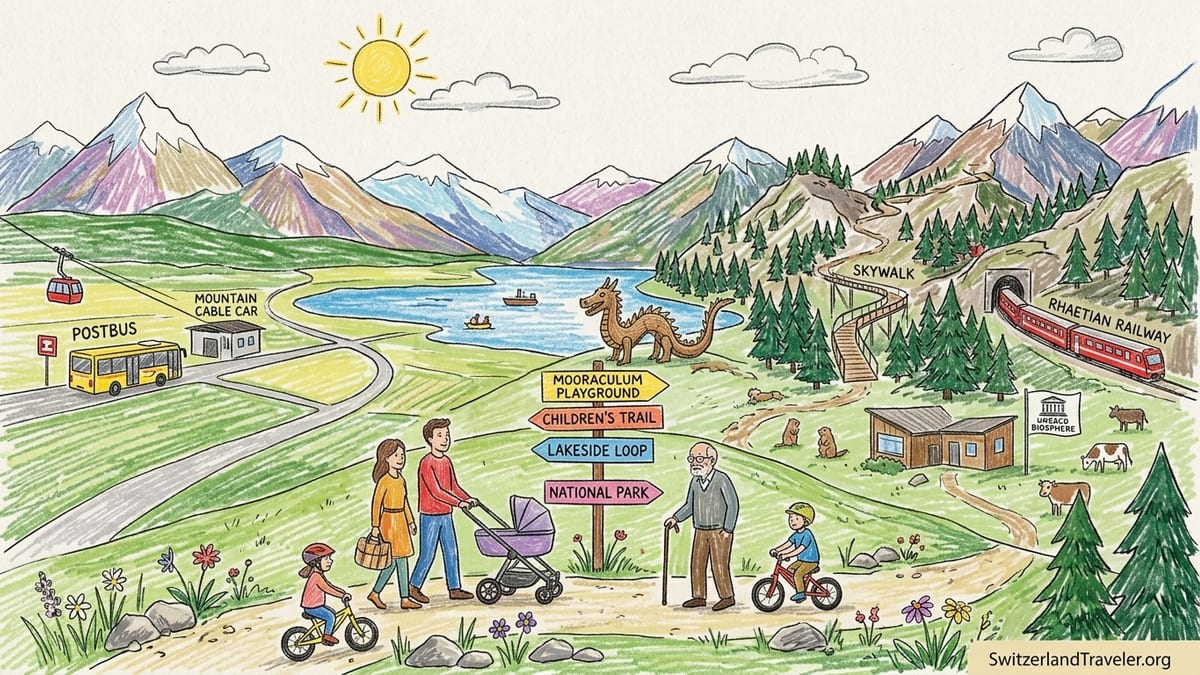
For families, Switzerland’s parks are less about peak bagging and more about that perfect mix of easy trails, cows and cable cars, play areas and picnic spots, and a train ride that drops you right at the start of an adventure. The Swiss Parks Network now curates thousands of activities that can be filtered specifically for children and families, which makes planning easier, but it can still be hard to judge what will work with a stroller, a four year old or grandparents in tow. This guide looks in detail at Entlebuch, Parc Ela, Gantrisch, the Jura parks and the Swiss National Park, focusing on real-world family needs rather than postcard views.
How to Choose the Right Swiss Park for Your Family
When Swiss parents plan a park day, the first question is usually not “Where is the best view?” but “Can we get there easily, push a stroller and keep everyone happy if the weather turns?” In practice that means checking public transport connections, cable cars and chairlifts, how rocky the paths are, and whether there is a visitor center with toilets and a café. In the parks highlighted here, most marquee family outings begin or end at a bus stop or mountain station, so you can rely on trains and PostBus rather than needing a rental car.
Walking ability is the second filter. Toddlers on balance bikes or in strollers need surfaced paths with gradients below roughly ten percent, while fit school-age children can handle two to three hours of undulating trail if there are regular distractions such as animal paddocks, play stations or themed nature panels. The Mooraculum play and moor area above Sörenberg in Entlebuch, the Champlönch children’s trail in the Swiss National Park and the Gäggersteg skywalk in Gantrisch are good examples of routes designed with frequent “wow” moments every few minutes so that shorter legs keep moving.
Budget and backup plans also matter. Cable cars in Switzerland are rarely cheap, but many parks bundle them with local guest cards or hotel packages. Around Entlebuch, for instance, the Sörenberg cable car is often discounted for guests staying in partner hotels, while in the Engadine valley by the Swiss National Park many three-star hotels include local buses and some mountain lifts in summer. On damp days, indoor alternatives such as the National Park Centre in Zernez or the visitor center in Entlebuch give families a focused two-hour experience for the cost of a modest museum ticket rather than a full day lift pass.
Finally, consider accommodation style. Family hotels in or near Swiss parks usually mean practical extras rather than luxury: bunk rooms that sleep four, shared playrooms with board games, a basic playground beside the terrace and healthy kids’ menus. In Gantrisch, for example, simple mountain inns around Gurnigel and Schwarzsee often have outdoor play corners and fields to run in, while in Parc Ela many families base themselves in small Engadine villages like Savognin or Bergün for apartments with kitchens and quick access to themed trails.
Entlebuch UNESCO Biosphere: Moor Playgrounds and Easy Transport
Entlebuch, between Lucerne and Bern, is a UNESCO Biosphere that has quietly become one of the most family-oriented nature regions in the country. From Lucerne it is around 40 to 60 minutes by train and bus to Sörenberg or the village of Entlebuch itself, and the majority of signature family outings start at public transport stops. This is one of the few alpine areas where you can spend several days doing short, educational walks without owning a car.
The star attraction for families is the Mooraculum above Sörenberg, a moorland adventure area at the summit station of a cable car. It combines short circular trails with barefoot paths, water play, wooden climbing structures and information stations about peat bogs and carnivorous plants. Most of the main loop is stroller friendly if you have larger wheels, although some side spurs involve steps or narrow forest paths. Families with toddlers often treat it like an open-air playground, doing just 20 or 30 minutes of walking in between sand and water games, while older children might follow the longer moor discovery trail for an hour or more.
Further down the valley there are additional child-focused circuits, such as forest play trails with giant spider webs and suspension bridges mentioned in recent Entlebuch summer brochures. These are generally graded “easy” and designed for children from around four years old who can walk one to two kilometres without being carried, though many parents still bring a baby carrier for steeper sections. Surfaces vary from gravel forestry roads to natural forest paths, so classic city strollers struggle, but three-wheel “jogger” models and hiking buggies cope well.
Accommodation in Entlebuch leans towards simple family hotels, farm stays and self-catering apartments. It is common to find guesthouses that provide family rooms under about the equivalent of a mid-range city hotel, often including breakfast and a local guest card with discounts on cable cars or moor-themed excursions. In bad weather, the regional visitor center and small indoor pools in nearby towns keep children occupied for an afternoon; many families in practice alternate one high-energy outdoor day with a quieter half-day using local buses and an indoor museum or pool.
Gantrisch: Forest Skywalks, Lakes and Short Ridge Views
Gantrisch Regional Nature Park sits between Bern, Thun and Fribourg and is one of the most accessible wild-feeling areas for families based in the capital region. A train and PostBus combination typically takes under an hour from Bern to the Gurnigel area or to Schwarzsee, and regional tourism boards explicitly advertise Gantrisch as a family region, with a cluster of themed trails and adventure options. Because elevations range from gentle foothills to over 2000 metres, you can choose between stroller-friendly lakeside loops and more adventurous but still family-appropriate ridge walks.
One of the most photogenic and practical family highlights is the Gäggersteg, a wooden skywalk that threads through storm-damaged forest above the Gurnigel pass. Visitor information describes it as a short, educational circuit with gentle gradients and frequent story panels about forest ecology. The elevated sections are built as boardwalks, and most families manage it with robust strollers, though doing the full loop still requires toddlers to walk short, slightly uneven stretches. Because the start is close to a bus stop and small parking area, it is a realistic half-day excursion for mixed-age groups including grandparents and preschoolers.
At Schwarzsee, a small lake included within the Gantrisch park area, there is a well-known lakeside path that typically takes families one and a half to two hours, with regular benches, picnic spots and a dragon-themed story about the “Dragon of the Schwarzsee” that local tourism offices promote. This loop is one of the better options in the region for standard strollers and balance bikes, as much of the path is broad and relatively flat. Older children can combine the lakeside walk with a ride on the small summer toboggan run or rental of monster scooters that descend nearby slopes, while adults appreciate that cafés are never far away.
Gantrisch’s accommodation offer skews towards mountain inns and guesthouses. Around Gurnigel and Schwarzsee, several properties position themselves as family friendly by providing simple four-bed rooms, children’s menus and grassy play areas. Prices and comforts are closer to two or three-star hotels than resort standards, but the trade-off is immediate access to trailheads. In wet weather, families often shift focus to indoor pools in nearby towns like Thun or to smaller attractions such as the rope park in Gantrisch that can operate in light rain with appropriate clothing, while saving longer ridge walks and panoramic routes for clear, dry days.
Parc Ela: Wide Valleys, Heritage Trains and Themed Trails
Parc Ela in Graubünden is Switzerland’s largest nature park and stretches between well-connected valleys served by the Rhaetian Railway. This makes it particularly attractive for families who enjoy combining trains with shorter walks. Villages such as Savognin, Bergün and Filisur are typical bases that offer apartments, mid-range family hotels and campsites, plus easy bus links to high meadows and lake walks. The famous Albula and Julier passes frame the park, but much of the best family terrain lies on gentler slopes and open valley floors.
In Savognin, local tourism offices promote several “Erlebniswege” or experience trails, often themed around marmots, water or local legends, where families follow a series of interactive stations. These routes are usually one to three hours in length, signposted as easy mountain paths, and intended for children from about five years old. Surfaces can be uneven, so classic strollers are impractical; instead, most parents use backpacks or off-road buggies, especially on the steeper stretches near chairlift stations. With the help of lifts, you can start high and walk mostly downhill, which works well for younger children and mixed fitness levels.
Bergün, known for its historic village and proximity to the Albula railway line, offers another style of family day. Many visitors combine a short heritage rail journey with a gentle walk on the railway adventure trail, which parallels the line for stretches and includes viewpoints over viaducts and tunnels. The gradients are generally modest, and sections close to villages can handle sturdy strollers, though there are still rough patches where a baby carrier is easier. This kind of outing appeals particularly to children who are fascinated by trains, as you frequently see and hear them passing.
Accommodation standards in Parc Ela are generally high for a rural area, with a good selection of apartments and a few hotels that market themselves directly to families with playgrounds and children’s corners. Prices vary but are often a little lower than in famous resort towns while still providing access to indoor pools or small wellness areas. For bad-weather days, families may ride the Rhaetian Railway through the park in both directions, stop at indoor village museums or use hotel playrooms and pools, turning the region into a comfortable base even when heavy rain rules out longer hikes.
Jura Parks and Nature Trails: Gentle Slopes and Farm Experiences
The Swiss Jura parks, including the Jura vaudois regional nature park and the Jura & Three-Lakes region, provide a different family experience from the Alps. Here the landscapes are dominated by rolling ridges, open pastures dotted with pines and dry-stone walls, and broad plateaus where cross-country ski trails in winter become pleasant walking and cycling tracks in summer. Elevation changes are typically smaller, and many routes follow farm roads or grassy paths that work well for school-age children and occasionally for strollers.
The Jura vaudois park between the Vallée de Joux and the La Dôle area promotes discovery itineraries and a short Sapin à Siméon nature trail near the Marchairuz pass. This loop is designed to introduce visitors to local forestry and farming traditions, with panels and viewpoints along a relatively modest circuit. Surfaces are mostly natural but not excessively rocky, so it suits children used to walking and exploring. Because the trailhead lies directly on a main pass road, it is easy to reach by car or regional bus, although fewer services run outside peak holiday periods, which families should factor into planning.
Farther north and east, in the Jura & Three-Lakes area, tourism boards bundle family offerings such as easy gorge walks near Delémont, island and riverside nature trails and farm visits where children can meet cows, goats or horses. Many paths follow rivers or lakeshores on well-graded tracks, suitable for children from about four or five and sometimes for strollers, though frequent gates and cattle grids mean you need to be comfortable lifting or manoeuvring wheels. What the Jura lacks in dramatic peaks it compensates for with space to roam, picnic areas and frequent contact with working agriculture.
Family accommodation in the Jura tends to be low-key: renovated farmhouses offering simple rooms, small hotels in market towns and occasional mountain hostels. Prices are often more moderate than in alpine hotspots. On rainy days, families typically pivot to regional museums, watchmaking attractions in towns like La Chaux-de-Fonds and indoor pools, or keep outings short with waterproof clothing on forest and pasture circuits that remain atmospheric in the mist. Because cable cars are rare here, most activities are low cost, focused on walking and farm encounters rather than mechanical uplift.
Swiss National Park: Wilderness With Structured Family Programs
The Swiss National Park in the Engadine valley is the country’s oldest national park and one of its most strictly protected. There are no playgrounds or barbecues within the core zone, dogs are not allowed, and visitors must remain on marked paths. Yet it offers some of the most carefully curated family experiences in the country, balancing a sense of true wilderness with accessible information and facilities. The gateway village of Zernez is reachable by hourly trains and buses, and from there regular PostBus services fan out to trailheads on the Ofen Pass.
The National Park Centre in Zernez functions as the main family hub. Its permanent exhibition is highly interactive, with audio plays for children roughly five to twelve years old, play stations for younger kids and a large relief model of the park’s hiking network. Admission pricing is moderate by Swiss standards, with family tickets available, and the center is recognised as barrier free by national disability associations, which gives an indication of stroller and wheelchair accessibility inside. Many families choose to spend their first morning in the exhibition, then plan one or two short park walks using information from the rangers’ desk.
On the ground, the park offers a few explicitly family-oriented trails, including the Champlönch children’s trail and a nature learning hike near the Fuorn pass. These routes are not suitable for classic strollers, as they follow mountain paths with roots and stones, but they are manageable for children from about six years old with regular breaks. Interpretation is delivered via panels and sometimes mobile audio content, encouraging children to search for plants, animal tracks or landscape features. Guided family walks led by park rangers run on set days in summer and early autumn; while places must usually be reserved in advance, they provide structure and reassurance for parents unused to mountain hiking.
Accommodation options around the National Park range from simple inns on the Ofen Pass to more comfortable hotels in Zernez, Scuol or S-chanf. Many of these properties cater to families with large rooms and informal dining, and some include free regional public transport in their rates, which significantly reduces the daily cost of getting to and from trailheads. In poor weather, families often adjust their plans to include time in the National Park Centre, indoor pools in nearby spa towns, or brief walks in the valley bottoms rather than committing to half-day hikes in the high core zone.
Strollers, Walking Ability and Getting Around
Across all of these parks, the same practical rules apply when deciding whether a route works for strollers. Lakeside promenades such as the Schwarzsee loop in Gantrisch, valley-bottom paths in Entlebuch and certain Jura farm roads are realistic options for robust strollers with larger wheels. Trails that start or end at cable cars in Parc Ela or Entlebuch usually involve at least some sections of gravel and roots, so most local families bring a combination of carrier and stroller or accept that the youngest child will ride in a backpack for most of the day.
In terms of walking ability, Swiss signage grades most family-suitable routes as yellow hiking paths rather than red-and-white mountain paths. On yellow trails, children from four to six years old can often manage one to two hours of walking with frequent pauses. For example, a preschooler may comfortably handle the educational loop at Gäggersteg or a shortened section of a Jura nature trail, while an eight year old can usually complete the full Mooraculum moor circuit or a longer Parc Ela experience trail. Alpine-style red-and-white trails in the National Park or higher parts of Parc Ela usually suit older children with hiking experience and appropriate footwear.
Public transport is a major strength. Entlebuch, Gantrisch and the National Park all have trailheads directly served by PostBus, with timetables coordinated around school holidays and weekends. The Jura vaudois and Jura & Three-Lakes regions are less densely served but still reachable by a mix of regional trains and buses, particularly on summer weekends. For families visiting from abroad, point-to-point train tickets combined with local day passes around each park often work out better value than a nationwide rail pass, especially if you plan a few concentrated days in each region rather than hopping daily between distant valleys.
Bad-weather alternatives exist in or close to every park, which is important given how quickly mountain and plateau weather can change. Indoor highlights include the National Park Centre in Zernez, regional museums in Parc Ela villages, visitor centers and information houses in Entlebuch, and small cultural or watchmaking museums in the Jura. In practice, many families build a flexible schedule: a clear day for a cable-car-assisted Mooraculum or high meadow walk, a changeable day for lakeside or forest circuits that allow quick retreat, and a rainy day for trains, museums and indoor pools.
The Takeaway
Entlebuch, Parc Ela, Gantrisch, the Jura parks and the Swiss National Park together offer a spectrum of family experiences, from moorland playgrounds and dragon-themed lakeside loops to quiet pasture walks and guided wildlife outings. Rather than chasing the most famous viewpoints, parents will get more value by weighing stroller suitability, the stamina of the youngest walker, how easy it is to reach trailheads by train or bus and what indoor options exist if storms roll in. In these regions, the infrastructure is strong enough that you can improvise, shortening a route, skipping a lift or swapping a ridge for a riverside at short notice.
With a bit of planning around age-appropriate trails, realistic distances and simple but well located family accommodation, these parks can deliver exactly what many families seek: fresh air, freedom to roam, and small discoveries that children will remember long after the last cable car ride or play station. The Swiss Parks Network’s growing catalogue of family-filtered activities makes it increasingly straightforward to match that promise to the needs of your own household, whether you travel with a stroller, a teenager or three generations at once.
FAQ
Q1. Which of these parks is best for visiting with a stroller?
For broadly surfaced paths that suit most robust strollers, Gantrisch around Schwarzsee, valley-bottom walks in Entlebuch and selected farm roads in the Jura parks are the most practical choices.
Q2. What is the minimum walking ability children need for the Swiss National Park?
Inside the National Park core zone, children usually need to walk independently on uneven mountain paths for at least one to two hours, so it is best suited to confident walkers from about six years old.
Q3. Are there family hotels directly inside these parks?
Most accommodation is in villages and small resorts on the edges of the parks, but many guesthouses and three-star hotels in Entlebuch, Parc Ela, Gantrisch and the Engadine market themselves explicitly to families.
Q4. Do we need a car to explore these regions with children?
No, although a car can add flexibility. Entlebuch, Gantrisch and the Swiss National Park in particular are well served by trains and PostBus services that connect directly to key family trailheads and visitor centers.
Q5. How expensive are cable cars in these family parks?
Cable car prices vary, but a return trip for two adults and one or two children can easily reach the equivalent of a mid-range restaurant meal. Some family hotels include discounts or local cards that reduce these costs.
Q6. What can we do if the weather turns bad mid-holiday?
Plan for indoor options such as the National Park Centre in Zernez, regional museums and visitor centers in Entlebuch and Parc Ela, or short forest and village walks in the Jura that remain enjoyable in light rain.
Q7. Are these parks suitable for families visiting Switzerland without hiking experience?
Yes, provided you stick to well-marked easy trails, choose conservative distances and use visitor centers or local tourist offices for route advice tailored to your children’s ages and the day’s conditions.
Q8. Can we combine farm experiences with hiking in these regions?
Farm encounters are common in the Jura parks and in parts of Entlebuch and Gantrisch, where trails often pass working pastures and some farms offer overnight stays, cheese tastings or short guided visits.
Q9. What is a realistic daily hiking time with young children?
For children under six, plan for one to two hours of actual walking split into short segments with frequent stops. Older children may handle three to four hours, especially on themed trails with play or discovery stations.
Q10. How far in advance should we book family accommodation in these parks?
In school holiday periods and September weekends, it is wise to book family rooms several months ahead, especially in smaller villages with limited beds such as Sörenberg, Savognin, Bergün or Zernez.