


Eastern Switzerland compresses snow capped peaks, waterfall drama, half timbered towns and lake shore cycling into a region that is compact enough to explore in a week. From the thunder of the Rhine Falls to the tranquil pastures above Appenzell and the rail linked ports of Lake Constance, this corner of Switzerland offers big scenery on a human scale. This guide links its standout stops into a selective route and explains where to linger overnight, where a day trip is enough, and how to make the most of your time on the ground.
How to Structure an Eastern Switzerland Itinerary
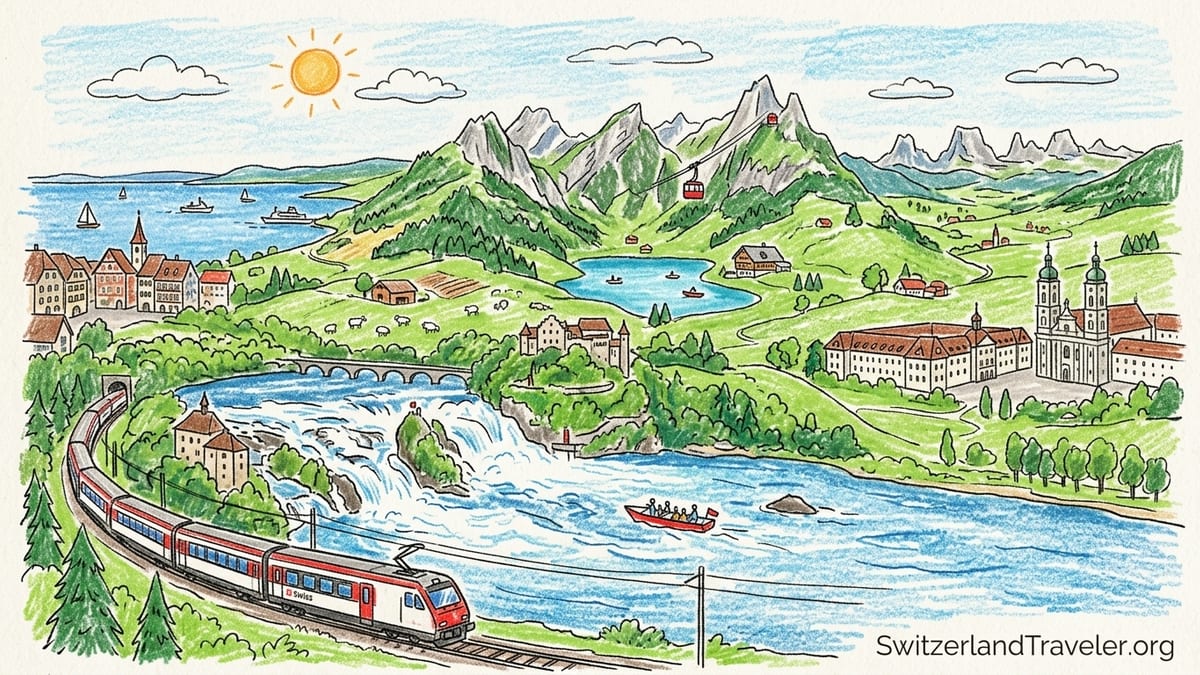
For most travelers, Eastern Switzerland works best as a loose loop, reached by train through Zurich. A practical sequence is Zurich to Schaffhausen and the Rhine Falls, then Stein am Rhein, onward to St. Gallen, into Appenzell and the Alpstein mountains around Ebenalp and Seealpsee, followed by Lake Constance, the pastoral Toggenburg valley, and finally Glarus in the Linth valley before returning to Zurich. Thanks to dense rail connections, you can cover this circuit comfortably in 6 to 9 days without a car.
Some stops are classic day trips. The Rhine Falls and nearby Schaffhausen, for example, can be combined in a single day if you are based in Zurich or St. Gallen. Stein am Rhein and short stretches of the Lake Constance shore also work as day outings, especially if you are content with a town walk and a lakeside stroll. In contrast, St. Gallen and Appenzell reward at least one night each, while the Alpstein area and Toggenburg can easily soak up two or three nights for hikers. Glarus often suits a single overnight unless you plan deeper walks in its side valleys.
Costs in Switzerland are high by European standards, so careful planning helps. A midrange hotel in towns like St. Gallen or Appenzell commonly runs in the region of 180 to 260 Swiss francs per night for a double room, breakfast usually included. Simple mountain guesthouses in the Alpstein or Toggenburg can be slightly less, particularly if you opt for dormitory lodging. Regional rail day passes, such as the Swiss Travel Pass or canton specific offers, often save money if you move every day, while many local guest cards include cable car or bus discounts.
Rhine Falls, Schaffhausen and Stein am Rhein
The Rhine Falls, near Neuhausen am Rheinfall, are one of Switzerland’s most visited natural sights. The falls are roughly 150 meters wide and around 23 meters high, with a huge volume of water plunging past viewing platforms and rocky outcrops. Modern visitor facilities include a central plaza, an information shop with lockers and tickets, and a network of paved paths and lifts leading to different vantage points, which makes the site manageable even on a quick stop. Boat operators run short round trips that take you close to the spray and, in season, to the rock in the middle of the river, giving you a sense of the river’s power that is difficult to grasp from shore.
Rhine Falls is best treated as a half day destination. From Zurich or St. Gallen, direct or one change trains to Neuhausen Rheinfall or Schloss Laufen am Rheinfall take under an hour. Once there, most visitors spend between two and four hours walking between viewpoints, taking a boat ride and perhaps stopping for a drink or simple lunch in one of the on site cafes or restaurants. Prices for boat rides vary, but roughly 10 to 25 Swiss francs per person covers most standard trips. Because the site is compact and heavily visited, staying overnight specifically at Rhine Falls is rarely necessary unless you want a quieter evening walk after day trippers have left.
Extend your day by continuing ten minutes upriver to Schaffhausen, a small city with a distinctive skyline of steep roofs and the ring shaped Munot fortress. Its old town lanes, decorated with oriel windows and painted facades, are ideal for a relaxed afternoon wander. Outdoor seating in the car free center fills quickly on sunny days, and you can expect to pay broadly 5 to 7 francs for a coffee and 25 to 35 francs for a main course in a midrange restaurant. Schaffhausen pairs naturally with Rhine Falls as a full day outing, and unless you crave a low key base, you can usually return to your hub city the same evening.
Further downstream, Stein am Rhein is one of Switzerland’s best preserved small historic towns. Its main square is ringed with half timbered houses whose exteriors are covered in colorful frescoes, and the setting at the point where the Rhine widens out from Lake Constance is especially scenic in late afternoon light. The town itself is compact enough to explore in two to three hours, including a climb or bus ride up to Hohenklingen Castle for a river panorama. Many travelers visit Stein am Rhein as a stop on a longer rail or cycling journey along the southern shore of Lake Constance, or as part of a day trip combining old town walks and swimming at nearby lakeside lidos. Staying overnight is pleasant but optional unless you want a quiet base and early morning streets almost to yourself.
St. Gallen and its UNESCO Abbey District
St. Gallen is the cultural anchor of Eastern Switzerland and justifies at least one and preferably two nights. The star attraction is the Abbey District, a UNESCO World Heritage site that includes the baroque cathedral and the Abbey Library, one of Europe’s most important collections of medieval manuscripts. The library’s wood paneled hall, lined with rococo balconies, is as much a work of art as the books themselves, and visiting requires soft slipper covers over your shoes to protect the floor. Entry fees are moderate by Swiss standards, typically in the range of a few dozen francs for combined tickets that also include the cathedral treasury or associated exhibitions.
Beyond the abbey complex, St. Gallen is a liveable city of about 80,000 inhabitants with steep streets, textile heritage and a strong student presence. Its old town is famous for tall, carved and painted bay windows, many of which belong to former merchant houses that once dominated the linen trade. You can easily fill a day weaving through alleys, dropping into small boutiques and coffee roasteries, and sampling regional food such as the local St. Gallen bratwurst served with a crusty roll. The city also serves as a weather friendly base, with museums and cafes that remain appealing on rainy days when mountain trails are less inviting.
Staying overnight in St. Gallen makes practical sense if you plan side trips. Frequent trains run north to Lake Constance ports like Rorschach and Romanshorn, south into Toggenburg and west toward Zurich. For example, you can leave St. Gallen after breakfast and be at the cable car in Wasserauen, gateway to Ebenalp, in about an hour by changing trains in Gossau and Appenzell. Evening returns are just as efficient, which is helpful in summer when you may come back from the trails after 6 or 7 pm.
Appenzell, Ebenalp and Seealpsee
Appenzell is both a village and a canton, known across Switzerland for colorful traditions, rural democracy and a signature cheese. The town center of Appenzell village is compact, with streets lined by low, brightly painted houses whose facades bear floral motifs and family crests. Local customs are very much alive, from the Appenzell brass band that plays at festivals to seasonal processions of cattle returning from high summer pastures. For many visitors, sampling Appenzeller cheese in a local dairy shop and trying sweet specialties such as bärli biber, a spiced honey pastry filled with almond paste, is as memorable as the scenery.
Most travelers use Appenzell as the main base for exploring the Alpstein massif directly to the south. A practical arrangement is to stay one or two nights in Appenzell village and add one night in a mountain guesthouse if you plan multi day hiking. Regular trains or buses connect from Appenzell to Wasserauen, the valley terminus for the cable car to Ebenalp. The cable car rises to a plateau with sweeping views over rolling hills and, on clear days, as far as Lake Constance. From the top, well marked paths lead through the Wildkirchli caves and past the clifftop guesthouse Aescher before zigzagging down toward Seealpsee, a small alpine lake surrounded by pastures.
Seealpsee can also be reached directly from Wasserauen by a steep paved farm road and footpath. Fit walkers usually need about an hour to climb up, and it is common to find families with children and travelers in regular walking shoes on the route when conditions are dry. Around the lake, a couple of simple guesthouses and alpine restaurants serve hearty dishes such as rösti, sausage and mountain cheese plates; prices for main dishes often land in the 20 to 30 franc range. On summer weekends and good weather days, arriving early in the morning or late in the afternoon helps avoid the midday crowd and heat on the ascent.
While day trips from St. Gallen are entirely feasible, an overnight stay in Appenzell allows for slower exploration. You can spend one day on the classic Wirwalk from Ebenalp through Wildkirchli to Seealpsee and back down to Wasserauen, and another on gentler panoramic walks closer to the village or on alternative cable car routes like Hoher Kasten above Brülisau. Even if you are not a committed hiker, waking up amid cowbells and catching the first or last cable car of the day, when light is softer and paths are quieter, adds a layer of experience missing on fast in and out trips.
Lake Constance and the Lake and Cycling Experience
Lake Constance, locally known as Bodensee, forms the northern edge of Eastern Switzerland and is a major attraction in its own right. On the Swiss side, towns such as Rorschach, Arbon, Romanshorn and Kreuzlingen line the shore, most with lively harbors, lakeside promenades and easy rail access. The lake has a distinct maritime feel thanks to ferries, excursion steamers and working ports, yet in clear weather the snow capped Alps remain visible on the horizon. Summer visitors mix swimming and stand up paddling from small beaches with lazy afternoons in lakeside cafes, where a drink typically costs around 5 to 8 francs and a light plate of fish from the lake commands a little more.
For many travelers, the standout experience at Lake Constance is cycling. An international route circles the entire lake for roughly 260 kilometers, but you do not need to ride the whole circuit to enjoy it. Swiss sections between Romanshorn and Stein am Rhein are well signposted and generally flat, following a mix of dedicated bike paths and quiet back roads. Families and casual cyclists often choose a modest 20 to 40 kilometer stretch, such as Romanshorn to Kreuzlingen or Kreuzlingen to Stein am Rhein, which can be comfortably covered in half a day with time for swimming breaks and ice cream stops. Bike rental shops operate in larger towns and at some train stations, with daily rental prices commonly around 35 to 50 francs for a standard touring bike.
Public transport integrates seamlessly with cycling at Lake Constance. Trains along the Lake Line connect the main Swiss lakeshore towns and take bikes on board, allowing you to shorten rides or escape bad weather. Ferries and cross lake boats also accept bicycles, useful if you want to combine Swiss and German or Austrian shores. When planning, consider visiting in shoulder seasons such as late May to June or early September. The water is warm enough for swimming on sunny days, but paths and lidos are less busy than during the school holiday peak in July and August, when the area attracts many domestic and German visitors.
Lake Constance can work either as a multi night base or a series of day trips. If cycling and lakeside relaxation are central to your plans, two or three nights in a town such as Romanshorn or Kreuzlingen allow you to mix short bike rides with excursions by train or boat. On the other hand, if your priority is mountains and culture, you might limit yourself to a single full day from St. Gallen, choosing one stretch of shore to explore by bike or on foot before returning inland.
Toggenburg’s Quiet Valleys and Soundscapes
Toggenburg is a green, relatively low lying valley system south of Lake Constance and west of Appenzell, threaded by the Thur River and backed by the jagged Churfirsten range. It is less internationally known than Appenzell, which means fewer crowds and a more everyday rural feel. Villages such as Wildhaus and Unterwasser serve as trailheads and small ski bases, with wooden houses, village churches and farmsteads scattered across the slopes. In summer, cable cars and chairlifts carry walkers to panoramic ridges, while in autumn the landscape turns a deep mix of green and gold that photographers appreciate.
The region has invested heavily in approachable outdoor infrastructure. Well signposted walking paths, themed routes such as sound trails that incorporate interactive instruments, and playgrounds near mountain inns make Toggenburg particularly attractive for families. Prices in cafes and guesthouses are broadly similar to Appenzell, with simple lunches like soup and bread, pasta or rösti typically costing between 15 and 25 francs. Unlike some high Alpine areas, the gradients around the valley floor are often gentle, which suits visitors who enjoy walking but are wary of exposure or very steep paths.
From a planning perspective, Toggenburg deserves at least one and ideally two nights if you appreciate quieter landscapes. It slots neatly between St. Gallen and Glarus on an itinerary, or can serve as an alternative to a second night in Appenzell if accommodation is tight. Rail and bus connections from St. Gallen to Toggenburg’s main villages are straightforward, though they may involve one or two changes, and travel times are generally between one and two hours. An overnight stay lets you take a slow morning walk, enjoy a long lunch on a terrace with a view of the Churfirsten and still have time for an afternoon cable car ride or short hike.
Glarus and the Gateway to the Glarus Alps
Glarus lies in a narrow valley southeast of Zurich, framed by steep mountains that rise abruptly from the valley floor. The town itself is modest in size and largely rebuilt after a major fire in the 19th century, with a grid of streets, a central square and a backdrop of peaks that can be snow streaked well into late spring. Regular trains link Glarus to Zurich in roughly an hour, which makes it feasible as both a standalone destination and a final stop before flying home. The surrounding canton of Glarus includes several side valleys that lead to high alpine scenery, with cable cars and chairlifts providing uplifts to village sized ski stations that retool for walking in summer.
For most travelers on a first visit, Glarus works well as a one night stop paired with one full day of walking or a short cable car excursion. From the town, buses fan out to villages such as Elm and Braunwald, the latter a car free resort reachable by funicular where you can follow simple panoramic paths with big mountain views. Many trails start directly from lift stations, which allows you to choose routes according to fitness and weather. Expect costs similar to other mountain areas in Eastern Switzerland, with cable car returns commonly in the range of 20 to 40 francs depending on length and operator.
If you are an experienced hiker, you could expand your time here to two or three nights, using Glarus as a base for longer walks into the Glarus Alps or for visiting geological sites such as the Glarus thrust area, part of a wider UNESCO World Heritage listing. However, given limited days and the strong pull of Appenzell and Lake Constance, many itineraries allocate only a short stay to Glarus on a first circuit of the region.
The Takeaway
Eastern Switzerland rewards those who balance movement with pauses. The Rhine Falls and Schaffhausen deliver their spectacle and charm in a single day, while Stein am Rhein and short rides along Lake Constance’s shore fit neatly into half day windows. By contrast, St. Gallen’s abbey district deserves the slow attention of at least one night, and Appenzell and the Alpstein mountains can easily fill two or three, particularly if you want to hike between Ebenalp and Seealpsee. Toggenburg and Glarus offer gentler but equally authentic mountain experiences that can be tailored to your appetite for walking.
When planning your route, think in clusters: waterfalls and river towns at the Rhine, culture and cuisine in St. Gallen, tradition and hiking in Appenzell, lakeshore cycling at Lake Constance, and quiet valleys in Toggenburg and Glarus. With efficient trains and cable cars, you can wake to cowbells, spend the afternoon by a lake and dine in a baroque city center, all within the same 24 hours. The key is to decide where you most want to linger overnight, then link the rest as flexible day trips around those anchor points.
FAQ
Q1. How many days do I need to see Eastern Switzerland’s highlights?
Plan on at least six full days to link Rhine Falls, Schaffhausen, Stein am Rhein, St. Gallen, Appenzell, Lake Constance and one of Toggenburg or Glarus. With eight or nine days you can add extra hiking days around Ebenalp and Seealpsee or longer cycling stages on Lake Constance.
Q2. Which places are best for overnight stays versus day trips?
St. Gallen and Appenzell are the strongest bases and merit at least one night each. Lake Constance towns like Romanshorn or Kreuzlingen are ideal for multi night lake and cycling stays. Rhine Falls, Schaffhausen and Stein am Rhein generally work well as day trips, while Toggenburg and Glarus often fit as one or two night stops depending on how much hiking you plan.
Q3. Do I need a car to follow this itinerary?
No. Eastern Switzerland is easy to explore by public transport. Trains reach Schaffhausen, St. Gallen, Appenzell, Lake Constance ports and Glarus, and local buses or short walks connect to cable cars such as the one from Wasserauen to Ebenalp. A car can save some time in rural valleys but is not essential for most travelers.
Q4. When is the best time of year to visit for hiking and cycling?
Late May to early October usually offers the most reliable conditions for both hiking in Alpstein and cycling along Lake Constance. July and August bring the warmest weather but also the largest crowds and higher prices. Shoulder months such as June and September balance open trails with fewer visitors and slightly lower accommodation demand.
Q5. How expensive is Eastern Switzerland compared with other parts of Europe?
Switzerland is generally more expensive than neighboring countries. In Eastern Switzerland, midrange hotel doubles often cost around 180 to 260 francs per night, and main dishes in standard restaurants commonly range from about 20 to 40 francs. Using regional rail passes, guest cards and self catered meals where possible helps manage costs.
Q6. Is Rhine Falls suitable for children and less mobile travelers?
Yes. The Rhine Falls visitor area offers paved paths, a panoramic lift and rail access close to the viewpoints, which makes it practical for families with strollers and people with limited mobility. Boat landings involve a few steps and moving platforms, so it is worth checking comfort levels individually before booking a ride.
Q7. What level of fitness do I need for Ebenalp and Seealpsee hikes?
Most classic routes around Ebenalp and Seealpsee are suitable for reasonably fit walkers who are comfortable with sustained uphill or downhill on sometimes steep but generally well maintained paths. Taking the cable car up to Ebenalp and walking down through Wildkirchli to Seealpsee reduces climb but still requires sure footing. Visitors who rarely hike should choose good weather days, wear proper shoes and allow extra time.
Q8. Can I swim in Lake Constance, and are there public beaches?
Yes. Lake Constance has numerous public lakeside baths and small beaches, particularly around towns such as Kreuzlingen, Romanshorn and Rorschach. Many have changing facilities, lawns and sometimes playgrounds or snack kiosks. Access to simple public bathing areas is often free or low cost, though some larger lidos charge modest entry fees.
Q9. Is it better to stay on the lake or in the mountains?
It depends on your priorities. Staying at Lake Constance works well if you enjoy flat cycling, swimming and easy rail connections between towns. Mountain bases like Appenzell, Toggenburg or Glarus are preferable if your main focus is hiking and alpine scenery. Many travelers split time between the two, spending a few nights by the lake and a few in the hills.
Q10. Do I need to book accommodation and cable cars in advance?
Booking accommodation in advance is strongly advised in peak season, especially in smaller places like Appenzell, Toggenburg and Glarus where room numbers are limited. In shoulder seasons, you can sometimes be more spontaneous. Cable cars usually operate on regular timetables and do not require advance seat reservations, but checking operating dates and any maintenance closures online before you travel is important.