


Western Switzerland compresses a remarkable amount of scenery and city life into a compact region. Within ninety minutes by train you can move from Geneva’s diplomatic skyline to Lavaux vineyard terraces, from the palm-lined promenades of Montreux and Vevey to the rolling pastures of Gruyères and the Jura ridges above Neuchâtel. The challenge is not getting around. It is choosing the right base for how you actually want to travel, eat and spend your hotel budget.
How to Choose Your Base in Western Switzerland
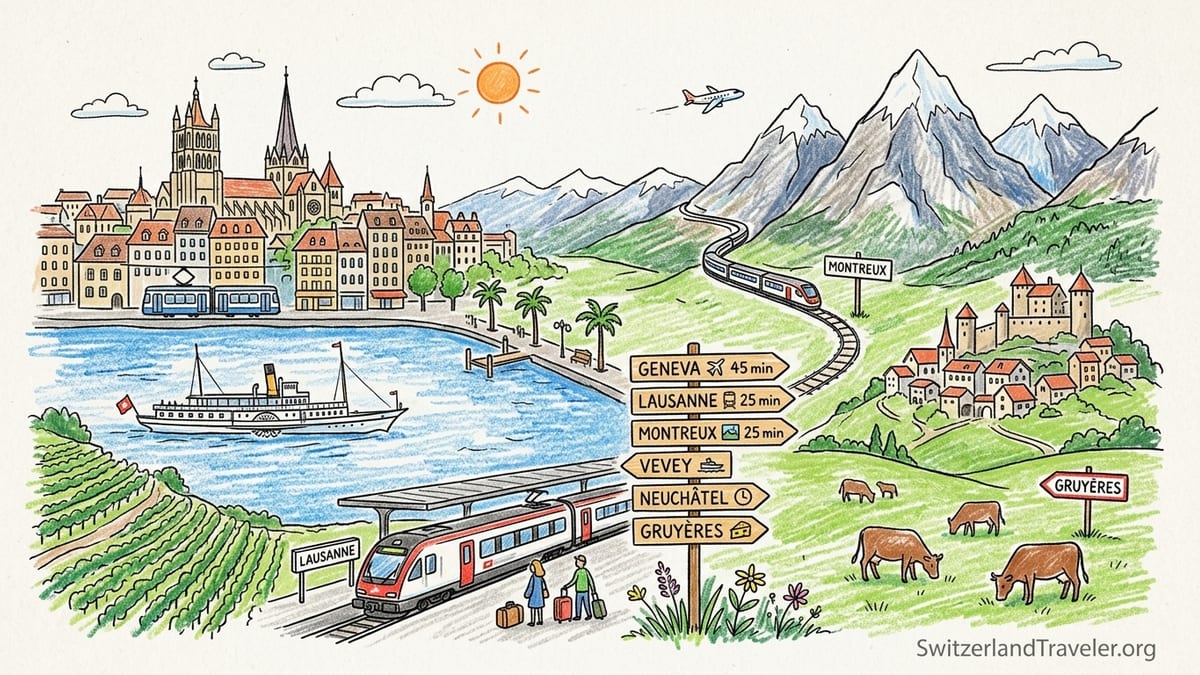
All six bases in this guide sit on major Swiss rail lines or easy branch routes, and most are under an hour apart. Geneva Airport to Lausanne is around 45 minutes by direct train, and on the same line you are in Vevey in roughly 1 hour and Montreux in about 1 hour 10 minutes. That means you can comfortably day trip between them without moving hotels every night, especially with a Swiss Travel Pass or saver day pass that covers trains and lake boats on the same ticket.
The real differences are about atmosphere and trip style. Geneva feels international, with embassies, banks and NGO offices alongside Old Town streets. Lausanne is a steeper university and cultural city with stronger nightlife and a central position on the lake. Montreux and neighbouring Vevey share the “Swiss Riviera” microclimate with palm trees and long promenades, but Montreux is more overtly resort-like and Vevey feels quieter and more local. Gruyères and Bulle put you in countryside and dairy country rather than on the lake, while Neuchâtel looks north to the Jura and the Three-Lakes region, with a more low-key, French-speaking Swiss feel.
Hotel prices reflect those differences. As a rough pattern, Geneva city and Montreux’s big-name lakefront hotels are typically at the top of the price range, especially in summer and during events. Lausanne often offers slightly better value a couple of tram stops back from the lake. Vevey’s high-end lakeside properties can rival Geneva in price but there are also modest family-run hotels and apartments in town. In Gruyères and Bulle you trade five-star spas for mid-range inns and guesthouses, while Neuchâtel tends to sit in the middle, with solid three and four-star options and fewer ultra-luxury addresses.
For most travelers, the decision comes down to three main questions: do you want a big-city base with the best flight options, an all-round Lake Geneva hub with nightlife and Lavaux access, or a more scenic resort or countryside stay with slower evenings and closer contact with nature. From there, you can layer on practical considerations like early-morning train departures, restaurant variety and how much you want to spend on a room with a lake view.
Geneva: Best for Flights, Short Stays and International City Life
Geneva is western Switzerland’s air gateway and one of the best-connected cities in the country for international flights and long-distance trains, including frequent direct services from Zurich, Basel and Bern and onward connections into France. The airport has its own rail station under the terminal, and trains typically reach central Geneva’s Cornavin station in about seven minutes, then continue along the lake toward Lausanne and the Riviera towns. For a short city break or a one-night stop on a wider European itinerary, staying here keeps transfers simple and minimizes time spent moving luggage.
As a base, Geneva works especially well if your day trips lean toward international-city travel rather than mountain excursions. Inside the city you can walk the compact Old Town, visit the Palais des Nations and Red Cross Museum, or explore the Patek Philippe Museum before an evening in the Carouge district’s cafes. Many hotels provide a free local transport card valid on trams, buses and the little yellow harbour boats for the duration of your stay, which makes it painless to base slightly away from the station if you prefer a quieter neighbourhood and still dip in and out of the centre.
Hotel prices in Geneva are generally at the higher end, particularly around the lakefront where international brands occupy prime real estate facing the Jet d’Eau. In high season, a standard double with partial lake view in a well-known chain near the quays can easily reach several hundred francs per night. More budget-conscious travellers often look near the station in the lower-priced three-star hotels or serviced apartments a few blocks inland, accepting a more urban atmosphere in exchange for quick access to early trains for Chamonix, Lausanne or Bern.
For Lake Geneva sightseeing specifically, Geneva is at the far western end of the water. You can still cruise eastward on historic paddle steamers, and in summer a full-day boat trip along the lake to Montreux via Lausanne is a scenic way to travel. However, rail connections from Geneva to mountain areas such as the Bernese Oberland or Valais require at least one change and more total journey time compared with starting in Lausanne or Montreux. If you plan frequent day trips into the Alps, or want to dine multiple nights in smaller lakeside towns, Geneva is better treated as an arrival or departure city than as your main base.
Lausanne: The Strongest All-Round Lake Geneva Base
Lausanne sits roughly in the middle of the north shore of Lake Geneva and at a crossroads of Swiss rail lines, which makes it the most versatile base for exploring the region. Direct trains run west to Geneva Airport and east to Vevey, Montreux and into Valais, while another main line heads north along the Jura foothills toward Neuchâtel, Biel and Basel. In practice, you can reach Geneva in about 45 minutes, Montreux in roughly 25 minutes and Neuchâtel in under 90 minutes with a simple connection, which is why so many rail-based itineraries use Lausanne as their anchor point.
The city itself offers more urban texture than its size might suggest. The upper town around the cathedral and Place de la Palud feels historic and compact, while the Ouchy district down by the water is all promenades, lawns and lake views. Between them you ride Switzerland’s only metro line outside Zurich, a practical detail for steep hills and a useful sign that Lausanne functions as a real working city as well as a tourist stop. Travelers who enjoy an evening scene appreciate that Lausanne has a reputation for some of the strongest nightlife in the French-speaking part of Switzerland, from wine bars around Rue de Bourg to clubs clustered near Flon.
Lausanne is also the easiest jumping-off point for Lavaux, the terraced vineyard landscape that climbs steeply above the lake and holds UNESCO World Heritage status. Regional trains connect Ouchy and the main station with villages such as Puidoux, Cully and Epesses, while a popular footpath winds through the vineyards. In practical terms, this means you can have breakfast in a city hotel, walk a vineyard trail above the water by late morning, stop for a tasting at a cellar, then be back in town in time for a late dinner. It is harder to achieve that mix of city convenience and vineyard access if you stay far west in Geneva or commit to the resort rhythm of Montreux.
Hotel prices in Lausanne occupy a middle ground. Direct lakefront properties in Ouchy with pools and full lake views can be expensive in high season, but you often find better value a short metro ride uphill near the main station or in neighbourhoods slightly removed from the water. Travellers choosing between Lausanne and Montreux often discover that Lausanne’s mid-range hotels offer more rooms at lower per-night rates, especially outside weekends and the Montreux Jazz Festival period. The trade-off is that you may walk a few extra minutes or ride public transport down to the lakefront rather than being right on the promenade.
Montreux: Scenery and the Classic Swiss Riviera Feel
Montreux is where Lake Geneva takes on its classic “Swiss Riviera” character. The lake narrows, the mountains close in, and the promenade between Clarens and Chillon Castle is lined with palms, flowerbeds and Belle Époque hotels. For travellers who equate Switzerland with lake-and-peak panoramas rather than city streets, Montreux is often the place where the mental picture matches reality. From many lakeside hotel balconies you can look straight across to the mountains rising above the opposite shore, often with a sunset that glows off the water.
From a transport perspective, Montreux is still well connected but sits one step further from Geneva than Lausanne. Direct trains from Geneva typically take just over an hour, with Lausanne about 25 minutes away and the mountain town of Zweisimmen reachable via the scenic Montreux Oberland Bernois line. That makes Montreux a convenient base if you want to combine lakeside strolling with classic panoramic train journeys, since you can connect further to Interlaken and the Bernese Oberland by staying on the same scenic route. Boats from Montreux also serve other points on the lake, including Vevey and Lausanne, and call at the foot of Chillon Castle, one of the region’s most photogenic landmarks.
Where Montreux differs strongly from Lausanne is in atmosphere and evening rhythm. Away from festival periods such as the famous summer jazz event, Montreux is relatively calm once the sun goes down. There are restaurants and hotel bars, but the density of casual cafes, student pubs and late-night venues is much lower than in Lausanne. Visitors who want a quiet glass of wine on the promenade after dinner and an early night often find this ideal, while those seeking a more energetic city feel can perceive it as too quiet, especially outside July and August.
Hotel pricing reflects Montreux’s reputation and its small size. The most iconic Belle Époque properties right on the water command some of the highest nightly rates on the lake, particularly in lake-view rooms with balconies. There are mid-range options set slightly back from the promenade or up the hill, but overall supply is limited compared with Lausanne, and availability can tighten considerably around major events. Travellers balancing budget and scenery sometimes compromise by staying in Lausanne or even Vevey, then visiting Montreux on a dedicated day for the castle and promenade, rather than paying a premium for every night.
Vevey: Quieter Lakeside Luxury and Local Life
Just a short train ride west of Montreux, Vevey feels like a more understated cousin. It shares the same sunshine-favoured lakeside setting and vineyard backdrop, but the town centre is less dominated by grand resort hotels and more by everyday shops, markets and a compact historic core. For many repeat visitors, Vevey hits a sweet spot: more relaxed and local than Geneva or Lausanne, yet with enough year-round residents to keep cafes and bakeries busy beyond peak tourist hours.
Rail and boat connections make Vevey adaptable as a base. Fast regional trains reach Lausanne in around 15 minutes and Montreux in ten, so you can treat all three almost as one extended urban area for sightseeing. In summer, lake boats tie Vevey into the broader network of Riviera towns, and hill trains and buses climb behind the town into vineyard villages and small viewpoints. This allows easy, car-free access to Lavaux wine tastings, lakeside walks and day trips further into Valais or back toward Geneva, all without the need to change hotels often.
The accommodation scene in Vevey ranges from internationally known five-star hotels on the waterfront to simpler family-run properties a few streets inland. Top-end lakefront suites here can rival Geneva and Montreux in nightly rates, particularly during peak holiday weeks, but mid-range rooms are often easier to find than in Montreux during major events. Many travellers who value a quiet evening and morning lake views prefer Vevey because it feels less like a resort built around one festival and more like a lived-in lakeside town that happens to have very good scenery.
For dining, Vevey’s size means you will not find the same breadth of cuisines as Geneva or Lausanne, but you can still eat very well. The town is known for lakeside terraces, classic Swiss brasseries serving perch fillets and local white wines, and bakery-cafes where you can pick up an affordable breakfast before catching a train or boat. Prices per main course are broadly similar to the rest of the Lake Geneva region, though midweek lunch menus can help trim costs. If you want at least one truly luxurious dinner with a refined wine list during your stay, Vevey’s top hotels and nearby Michelin-noted restaurants offer that option without the need to stay in Geneva.
Gruyères and Bulle: Countryside Charm Beyond the Lake
Move northeast from Lake Geneva into the canton of Fribourg and the landscape shifts from vineyard terraces to green pastures and soft hills. Here, the twin bases of Gruyères and Bulle offer countryside stays that focus less on the lake and more on Switzerland’s dairy and chocolate heartland. Gruyères itself is a small, fortified village on a hill, known for its medieval château and cheese-making heritage. Bulle, a few kilometres away in the valley, is the larger market town and regional transport hub, with more shops, schools and everyday life.
By public transport, both are reachable from Lausanne in around 1 hour 20 minutes with a simple connection in towns such as Romont or Fribourg, and there are direct regional trains linking Bulle to places like Broc, home of a major chocolate visitor centre. Special tourist trains, including retro breakfast or chocolate-themed services, also operate on some weekends and seasons between Bulle, Gruyères and other nearby destinations, which adds novelty to day trips without requiring a car. In practice, that means you can base in Bulle or Gruyères and still explore by rail and bus, though services are naturally less frequent in the late evening than along the Lake Geneva spine.
Accommodation in this area skews toward small hotels, inns and guesthouses. In Gruyères, several properties sit just below or within the car-free historic centre, often in traditional stone or chalet-style buildings. Rooms tend to be simpler than lakeside luxury but compensate with balcony views over the valley or cobbled streets at your doorstep. Bulle offers a handful of modern three and four-star hotels close to the station, usually at prices below equivalent rooms in Lausanne or Montreux, especially in shoulder seasons. This makes the Fribourg countryside attractive to travellers who do not need direct lake access every day and would rather spend on food experiences.
Those food experiences are a major draw. From a base in Gruyères or Bulle you can visit a show dairy, watch cheesemakers at work, sample fondue and raclette where the milk originates, and combine this with trips to a chocolate attraction where tasting is built into the visit. Families often appreciate the mix of short, manageable train rides, castle tours and interactive exhibits. The trade-off is that you will not step out of your hotel onto a lake promenade, and journeys back to Geneva Airport on departure day take longer than from Lausanne or Montreux, so you need to factor connections into your schedule.
Neuchâtel: Gateway to the Jura and Three-Lakes Region
North of Lausanne and beyond the low ridge of the Jura, Neuchâtel looks over a different stretch of water: Lake Neuchâtel, part of the Three-Lakes region alongside Lakes Biel/Bienne and Murten. The town mixes a historic centre built from warm yellow stone with a university presence and a quieter, more everyday rhythm than Geneva or Lausanne. For travellers who prefer under-the-radar destinations to headline cities, Neuchâtel often feels like a discovery rather than a box to tick.
In rail terms, Neuchâtel occupies a strategic position on the Jura foot line, which links Geneva and Lausanne with Biel/Bienne, Solothurn and onward into northern Switzerland. Regular intercity and interregional trains connect Neuchâtel southwards to Lausanne in roughly an hour, and eastwards along branch lines that climb into the Jura to watchmaking towns such as La Chaux-de-Fonds and Le Locle. That makes Neuchâtel the most efficient base for exploring the Jura plateau and the Three-Lakes area, including boat trips that link the lakes via canals and excursions to viewpoints above vineyards and wetlands.
Accommodation ranges from modest city hotels near the station to more characterful options in the old town and along the lakefront. Nightly rates are often a little lower than in Geneva or Lausanne, though, as in most of Switzerland, high summer and major local events can still push up prices. Because Neuchâtel has fewer large hotels than the bigger Lake Geneva cities, it is worth booking early if you want a room with direct lake views and easy walking access to the historic centre.
As a base, Neuchâtel suits travellers more interested in hikes through rolling Jura forests, bike rides along lakeshores and visits to small watchmaking museums than in Lavaux vineyards or the Montreux promenade. Restaurant choice is good but not overwhelming, leaning toward brasseries, lake-fish specialists and simple pizzerias, typically at similar price levels to the Lake Geneva towns. If your trip combines both regions, many itineraries work well with a few nights in Lausanne or Vevey for Lavaux and the Swiss Riviera, followed by two or three nights in Neuchâtel to change scenery and experience a different side of French-speaking Switzerland.
Rail Convenience, Day Trips, Food and Prices: The Comparisons
Across these bases, rail convenience often becomes the deciding factor once you know your main day trips. For a high number of one-day excursions along Lake Geneva plus an efficient exit to the rest of Switzerland, Lausanne is the most central choice. You can be in Geneva early for a flight, in Montreux late for dinner by the water, or on a train toward Bern and Zurich without lengthy detours. Montreux and Vevey share the same main line and are excellent for Riviera views and onward travel into Valais and the Bernese Oberland, but they add time if you are repeatedly heading west to Geneva or north to the Jura. Neuchâtel is ideal for a Jura and Three-Lakes focus, while Gruyères and Bulle work best when your trip is oriented around nearby countryside, cheese and chocolate rather than frequent long-range rail travel.
Restaurant variety is richest in Geneva and Lausanne. Both offer everything from simple takeaways and supermarkets with salad bars to high-end tasting menus, international cuisines and lively after-dinner bars. Montreux and Vevey concentrate more on Swiss and French-inspired dining, lake-fish dishes and hotel restaurants, with some variation but fewer late-night venues. In Gruyères and Bulle you will find cheese-focused menus, village restaurants and a handful of international options that largely close earlier in the evening. Neuchâtel sits somewhere in the middle, with enough choice for a week’s stay but less culinary variety than Geneva.
Lake views are strongest in Montreux and Vevey, where a high proportion of hotels sit directly on or very near the water and most guests are there specifically for that outlook. Lausanne’s Ouchy district also offers beautiful views, but many city hotels sit higher on the hill without immediate lakefront access. Geneva’s best lake views cluster along a relatively small stretch between the Jardin Anglais and the international quarter, and you tend to pay a premium for those rooms. Neuchâtel’s lakeside hotels enjoy a more open horizon over Lake Neuchâtel, although the surrounding mountains are lower than those around Montreux. In Gruyères and Bulle, views shift to rolling hills, pastures and distant peaks rather than water.
On hotel pricing, a helpful way to think about it is in tiers rather than precise numbers, which fluctuate by season and event. Geneva’s centre and lakefront, Montreux’s most iconic properties and Vevey’s leading luxury hotels generally sit in the top band. Lausanne’s city hotels, Vevey’s mid-range options and Neuchâtel’s better three and four-star properties occupy the middle. Bulle, Gruyères and some out-of-centre Geneva and Lausanne neighbourhoods offer relatively lower nightly rates at the cost of fewer amenities or direct lake access. When comparing Lausanne and Montreux specifically, many travellers find that for the same budget they can secure a more spacious or better-located room in Lausanne, while Montreux justifies its premium when a lakefront balcony and an unbroken Riviera panorama are non-negotiable.
The Takeaway
If you are flying in and out on a tight schedule and want at least one full “big city” day, Geneva is the practical choice for the start or end of your trip. For a longer stay focused on flexibility, day trips and a balance of city life with lakeside relaxation, Lausanne is the strongest all-round base, especially if you plan to ride trains frequently and visit Lavaux. If you dream more of palm trees, promenades and breakfast on a lake-view balcony, Montreux gives you the most concentrated Swiss Riviera experience, with Vevey offering a slightly quieter and more lived-in variant a few minutes away.
Travelers who prefer countryside, dairy farms and castle villages but still want rail access gravitate toward Gruyères or Bulle, while those drawn to lesser-known corners of French-speaking Switzerland and the Jura often find Neuchâtel and the Three-Lakes region more appealing than another big-city stay. Because train rides between these places are short, you can comfortably combine two bases on a week-long trip, such as Lausanne plus Montreux, or Vevey plus Neuchâtel, to sample different moods without feeling you are constantly packing and unpacking.
Above all, remember that in this part of Switzerland it is hard to make a wrong choice. The distances are short, the rail network is dense and reliable, and boats link many lakeside towns in season. Decide first how you want to feel at the end of each day – energised by city lights, soothed by waves on a promenade, or grounded in quiet fields and forests – and then let that guide your pick between Geneva, Lausanne, Montreux, Vevey, Gruyères or Bulle, and Neuchâtel.
FAQ
Q1. If I have four nights and want to see as much as possible without changing hotels, where should I stay?
Lausanne is usually the best all-round base for four nights. From there you can day trip to Geneva, Montreux, Vevey, Lavaux vineyards and even Gruyères or Neuchâtel using direct or one-change trains, then return each evening to a city with plenty of restaurants and nightlife.
Q2. How do hotel prices compare between Geneva, Lausanne and Montreux?
Geneva and Montreux generally have the highest hotel prices, especially for lakefront rooms and during major events. Lausanne often offers more mid-range options at slightly lower rates, especially if you are willing to stay a short metro ride away from the lake and focus on city neighbourhoods near the main station.
Q3. Is Lausanne or Montreux better if I want both nightlife and scenery?
Lausanne offers stronger nightlife, a larger choice of bars and late-opening restaurants, and quick train access to Lavaux and the Riviera. Montreux has the more dramatic lake-and-mountain scenery right at your doorstep but is quieter in the evenings outside festival periods. Many travellers stay in Lausanne for nightlife and visit Montreux on a dedicated day for its promenade and castle.
Q4. I am travelling without a car. Can I still stay in Gruyères or Bulle and get around easily?
Yes. Regional trains and buses link Gruyères and Bulle with Fribourg, Lausanne and nearby attractions like chocolate centres and show dairies. Services are less frequent than along Lake Geneva, especially late at night, but for daytime sightseeing and countryside walks a car is not essential, provided you plan your return journeys in advance.
Q5. Which base is best for exploring the Jura and Three-Lakes region?
Neuchâtel is the most convenient base for the Jura and Three-Lakes area. It sits on a main rail line with frequent trains along the lake and into the Jura hills, and boats connect to nearby lakes in season. From Neuchâtel you can easily visit watchmaking towns, lakeside vineyards and forested ridges without long transfers.
Q6. Where should I stay if lake views from my room are a top priority?
Montreux and Vevey offer the highest concentration of hotels directly on or very near the lake, many with balconies facing the water and mountains. Lausanne’s Ouchy district also has excellent lake views, but many city hotels sit further uphill. In Geneva and Neuchâtel, lake-view rooms exist but are limited to certain streets and usually command a premium.
Q7. Is Geneva a good base for day trips to the Alps and other Swiss cities?
Geneva works well for some day trips, but if you plan to visit multiple alpine areas and other Swiss cities, Lausanne is usually more central. From Geneva you will often spend extra time retracing the same stretch of track to reach places you could access more quickly from Lausanne, Montreux or even Neuchâtel.
Q8. How many bases should I choose for a one-week trip in this region?
For a week, two bases are usually enough. A common pattern is three or four nights in Lausanne or Vevey for Lake Geneva and Lavaux, followed by two or three nights in either Montreux for a resort feel, Gruyères or Bulle for countryside, or Neuchâtel for the Jura and Three-Lakes region. This keeps transfers simple while giving you a change of atmosphere.
Q9. Will I need to reserve train seats when moving between these towns?
On regular intercity and regional trains around Lake Geneva and to Neuchâtel, reservations are usually not required. You can simply board with a valid ticket or pass and sit in any unreserved seat. Reservations may be needed or recommended on certain panoramic or long-distance international services, but not for the typical short hops described in this guide.
Q10. Are lake cruises included in Swiss rail passes from these bases?
Many national rail passes, such as the Swiss Travel Pass, include standard lake boat services on Lake Geneva and in the Three-Lakes region or offer them at a discount, depending on the specific pass and route. If you plan to cruise frequently between towns like Geneva, Lausanne, Vevey and Montreux, or around Neuchâtel, it is worth checking current pass conditions when you buy your ticket, as they can significantly reduce overall transport costs.