


Eastern Switzerland packs a lot of variety into a relatively compact area. Within 60 to 90 minutes of each other you can move from a Baroque abbey library in St. Gallen to flower-decked farmhouses in Appenzell, crashing water at Rhine Falls, quiet quays on Lake Constance and green valleys under the peaks of the Alpstein and Churfirsten ranges. The challenge is not what to see, but where to base yourself. This guide compares the main bases in Eastern Switzerland and helps you decide which works best for your itinerary, budget and travel style.
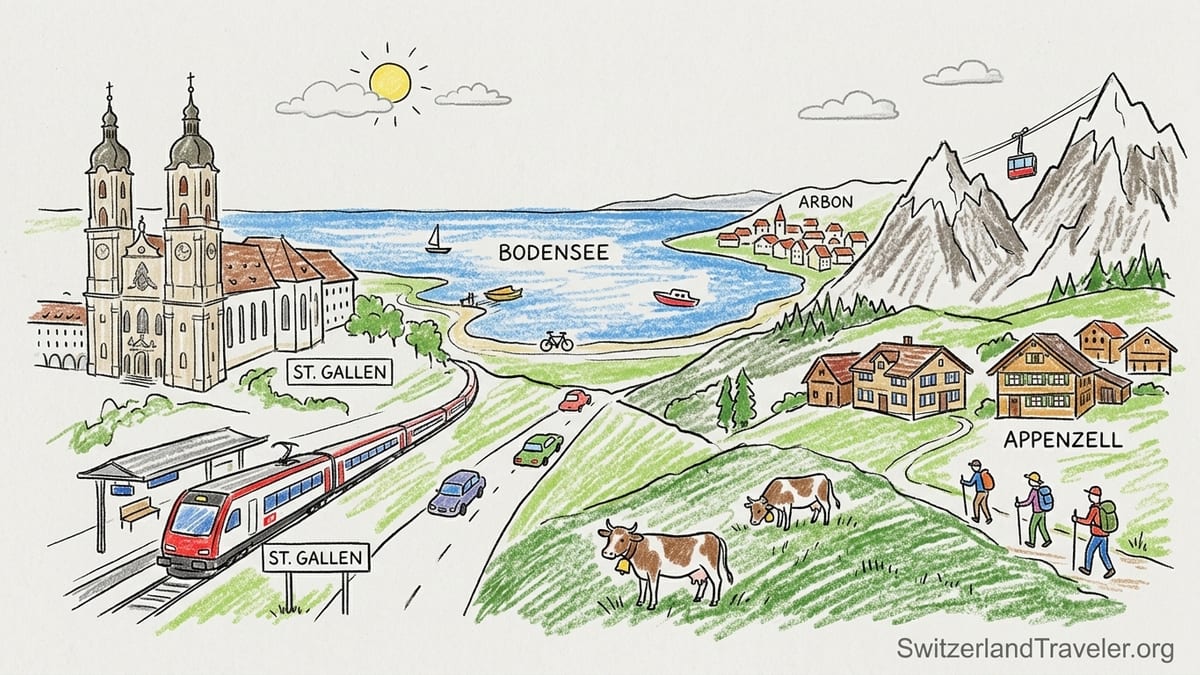
How to Choose a Base in Eastern Switzerland
Before looking at each town, it helps to think about how you will move around. Most visitors arrive via Zurich and then use the dense Swiss Federal Railways network and local operators such as Appenzeller Bahnen and Thurbo. Fast InterCity and InterRegio trains run from Zurich to St. Gallen in roughly one hour, and to Schaffhausen in about 40 minutes, while slower but scenic regional trains link Lake Constance, the Rhine and the pre-Alpine valleys. For drivers, the A1 and A4 motorways connect quickly into the region, with smaller roads taking you into Appenzell and Toggenburg.
Accommodation availability also shapes your decision. As of late 2026, booking platforms show the largest inventories in St. Gallen, Kreuzlingen, Schaffhausen, Appenzell and Arbon, which means more price points and better odds of finding rooms during busy periods like summer weekends or autumn cattle descents. Smaller villages in Toggenburg or the Glarus valley may have only a handful of hotels and guesthouses, which can sell out months ahead during school holidays and alpine event weekends.
Think in terms of themes: St. Gallen works as the best all-round transport hub and rainy-day base, with easy rail spokes in every direction. Appenzell is ideal for traditions and hiking in the Alpstein. Schaffhausen suits visitors who want to focus on Rhine Falls and Stein am Rhein. Arbon and Rorschach on Lake Constance work well for lake views, cycling and a quieter feel. Toggenburg and the Glarus region are for travelers who prioritise outdoor trips and do not mind a little extra train or car time for day trips further afield.
Finally, consider how many bases you really want. Packing and unpacking eats into sightseeing time. A common pattern is three to four nights in St. Gallen or Schaffhausen as a main hub, then two to three nights in Appenzell or Toggenburg for hiking. If you just have three or four days, choosing one base and adding long day trips by train may be more relaxing than changing hotels every night.
St. Gallen: Best All-Round Transport and Urban Comfort
St. Gallen is the most practical all-round base in Eastern Switzerland. Its main station sits on key east–west and north–south rail lines, with direct trains to Zurich Airport, Zurich, Winterthur and onward to Chur and Munich. Regional trains fan out to Rorschach and Arbon on Lake Constance, Appenzell via Gossau, and Schaffhausen via the Lake Line. For visitors travelling with Swiss Travel Passes, this makes it easy to bundle several classic day trips without worrying about connections or timetables.
The city itself gives you enough to fill at least one full day without leaving town. The UNESCO-listed Abbey of St. Gall and its rococo library are a highlight, and the compact traffic-calmed old town is filled with historic oriel windows and textile-era townhouses. On a practical level, St. Gallen has the broadest range of hotels in the region, from international chains near the station to mid-range options such as traditional town hotels in the old centre and simple budget lodgings in residential neighbourhoods. Nightly rates can start around the low to mid three-figure mark in Swiss francs for a basic double, rising significantly during trade fairs or major football matches.
Food-wise, St. Gallen offers much more than the famous St. Galler Bratwurst. You can spend one evening at a beer hall near the station, another in a contemporary Swiss restaurant near the abbey, and a third at an Italian trattoria or Asian spot in the Neustadt. There are enough bakeries and supermarkets for simple breakfasts if your hotel does not include one. Parking garages are dotted around the centre, though inner streets can be tight. If you plan to explore mainly by train, consider a hotel within easy walking distance of the station and leave the car in a peripheral car park or at your incoming airport.
In terms of reach, St. Gallen works best if you want variety in short hops. You can be in Appenzell village in about 45 minutes by changing at Gossau, soaking in mountain views on the way. Trains and boats connect you to Rorschach, Arbon and other Lake Constance towns for lake promenades and cycling. The Rhine Falls and Schaffhausen are more of a stretch but still workable as a long day: plan on roughly 90 minutes to 2 hours each way by a combination of regional trains along the Lake Line. For this reason, most travelers will be satisfied with three to four nights in St. Gallen, using one day for the city, one for Appenzell and one for Lake Constance or a longer day to the Rhine.
Appenzell: Traditions, Alpstein Hiking and Village Atmosphere
Appenzell delivers exactly the Switzerland many visitors imagine: painted wooden houses, village squares with traditional bakeries, and rolling green hills leading up to dramatic limestone peaks. The village is car-reduced at the centre but easily reached by narrow-gauge trains from St. Gallen via Gossau, usually in under an hour. Services are regular throughout the day, and they are covered by standard Swiss rail passes. If you are driving, expect scenic but winding roads and limited parking within the historic core, though guesthouses often provide guest spaces on the edge of the village.
The real draw of Appenzell is its access to the Alpstein massif. From nearby Wasserauen station, a short train ride from the village, you can take cable cars to Ebenalp and hike to the well-known Aescher mountain inn, or wander down to Seealpsee for lakeside picnics. Another cableway from Schwägalp brings you to the Säntis peak, which on clear days offers wide views into Germany and Austria. These excursions require decent weather, so building flexibility into your stay is wise if hiking is a priority.
Accommodation in Appenzell ranges from simple family-run guesthouses with wood-panelled rooms to a few more polished hotels featuring wellness areas and indoor pools. Current price comparisons suggest that average hotel rates sit in the mid range for Switzerland, often a bit lower than in major cities but higher than in some neighbouring German towns. Booking in advance is essential during high summer, school holidays and around traditional events such as cattle processions and village fairs, which can draw regional crowds and fill the limited room stock quickly.
For dining, you will find hearty local dishes like cheese fondue, rösti and Appenzeller cheese plates in village restaurants, alongside lighter options in café terraces. A typical dinner in a mid-range restaurant might run to the mid two figures in Swiss francs per person for a main course and non-alcoholic drink. Evening atmosphere is quiet, with most activity focused on early dinners and hotel bars; this is a place to sit on a balcony and listen to cowbells rather than seek nightlife. Given the hiking options and the slower rhythm, plan on at least two nights, and preferably three, so that weather does not determine your whole impression of the region.
Schaffhausen: Rhine Falls and Medieval River Towns
Schaffhausen is the closest substantial town to the Rhine Falls and a good base if that spectacle is a priority. InterRegio and S-Bahn trains from Zurich take around 40 minutes, and from Schaffhausen local trains and buses bring you to stations on both sides of the falls in under 10 minutes. Signage is clear, and walking paths link viewpoints, boat jetties and the small Schloss Laufen visitor area. In high season you can expect frequent service and extended evening opening hours, which makes it easy to visit early or late in the day to avoid tour groups.
The town itself rewards at least half a day. The compact old town features painted facades, oriel windows and the circular Munot fortress on a hill above the river. Cafes along the Rhinefront are pleasant for lunch or an early evening drink, and several hotels sit within walking distance of both the station and the waterfront. Because Schaffhausen has a healthy hotel inventory compared with its size, you can browse a range of options from straightforward business hotels to characterful inns with painted beams. Prices typically sit a little below those in Zurich but above rural guesthouses, especially when river-view rooms or on-site spa facilities are involved.
Schaffhausen also serves as a springboard for Stein am Rhein, one of the best-preserved medieval towns along the High Rhine. Trains follow the Lake Line upstream in roughly 20 to 30 minutes, and in warmer months boats connect Schaffhausen and Stein am Rhein for a scenic journey past vineyards and small villages. From Stein am Rhein you can continue by train along the south shore of Lake Constance to Kreuzlingen and Romanshorn, or simply wander the frescoed main street and riverside promenade before heading back to your base.
If you plan to focus on the Rhine Falls, Stein am Rhein and perhaps one excursion along Lake Constance, two nights in Schaffhausen are usually enough; three nights give you time to include a relaxed day by the river or a local wine walk in the surrounding canton. Parking is straightforward compared with larger Swiss cities, but like anywhere in the country, expect structured parking to be metered and inner streets to have resident zones. For travellers using public transport, Schaffhausen’s combo of S-Bahn, regional trains and boats provides good flexibility without a car.
Lake Constance: Rorschach, Arbon and Kreuzlingen as Lakeside Bases
Lake Constance, known locally as Bodensee, offers a more laid-back base with easy day trips rather than headline alpine sights. On the Swiss side, Rorschach, Arbon and Kreuzlingen stand out for visitors. Rorschach sits directly on the lake and is reached by frequent trains from St. Gallen in about 15 minutes. The town has a lakeside promenade, a small harbour for local boat services and a sand sculpture festival that draws visitors in late summer. Hotels in Rorschach often cluster near the shore and station, with mid-range room rates typically starting in the low to mid three-figure range in Swiss francs according to recent booking data.
Arbon, a short train ride west of Rorschach, combines a preserved old town with lakeside parks and bathing areas. It has a solid accommodation inventory for its size, which currently shows up clearly on major booking platforms. You can stay in smaller hotels housed in historic buildings, family-run guesthouses or newer properties near the lake. For meals, lakefront restaurants serve grilled fish and seasonal dishes, while simple takeaways and kiosks handle picnic supplies for cyclists and walkers using the well-marked shore paths.
Kreuzlingen, at the western end of the Swiss shore and paired with the larger German city of Konstanz next door, offers the most urban infrastructure on Lake Constance within easy reach of Eastern Switzerland. Current online listings show a particularly substantial number of rooms here, ranging from business hotels near the station to apartments. It is connected by the Lake Line railway to both Schaffhausen and Rorschach, so you can base yourself in Kreuzlingen and still day-trip easily to other parts of the region. The lakeside parks between Kreuzlingen and Konstanz are lively in summer, with swimming areas, boat rental stands and shaded lawns.
Lake Constance suits travellers who prioritise gentle walking, cycling and water views over high mountains. From any of these towns you can hop on regional trains along the Lake Line to Schaffhausen and Stein am Rhein in one direction, or to St. Gallen in the other. Bicycles are easy to rent locally, and the mostly flat lakeside paths appeal to families. Because the lake area doubles as a local weekend getaway, it can feel busy on warm Saturdays while remaining calm midweek. For many itineraries, two to three nights on Lake Constance is ideal, especially when combined with a more alpine base like Appenzell or Toggenburg.
Toggenburg and Glarus: Outdoor Valleys off the Main Tourist Track
South of St. Gallen, Toggenburg stretches as a green valley framed by the Churfirsten ridgeline. Towns like Wattwil, Lichtensteig and Wildhaus are linked by regional trains and buses, often with a change at Wattwil or Nesslau-Neu St. Johann, and the Voralpen-Express connects the wider region to Lucerne via St. Gallen. This is classic pre-Alpine scenery: rolling pastures, small sawmills and villages with a strong local identity. Several cable cars and chairlifts run up to hiking and skiing areas, and in summer there are themed routes such as sound trails and family-friendly paths with play stations.
The Glarus region, reached from Zurich or Ziegelbrücke by train, feels wilder and steeper, with glaciated valley walls and a more rugged atmosphere. Towns such as Glarus, Ennenda and Linthal offer simple hotels and guesthouses, and mountain resorts like Braunwald add car-free village experiences. Public transport is good by alpine standards but less frequent than along the Lake Line or in the St. Gallen area, so checking the evening bus back from a cable car station before you set out is important.
Both Toggenburg and the Glarus valley work best for visitors whose main aim is hiking, climbing or winter sports rather than sightseeing in multiple towns. Restaurants here are more functional than fancy, with menus focused on hearty Swiss classics and seasonal mountain dishes. You may eat several dinners in your hotel or in the nearest village inn rather than seeking out a different place every night. Prices are generally similar to rural Appenzell, sometimes a little lower than in bigger hubs due to simpler facilities and less international demand.
In terms of how many nights to allow, two to three nights in either Toggenburg or Glarus gives you time for a pair of full-day hikes and some flexibility for weather. Because these valleys are a bit more out of the way, they are usually combined with a stay in St. Gallen, Appenzell or Zurich rather than used as a sole base for exploring the broader region. Drivers will find valley parking at lifts and trailheads straightforward, though some smaller mountain roads can be narrow and closed in winter or after heavy snowfall.
How Many Nights in Each Base and Sample Combinations
Once you understand what each base offers, the next step is to fit them into your overall Swiss route. For many travellers arriving in Zurich and focusing on Eastern Switzerland, a six- or seven-night trip splits neatly between a transport hub and a more rural base. One popular pattern is three nights in St. Gallen, using one day for the city, one for Appenzell and one for Lake Constance or the Rhine, followed by three nights in Appenzell or Toggenburg for hiking and village life. This keeps hotel changes to a minimum while giving you a mix of culture and countryside.
If Rhine Falls and medieval river towns are a priority, you might choose Schaffhausen as your first stop instead. In that case, two nights in Schaffhausen allow a full day for Rhine Falls and Stein am Rhein, plus an evening on the riverfront. From there, move on to St. Gallen or Appenzell for three to four nights, adding an optional lakeside day in Arbon or Rorschach. Travellers who want a gentler, water-focused trip can reverse the emphasis by staying two to three nights on Lake Constance and making rail day trips to St. Gallen or Schaffhausen when they feel like more activity.
Shorter stays of three to four nights call for more focus. If you want the most variety with minimal logistics, base entirely in St. Gallen or Schaffhausen and accept that some days will involve 90-minute journeys each way. A three-night base in Appenzell works well if your goal is hiking and traditions, with maybe one day set aside for St. Gallen by train. For trips that include other Swiss regions like Lucerne or the Bernese Oberland, consider weaving Eastern Switzerland at the beginning or end of your route using the Voralpen-Express between St. Gallen and Lucerne.
Whatever combination you choose, keep train access and parking in mind as you book accommodation. In station-adjacent districts of St. Gallen, Schaffhausen and Kreuzlingen, you can usually walk to your hotel in five to ten minutes with luggage and rely fully on public transport afterward. In villages like Appenzell, Toggenburg hamlets or Glarus side valleys, check whether your hotel offers a shuttle from the nearest station or bus stop, especially if you are arriving in the evening when services thin out. This small planning step can save you a damp walk along rural roads after dark.
The Takeaway
There is no single “best” place to stay in Eastern Switzerland, only bases that suit different priorities. St. Gallen stands out as the most versatile choice, with strong rail connections, a deep accommodation pool and enough city life to fill rainy days. Appenzell provides the iconic village-and-meadow experience and direct access to Alpstein hiking, while Schaffhausen brings you close to Rhine Falls and the storybook façades of Stein am Rhein. Along Lake Constance, Rorschach, Arbon and Kreuzlingen add water views and relaxed promenades, and the valleys of Toggenburg and Glarus reward travellers who come primarily for outdoor time.
When choosing your base, think not just about what looks pretty in photos, but about how you will get around, where you will park or arrive by train, and how many times you really want to repack. Use the region’s excellent public transport to your advantage, keep a flexible day for weather-sensitive hikes, and do not be afraid to slow down. Eastern Switzerland is compact enough that you can see a great deal from a single hub, yet diverse enough that an extra night or two often reveals a quieter side beyond the postcard views.
FAQ
Q1. If I have only three nights in Eastern Switzerland, where should I base?
For maximum variety with minimal logistics, base in St. Gallen or Schaffhausen. From either town you can reach Appenzell, Lake Constance and Rhine Falls on day trips using direct or one-change trains.
Q2. Is it realistic to visit Rhine Falls and Appenzell in the same day?
It is technically possible using fast trains and early starts, but it makes for a rushed day with several changes. It is usually better to devote one day to Rhine Falls and Stein am Rhein, and another to Appenzell and the Alpstein area.
Q3. Do I need a car to explore Appenzell and Toggenburg?
No. Narrow-gauge rail lines and postbuses reach most villages and cable car bases, and many trailheads are directly at stations. A car adds flexibility for remote trailheads but is not essential for typical hikes and village visits.
Q4. Which base is best for families with young children?
Lake Constance towns such as Arbon, Rorschach and Kreuzlingen work well thanks to flat lakeside paths, playgrounds and shallow bathing areas. Appenzell is also family friendly if your children enjoy easy hikes and short cable car rides.
Q5. How far in advance should I book hotels in Appenzell and Schaffhausen?
In summer and early autumn, aim to book at least a few months ahead for weekends, especially in Appenzell where the room stock is limited. For midweek stays outside school holidays, you can often find options closer to arrival.
Q6. Are hotel prices much higher in St. Gallen than in smaller towns?
St. Gallen covers a wider range of prices, from simpler hotels on the edge of town to more upscale central properties. Smaller villages may have narrower options, so although headline rates can be lower, there is less chance of last-minute deals.
Q7. Is parking difficult in these towns if I am driving?
St. Gallen, Schaffhausen and Kreuzlingen have structured car parks near the centre and station, but inner streets often have resident-only zones. In Appenzell, Toggenburg and Glarus, parking is generally straightforward near hotels and cable cars, though spaces can fill on sunny weekends.
Q8. Which base is best in bad weather?
St. Gallen and Schaffhausen are better in poor weather because they offer museums, historic centres and covered shopping streets. Rural bases like Appenzell or Toggenburg feel more limited when mountain views are obscured and lifts are closed for storms.
Q9. Can I combine Eastern Switzerland with Lucerne using scenic trains?
Yes. The Voralpen-Express links St. Gallen and Lucerne on a scenic route through Toggenburg, so you can travel between the two regions in around two and a half hours without needing to route back through Zurich.
Q10. Is Lake Constance worth a stay or just a day trip?
If you enjoy lakeside walks, cycling and a slower pace, two nights in Arbon, Rorschach or Kreuzlingen can be very pleasant. If your priority is mountains and classic Swiss icons, a day trip from St. Gallen or Schaffhausen may be enough.