


Choosing a hotel in Appenzell is no longer just about charm and comfort. If you stay at least three nights in a participating property, you can unlock the Appenzell Holiday Card, a powerful local pass that turns your room into an all-in-one ticket for public transport, mountain railways and a long list of attractions. For hikers and scenic travelers in particular, this card can easily be worth hundreds of francs in saved tickets and entrance fees over a few days, which means your choice of accommodation directly determines how much value you get from your stay in Appenzellerland.
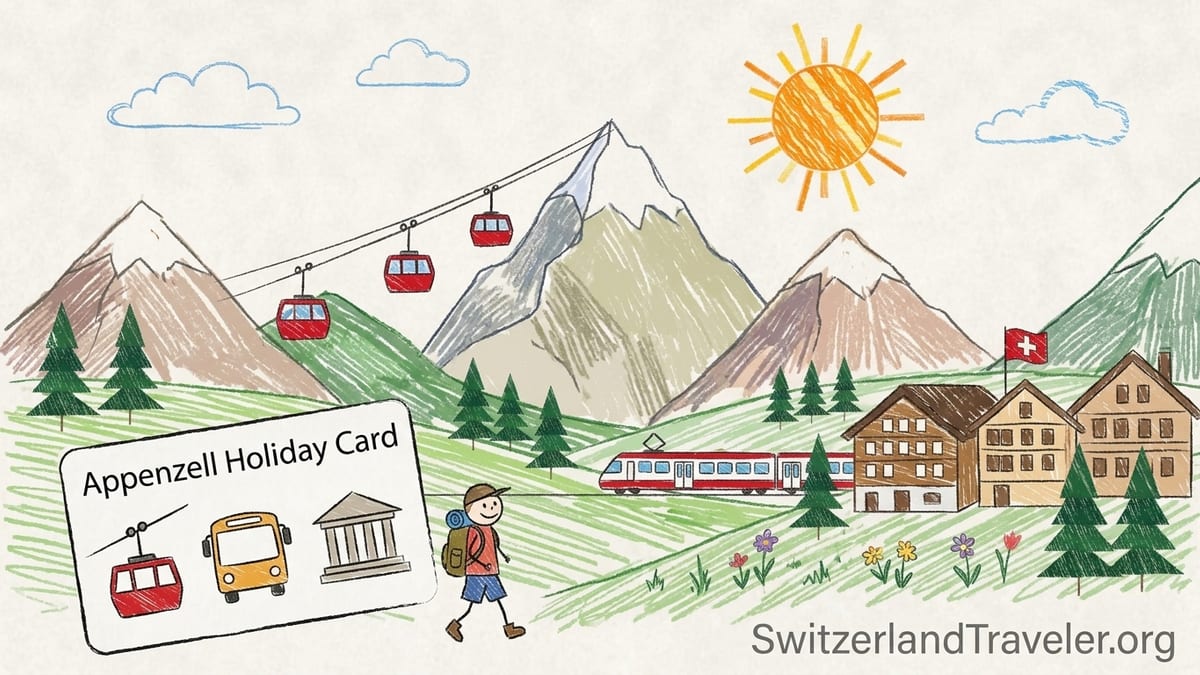
How the Appenzell Holiday Card Works
The Appenzell Holiday Card, often referred to locally as the Appenzeller Ferienkarte or Appenzell Card, is a guest card that many hotels, guesthouses and holiday apartments in the Appenzell region offer to guests who stay at least three consecutive nights. The core idea is simple: instead of paying separately for local transport, cable cars and selected attractions, you receive a bundled pass that grants free or heavily discounted access during your stay. You receive the card from your host at check in, and it is valid for the registered guests in the room or apartment for the duration of the booked nights.
The card’s headline benefit is free use of regional public transport around Appenzell, typically including local trains and buses within the Appenzellerland tourism area and extending to hubs such as St. Gallen in many seasons. That means you can ride from Appenzell to trailheads like Wasserauen or Jakobsbad without buying individual tickets, and you can often do day trips to nearby towns on the same card. For visitors who would otherwise buy point to point tickets, even a few journeys per day add up quickly in Switzerland.
What makes the Holiday Card especially attractive for hikers and mountain lovers is that it usually includes multiple free trips on key cable cars and mountain railways. Common examples cited by local tourism partners include several return rides each on the Wasserauen Ebenalp cable car, the Hoher Kasten cable car and the Jakobsbad Kronberg gondola, all of which serve popular hiking areas and viewpoints above Appenzell. Buying these individually can cost in the region of 30 to 50 Swiss francs per return trip, so using just a handful of included rides can already offset a meaningful part of your accommodation bill.
Alongside transport, the card also opens the door to a range of smaller extras that enrich a stay without constant small payments. Typical inclusions are free or discounted entry to local museums, a visit to the Appenzell brewery with a small gift, free access to the summer toboggan run near Kronberg, bike rentals for a day and entry to outdoor swimming pools in season. None of these individually justify a hotel choice, but together they encourage you to explore more of the region without thinking about every ticket purchase.
Why Three Nights Change the Value Equation
The crucial threshold for unlocking the Appenzell Holiday Card is the three night minimum stay in a participating accommodation. Guests who book only one or two nights typically do not receive the card, or only receive a lighter version of a guest card that focuses on limited discounts rather than free transport and cable cars. Once you cross the three night mark, however, the full Holiday Card can be issued, and the economics of your trip shift significantly.
Consider a common hiking itinerary. A couple staying three nights in Appenzell might plan one day on Ebenalp and Aescher, another day at Kronberg with the summer toboggan run and a third day riding the Hoher Kasten cable car for panoramic ridge walks. Without the Holiday Card, each of these mountain transport days could easily involve 70 to 100 Swiss francs of spending for two adults when you add cable car tickets and regional train or bus travel to and from the valley stations. With the Holiday Card, many of those rides become free, so the marginal cost of an extra cable car outing drops close to zero.
This is why it often makes sense to lengthen a stay from two to three nights specifically in Appenzell rather than spreading nights thinly across several Swiss destinations. By doing so, you compress several days of expensive mountain and transport use into a window where your marginal cost is largely contained in your room rate. In practical terms, travelers who would normally hesitate to add another lift ride or spontaneous museum visit often end up doing more, because each additional activity does not trigger a separate ticket purchase.
The value effect compounds further when you factor in that many properties cooperating with Appenzellerland Tourismus also participate in a free arrival and departure initiative for guests staying at least three nights and traveling by public transport. If you opt in to this offer when booking, the tourism office sends you public transport tickets to and from Appenzell in advance, meaning the train journey from elsewhere in Switzerland can also be free or strongly reduced. This moves potentially expensive intercity tickets out of your budget and reinforces the logic of choosing one base for several nights.
Free Arrival and Departure: Where It Applies and How It Helps
The free arrival and departure program in Appenzell is closely tied to the Holiday Card ecosystem and is one of the most compelling reasons to choose a participating hotel over a slightly cheaper non participating option. The concept is targeted at guests who commit to at least three consecutive nights in a hotel, B&B or holiday apartment and promise to travel to the destination by public transport rather than by private car. When you book such an accommodation, you typically indicate that you wish to take advantage of free arrival and departure and then submit an online form at least several days before traveling.
In response, Appenzellerland Tourismus sends you valid public transport tickets and, where relevant, a code for discounted station parking under their P plus Rail arrangement. In practice, this means that a family traveling from Zurich, Bern or another Swiss city to Appenzell no longer faces a separate bill for rail tickets on top of their hotel invoice. For visitors arriving from abroad who are already holding some kind of rail pass, the value may be lower, but for many domestic travelers or those without a Swiss Travel Pass, the saving on round trip tickets for multiple people can be substantial.
When comparing hotels, it is important to check whether the property participates in both the Holiday Card and the free arrival and departure scheme, because not every bed provider in the region is part of the program. Traditional hotels and larger guesthouses in and around Appenzell village are most likely to offer it, while very small B&Bs or remote alpine huts may not. If free arrival is important to you, confirm with the hotel that your stay length and booking channel qualify and that they will coordinate the tickets in time for your trip.
Crucially, taking advantage of free arrival and departure also reshapes the value of other Swiss rail products. For example, if your stay in Appenzell already covers travel to and from the region and most of your local journeys, you may not need a nationwide rail pass for those specific days. Instead, some travelers combine a few intensive days in Appenzell with other regions where local guest cards play a similar role, thus building a Switzerland itinerary that uses regional holiday cards as the backbone of their transport budgeting.
Comparing Participating Hotels by Price and Card Value
Once you understand how the Appenzell Holiday Card and free arrival work, hotel comparison is no longer just about the nightly room rate. A property that is 20 Swiss francs more expensive per night may still be the smarter choice if it participates in the program while a cheaper competitor does not. For a three night stay, that 60 franc difference can easily be outweighed by one or two free cable car rides and a handful of regional train tickets covered by the card.
Start by identifying hotels that clearly advertise the Appenzell Holiday Card as part of their offer. Many mid range properties in Appenzell village do this prominently in their room descriptions or special packages, especially for summer and autumn seasons when hiking demand is highest. Typical examples include classic inns on the main square which bundle three or four nights with the card, breakfast and sometimes a set evening menu. Nightly prices for such hotels often sit in the mid range for Switzerland, but include the embedded value of the card.
Next, look at the room categories. A standard double room in a participating three star hotel might cost roughly the same as a larger room in a non participating property when you simply scan headline prices. Yet if you count in that the Holiday Card will give each guest free public transport and several cable car rides, the standard room with the card often comes out ahead by a wide margin. For solo travelers, the effect can be even stronger, because the card is issued per person, not per room, so a single paying a modest single room supplement still enjoys the full range of free offers.
Families and small groups should also watch how child policies interact with the card. In many accommodations, children sharing a room with parents either stay at a reduced rate or free up to a certain age. Those children can usually still receive their own Holiday Card so long as they meet the age rules, which means complimentary transport and cable cars extend to them as well. That can transform a multi day family hiking trip, where children might otherwise be left out of certain excursions purely on cost grounds, into a more relaxed and inclusive experience.
Hiking Access: Choosing a Base for Trails and Cable Cars
For active travelers focused on hiking, the most important hotel comparison factor after price and card eligibility is access to trailheads and cable car stations. Appenzell village itself is a compact hub that connects by train or bus to key starting points such as Wasserauen for Ebenalp and the Schäfler ridge, Jakobsbad for Kronberg and Brülisau for Hoher Kasten. A hotel within easy walking distance of Appenzell railway station effectively places you one short train ride away from most of the region’s headline hikes, particularly once those trains and buses are covered by your Holiday Card.
If you prefer to stay closer to a specific mountain, look at hotels and guesthouses in satellite villages directly beneath the lifts. For instance, a stay near Wasserauen station puts you at the doorstep of the Ebenalp cable car and the trails that traverse to Aescher, Seealpsee and down into the Alpstein massif. Similarly, accommodations around Jakobsbad are convenient for days centered on Kronberg’s family friendly activities and panoramic walks. In such cases, the Holiday Card reduces the friction of popping back and forth between your mountain base and Appenzell village for meals, shopping or evening strolls.
The card also encourages more flexible route planning. On a good weather day, you might ride the cable car up to Ebenalp in the morning, hike a demanding route across to Hoher Kasten or down to Brülisau and then use your free transport entitlements to return to your hotel without worrying about the cost of an extra bus or train. In rainy or low visibility conditions, you can pivot to museum visits in Appenzell or a relaxed ride to nearby St. Gallen, knowing that the journeys themselves will not increase your daily spend.
When evaluating hotels online, pay attention not only to the official distance to the nearest station but also to the practical walking route. A property can be listed as a short distance away in kilometers, but a steep hill or awkward road crossing may make early morning departures less pleasant. Street level satellite imagery and guest reviews often give a better sense of whether you will feel comfortable walking to the station with hiking gear, especially after a long day on the trail.
Free Offers Beyond Transport: Museums, Pools and Local Color
While the biggest financial impact of the Appenzell Holiday Card comes from transport and cable cars, the smaller inclusions can meaningfully enhance a stay. Many versions of the card include admission to several local museums, such as the regional museum in Appenzell village that showcases traditional costumes, folk art and the unique political history of the canton. Without the card, individual museum entries quickly approach the price of a modest meal, so being able to visit spontaneously for an hour or two feels more relaxed.
Summer visitors in particular benefit from free or discounted access to swimming pools and leisure facilities. On hot afternoons after a long hike, being able to cool off in an outdoor pool without paying a separate entrance fee for each family member makes it more likely that you will actually take advantage of the amenity. Similarly, the inclusion of the Kronberg summer toboggan run encourages playful detours that might otherwise be skipped when you are watching your budget carefully.
The brewery gift and tasting experience attached to many Holiday Card packages also delivers a slice of local flavor. Appenzell is known throughout Switzerland for its brewing tradition and distinctive label art, and a complimentary visit helps turn an ordinary evening into a memorable cultural moment. Because this perk comes as part of the card, travelers who would not normally pay for a brewery tour feel more willing to drop in for an hour between hikes.
These extras matter when you compare hotels because they influence how you will actually spend your time off the trails. A property that participates fully in the Holiday Card program effectively surrounds you with low friction opportunities to fill gaps in your itinerary, from a quick museum visit on a rainy morning to an impromptu trip to a nearby village. When the marginal cost of such diversions is negligible, you end up seeing more of Appenzellerland than you might if every doorway required a new ticket.
How to Evaluate a Specific Hotel’s Holiday Card Offer
Because the Appenzell Holiday Card is administered in partnership with the regional tourism office, its core benefits are broadly similar from one participating accommodation to another. However, there can be differences in how clearly hotels communicate the inclusion, which seasons it applies to and whether additional services such as breakfast or half board are bundled with the card in promotional packages. Before you book, it pays to read the fine print on the hotel’s own description, not just third party listings.
Verify first that the property explicitly mentions the Appenzell Holiday Card or Appenzeller Ferienkarte for stays of at least three nights. Some hotels run time limited offers, for example only between early November and late March, or concentrate the most generous benefits in summer seasons. If your travel dates sit at the edge of a season, email the property briefly to confirm that your stay will still qualify, particularly if the card is a deciding factor in your choice.
Next, ask whether the hotel participates in the free arrival and departure scheme and if there are any conditions related to the booking method. In some destinations, special rates sold via certain online platforms may not always include the guest card benefits, while direct bookings or official package deals definitely do. In Appenzell, clear communication around this point is improving each year, but it is still sensible to keep a record of written confirmation that your rate includes both the Holiday Card and free arrival should you qualify for it.
Finally, balance the card benefits with the hotel’s core qualities. Location, noise levels, room size and breakfast quality all still matter. A modestly higher price is justifiable when the Holiday Card value is strong, but a hotel that is significantly more expensive than similar peers, yet no better located, may not be the optimal choice even with the card. Look for places where reviewers consistently mention the convenience of using the Holiday Card, the helpfulness of staff in explaining the offers and the ease of reaching trailheads by public transport from the property.
The Takeaway
The Appenzell Holiday Card transforms how travelers should think about accommodation in Appenzellerland. Instead of viewing your hotel simply as a place to sleep, you can treat it as a gateway to free regional transport, cable cars and a suite of cultural and leisure experiences. The three night minimum stay is not an arbitrary hurdle, but the point at which the economics of your trip begin to tilt in your favor, especially if you plan to ride multiple mountain lifts and explore widely by train and bus.
For many visitors, the smartest move is to consolidate their Appenzell time into a three to five night block in a participating property that also offers free public transport for arrival and departure. This allows you to stack savings on airport or intercity trains, local journeys to trailheads and big ticket cable car excursions, all while enjoying museums, pools and local brewery visits with little or no extra cost. When you compare hotels, consider the Holiday Card and free arrival eligibility as critical criteria alongside nightly rates, room size and breakfast.
With a bit of planning, your choice of Appenzell hotel can unlock a level of value that would be hard to replicate with separate tickets and shorter stays. That makes Appenzellerland not only one of Switzerland’s most distinctive cultural regions, but also one of its most compelling bases for cost conscious hikers and families who still want to ride the lifts, see the views and sample local life without counting every ticket stub.
FAQ
Q1. What is the Appenzell Holiday Card and who can get it? The Appenzell Holiday Card is a regional guest card that provides free local public transport, selected cable car rides and various attraction entries or discounts. It is typically issued to guests who stay at least three consecutive nights in a participating hotel, guesthouse or holiday apartment in the Appenzell region.
Q2. How many nights do I need to stay to qualify for the card? In most participating accommodations you must stay a minimum of three consecutive nights to receive the full Appenzell Holiday Card. Stays shorter than three nights usually do not qualify for the complete package of free transport and cable cars, although some properties may offer more limited guest benefits.
Q3. Which cable cars are usually included with the Appenzell Holiday Card? The card normally includes several free rides on key lifts that serve major hiking areas, such as the Wasserauen Ebenalp cable car, the Hoher Kasten cable car and the Jakobsbad Kronberg gondola. The exact number of rides and seasonal operating dates can vary, so you should check the current information provided by the tourism office or your hotel for your travel period.
Q4. Does every hotel in Appenzell offer the Holiday Card? No, not every accommodation participates. Many mid range hotels, traditional inns and some holiday apartments in and around Appenzell village do offer the Holiday Card for qualifying stays, but smaller B&Bs, remote mountain huts or budget properties may not. Always check the hotel’s description or contact them directly to confirm that your booking includes the card.
Q5. How does the free arrival and departure offer work? If you book at least three nights in a participating accommodation and commit to traveling by public transport, you can often register for a free arrival and departure offer. After you book, you submit your travel details through an online form, and the regional tourism office sends you valid public transport tickets and, where applicable, a parking discount code. This usually covers your train or bus journey to and from Appenzell within Switzerland.
Q6. Is it worth extending my stay from two nights to three? For most travelers planning to use cable cars and regional transport, extending a stay from two to three nights in a participating property is highly worthwhile. The additional night unlocks the Holiday Card, which can quickly repay the extra room cost through free lift rides, train journeys and attraction entries, especially for couples, families or groups.
Q7. Can children also receive the Appenzell Holiday Card? Yes, children who meet the age requirements and are registered as overnight guests in a participating accommodation can usually receive their own Appenzell Holiday Card. In many hotels, children staying at reduced or even free rates still qualify, which makes family transport and cable car costs significantly lower than buying separate tickets for each child.
Q8. Do I still need a Swiss Travel Pass if I have the Holiday Card? The Appenzell Holiday Card covers a defined regional area rather than the entire country, so a national Swiss Travel Pass may still be useful if you plan extensive travel elsewhere. However, during the days when you are based in Appenzell, the Holiday Card and free arrival or departure can substantially reduce the need for additional national rail products, and some visitors choose to combine several regional guest cards instead of one nationwide pass.
Q9. How do I know if my booking rate includes the Holiday Card? The safest approach is to check the wording of your chosen rate on the hotel’s own site and then request written confirmation. Some properties clearly label special packages that include the Holiday Card, while others provide it automatically for eligible stays. If you book through a third party platform, verify that the hotel will still issue the card for your stay length and room type.
Q10. What happens if I leave earlier than planned and no longer meet the three night minimum? If you depart earlier than your original booking and your total stay drops below the three night threshold, the accommodation provider may be allowed to adjust your bill or charge a fee related to the Holiday Card. Policies differ, but you should expect that early departure could mean losing the card benefits and potentially paying more per night than originally quoted.