


Western Switzerland is often reduced to glossy photos of Lake Geneva and Montreux’s palm-lined promenade, but the region is far broader and richer. For a first visit, understanding how Geneva, Lausanne and the lakeside towns fit together with the quieter Three-Lakes and Jura regions will help you build a trip that feels both efficient and deeply rewarding.
Understanding Western Switzerland as a Region
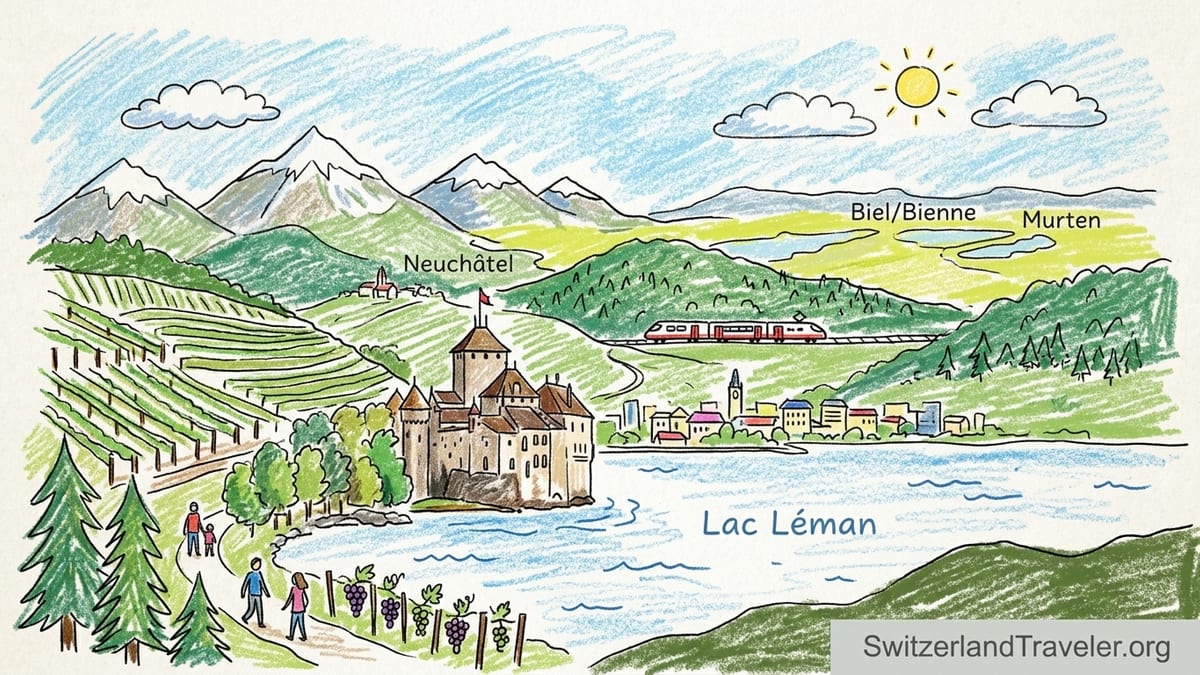
Western Switzerland roughly covers the French-speaking corner of the country, from Geneva on the far western tip of Lake Geneva to the Jura mountains and the Three-Lakes region around Neuchâtel, Biel/Bienne and Murten. Many first-time visitors never see beyond the Geneva to Montreux stretch of lakefront, yet tourism boards now consistently promote “Jura & Three-Lakes” as a distinct region in its own right, anchored by Neuchâtel and the surrounding Jura peaks and nature reserves. On a map you will see that Lake Geneva forms the southern fringe of the Jura foothills rather than the whole story.
In practical terms, this means you can have two very different trips without leaving Western Switzerland. A Lake Geneva itinerary might focus on promenades, vineyards and Belle Époque hotels between Geneva, Lausanne, Vevey and Montreux. Push only an hour or so north by train and you are in a calmer landscape of rolling Jura hills, lakeside towns like Neuchâtel and Biel/Bienne, and nature sites such as the rock amphitheatre of Creux du Van, often described as Switzerland’s own “Grand Canyon” for its 200-metre cliffs and sweeping views.
For a first-time visitor with 7 to 10 days, a realistic plan is to combine both halves: three or four nights on Lake Geneva, then three or four nights in the Three-Lakes or Jura area. This avoids constant packing and still gives access to day trips like Gruyères from the lake and Creux du Van from Neuchâtel or the Val-de-Travers. Crucially, frequent and punctual trains link all these bases, so you can treat the region as a connected whole.
Because this is a relatively compact area, distances are modest. The direct train from Geneva to Lausanne takes around 40 minutes, Lausanne to Montreux about 20 minutes, and Lausanne to Neuchâtel about 80 to 90 minutes with a change in Yverdon-les-Bains. From Fribourg to Neuchâtel is roughly 45 to 50 minutes by train. These journey times make it entirely feasible to sleep in one place for several nights while exploring a wider radius by rail and boat.
Lake Geneva: Geneva, Lausanne, Lavaux, Vevey and Montreux
Lake Geneva, also known locally as Lac Léman, is the visual anchor of Western Switzerland. Geneva sits at the southwestern tip, an international, diplomatic city where the lakeshore feels urban and polished. A typical first-day experience might be a walk along the Quai du Mont-Blanc to see the Jet d’Eau fountain and a stroll through the old town around St. Pierre Cathedral. Geneva is convenient if you arrive or depart by plane, but hotel and restaurant prices tend to be among the highest in Switzerland, so many travellers limit their stay to one or two nights.
Lausanne, about 40 minutes by train up the lake, is a livelier university city built on steep hills above the water. The lakeside district of Ouchy has parks, a long promenade and mid-range to upscale hotels, including classic Belle Époque properties overlooking the water. A first-time visitor might spend a morning exploring the Gothic cathedral and old town, then ride the metro down to Ouchy in the afternoon for a cruise or lakeside aperitif. Compared with Geneva, Lausanne often offers a broader range of mid-priced accommodation and restaurant choices, from simple brasseries to contemporary Swiss bistros.
East of Lausanne, the Lavaux vineyard terraces are one of the region’s signature landscapes, a UNESCO-listed stretch of hillside where rows of vines plunge towards the lake. You can experience this area as a simple train hop to villages such as Cully or Lutry, then walk between wine villages on marked paths while sampling local Chasselas wines at cellars that post open hours on chalkboards. A common real-world pattern is to buy a takeaway picnic in Lausanne, ride 15 minutes by train to Cully, hike for two to three hours among the terraces, then board a late-afternoon boat back to Lausanne or continue to Vevey.
Vevey and Montreux, further along the north shore, share the same mild, almost Mediterranean climate but have distinct personalities. Vevey feels more low-key and residential, with a compact old town and lakeside parks. Montreux, about 20 minutes beyond by train, is more overtly resort-like, with grand hotels lining the waterfront and a famous jazz festival each July. From Montreux, a lakeside promenade leads to Chillon Castle, one of Switzerland’s best-preserved medieval castles, which you can reach on foot in about 45 minutes or by frequent bus or boat in around 10 minutes. Many first-timers choose Montreux or nearby Vevey for two to three nights as a quieter base that still offers easy day trips into the Alps via the cog railway to Rochers-de-Naye or the GoldenPass line towards Gstaad.
The Three-Lakes and Neuchâtel: Western Switzerland Beyond Lake Geneva
North of Lake Geneva lies the Three-Lakes region, formed by Lake Neuchâtel, Lake Biel/Bienne and Lake Murten. Neuchâtel is the main hub here, a lakeside town of roughly 30,000 people climbing up from the waterfront to a hilltop castle and collegiate church. The old town streets are built in warm yellow limestone, giving the centre a distinctive glow in late-afternoon light. Visitors often comment that Neuchâtel feels like a smaller, more relaxed version of Lausanne, with enough cafes, boutiques and museums to fill two or three days without the crowds of the big Alpine resorts.
Tourism authorities now deliberately promote Neuchâtel not only as a lakeside town but as a gateway to a wider northwestern region of lakes, Jura mountains, towns and nature sites. One of the signature natural landmarks is Creux du Van, a rock amphitheatre in the Neuchâtel Jura with cliffs about 200 metres high and panoramic views across the plateau and often as far as the Alps on a clear day. Reaching it typically involves a 30-minute train ride from Neuchâtel to Noiraigue in the Val-de-Travers, followed by a steep hike of two to three hours, or a drive up a mountain road to a farm restaurant near the rim.
Lake Neuchâtel itself is long and shallow, with reed beds and vineyards along the shore. In summer, locals use the public bathing areas and beaches at places like Neuchâtel, Yverdon-les-Bains and Estavayer-le-Lac, and regular boats connect lakeside communities, often with combined boat and train tickets. The region is also associated with cycling; a popular day out is to rent bikes from Neuchâtel station and follow the relatively flat lakeside paths for 20 to 40 kilometres, stopping in small wine villages or nature reserves on the way.
Further east and north, the Three-Lakes label extends to Biel/Bienne, a bilingual town where French and German meet, and Murten, a walled medieval town on the shore of Lake Murten. Even if you do not stay overnight, a loop by train and boat from Neuchâtel to Murten, then by boat or train to Biel/Bienne, and back via the vineyards of Lake Biel gives you a sense of this quieter, less touristed Western Switzerland. Prices for hotels and casual restaurants are often slightly lower here than in Geneva or Montreux, which can matter for travellers watching their Swiss franc budget.
Fribourg, Gruyères and the Rural Heart of Western Switzerland
Between Lake Geneva and the Three-Lakes region sits the canton of Fribourg, a kind of hinge between French and German Switzerland. The city of Fribourg itself stands on a rocky outcrop above the Sarine River, its old town full of Gothic facades, covered bridges and steep streets. From Lausanne, Fribourg is about one hour by direct train, making it a comfortable day trip or an overnight stop for travellers moving from the lake to the Jura and Neuchâtel.
Gruyères, in the foothills southeast of Fribourg, is one of Western Switzerland’s most recognisable rural destinations, known worldwide for its cheese. The village is traffic-free, perched on a hilltop with a castle at one end and stone houses lining the main street. A typical visit for first-timers combines a tour of a nearby cheese dairy, where you can watch curds being stirred in copper vats, with a walk through the medieval lanes and a simple meal of fondue or raclette. Many visitors also combine Gruyères with the Cailler chocolate factory in Broc, a short train ride away, buying a day ticket that covers both attractions and the regional trains.
From the Lake Geneva side, Gruyères is reached by train in about 90 minutes from Lausanne or around two hours from Geneva, usually with a change in Palézieux and Bulle. There are also scenic options, such as the chocolate-themed tourist train that links Montreux, Gruyères and Broc on selected days, combining lake views with rolling pre-Alpine pastures. For travellers based in Vevey or Montreux, visiting Gruyères as a day trip is straightforward, leaving after breakfast, touring the dairy and castle, enjoying a long lunch and returning in time for a sunset stroll along the lake.
Staying one or two nights in this rural heartland offers a very different experience from the lakefront cities. Accommodation ranges from family-run inns in small villages to modern mid-range hotels in Fribourg itself. Prices are often slightly below those on Lake Geneva for similar standards. A double room in a simple three-star hotel in or near Gruyères might cost the equivalent of 180 to 230 Swiss francs per night in high season, while a comparable room in central Geneva could easily run 260 to 350 francs or more, especially during major events.
The Jura Mountains and Nature: Beyond the Postcard Switzerland
The Jura is one of Switzerland’s three main geographic regions, a band of folded limestone hills that extend along the country’s northwest. In Western Switzerland, the Jura rises above lakes such as Geneva, Neuchâtel and Biel, with a landscape of forests, pastures, watchmaking towns and high plateaus. Compared with the jagged Alpine peaks seen from Montreux, the Jura offers gentler, more accessible hiking, cross-country skiing in winter and big-sky views from rounded summits like Chasseral or the heights above the Vallée de Joux.
Nature tourism in this region is increasingly centred on a handful of standout sites. Creux du Van, in the Neuchâtel Jura, is one of the most visited, but there are also high bogs such as the Étang de la Gruère in the canton of Jura and panoramic lookouts in the Chasseral Nature Park above Lake Biel. For a first-time visitor staying in Neuchâtel or Biel/Bienne, it is realistic to plan a full day in the Jura with a combination of public transport and hiking: for example, an early train to Noiraigue, hike up to Creux du Van and back down by a different trail, then a return train in the late afternoon.
The Jura valleys are also the historic heart of Swiss watchmaking. Towns like La Chaux-de-Fonds and Le Locle, reachable by train from Neuchâtel in 30 to 40 minutes, feature grid-planned streets and museums that explain how watchmaking shaped the region. Even if you are not buying a luxury watch, walking past the workshops and visiting a museum can give context to the familiar “Swiss Made” label. Many travellers pair a morning in La Chaux-de-Fonds with an afternoon swim in Lake Neuchâtel or a relaxed stroll through the vineyards on the lakeshore.
Because these Jura and Three-Lakes landscapes sit slightly off the main Alpine circuit, they tend to be quieter and somewhat more affordable. Mountain restaurants on the Jura ridges often serve hearty plates of rösti, sausages or seasonal game for prices that feel modest by Swiss standards, while the views over lakes and, on clear days, distant Alpine chains rival more famous panoramas. For a first visit, including even one Jura day in a Western Switzerland trip can provide balance after time spent in the busier lakefront cities.
Getting Around: Trains, Boats and Passes
Western Switzerland is particularly easy to navigate without a car thanks to dense train, bus and boat networks. The main Lake Geneva cities, including Geneva, Lausanne, Vevey and Montreux, sit on the same heavily served rail line, with at least two trains per hour in each direction during the day. From Lausanne, frequent regional trains fan out towards Fribourg, Neuchâtel and the Jura valleys, making it possible to breakfast by the lake and be on a mountain trail by midmorning.
Boats are a highlight in their own right. The Lake Geneva navigation company runs scheduled services connecting Geneva, Nyon, Rolle, Lausanne-Ouchy, Vevey, Montreux and smaller piers, using a mix of historic paddle steamers and modern vessels. In summer, you might ride a late-morning paddle steamer from Lausanne to Montreux in about 90 minutes, sitting on the open deck as you glide past the Lavaux terraces, then return by train in 20 minutes. Holders of national rail passes such as the Swiss Travel Pass typically have free or heavily discounted access to these scheduled boats, though supplements may apply for special dining or excursion cruises.
On the Three-Lakes, smaller fleets link towns on Lakes Neuchâtel, Biel/Bienne and Murten, often allowing you to create loop trips that combine trains and boats. For example, one day itinerary might be a morning train from Neuchâtel to Murten, a leisurely lakeside walk and lunch within the old town ramparts, then an afternoon boat ride across Lake Murten and connecting trains back via Fribourg. These services tend to be more seasonal, with the fullest timetables from roughly late spring to early autumn, so it is wise to check departure boards at the pier or station a day or two in advance.
For many first-timers, a regional or national rail pass simplifies travel and keeps costs predictable. The Swiss Travel Pass, sold for consecutive days, typically covers trains, most boats and many city trams and buses, plus free or reduced admission to numerous museums. As a concrete example, if you plan to ride trains almost every day between Geneva, Lausanne, Montreux, Fribourg and Neuchâtel, and also take a couple of lake cruises, a multi-day pass often compares favourably to buying individual tickets, especially once you factor in museum entries like Chillon Castle or the Olympic Museum in Lausanne. Travellers staying mostly in one canton may also find canton-specific passes or day passes sold through local transport authorities that offer better value for a short, concentrated stay.
Language, Culture and Practicalities
Western Switzerland is predominantly French-speaking, which is why you will often see the term “Suisse romande” used for the region. Geneva, Lausanne, Vevey, Montreux, Neuchâtel and most of the Jura towns use French in daily life and on signage. However, the canton of Fribourg and the Biel/Bienne area are officially bilingual; it is entirely normal in Fribourg city to hear announcements in both French and German and to see restaurant menus printed in both languages. English is commonly spoken in hotels, main tourist attractions and larger restaurants, so a few basic French phrases combined with patient English usually work well.
Culturally, the lakefront cities feel outward-looking and international, especially Geneva with its concentration of international organisations and Lausanne with its large student population. Lakeside promenades in Vevey or Montreux have a relaxed, almost Riviera atmosphere in summer, with locals eating ice cream on benches, street musicians performing and temporary summer bars set up on the water. In the Three-Lakes and Jura regions, life feels more small-town and agricultural, with festivals tied to local crops such as wine harvests, absinthe in the Val-de-Travers, or traditional cattle drives from Jura pastures in autumn.
Costs are high by global standards, but there is some variation within Western Switzerland. Geneva and Lausanne tend to be the most expensive for accommodation and dining, followed by Montreux in peak festival periods. Neuchâtel, Fribourg and smaller Jura towns often offer better value. As a practical benchmark, a simple restaurant lunch of a plat du jour with a soft drink might be around 20 to 28 Swiss francs in a mid-range bistro, while a sit-down dinner with a main course and a glass of wine in a lakeside city can easily reach 40 to 55 francs per person. Self-catering by shopping at supermarkets near train stations is a common way for budget-conscious travellers to manage costs.
Weather patterns vary with altitude and proximity to the lakes. Lake Geneva and Lake Neuchâtel have relatively mild climates, with warm but usually not extreme summers and cool, damp winters that can feel colder due to humidity and lake breezes. The Jura hills are typically a few degrees cooler and often hold snow longer into spring, which matters if you are planning early-season hiking. In practical terms, even in July and August it is wise to pack a light jacket and layers, as a sunny lakeside morning can give way to a breezy, cooler afternoon on a boat or in the Jura.
Where to Stay and How Many Bases You Really Need
One of the most common planning questions for Western Switzerland is how many bases to choose. For a first-time visitor with around a week, two or three bases usually provide the best balance between variety and simplicity. A classic pattern is to spend three or four nights on Lake Geneva, often in Lausanne, Vevey or Montreux, and then three or four nights in either Neuchâtel or Fribourg to explore the Three-Lakes and Jura area. This structure gives you two contrasting “home” environments while limiting repacking and check-ins.
Lausanne works well as a Lake Geneva base because it offers good value compared with Geneva, direct rail links in both directions along the lake and up to Fribourg and Bern, plus a full range of accommodation from international chain hotels near the station to historic lakeside properties in Ouchy. Travellers focused on a more resort-like feel and easy access to mountain excursions might prefer Montreux or Vevey, where you can walk directly from your hotel to the promenade and board boats or cog railways with minimal transfers.
For the second base, Neuchâtel is particularly strong if you want to combine lakeside relaxation with outings into the Jura and to sites like Creux du Van, La Chaux-de-Fonds or the Three-Lakes. Staying three nights there allows for one day exploring the town and lake, one day in the Jura, and one day visiting neighbouring towns such as Murten or Biel/Bienne. Alternatively, choosing Fribourg as your second base makes sense if you are especially interested in Gruyères, the Sarine valley and connections further into central Switzerland; from Fribourg you can reach both Lake Geneva and the Three-Lakes in about an hour by train.
In terms of accommodation categories, Western Switzerland offers everything from five-star historic palaces to simple guesthouses and serviced apartments. In lakefront cities, it is common to find modern business hotels clustered near train stations and convention centres, while the grand lakefront hotels often command premium prices for direct views. In Neuchâtel, Fribourg and smaller Jura towns, mid-range family-run hotels and inns remain a mainstay, often with on-site restaurants serving local cuisine. Booking well ahead for July and August, as well as key festival periods such as Montreux Jazz, is wise, as popular properties on the lake can sell out or raise rates significantly.
The Takeaway
For a first-time visitor, Western Switzerland is best understood as more than the postcard views of Lake Geneva. Geneva, Lausanne, Lavaux, Vevey and Montreux deliver the expected blend of promenades, vineyards and grand hotels, with trains and boats tying them together into an easy, scenic arc. Yet the experience deepens when you continue beyond the lakefront to Fribourg, Gruyères, Neuchâtel and the Jura, where the pace slows and everyday Swiss life feels closer at hand.
With thoughtful planning, you can move between these worlds in under two hours by train, using two or three well-chosen bases instead of a new hotel every night. A week that starts with a sunset cruise past Lavaux, continues with fondue in Gruyères and ends on a Jura ridge above Lake Neuchâtel will give you a sense of Western Switzerland as a complete region: lakes, mountains, towns and nature woven into a compact, well-connected corner of the country.
FAQ
Q1. How many days should I spend in Western Switzerland on a first trip?
For a balanced first visit, seven to ten days works well. That allows three to four nights on Lake Geneva and three to four nights in the Three-Lakes or Jura area without rushing.
Q2. Is it better to base in Geneva or Lausanne?
Geneva is ideal for short stays and flight connections, but Lausanne generally offers more mid-range accommodation, a livelier atmosphere and easier onward rail links, making it a stronger base for most travellers.
Q3. Do I need a car to visit Lavaux, Gruyères and Creux du Van?
No. Lavaux and Gruyères are easily reached by train from Lausanne or Montreux, and Creux du Van can be accessed by train to Noiraigue followed by a hike. A car adds flexibility but is not essential.
Q4. What is the difference between Lake Geneva and the Three-Lakes region?
Lake Geneva is more urban and resort-like, with big cities and grand hotels, while the Three-Lakes region around Neuchâtel, Biel/Bienne and Murten feels quieter, more rural and generally a bit less expensive.
Q5. Where does Neuchâtel fit into a Western Switzerland itinerary?
Neuchâtel makes an excellent second base after Lake Geneva. From there you can explore Lake Neuchâtel itself, day trip to the Jura, visit watchmaking towns and take boat or train excursions to nearby lakeside towns.
Q6. Are boat trips on Lake Geneva included in rail passes?
Most national rail passes, such as the Swiss Travel Pass, include regular scheduled boats on Lake Geneva, though special dining or themed cruises may require a supplement or separate ticket.
Q7. How expensive is Western Switzerland compared with the rest of the country?
Prices in Geneva, Lausanne and Montreux are among the higher end of Swiss destinations, while Neuchâtel, Fribourg and many Jura towns are somewhat more affordable for similar standards of lodging and dining.
Q8. When is the best time to visit Western Switzerland?
Late spring to early autumn offers the best mix of open boat services, accessible hiking and pleasant lake temperatures. July and August are warmest but also busiest and often most expensive.
Q9. Is English widely spoken in Western Switzerland?
Yes. French is the main language, but English is commonly spoken in hotels, major attractions and many restaurants, especially in cities and tourist areas. Basic French phrases are still appreciated.
Q10. How many hotel bases do I realistically need?
For most first-time visitors, two or three bases are enough. One on Lake Geneva, plus one in either Neuchâtel or Fribourg, will cover the main cities, vineyards, lakes and Jura highlights efficiently.