


On a clear September morning in 2026, I traded Lugano’s polished lakefront for a short, steep ride into the sky. Monte San Salvatore rises to 912 meters just behind the suburb of Paradiso, and its funicular has been hauling locals and visitors upward for more than a century. I went up with a simple question in mind: is it really worth leaving the lakefront to ride a 12‑minute train to the top, or are the brochures overselling it? Here is exactly what I learned, step by step, from the walk to the lower station to the moment I came back down and rejoined the crowds by the water.
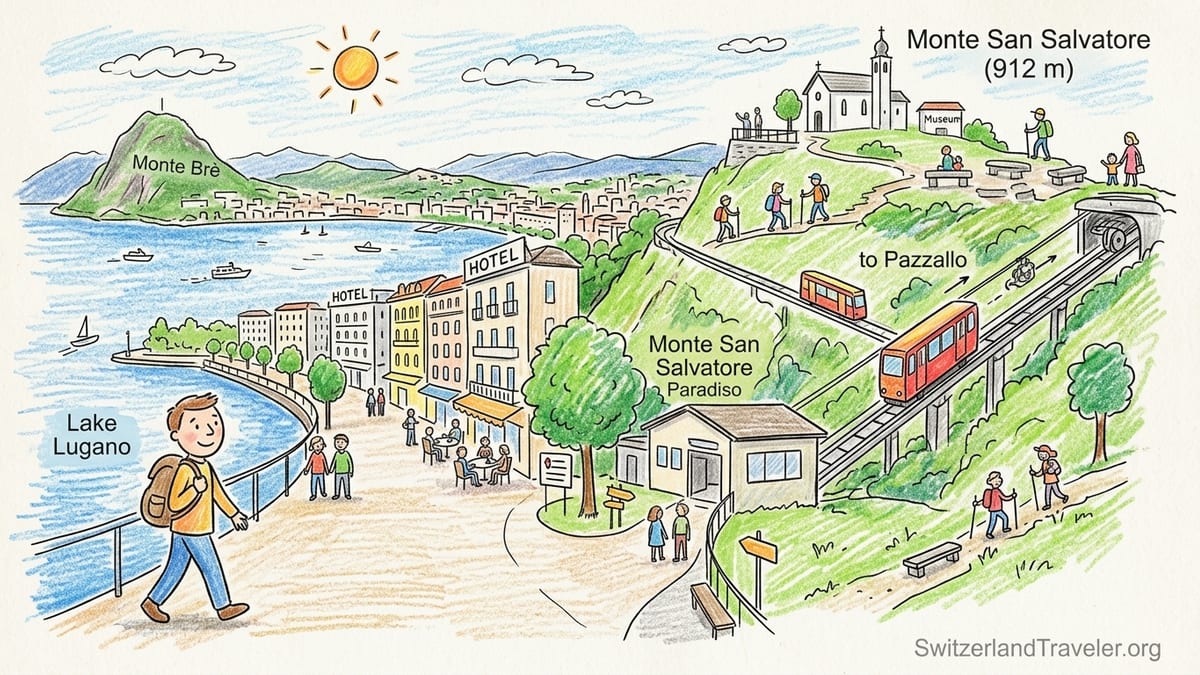
Getting From Lugano Center to the Funicular Base
I started at Lugano’s lakeside promenade near Piazza della Riforma, where most visitors naturally gravitate. From there, reaching the Monte San Salvatore funicular base in Paradiso is remarkably straightforward on foot. I followed the curve of the lake toward the south, keeping the water on my left and the line of hotel facades on my right. The walk is flat, paved, and pleasant, taking me through a mix of locals walking dogs and visitors lingering over late breakfasts on outdoor terraces.
The funicular base station is in Lugano‑Paradiso, about 20 to 25 minutes’ walk from central Lugano for someone of average fitness. You do not need hiking shoes or special gear for this section; trainers or casual sandals are fine in good weather. The last stretch cuts slightly inland along Via delle Scuole, where a modest station building sits a short distance from the Paradiso railway stop and a few blocks from the Lugano‑Sud motorway exit. It feels more like a neighborhood tram stop than the gateway to a major viewpoint, which keeps expectations in check until you step inside.
Arriving just before 10:00, I found the station already ticking over with steady traffic but nothing like the dense crowds of large Alpine ski lifts. There is a small ticket office and some machines, as well as basic information on operating times. In 2026 the main summer season runs from 14 March to 8 November, with services generally from 09:00 and up to 18:00 or later depending on the period, and cars every 30 minutes. That regular half‑hour rhythm becomes part of your planning, especially for the return trip when you might be choosing between one more panoramic photo or catching the next departure.
What struck me at ground level was how close the mountain feels to town. Monte San Salvatore looks almost vertical when you tip your head back from the station forecourt, but the setting is firmly urban. This contrast, between city convenience and almost immediate mountain scenery, is one of the key reasons the outing is so attractive if you only have a spare half day in Lugano.
Tickets, Guided Excursion Pricing, and Ticino Ticket Discounts
Before stepping onto the platform, I bought my ticket directly at the station counter. For 2026, the official tariff lists an adult return ticket at 32 Swiss francs, with a single ride up or down priced at 25 francs. Holders of the national Half‑Fare or GA rail cards pay 16 francs for a return, and 12.50 francs for a single journey. Children from 6 to 16 travel for 14 francs return or 11 francs one way, with additional concessions for junior travelcard holders. These prices were clearly displayed both on the official tariff board and through the operator’s online shop in autumn 2026, which makes it straightforward to budget before you arrive.
The Ticino Ticket, a complimentary guest card provided by many hotels and campsites in the canton, is accepted on the Monte San Salvatore funicular. For 2026 the tariff board shows a reduced adult return price of 25.50 francs for Ticino Ticket holders, compared with the standard 32 francs, while a single ride is 20 francs instead of 25. That is not an enormous saving, but on a trip for two adults it covers at least a coffee and a pastry at the summit restaurant, which is a very Swiss way of thinking about discounts.
Alongside the standard tickets, 2026 also introduced an official guided Lugano–San Salvatore excursion running from 10 June to 21 October. This package combined a guided visit and the funicular ride for 20 francs per adult, with a 30 percent reduction for Ticino Ticket holders. In other words, if you were already staying in official accommodation and used the Ticino Ticket, the guided excursion cost about 14 francs, which is less than half of the usual return fare alone. Availability and exact running days were handled through local tourism partners, so it required a little advance checking, but as a value proposition it made a clear case for joining a group if your travel dates lined up.
I chose to go independently for this visit, partly to keep my schedule flexible and partly because I wanted to see how intuitive the experience is for a first‑time visitor relying only on station signage and a bit of prior reading. If you prefer commentary and structured time at the top, however, that official excursion pricing is a key detail that can significantly lower the cost of your ascent.
Waiting at the Lower Station and Boarding the Historic Funicular
With ticket in hand, I joined the short queue that formed a few minutes before departure. The waiting area is covered and practical rather than charming, with benches along the walls and a gentle buzz of conversation in Italian, German, and English. On my weekday morning visit, the queue built to perhaps 30 people, which filled the carriage comfortably without forcing anyone to stand shoulder to shoulder. I spoke briefly with a couple from Zurich who had driven down for the day and with a solo traveler from the United States who had arrived on the morning InterCity from Basel. None of us had reserved ahead, and none had any trouble boarding the first car that came.
For a more compressed weekend schedule, I would expect the queues to lengthen around late morning when coach groups and late risers converge. Because the funicular departs every 30 minutes, missing one departure simply means another short wait, not a serious disruption. The advice here is practical: arrive at least 5 to 10 minutes before the departure you want, especially in peak summer, to have first choice of window positions and to avoid being separated if you are in a larger group.
Boarding itself is straightforward. The Monte San Salvatore funicular uses two connected sections with an intermediate station at Pazzallo, operating in a shuttle pattern. The carriages are stepped inside to match the gradient, with wide windows that invite you to press your forehead to the glass. As the doors closed and the car eased away from the lower station, there was a subtle shift from urban backstreet to hillside forest almost immediately. The creak of cables and the low whir of the mechanism never felt intrusive, instead adding a faintly nostalgic layer to the climb.
I chose a position near the lower window, which meant that as we rose, Lugano’s lakefront slowly unfolded behind us. The funicular covers the roughly 600 meters of elevation in about 12 minutes, which is long enough to take in the changing viewpoint but short enough that children in the carriage remained happily engaged. The brief pause at Pazzallo to exchange cars adds a slight theatrical touch, with a mid‑slope crossing that underlines how steep the track really is.
First Impressions at 912 Meters: Weather, Atmosphere, and Views
Stepping off the upper station platform feels like emerging onto a balcony suspended over southern Switzerland and northern Italy. On my mid‑September visit, it was several degrees cooler at the summit than on the lakefront below. In the shade it felt fresh enough that I pulled on a light jacket, while in the sun a T‑shirt was still comfortable. The lesson is a familiar Alpine one: even for such a modest altitude, pack at least one extra layer and a light windproof, especially if you plan to linger into the late afternoon.
The weather was on my side. High clouds drifted across an otherwise blue sky, keeping glare under control while leaving the main peaks visible. From the terraces and viewpoints around the summit, the panorama arcs across Lake Lugano, down the long arm toward Melide and Bissone, and out toward the Lombardy plain in Italy. In good visibility you can trace the line of the distant Pennine Alps and, turning in the other direction, look back toward Monte Brè, which stands across the water like a sibling rival for the best viewpoint in town.
The main terrace area is directly connected to the upper station and the restaurant, making it the first stop for most visitors. Even here, without any additional walking, the scene is genuinely impressive. Boats appear as white stitches across the lake surface, and the city of Lugano feels compact and legible in a way that is impossible to grasp from the quayside. There is something both calming and clarifying about seeing the entire setting in one sweep, and you quickly understand why this mountain has been a classic excursion for decades.
Noise at the top is mostly limited to conversation, clinking cutlery from the restaurant’s outdoor seating, and an occasional distant bell. If you have only experienced Lugano at street level amid traffic and shopfronts, the relative quiet of Monte San Salvatore is as much a part of its appeal as the sweeping views.
The Church, Museum, and Short Walks Around the Summit
After soaking up the main terrace view, I followed the signposted path toward the small church that sits just below the highest point. The walk from the upper station to the church takes about 10 minutes at a relaxed pace on a combination of paved paths and well‑maintained gravel. There are a few short, steeper sections and some stone steps, but nothing that would challenge anyone with average mobility. Families with small children were managing easily, though some parents carried strollers rather than pushing them across the roughest patches.
The church itself is modest and whitewashed, with a simple interior and a stillness that contrasts with the chatter outside. Adjacent rooms house a small museum space. Exhibits focus on religious art, local history, and the development of the funicular, with old photographs that show earlier generations making essentially the same ascent. Information is presented mainly in Italian and German, with some English summaries. Entry was included in the general summit access during my visit, and the low‑key nature of the collection felt well matched to the setting; you do not come here for a blockbuster gallery, but taking 15 to 20 minutes to wander through adds context to the landscape outside.
From the church, a short path continues upward to a higher viewpoint that serves as the true panoramic climax of the visit. Here the view opens a little further, with fewer foreground trees, and there are several stone benches where you can sit with a picnic or simply lean back against the rock and scan the horizon. I met a group of hikers who had walked up from Carona and planned to continue down toward Morcote, demonstrating another side of the mountain: for many locals and experienced walkers, the funicular is simply one option among several to integrate into longer ridge or descent routes.
For those who prefer gentle strolls, there are signed panoramic paths radiating from the summit area that offer 20 to 40 minutes of easy walking. One loop stayed roughly level around the top, dipping in and out of forest and emerging at occasional viewpoints with railings. Even if you never leave these short trails, it is easy to spend an hour or more on the mountain without feeling rushed.
How Long to Stay and How Physically Demanding It Feels
Door to door from the Lugano lakeside, my total outing lasted about four hours. Of that, roughly 30 to 40 minutes were spent walking between the city center and the base station, 25 minutes in total on the funicular up and down, and the remaining three hours exploring the summit, visiting the church and museum, taking short walks, pausing for coffee, and simply sitting on benches watching the light shift on the lake.
If you move more quickly and skip the restaurant, it is realistic to fit the entire experience into two to two and a half hours, especially if you use the bus or a taxi between central Lugano and Paradiso. On the other hand, if you plan a full lunch on the terrace and tackle one of the longer walks down toward Carona, you could easily be out for most of the day. The pace is very much yours to choose, which is one of the strengths of an excursion so tightly connected to the city.
In terms of physical effort, this is a relatively gentle outing. There is minimal exertion beyond the modest walk from Lugano to Paradiso and the short up‑and‑down paths at the top. Elevation gain is handled entirely by the funicular. The summit paths include steps and some uneven surfaces, so they are not ideal for anyone with very limited mobility, but for most visitors a slow stroll is straightforward. I saw a mix of ages on the day of my visit, from grandparents with hiking poles to children hopping from rock to rock near the viewpoint railings.
The main caution concerns weather. On a clear, dry day the paths are simple, but after rain the rocks and wooden steps can feel slick, especially beneath tree cover. Good soles and a bit of attention are all you need, but if low cloud has settled over the lake, much of the distant view disappears. If your schedule in Lugano gives you flexibility, it is worth watching the forecast and choosing the brightest day available for your ascent.
Comparing Monte San Salvatore to Staying by the Lakefront
The obvious question is whether the trip up Monte San Salvatore is worth it compared with simply enjoying Lugano from the lakeside promenade. After all, a cappuccino at a waterfront cafe costs less than a funicular ticket, and the lakefront is where the atmosphere feels most immediately alive, with people strolling, boats coming and going, and the old town just behind.
What Monte San Salvatore offers that the lakefront cannot is a sense of scale. From Piazza della Riforma or Parco Ciani, your view is framed tightly by the opposite shore and the buildings around you. The funicular lifts you into a different register, where the winding shape of Lake Lugano becomes clear, and the surrounding valleys and ridges slot into place like pieces of a topographic model. This broader perspective changes how you understand the city. After coming back down, I found myself mentally mapping vantage points from the summit onto street corners and waterfront paths I had walked earlier.
There is also a psychological shift in leaving the bustle for two or three hours. The summit does attract visitors, but it never felt crowded in the way a busy promenade can on a warm evening. I could step away from the terrace and be almost alone within a minute’s walk along a side path. For some travelers, especially those coming from bigger cities or dense schedules, this pause above the lake is part of the appeal of Lugano itself.
If you are short on time or money, it is fair to say that Monte San Salvatore is not absolutely essential. You can have a lovely stay in Lugano limited to boat rides, old town alleys, and gelato by the water. Yet for a first visit, particularly in good weather, I found that the mountain added a dimension that justified both the time and the cost. The return fare, even at 32 francs, bought me several hours of views, air, and space that the lakefront simply cannot replicate.
Practical Tips Learned From the Excursion
Several practical lessons emerged from my day on Monte San Salvatore. The first was to treat the funicular’s 30‑minute interval timetable as a framework for the visit. At the top, I kept half an eye on the clock and mentally slotted activities between departures. For example, I knew a relaxed loop walk and a short stop at the church would fit between two scheduled cars, and when I opted for a coffee on the terrace, I timed it to finish just before another departure. This small bit of planning meant no frustrated sprinting back to the station.
Second, I was glad I had brought sun protection despite the relatively low elevation. Many viewpoints are fully exposed, and the combination of reflective lake light and clear skies can be intense, especially in midsummer. A hat, sunglasses, and sunscreen make as much sense here as they do on a boat tour. At the same time, the temperature difference between the shade and the sun at 912 meters can be noticeable, so an extra layer in your daypack helps you adapt quickly when a breeze picks up.
Third, I found that buying the ticket on site was perfectly adequate in early autumn, but if you are visiting in high summer or on a holiday weekend and are certain of your schedule, checking digital ticket options in advance can save a few minutes at the counter. The operator’s online shop offers dated tickets with QR codes that are scanned directly at the turnstiles, which simplifies things if you are trying to coordinate the ascent with a lunch reservation at the summit restaurant or onward travel later in the day.
Finally, think about how Monte San Salvatore fits into the rest of your Lugano itinerary. Pairing the morning ascent with an afternoon lake cruise or a stroll through the old town keeps the day balanced. If you have more time in the region, you might compare this outing with Monte Brè or with a boat trip down to Morcote, using Monte San Salvatore as your first taste of the surrounding landscape before venturing farther.
The Takeaway
By the time I rode the funicular back down to Paradiso and walked along the lake to central Lugano, I felt that Monte San Salvatore had answered the question I began with. The mountain is not remote, extreme, or time‑consuming. It is a compact excursion that trades a modest ticket price and a 12‑minute ride for a sweeping, clarifying view of Lugano’s setting and a few hours of quieter air above the water.
In 2026, with clear pricing, reliable service from March to early November, and useful discounts for holders of Swiss rail passes and the Ticino Ticket, the logistics of the outing are straightforward. The introduction of the official guided Lugano–San Salvatore excursion between 10 June and 21 October further enhances its value for visitors who appreciate structure and commentary. Whether you go with a guide or on your own, the path from lakefront promenade to summit viewpoint is easy to follow and rewarding to walk.
Is Monte San Salvatore indispensable? No. You can enjoy Lugano very well without ever setting foot in the funicular car. But if you care about understanding where you are and how the city nestles into its lake and mountains, the ascent is worth making at least once. I left with a mental map sharpened by altitude, a camera full of layered horizons, and the simple satisfaction of having traded a few hours at street level for a new angle on a familiar postcard scene.
FAQ
Q1. How do I get from central Lugano to the Monte San Salvatore funicular?
From the lakeside in central Lugano you can walk about 20 to 25 minutes along the flat promenade toward Paradiso, then follow signs inland to the funicular station on Via delle Scuole. Alternatively, local buses and taxis connect the center with the Paradiso area in roughly 10 minutes.
Q2. How much does the Monte San Salvatore funicular cost in 2026?
In 2026 an adult return ticket costs 32 Swiss francs, while a one‑way ticket is 25 francs. Holders of Swiss Half‑Fare or GA rail cards pay 16 francs return, and Ticino Ticket holders pay 25.50 francs for a return and 20 francs for a single ride. Children from 6 to 16 pay 14 francs return and 11 francs one way.
Q3. Is there a guided excursion that includes the funicular?
Yes. In 2026 an official guided Lugano–San Salvatore excursion operated from 10 June to 21 October. It cost 20 francs per adult and included both the guide and the funicular, with a 30 percent discount for Ticino Ticket holders. Details and scheduling were handled through local tourism providers.
Q4. How long should I plan for a visit to Monte San Salvatore?
Allow at least two to three hours if you are starting in Lugano, riding the funicular up and down, and spending some time at the summit. If you want a relaxed lunch, a visit to the church and museum, and short walks along panoramic paths, four hours is a comfortable window.
Q5. Is the visit physically demanding?
The outing is relatively gentle. The walk from Lugano to the base station is flat, and the funicular handles the elevation. At the summit there are easy paths and short flights of steps, suitable for anyone with average mobility. Sturdy shoes are helpful but technical hiking gear is not necessary in good weather.
Q6. What is the weather like at the summit compared with Lugano?
The summit at 912 meters is usually a few degrees cooler than the lakefront. On my visit, a light jacket was useful in the shade, while a T‑shirt was comfortable in the sun. Conditions change quickly, so carrying an extra layer, sun protection, and in uncertain forecasts a light waterproof is sensible.
Q7. Can I visit the church and museum at the top?
Yes. A short, signposted path from the upper station leads to a small church and an adjacent museum space with religious art and local historical displays. Visiting them typically adds 20 to 30 minutes to your time at the summit and provides context for the landscape you see outside.
Q8. Is Monte San Salvatore worth visiting if I am only in Lugano for one day?
If the weather is clear and you value wide views, it is worth considering. The trip can be done comfortably in half a day, leaving time for a lake cruise or a walk through the old town. If conditions are cloudy or you prefer to focus on city and lakeside life, you can still have a rewarding day without going up.
Q9. Do I need to book funicular tickets in advance?
For most visitors it is not essential to book in advance. Tickets are easily purchased at the base station. In peak summer or on holiday weekends, checking digital ticket options and buying a QR‑code ticket ahead of time can save a few minutes and help you coordinate with meal reservations or onward travel.
Q10. How does Monte San Salvatore compare to Monte Brè?
Monte San Salvatore rises directly above Paradiso and offers sweeping views along Lake Lugano toward the south, while Monte Brè, on the opposite side of the lake, looks more toward the northern arm and the city. Both are short funicular rides from town. If you have time for only one, San Salvatore pairs especially well with a lakeside walk in Paradiso and offers a particularly clear sense of the lake’s sinuous shape.